Point-of-Operation Guarding
Start with the risk assessment, required detection capability and measured machine stopping time before selecting a series.
Compare core series →
Use this category to browse light curtain series, compare selection requirements and request model documentation. For supplier qualification, OEM options, MOQ, lead time and export planning, use the dedicated manufacturer and sourcing guide.
Our Type 4 safety light curtain (PL e / Cat.4 safety-chain applications) is represented by the DQT4 series. Other families cover different protection tasks and interfaces, so the required safety architecture must be confirmed model by model before integration.
Whether you need a heavy-duty setup with 14 mm / 30 mm resolution or a compact safety light curtain for tight automated packaging lines and robot cells, our sealed models are available for oily, dusty, humid or outdoor environments. Confirm the enclosure rating for the exact model and cable configuration selected.
Because you are dealing directly with the safety light curtain manufacture team, you source through a factory-direct channel. This ensures you receive a competitive safety light curtain price along with model-specific wiring information and technical support. Review OEM, MOQ and export information when planning a sourcing project.
Industrial safety light curtain sensors are electro-sensitive protective devices used to detect a person reaching through an open machine access point. Select the required detection capability, protective height and mounting distance from the machine risk assessment and measured stopping performance, then confirm the safety architecture, response time, outputs and certificate scope for the exact ordered model. To choose the appropriate device type, compare Type 2 and Type 4 light curtains. Safety outputs must also be integrated into a validated machine control system; review safety relay modules for light curtains where relay-based integration is appropriate. Measuring light grids, vehicle detectors and perimeter alarm beams are presented separately because they are not substitutes for personnel- protection safety light curtains.
In the realm of industrial automation, machine guarding is not a place for compromises. Sourcing directly from a reputable safety light curtain manufacturer like DAIDISIKE gives you consistent quality, full technical transparency, and factory-direct pricing. We specialize in designing and producing robust optical safety sensors that meet the rigorous demands of modern manufacturing facilities worldwide.
Our comprehensive portfolio covers everything from basic access control to high-risk point-of-operation guarding. Whether you are securing mechanical punch presses, hydraulic press brakes, robotic welding cells, or automated packaging lines, our product range offers different safety architectures, resolutions, outputs and housings. DQT4 is catalogued with an IEC 61496 Type 4 and dual-OSSD architecture; final system capability still depends on the valid certificate, response time, detection capability, circuit integration and validation for the exact model.
We understand that B2B procurement requires verified trust. Every safety sensor that leaves our facility undergoes strict quality control testing. Applicable CE declarations, test reports, IEC 61496 classification and ingress-protection evidence depend on the selected series and configuration. Tell us the required market and document scope before ordering so the evidence can be checked against the exact model rather than assumed across the full range.
Unlike standard distributors, DAIDISIKE offers deep technical customization. From specific cable lengths and anti-vibration mounting brackets to custom protective heights and blind-zone-free designs (like our DQO series), our OEM and ODM services are tailored to fit your exact machinery footprint. Through factory-direct sourcing, we offer a competitive safety light curtain price without sacrificing the premium internal components that keep your production line running safely shift after shift.
Already know the broader equipment family you need? Browse the full DAIDISIKE product catalog for related machine-safety, sensing and automation products.
Start with the function the machine needs. A personnel-safety device, a measurement grid and a perimeter alarm can all use infrared beams, but they are not interchangeable.
Start with the risk assessment, required detection capability and measured machine stopping time before selecting a series.
Compare core series →Compare fixed light curtains, press-specific photoelectric guards and moving-tool laser guards for the actual press process.
Review the press-guarding route →Use detection or measurement light curtains when the job is profiling, counting, dimension checks or vehicle separation rather than personnel protection.
Review non-safety light grids →Route safety outputs through an appropriate safety relay or safety PLC and validate the complete machine safety function.
Review integration requirements →These series form the core machine-guarding collection. The safety level, outputs, resolution, response time, enclosure rating and documentation are model-specific; verify them before final selection.
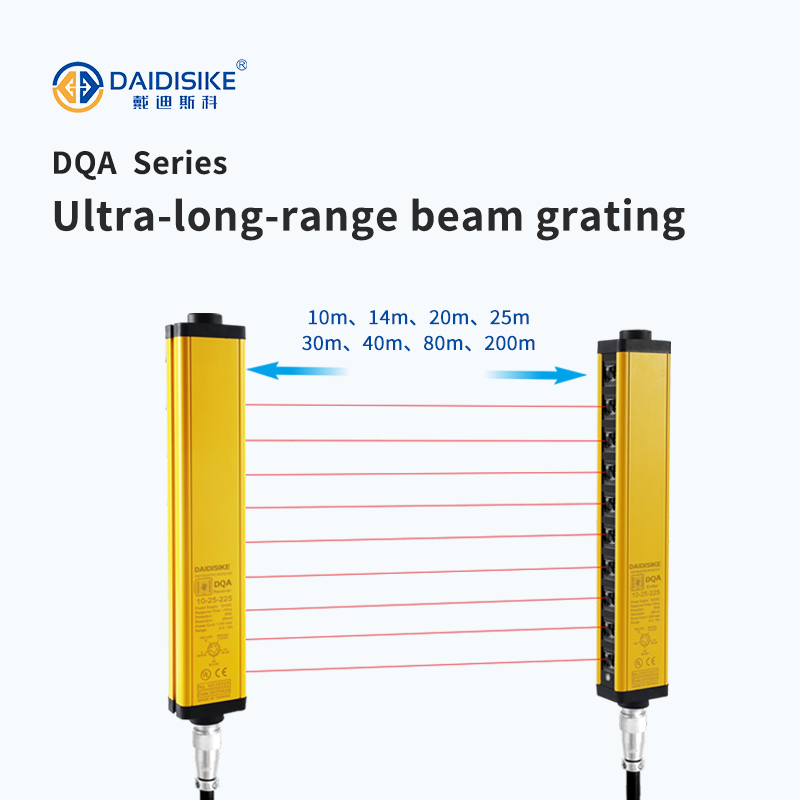
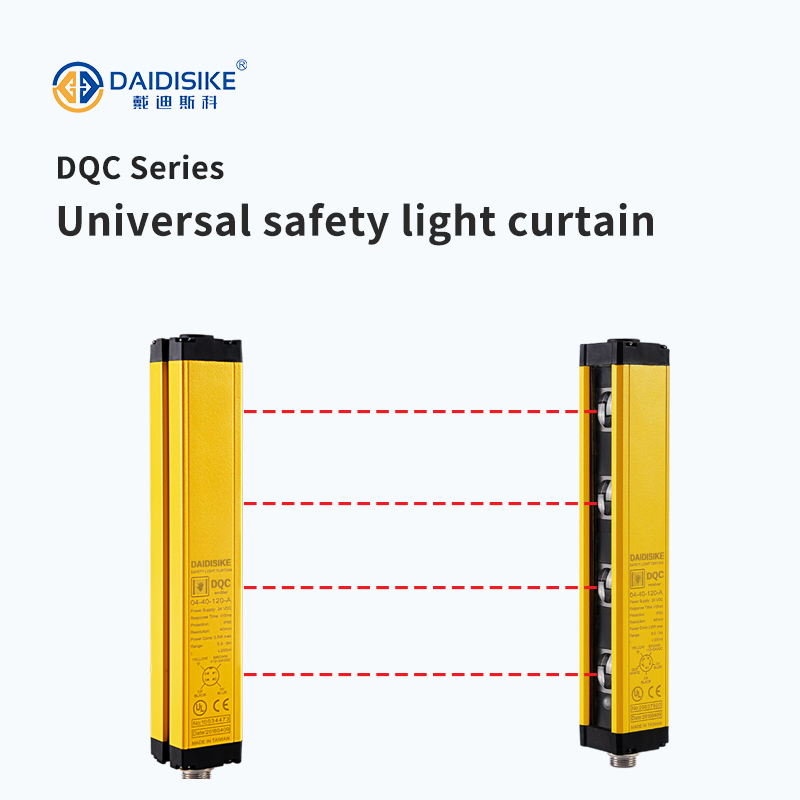
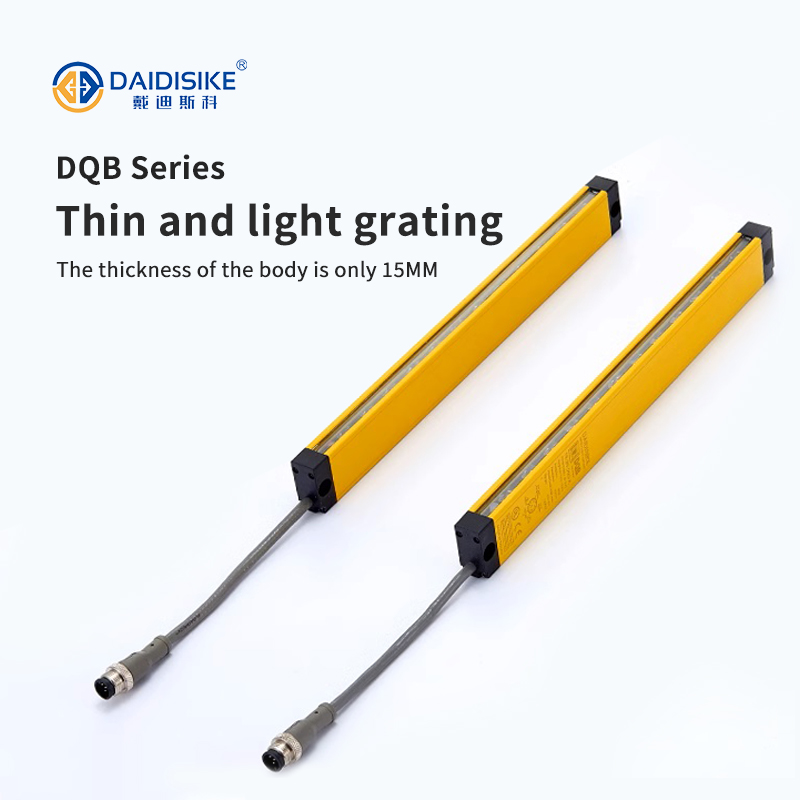
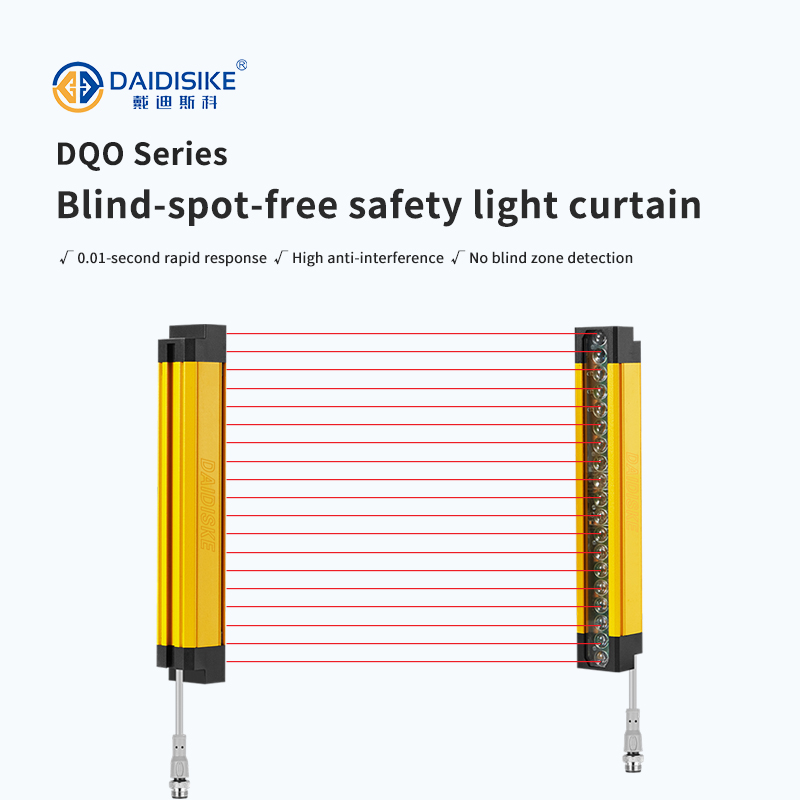
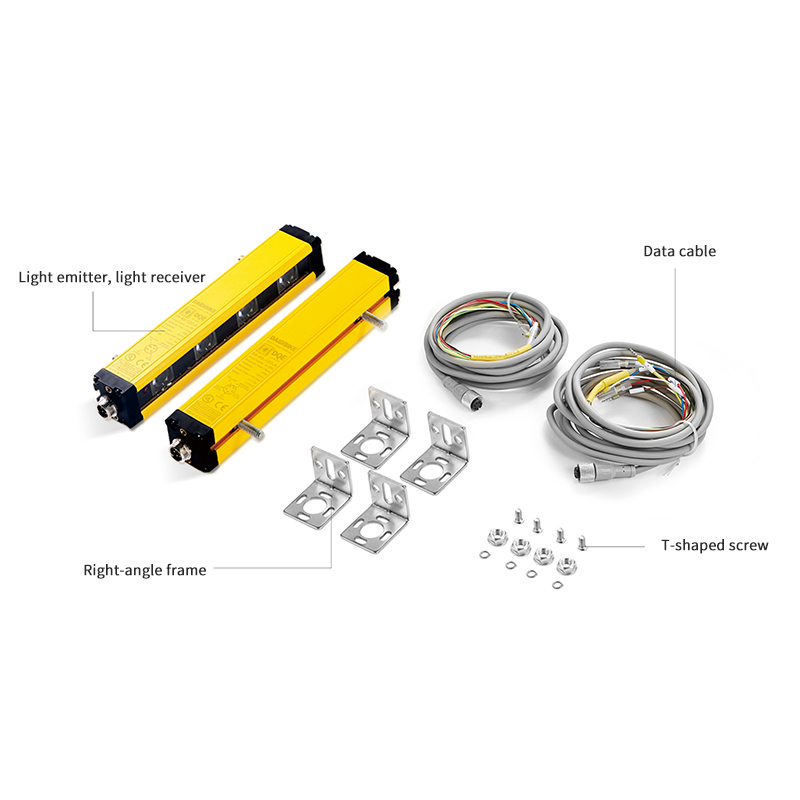
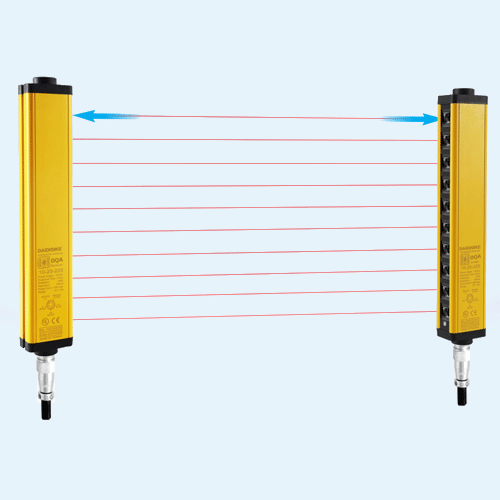
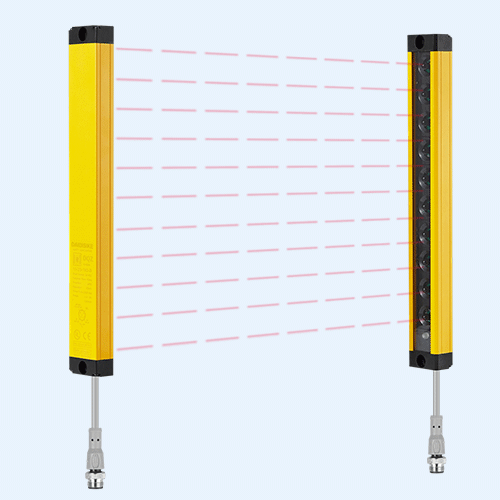
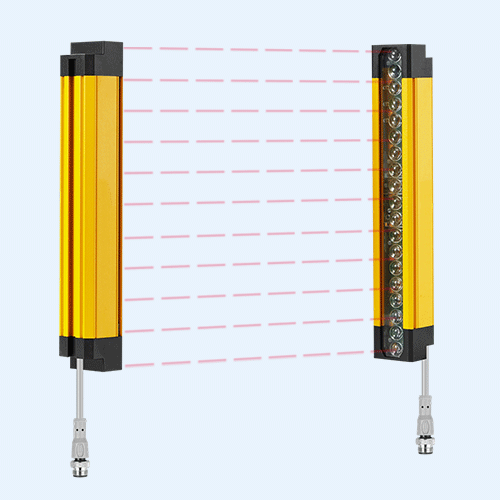
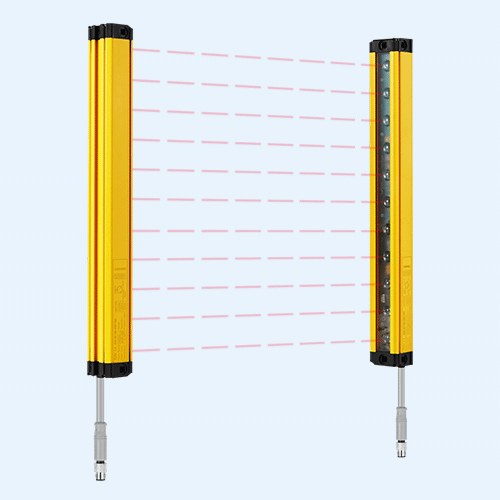
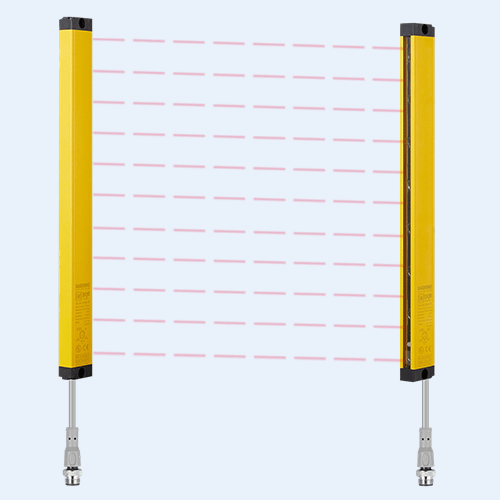
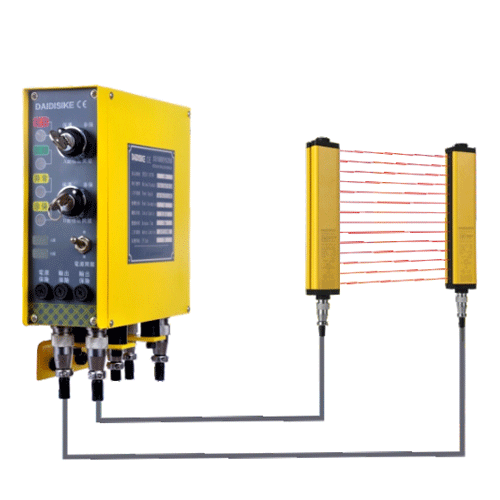
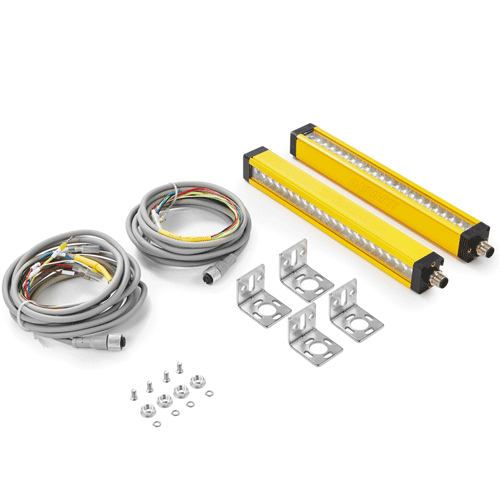
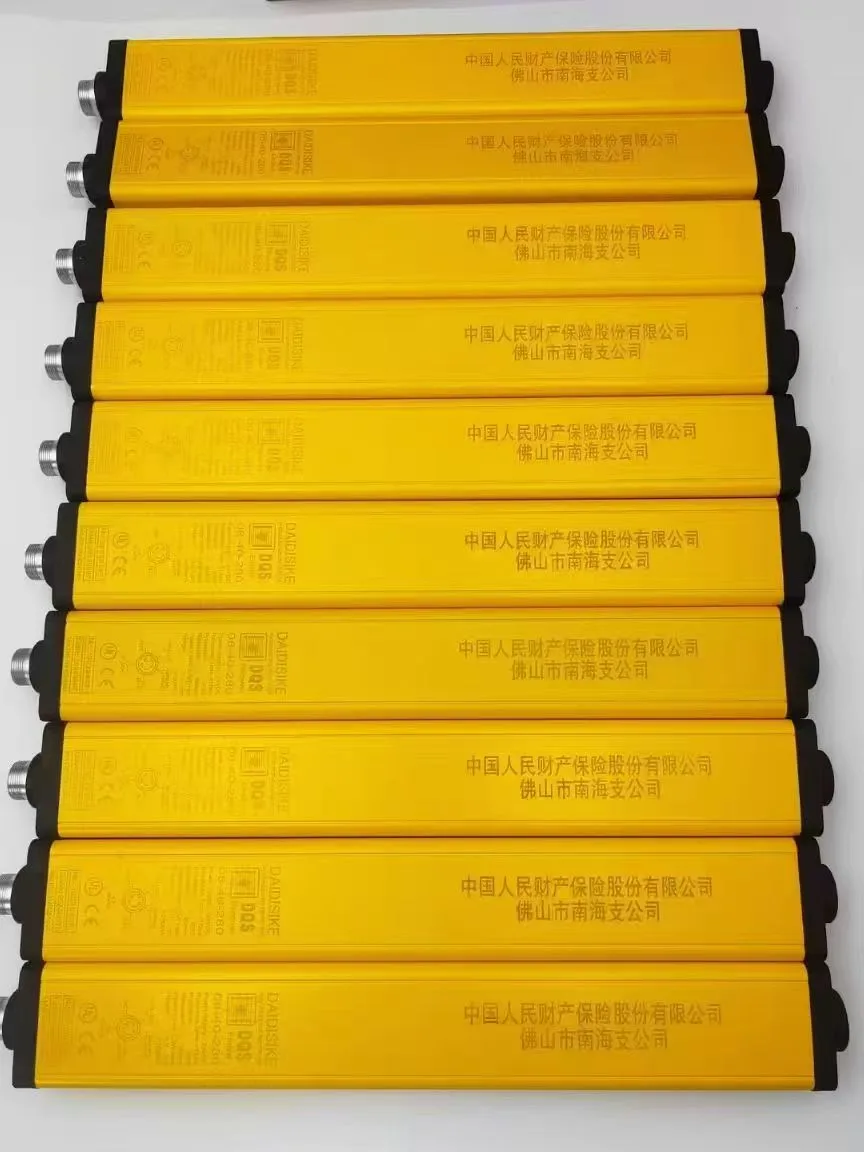
Compare the intended role and physical design first, then confirm the ordered model's safety architecture, detection capability, protective height, range, response time, outputs and enclosure rating.
This is our bread and butter. It's the model we ship the most because it's reliable, easy to align and gets the job done on standard presses or automation lines without any hassle.
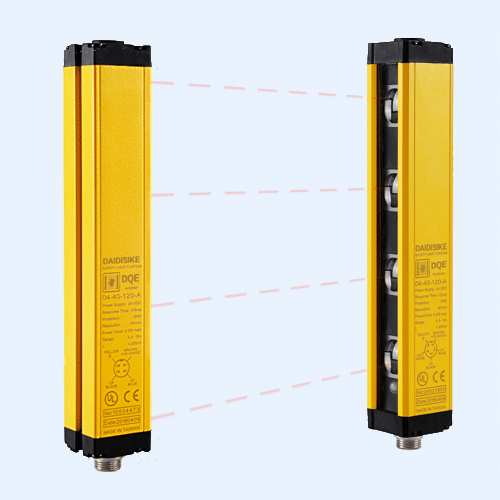
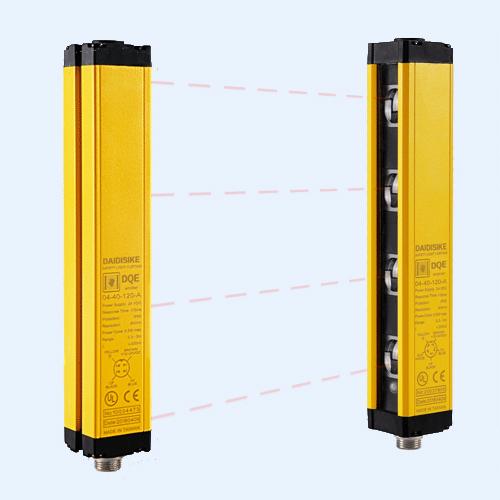
Standard curtains can struggle with alignment over large gaps. We built the DQE with a reinforced housing specifically for tall or wide windows where rigidity is key.
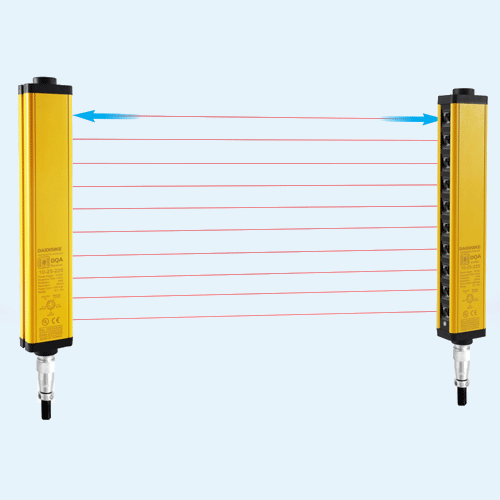
When productivity is the priority, you can't have false trips. The DQA series is our premium, high-speed line designed for environments that require maximum uptime.
Need to cover a massive vertical area? The DQT series extends the beam count beyond standard limits, making it the go-to choice for tall gates and palletizing systems.
If you're tight on space, the MK series is the answer. It's a slim, cost-effective option for small machines where a bulky sensor just won't fit.
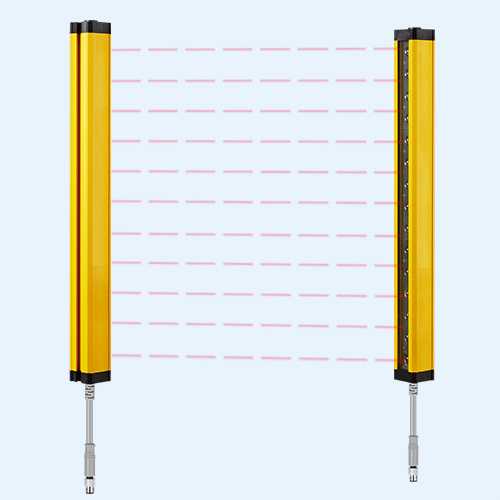
The daily workhorse. This series offers great value for standard guarding tasks, providing reliable protection without the premium price tag.
Traditional light curtains often have 'dead zones' at the ends. The DQO protects the entire length of the unit, preventing hands from slipping through at the top or bottom.
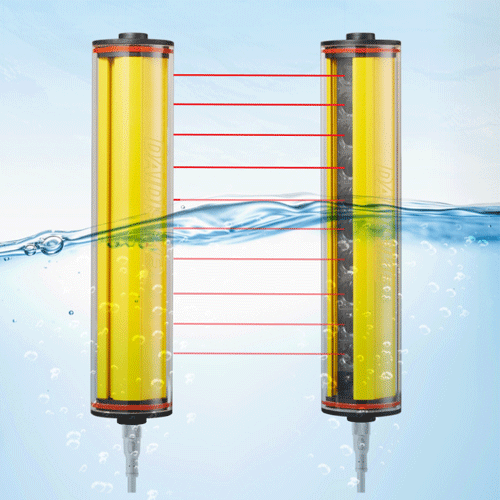
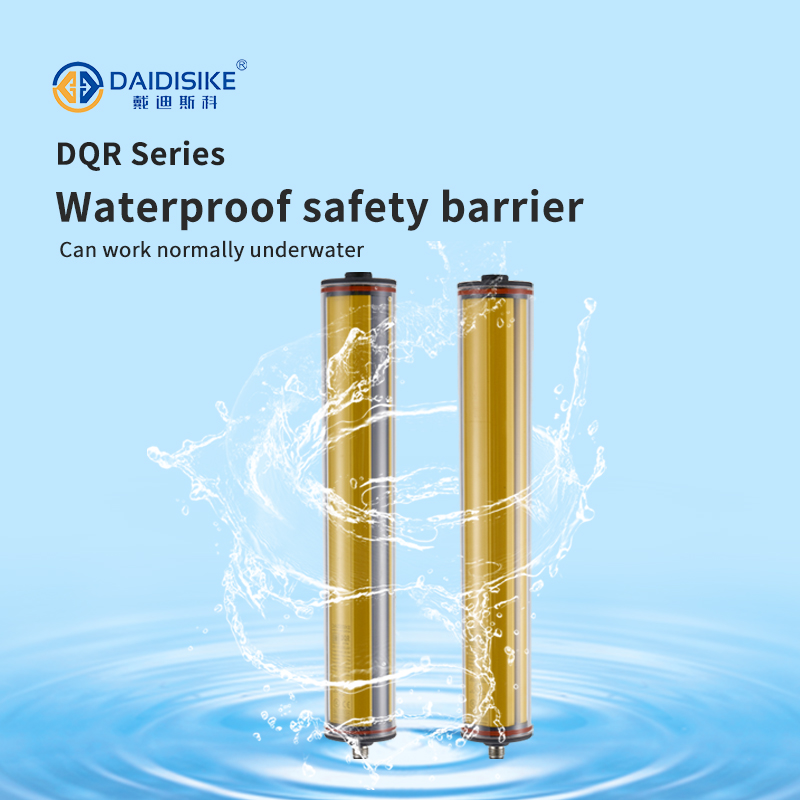
DQR is documented as IP65 for wet, oily or outdoor installations; the DQRF protective-cover configuration is the option documented up to IP68. Confirm the ordered enclosure and cleaning method before use.
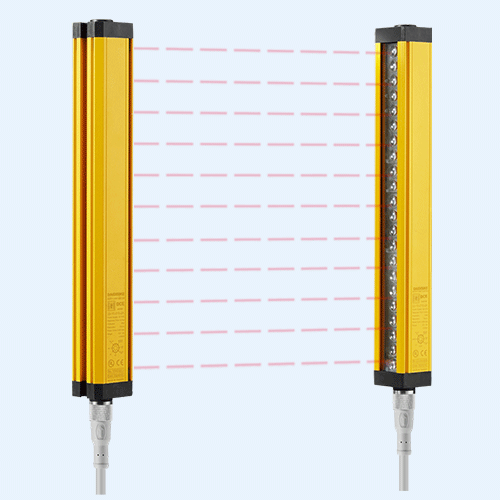
We designed the DCE with OEMs in mind. It's modular, easy to integrate into new machine builds and simple for end-users to maintain.
When you're mounting to a very narrow frame, every millimeter counts. The DQZ has an incredibly slim front profile to fit right into the machine structure.
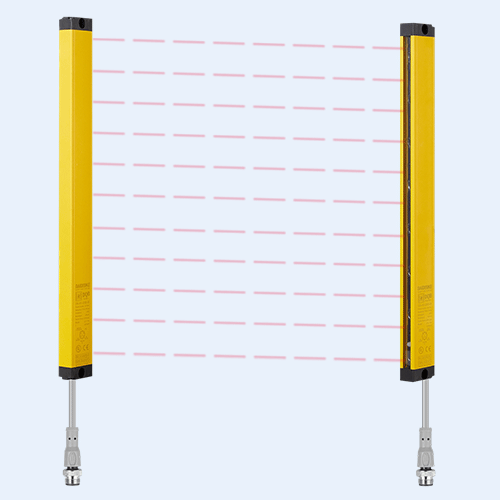
This model is razor-thin from the side. It's designed to slide into narrow gaps between machine guards where traditional sensors won't fit.
Forget the sync cable. The DQBT uses optical synchronization, which makes retrofitting existing machines much easier since you have fewer wires to run.
Our slimmest through-beam pair with a clever trick: synchronisation travels inside the light beam, so there is no wire at all between transmitter and receiver — even separate power supplies work. 87 standard models across 10/20/40 mm pitches, all M12 plug-and-play.
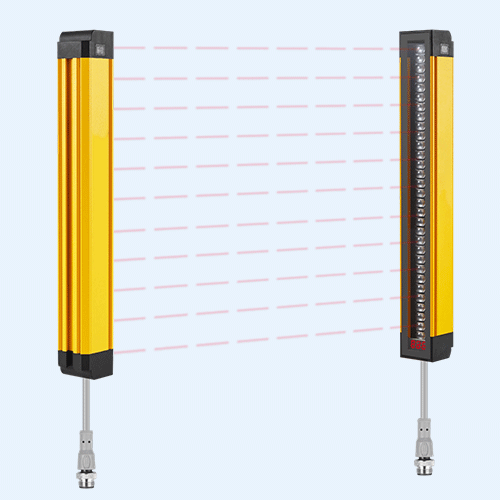
The DQT4 is catalogued with an IEC 61496 Type 4 architecture, redundant OSSD outputs and EDM support. Final system capability depends on the valid certificate for the ordered model, circuit integration and validation.
A project-specific welded enclosure built around a selected DAIDISIKE optical curtain for hazardous-area machinery. The applicable zone, gas or dust group and documentation must be confirmed for each project before ordering.
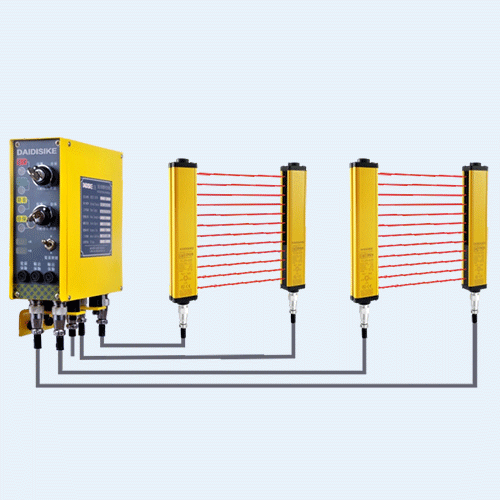
A flexible solution for press guarding that allows for more complex I/O logic and wiring, perfect for sophisticated forming lines.
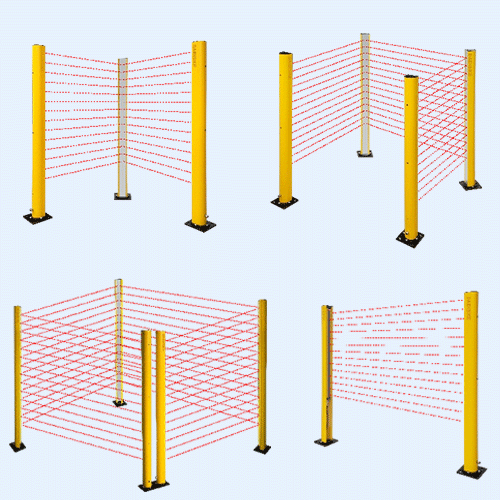
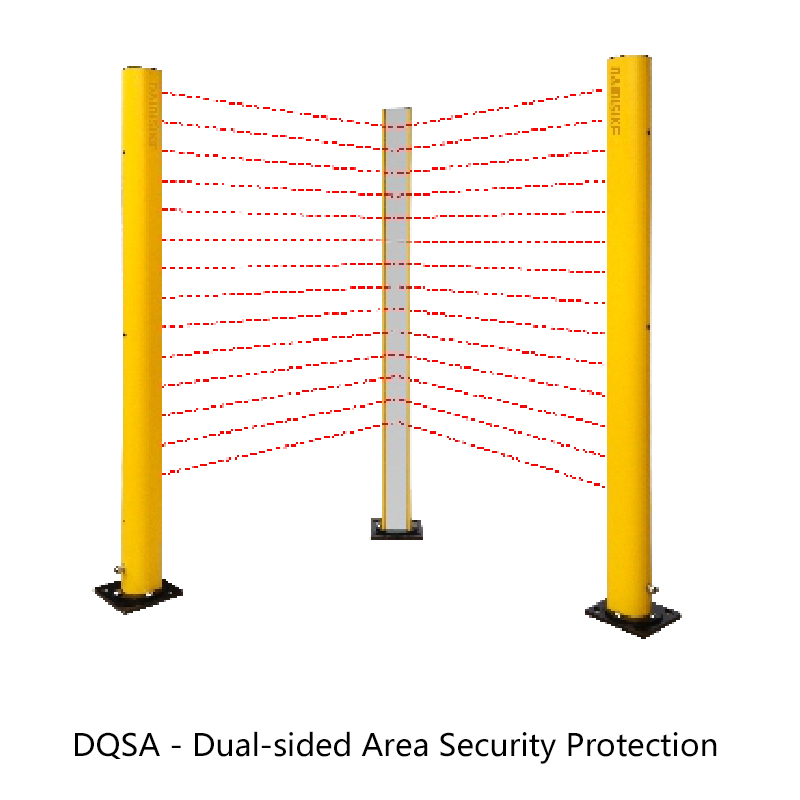
When you need to guard a whole perimeter rather than just a window. It uses wider beam spacing to secure entire zones around machines.
This table is a first-step selector, not a substitute for the model datasheet or machine risk assessment. “Confirm by ordered model” means the value varies within the family and must be checked in the quotation and technical documentation.
| Series | Primary task | Detection capability | Safety output / interface | Selection note |
|---|---|---|---|---|
| DQT4 | Type 4 point-of-operation guarding | 7.5 / 15 / 30 mm | Dual PNP OSSD; EDM supported | Confirm response time for the ordered model |
| DQB / DQZ / DQBT / MQ | Compact machine openings | Multiple options by series | Varies by series and model | Choose by available mounting space and wiring method |
| DQO | End-to-end coverage at an opening | Confirm by ordered model | Confirm by ordered model | Use where end blind zones affect the mounting layout |
| DQR | Wet, oily or outdoor installations | Confirm by ordered model | Confirm by ordered model | Confirm enclosure rating and environment for the exact model |
| DQA / DQC / DQE / DQT | General machine and access guarding | Multiple options by series | Confirm by ordered model | Match protective height, range and response time to the machine |
| DCE / DQV / MK / JER | OEM machines and compact automation | Multiple options by series | Confirm by ordered model | Verify safety architecture and interface before selection |
| DQSA | Wider-area access detection | Confirm by ordered model | Confirm with the selected controller | Safety use depends on the selected model and complete safety chain |
| FB | Hazardous-area machine guarding | Depends on the selected optical core | Depends on the selected optical core | Project-specific enclosure and documentation |
What are the advantages of our products?
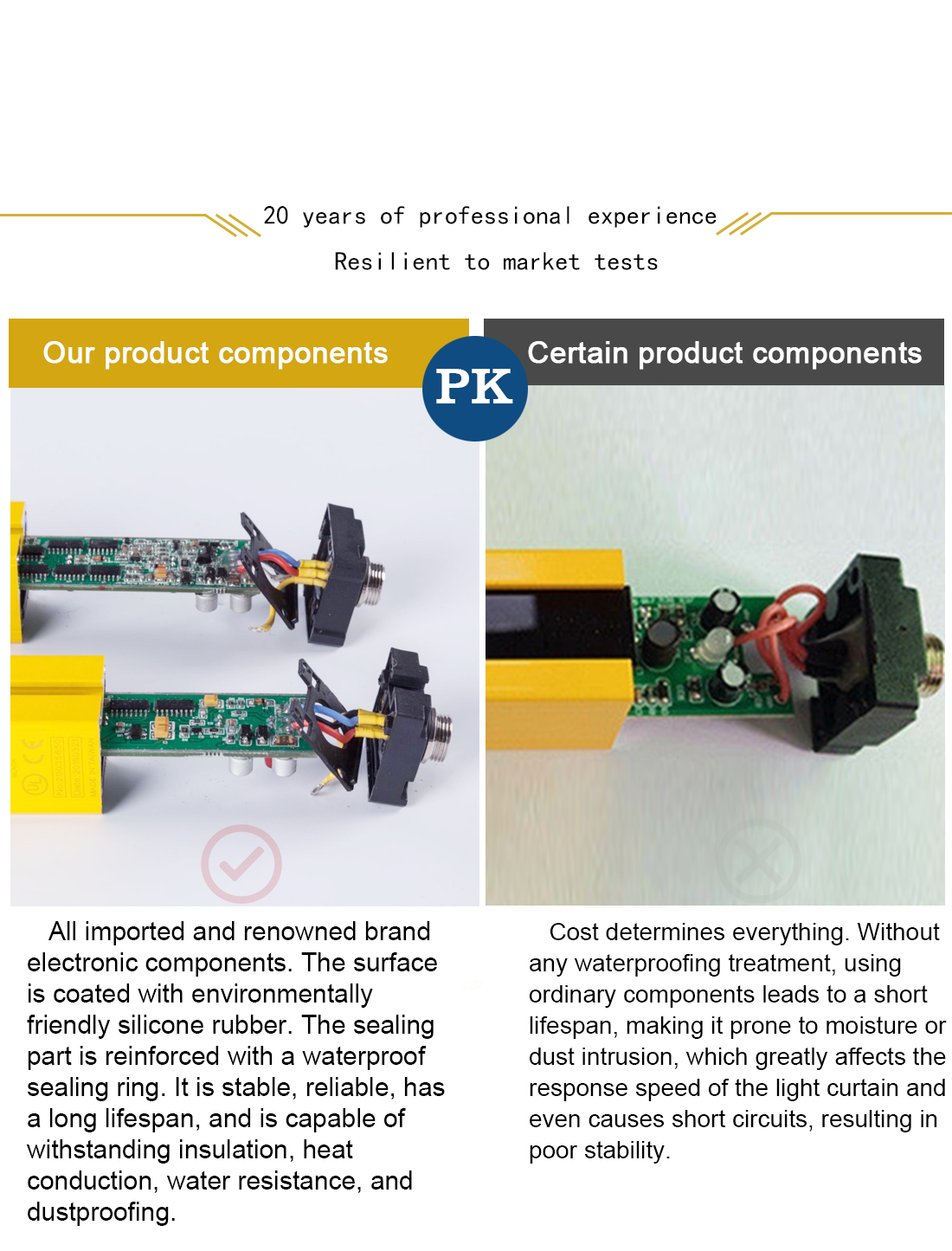
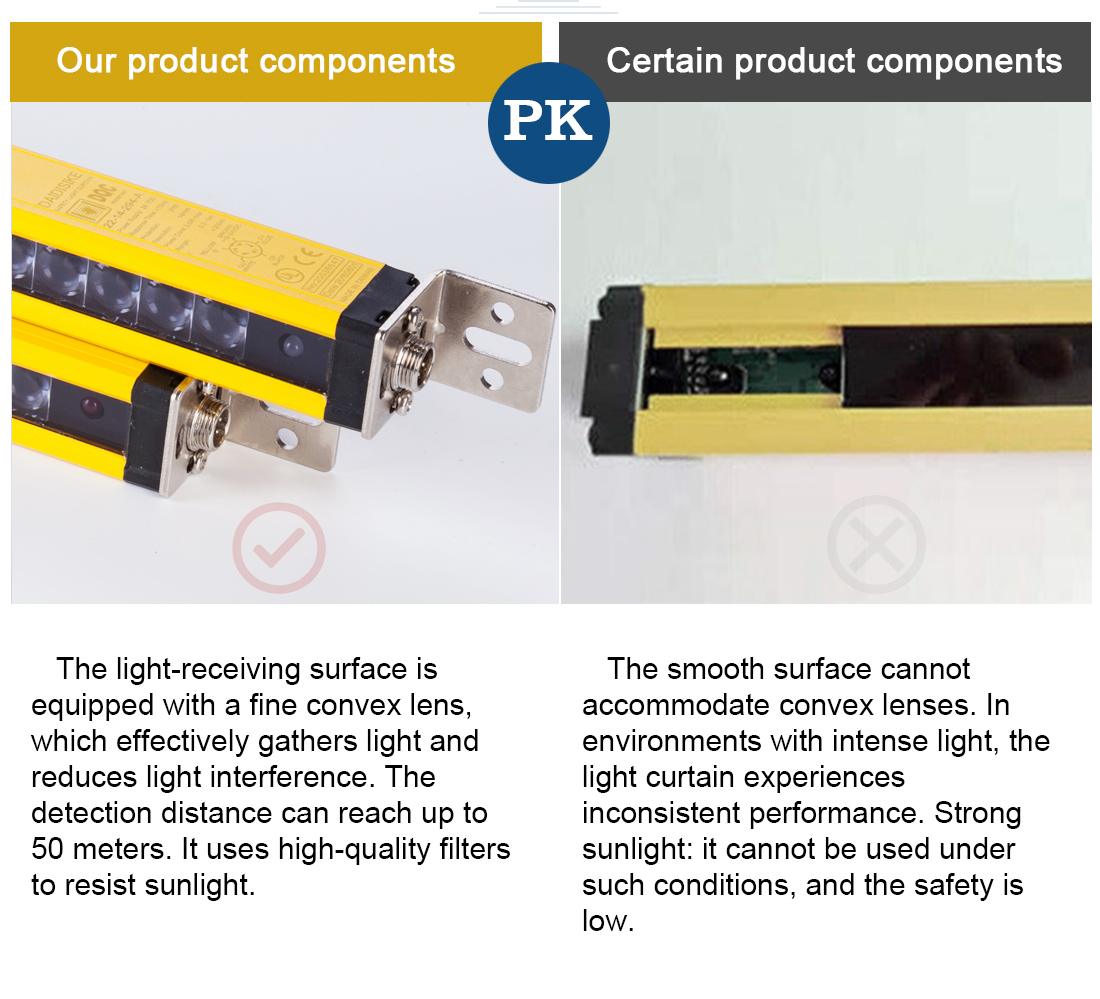
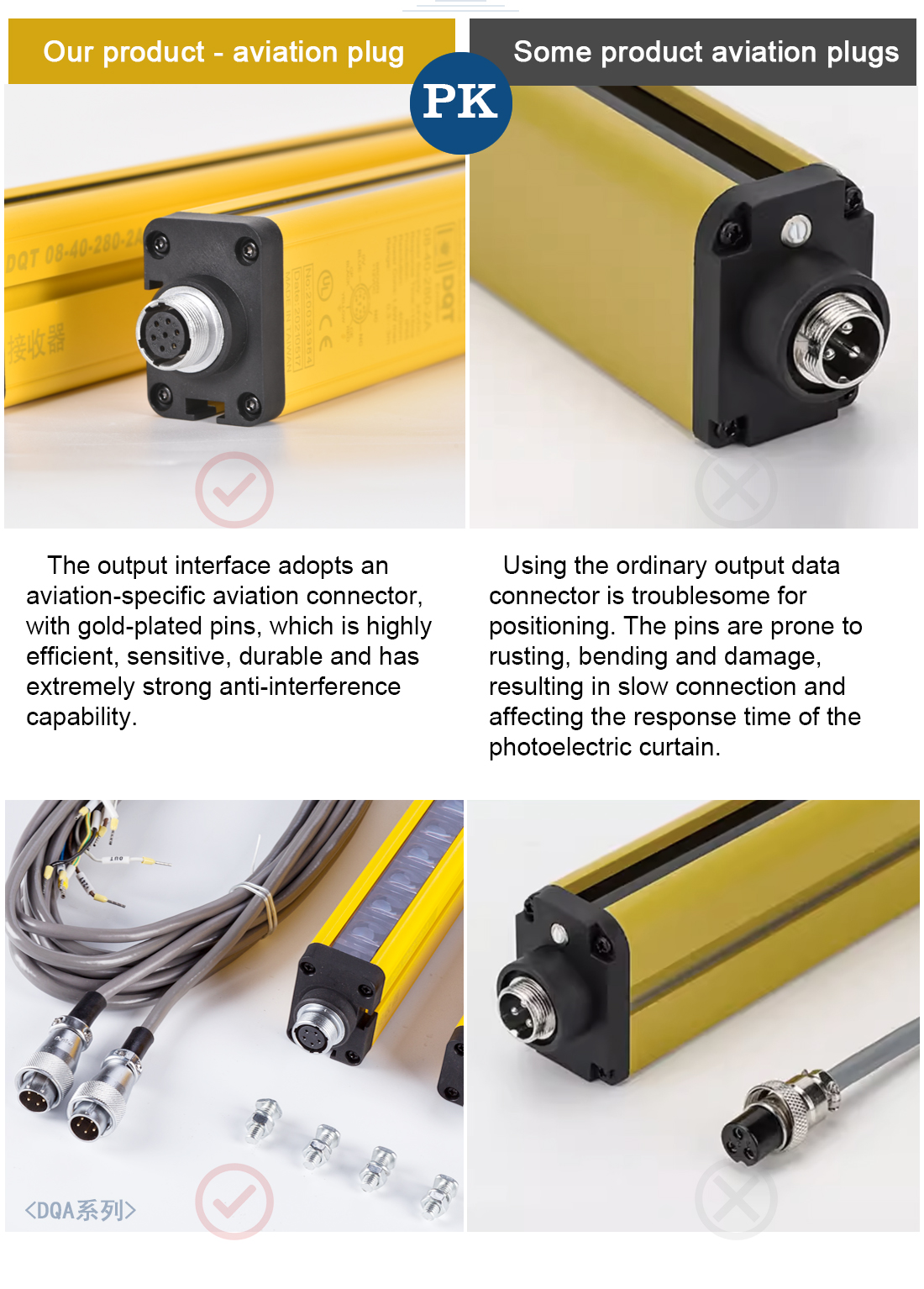
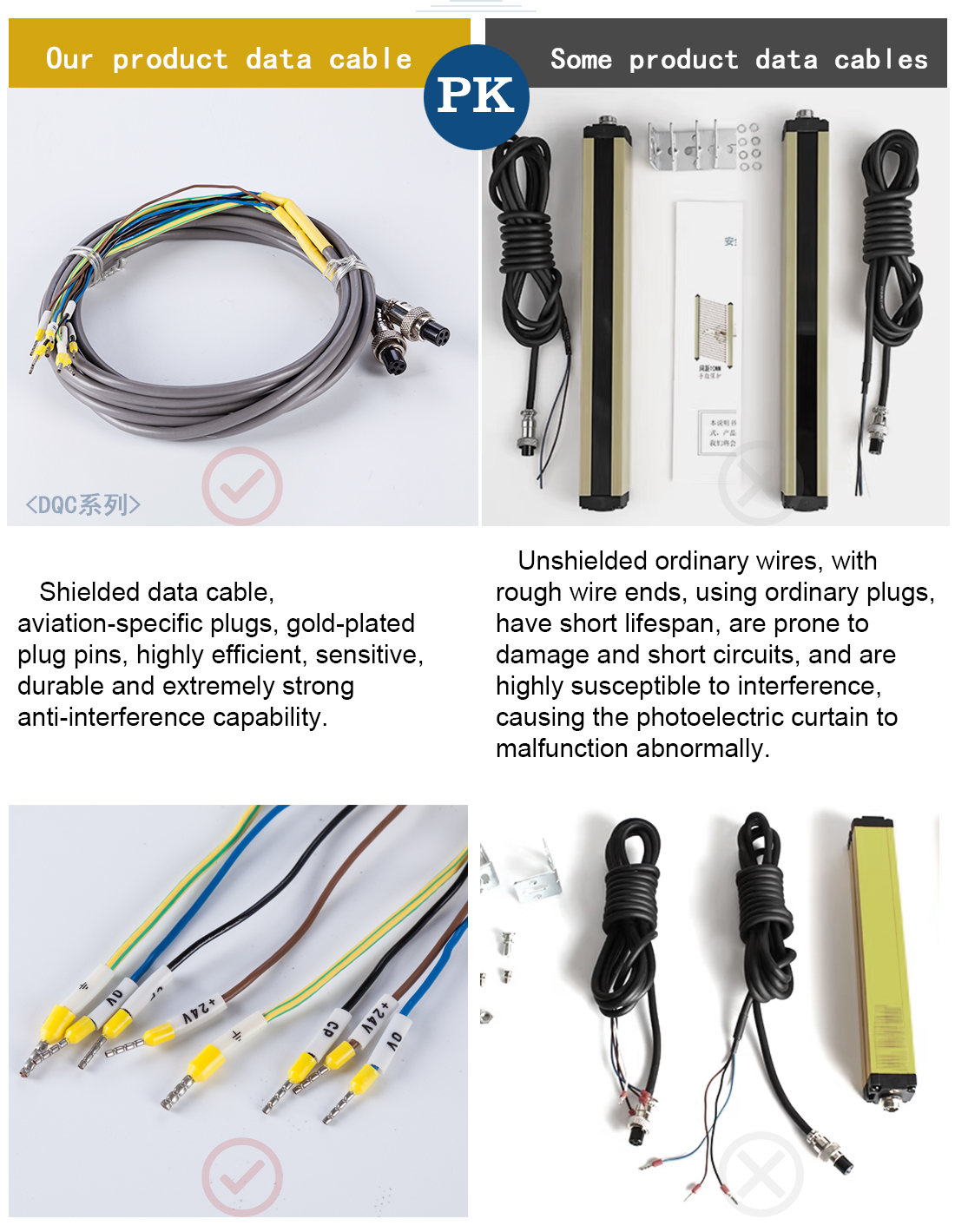
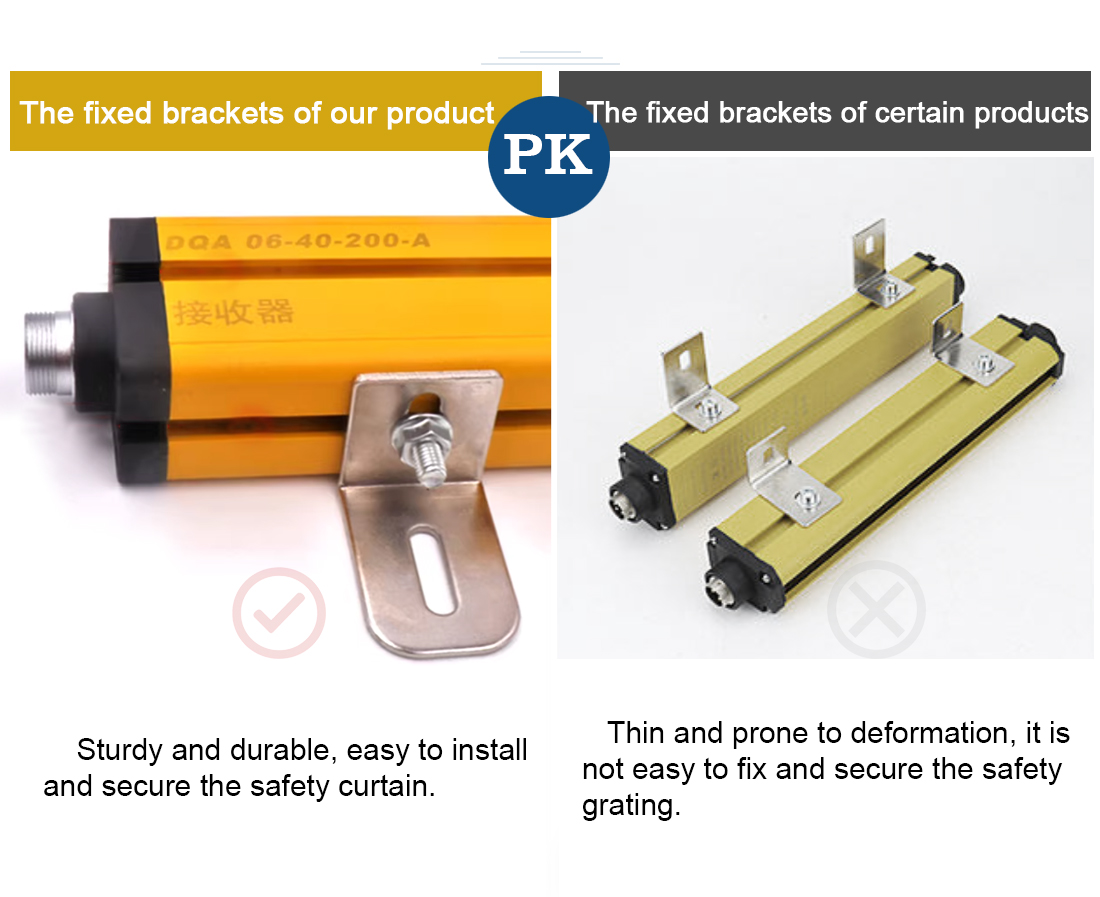
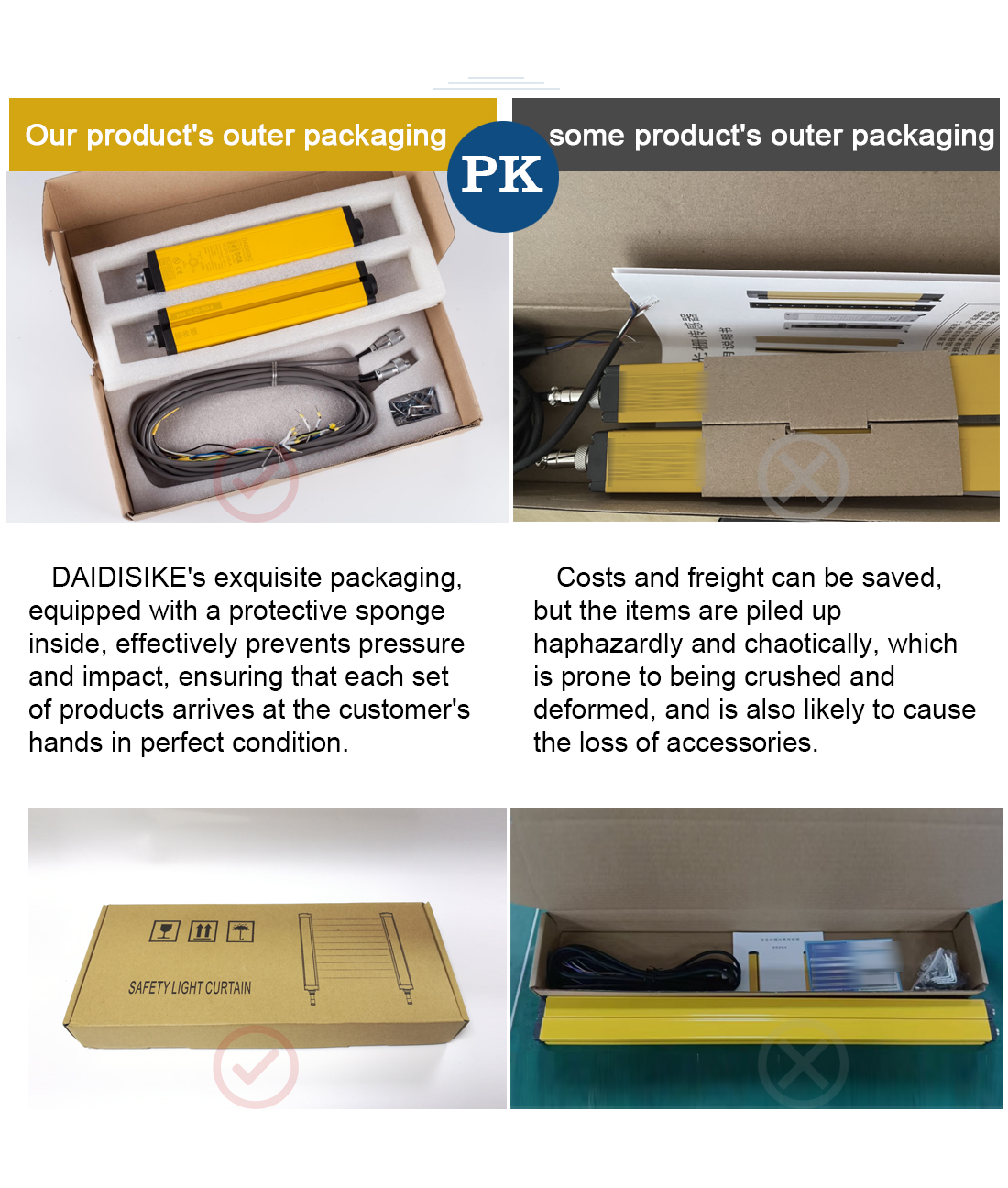
Confirm the safety type, diagnostics and output architecture for the exact series. Do not infer Type 4, OSSD or EDM functionality from the housing style alone.
Range, alignment tolerance, resolution and ambient-light immunity vary by optical design. Select them from the ordered model's verified data.
Match the output type, connector, cable shielding and controller interface to the machine circuit. Keep both safety channels independent where the selected architecture requires it.
Choose brackets and an enclosure rating for vibration, coolant, dust, washdown or outdoor exposure. Verify special environmental claims on the selected model.
Final selection depends on the complete machine safety function, not the sensor alone.
Safety light curtain is a kind of photoelectric sensor used for industrial safety protection, which forms a protective area by transmitting and receiving infrared light beams, and triggers a safety signal when the light beams are blocked, preventing people or objects from entering the dangerous area. In modern factories, people and machines work together; on some potentially dangerous machinery — stamping machines, shearing equipment, metal-cutting equipment, automated assembly lines — the safety light curtain solves the operator-protection problem.
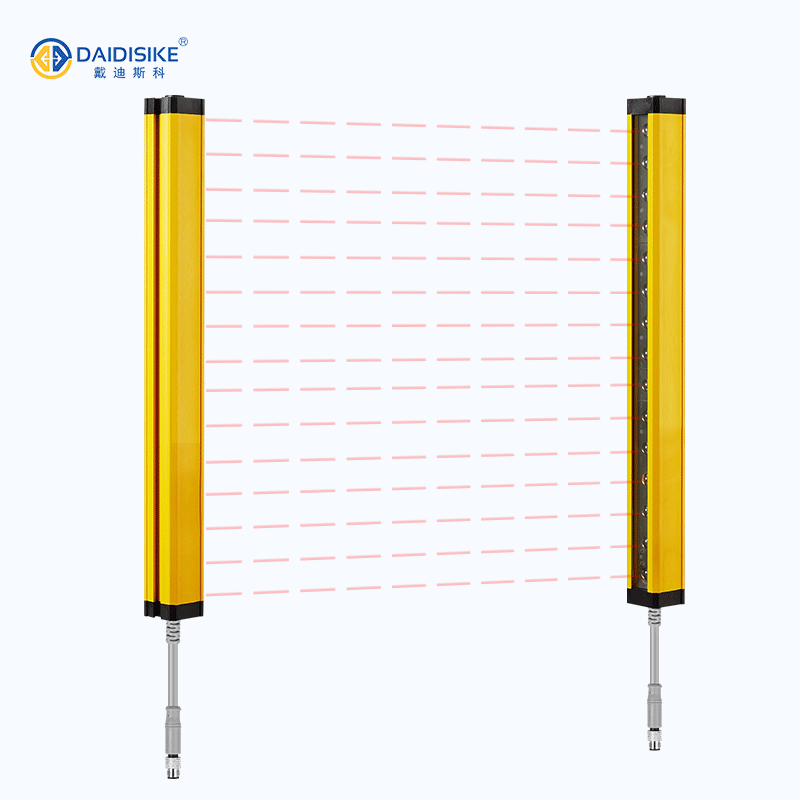
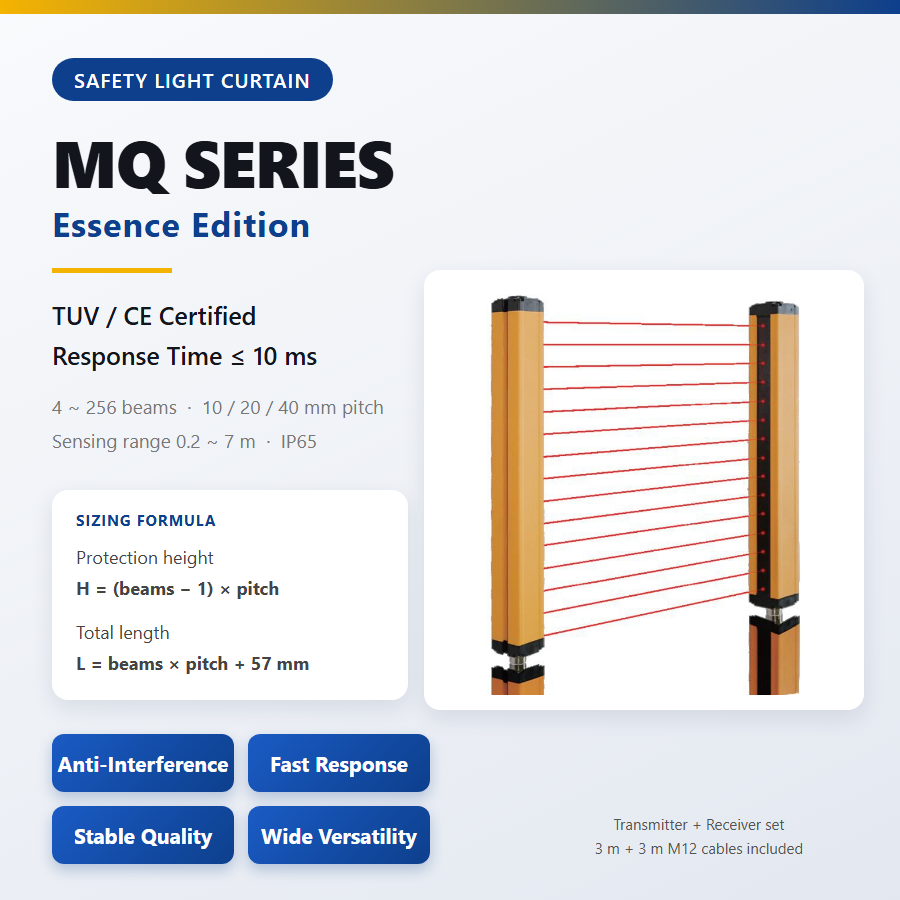
The safety light curtain consists of two parts: the light emitter and the light receiver. The emitter sends modulated infrared light, the receiver captures it, and together they form a protective net. When an object enters the net and blocks one or more beams, the receiver changes its outputs. An appropriate safety relay or safety PLC then commands the machine to a safe state as defined by the validated safety circuit.
Safety light curtains are called the “invisible shield” of the danger zone. The emitter sends evenly-distributed infrared rays under precise rules and the receiver monitors the beam state. Diagnostic coverage, fault response and output architecture differ by series, so these functions must be verified for the exact model.
Depending on the application requirements, our safety light curtains offer a wide range of resolution options to meet the protection requirements of different scenarios:
| 2.5 mm / 5 mm | Fine detection | Suitable for precision measurements and small-object detection. The high resolution enables accurate detection of small objects and dimensions, particularly in electronic processing and precision assembly. These are measurement tasks, not personnel protection. See the DQL measurement light curtain and related DQM models. |
| 14 mm | Finger protection | Commonly considered for finger-detection tasks. Confirm the actual detection capability, response time and required safety distance for the selected model. |
| 20 mm / 30 mm | Hand / palm detection | Used for wider detection tasks where the risk assessment permits. Coarser resolution generally increases the intrusion allowance in the safety-distance calculation. |
| 40 mm and above | Hand / body access | Considered for access or perimeter tasks rather than fine finger detection. Confirm the approach direction, beam arrangement and applicable standard. |
| 80 mm / 200 mm+ | Large-object detection | Suitable for vehicle separation, logistics detection and other automation tasks. These uses are not automatically personnel-safety applications. DQLV vehicle-separation light curtain |
The working principle is based on infrared-beam detection technology. On one side of the light curtain, infrared emitting tubes are installed at equal intervals; on the other side, the same number of infrared receiving tubes are arranged in the same way, each emitter aligned with its receiver.
When no obstacle blocks the line between emitter and receiver, the modulated optical signal reaches the receiver normally. When a beam is blocked, the receiver detects the interruption and changes the relevant output state according to that model's documented logic.
When no object passes through the light curtain, all modulated signals reach their receivers normally. The safety controller evaluates the clear, interrupted and fault states; the output polarity and diagnostic behavior must be taken from the selected model's wiring documentation.
A safety light curtain does not create a complete machine safety function by itself. Connect the selected outputs to an appropriate safety relay or safety PLC, then use the evaluated safety outputs to control the machine's final switching devices. Review the relay and control module range and confirm which model supports the curtain's actual output architecture.
B2J0601 and E4J0101 are general timing/control modules. They must not be used as the safety-rated decision element for personnel protection or as a substitute for an appropriate safety relay or safety PLC. A timing function may be used only on a separate, non-safety process-control side where the risk assessment allows it.
To receive an accurate series recommendation, datasheet and CAD availability check, include the following project information:
Final safety distance and suitability remain the machine integrator's responsibility and must be validated using the confirmed model data.
Advanced Sensor Solutions for Industrial Safety and Automation
Discover our commitment to precision engineering and manufacturing.
Real-world application for advanced machine safeguarding.
Enhanced perimeter security and collision prevention solutions.
Optimized for toll stations and weighbridges profiling.
Dimensional measurement and object positioning principles.
Installation guide for hand & finger safeguarding.
Performance under high-pressure washdowns.
Intelligent recognition for high-speed packaging lines.
Advanced background suppression for irregular shapes.
Cost-effective side safeguarding using mirror reflection.
As a sales professional, I see it all the time: a customer lands on this page because they know they need a safety light curtain, but then they get stuck. With so many models available, how do you pick the right one without overthinking it?
It actually comes down to a few simple questions. Here is how I personally guide my clients to the best fit:
First, look at the machine itself.
Where will the light curtain live? Indoors or outdoors?
Selection can be tricky if you haven't done it before. If you're still scratching your head, just reach out — chat with our online support or send an inquiry email. We'll get back to you ASAP.
There are more specs to cover than I can list here.
Click here to read our detailed Light Curtain Selection Guide.
Guides on selecting, wiring, checking safety evidence and troubleshooting safety light curtains. Use the relevant task below; a replacement or application guide is not approval of a particular machine design.
A safety light curtain is selected and integrated to protect people at a machine hazard. A measuring light curtain reports beam interruption for counting, profiling, dimensions or vehicle detection. DQL, DQM and DQLV belong to the measurement and detection group and must not be used by themselves for personnel protection.
No. Architecture, outputs, ingress protection, response time and certification scope vary by series and ordered model. DQT4 is catalogued with an IEC 61496 Type 4 architecture, while DQS has a factory-documented Type 4 architecture that requires the certificate for the exact configuration. Final system capability depends on valid evidence, integration and validation. DQA, DQC and DQE are not presented as Type 4 here, and no currently listed series should be treated as a verified Type 2 offering without model-specific evidence.
Choose the required detection capability from the risk assessment, then calculate the safety distance using the complete stopping time of the machine and the confirmed response time of the selected curtain. Finer resolution can reduce the intrusion allowance, but the final installation must be validated on the machine.
Do not treat a general sensor output or a timing relay as the complete safety chain. Connect the selected safety outputs to an appropriate safety relay or safety PLC, then control and monitor the final switching devices according to the validated circuit design.
Send the machine type, hazard and access direction, required protected width and height, desired detection capability, sensing distance, supply voltage, output or controller interface, environment, mounting constraints, quantity and destination country. Also state any required certificate or technical-document scope.
Use the dedicated manufacturer and sourcing page for OEM options, MOQ, current lead time and export documentation. These commercial details are confirmed with the final model and order configuration.