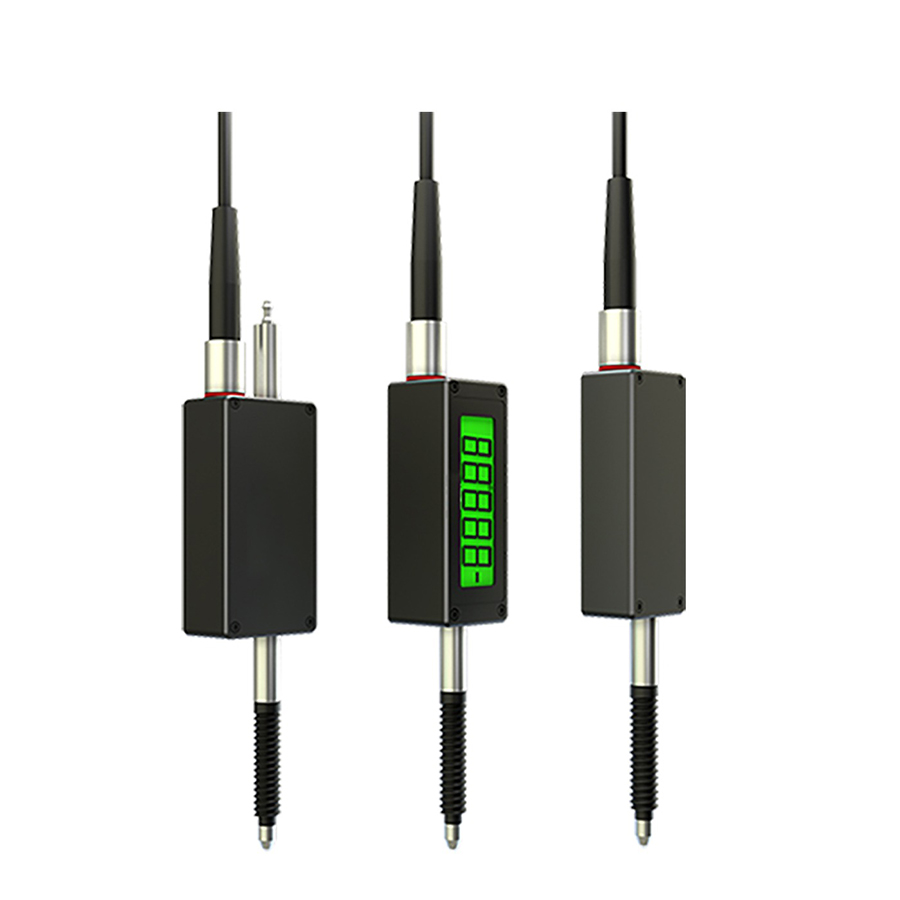
JNS-Q120 Pneumatic Rebound Contact-Type Displacement Grating Sensor with Digital Display

DAIDISIKE displacement grating sensors are contact-type measurement probes built for the kind of work where ±2 μm matters and a non-contact optical setup is either overkill or unsuited to the surface. A spring-loaded or pneumatic-rebound tip touches the workpiece, an internal optical grating reads the tip's vertical travel. Choose an integrated-display variant or an external display controller; verify analog or serial output availability for that combination. The flagship JNS-Q120 covers a 12.7 mm range with ±2 μm repeatability. Confirm the exact variant and measurement setup for stamping thickness checks, gasket-stack heights, assembled-product verification, and machined-part QC.
This category is for contact-type displacement probes. Compare the JNS-Q120 model and interface configurations for the probe itself. For a non-contact point measurement use the laser sensing selection page; for object profiles across a beam array, use detection and measurement light curtains.
Display configuration: the display controller is optional. Some integrated-display variants can operate without an external display controller; non-display probes can be paired with one. Choose the readout and PLC interface separately, and confirm the exact ordered combination.
Manufacturer confirmation — September 6, 2026: JNS-Q120 measuring range is 12.7 mm and repeatability is ±2 μm, correcting the older 12 mm / approximately 1 μm summaries. Display controllers are optional. Display resolution, absolute accuracy and interface availability are separate specifications; confirm them for the ordered probe/display combination. Other historical catalogue figures below still require exact-variant verification and must not be combined across versions.
Laser displacement sensors get most of the publicity, but on a real factory floor a contact-type displacement grating still wins in three specific situations:
That's the contact probe's place in the toolbox. For moving targets, long-range standoff, or surfaces you can't touch (paint that's still drying, hot castings, food contact), reach for a laser sensor instead — see the DAIDISIKE laser switch sensor family.
The JNS-Q120 uses a low-pressure air cushion instead of a mechanical spring to hold the probe tip against the workpiece. Three practical advantages flow from that choice:
| Specification | JNS-Q120 | Typical Use Case |
|---|---|---|
| Measurement range | 12.7 mm (manufacturer confirmed) | Stamping thickness, gasket stacks, machined-part height |
| Resolution | 0.001 mm (1 μm) | Inline thickness sort, assembled-stack verification |
| Repeatability | ±2 μm | Tight-tolerance dimensional QC |
| Contact force | 0.5 – 2 N (adjustable) | Soft materials → rigid stampings, same probe |
| Tip material | Tungsten carbide (std), diamond (optional) | Steel parts; abrasive ceramics → diamond |
| Tip life | 1M+ cycles (carbide) · 10M+ (diamond) | Months of inline duty between replacements |
| Power supply | 24 VDC ± 10% | Standard industrial control cabinet |
| Analog output | 4–20 mA scaled to range | Direct PLC analog input |
| Digital output | RS-485 Modbus-RTU | MES logging, SPC charts, recipe switching |
| Display | Integrated-display variant or optional external controller | Select the exact readout and interface configuration |
| Air supply (rebound) | 0.3 – 0.5 bar, clean dry | House compressed-air system, < 5 µm filter |
| Operating temperature | 0 °C to +60 °C | Indoor industrial environments |
| IP rating | IP54 (probe body) | Splash-protected; not for washdown |
Mount on the press exit conveyor to check stamped-blank thickness or coining depth on every part. Discrete output triggers a pneumatic reject flap when a stamping falls outside tolerance.
Multi-layer assemblies (gasket-on-housing, bearing pre-load shims, motor laminations) need their total assembled height verified before the next operation. Contact probe reads to ±2 μm regardless of surface color or finish.
Replace dial-indicator and comparator setups with a digital probe that logs every reading to a CSV. Cleaner audit trail, faster part throughput, and the operator can't mis-read the scale.
Assess a properly engineered fixture for BDC position checks during die setup. JNS-Q120 has a 12.7 mm measuring range; verify the required travel and protect the probe from overtravel and impact. The measurement does not replace machine safeguarding or a validated setup procedure.
Through-hole connector pins must protrude within a tight tolerance for the next-stage wave-solder. Probe + fixture gives a go/no-go signal per board.
MDF, particleboard, and veneer panels are sold by nominal thickness with tight grading tolerances. Pneumatic-rebound probes handle the variable surface texture without crushing.
A displacement grating sensor is a contact-type probe — the spring-loaded tip physically touches the workpiece, and an internal optical grating converts the tip's vertical travel into a digital reading with sub-micron resolution. A laser displacement sensor is non-contact, measuring distance optically via triangulation or time-of-flight. Contact probes give higher repeatability on small ranges (±2 μm typical) at lower cost, but the tip must touch the surface and wears over time. Laser sensors are faster, work on moving parts, and never wear, but cost more and can be confused by reflective or transparent surfaces.
Pneumatic-rebound means the probe tip is held against the workpiece by a low-pressure air cushion (typically 0.3 to 0.5 bar) instead of a metal spring. The cushion gives a constant, low contact force that's adjustable from the regulator — about 0.5 N to 2 N — so soft materials don't deform, knife-edge features don't get crushed, and the same probe works on rubber gaskets, brass shims, and steel stampings without changing tips. Pneumatic actuation also retracts the tip cleanly between measurements, which is what makes high-speed inline inspection possible.
The manufacturer confirms a 12.7 mm measuring range and ±2 μm repeatability for JNS-Q120. Repeatability describes consistency under repeated measurement and must not be confused with display resolution or absolute accuracy. Select the exact display/interface configuration and verify resolution, calibration and the fixture against the workpiece tolerance.
A display controller is optional: some variants have an integrated digital display and can be used without an external display controller, while non-display variants can be paired with one. Select the exact probe and display/interface unit, then verify its supply, output scaling, protocol and register map against the PLC input. Display choice alone does not establish analog-output availability. DQL measuring curtains and DQM switching curtains are different families: DQM has NPN/PNP outputs and no RS485 or RS232 communication.
Three scenarios where a contact probe is the better choice: (1) Small, well-defined measurement windows under 20 mm where laser triangulation accuracy degrades. (2) Transparent or mirror-finish parts (glass, polished brass, optical coatings) where lasers struggle with reflection or transmission. (3) Bulk dimensional checks on a fixture or shuttle where the part comes to rest at a known position — the simplicity of 'press the probe, read the value' beats the calibration overhead of an optical setup.
The standard tungsten-carbide tip lasts well over one million measurement cycles on steel stampings before perceivable wear shifts the zero. The tip is user-replaceable in about a minute — no recalibration required since the grating reads the carrier, not the tip itself. For abrasive workpieces (sand-cast iron, ceramic) we recommend the diamond-coated tip option, which extends life to roughly 10 million cycles.