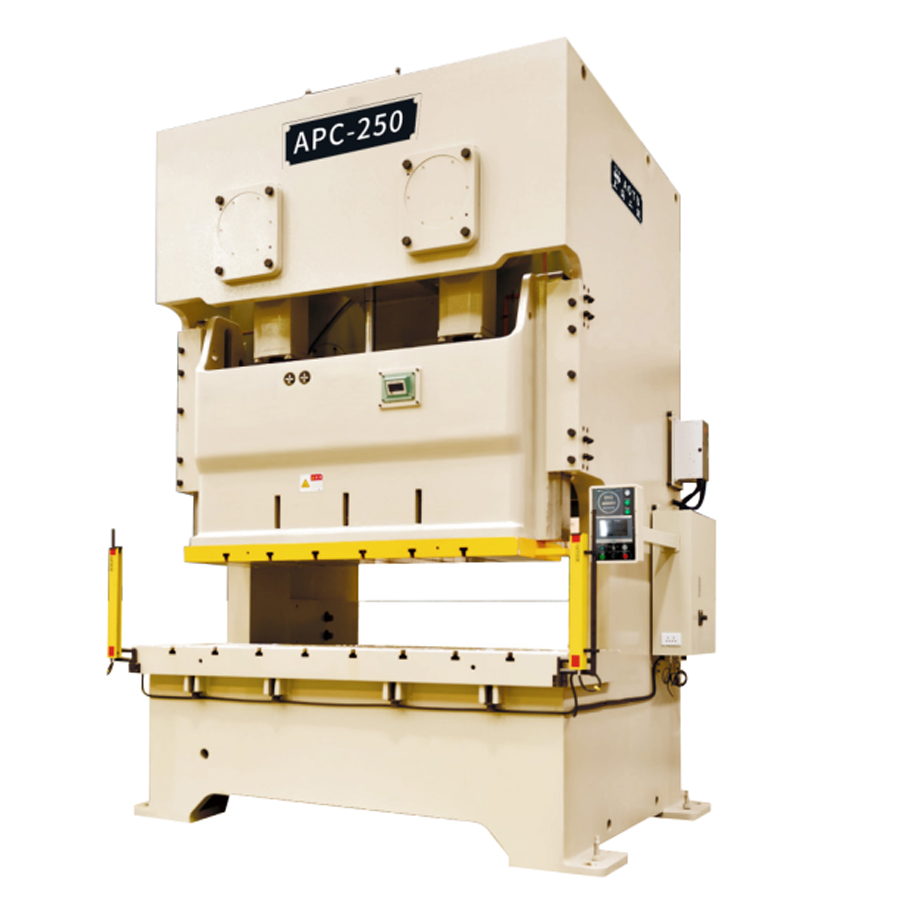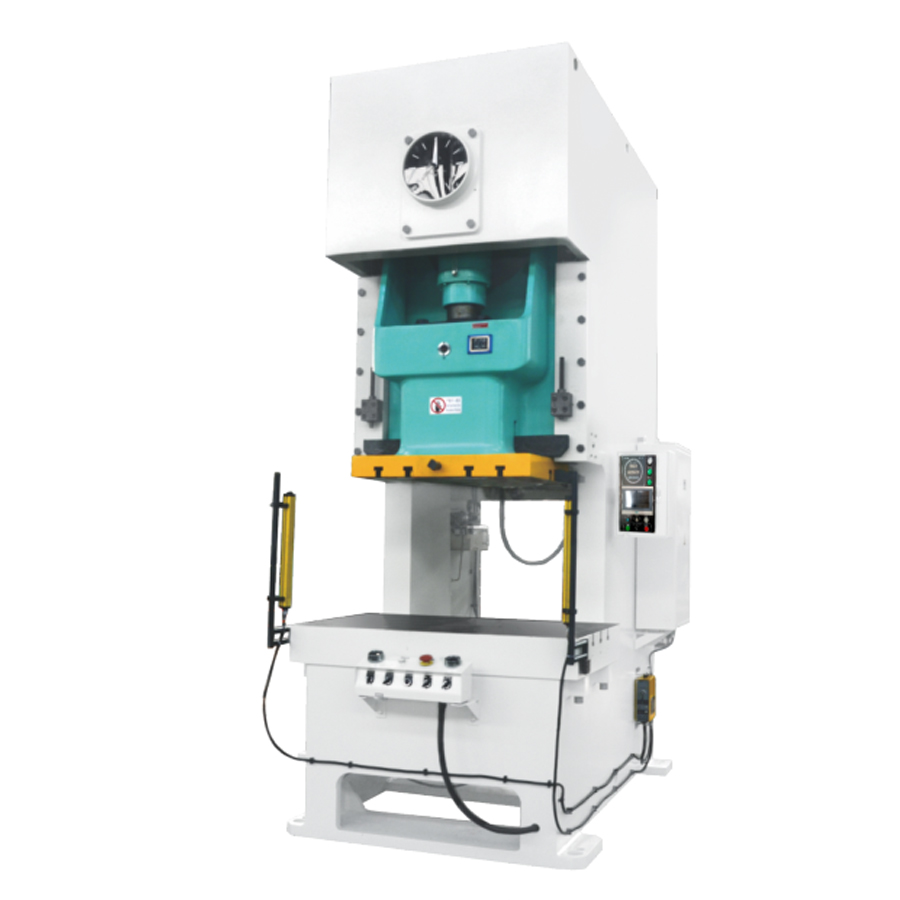
APA / JH21 Open-type Precision Pressing Machine

DAIDISIKE supplies the workhorses of the stamping floor: open-type C-frame pressing machines from 25 tons up to 160 tons, with a flywheel-and-crankshaft mechanical drive and pneumatic clutch control — the configuration that gives you the speed of a true mechanical press (up to 110 strokes per minute) and the safety/repeatability of pneumatic engagement. The APA / JH21 single-crankshaft range covers the everyday 25–80 ton bracket for blanking, piercing, trimming, coining, and progressive-die work; the APE / APC / APD double-crankshaft family steps up to wider bolsters and heavier drawing where slide parallelism matters. All presses ship ready to integrate with the DAIDISIKE feeder and straightener line for a complete coil-to-part automation stack, with guarding selected separately from the machine risk assessment. Review our press photoelectric protection selection guide for the stopping-capability and sensor/controller checks; adding a curtain alone does not establish machine compliance.
Pick tonnage based on cutting perimeter × material thickness × shear strength, with a 30 % safety margin (see the FAQ below for the formula). Stroke rate trades off against tonnage — bigger presses have heavier slides and run slower.
| Model | Tonnage | Max Speed | Slide Area | Typical Work |
|---|---|---|---|---|
| APA-25 | 25 t | 110 SPM | 200 × 300 mm slide | Small electronics stamping, terminal & connector manufacturing |
| APA-35 | 35 t | 100 SPM | 250 × 350 mm slide | Mid-size brackets, small enclosures, lock parts |
| APA-45 | 45 t | 90 SPM | 300 × 400 mm slide | Hardware fittings, motor laminations, hinge plates |
| APA-60 | 60 t | 80 SPM | 350 × 450 mm slide | Heavier brackets, automotive small parts, structural plates |
| APA-80 | 80 t | 70 SPM | 400 × 500 mm slide | Drawing operations, deeper coining, multi-station tools |
| APE/APC/APD | 60-160 t | 60-80 SPM | Wider bolster, 600-1000 mm | Wide tools, heavy drawing, large multi-cavity dies |
Cut flat blanks from coil or sheet stock — the most common stamping operation. APA-35 at 100 SPM handles 90 % of typical mid-size blanking jobs in mild steel, aluminum, and brass up to about 3 mm thickness.
Multi-station tools that punch, bend, and form a part across successive strokes in a single press. Requires accurate feed pitch — pair the press with an NCF servo feeder for ±0.05 mm registration.
Stamp logos, serial numbers, or decorative features into the part surface. Smaller depth than blanking but higher precision and finish requirement. Pneumatic clutch gives consistent dwell at bottom dead centre.
Form a flat blank into a cup, cone, or box shape. Tonnage is heavily dependent on draw ratio and material. Double-crankshaft APE/APC/APD models hold slide parallelism under off-centre draw loads.
Secondary operations after forming — trim flash, pierce holes, notch edges. Lower tonnage requirement (often a 25-ton APA), high cycle rate critical to keep up with the upstream forming press.
Terminals, contacts, lead frames, shield cans — thousands of small precision parts per coil. Pair APA-25 or APA-35 with a small pneumatic feeder and pitch-accurate progressive die.
The double-crankshaft family is presented on this category page; there is no separate model page linked from its card. Send the required tonnage, material and tool drawing, bolster dimensions, stroke, die height, off-centre loading and production rate for a configuration review.
Request an APE / APC / APD configuration review. For the existing single-crankshaft range, use the APA/JH21 model specifications. Discuss a complete press here and coil feeding/straightening at the press peripheral equipment hub.
A pressing machine alone is only half the system. The full automated coil-to-part line has four DAIDISIKE components working in sync:
The APA and JH21 are mechanical presses driven by a flywheel-and-crankshaft system, with a pneumatic clutch for engagement and disengagement. This combination gives the speed of a mechanical press (up to 110 strokes per minute) with the safety and repeatability of pneumatic clutch control — far faster than a hydraulic press, far more controllable than a pure mechanical clutch. The 'pneumatic mechanical' designation refers specifically to the clutch type, not to the main drive.
The rule of thumb: required tonnage (in tons) = perimeter of the cut (in mm) × material thickness (in mm) × shear strength (in kg/mm²) / 1000, plus a 30 % safety margin. For typical mild steel (35 kg/mm² shear) cutting a 100 mm × 50 mm rectangle (perimeter 300 mm) at 2 mm thickness: 300 × 2 × 35 = 21,000 kg = 21 tons, plus 30 % = 27 tons. Round up to the next standard tonnage: a 35-ton APA-35 handles this job with margin. For drawing and coining the math is different — please contact us with your specific operation.
Single-crankshaft presses have one drive shaft and one connecting rod attached to the centre of the slide — simpler, cheaper, more compact, suitable for narrow tools and progressive-die operations. Double-crankshaft presses have two drive shafts and two connecting rods supporting the left and right ends of the slide — they hold the slide perfectly parallel even when the work is loaded off-centre (e.g., a wide drawing operation where the load shifts during the stroke). Double-crankshaft is the right choice for wide tools (>500 mm bolster), heavy drawing, and applications where slide tilt would damage the die.
DAIDISIKE supplies the matching automation: the A50/A100/BX150 pneumatic feeder mounts directly on the press for synchronized strip advance, the NCF servo roller feeder handles tighter pitch accuracy on progressive-die work, the TL-series leveler-straightener flattens coil set before feed, and the UL-series 2-in-1 material rack handles coil unwind plus loop control. A typical complete line is: uncoiler → straightener → feeder → press → exit conveyor, with the press's cam-controlled output triggering each upstream device.
Select safeguarding from the actual press type, clutch, stopping capability, access paths and risk assessment. A light curtain is suitable only where the machine can stop the hazardous motion and the applicable rules permit presence sensing. OSHA 1910.217 prohibits its use as point-of-operation protection on full-revolution clutch presses. Exact sensor/controller inputs, reset and monitoring functions must be documented and validated; do not assume every relay provides EDM or every curtain is Type 4.
The manufacturer-confirmed lead time for APA/JH21 presses is 2–6 weeks. Confirm the delivery scope on the quotation: press, foundation bolt set, pneumatic clutch, lubrication system, electric control cabinet, operator station and operation/maintenance documentation. Specify any tonnage monitor, die cushion, photoelectric guarding, die-change equipment or feeder/straightener integration with the order. Lead time is not a freight transit-time promise.