Selecting and certifying a safety light curtain / barrier means returning again and again to a handful of core standards. This page sets out, in an objective and citable way, the definitions, key points and inter-relationships of GB/T 19436, IEC 61496 (Type 2 / Type 4), ISO 13849-1 (PL e), IEC 62061 (SIL 3) and the ISO 13855 safety-distance formula, for the reference of engineers and buyers.
Content updated: . Standard summaries do not replace the applicable documents or machine validation.
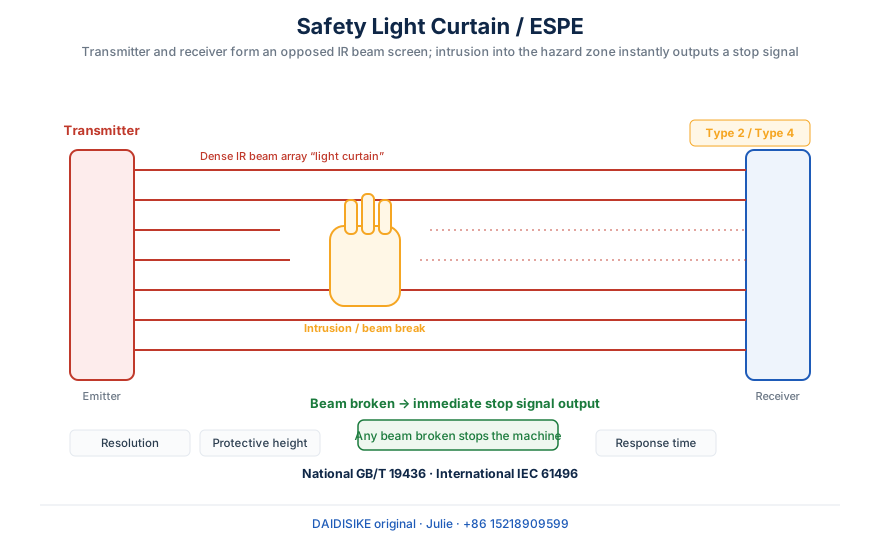
An industrial protective device that detects a specified test object entering its light field and changes its safety output state within the declared response time. The validated safety system then performs the protective stop.
A safety light curtain is one form of electro-sensitive protective equipment (ESPE). A transmitter and receiver form a through-beam detection field. Suitable devices may be used in validated guarding arrangements on presses, press brakes or robot cells. Selection requires the declared detection capability, effective protective height, maximum response time for the configured mode, safety type and applicable installation limits. Neither beam spacing nor a catalog-wide response-time number establishes these properties. Check the exact model and applicable parts of IEC 61496 or GB/T 19436.
National standard GB/T 19436International IEC 61496Resolution 14/20/30/40 mmModel-specific maximum response time
GB/T 19436 "Safety of machinery — Electro-sensitive protective equipment"
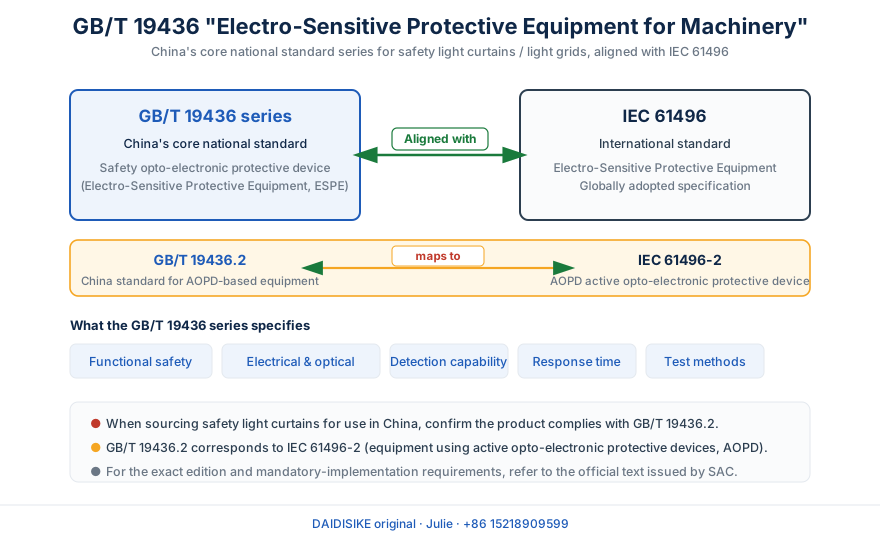
The core Chinese national-standard series for safety light curtains / barriers, aligned with the international standard IEC 61496.
The GB/T 19436 series is the core Chinese national standard for electro-sensitive protective equipment (ESPE). It specifies the functional-safety requirements, electrical and optical performance, detection capability, response time and test methods for safety light curtains / barriers, and is broadly aligned with the international standard IEC 61496. In particular, GB/T 19436.2 corresponds to IEC 61496-2 (equipment using active opto-electronic protective devices, AOPD). When procuring a safety light curtain for use in China, confirm that the product conforms to GB/T 19436.2. The exact edition and any mandatory-implementation requirements are governed by the original standard text published by the Standardization Administration of China (SAC).
National standardCorresponds to IEC 61496GB/T 19436.2 ↔ IEC 61496-2
IEC 61496 and Type 2 / Type 4
The IEC 61496 series specifies electro-sensitive protective equipment (ESPE). Light curtains commonly use Type 2 or Type 4 classifications; the applicable part and model documentation matter.
IEC 61496 equipment type describes specified performance and fault behavior, not a universal recipe for the internal circuit. Type 2 and Type 4 light curtains have different fault-detection requirements. Do not treat Type 2 as a general PL d solution or infer the safety performance of an entire machine from a Type 4 label. Verify the particular device rating, applicable standard edition and complete safety function against the risk assessment. Laser scanners use additional requirements in IEC 61496-3 rather than inheriting a light-curtain classification.
Equipment type Check the applicable IEC 61496 part, edition and exact model evidence.
Required safety function Determine the PLr or required SIL from the machine risk assessment.
Complete-system validation Check sensors, logic, final elements, diagnostics and systematic measures together.
Engineering checks, not a model certificate or an installation approval.
Check the applicable IEC 61496 partType is not the complete-system PLVerify model-specific safety evidenceValidate the full safety function
ISO 13849-1 Performance Level PL e
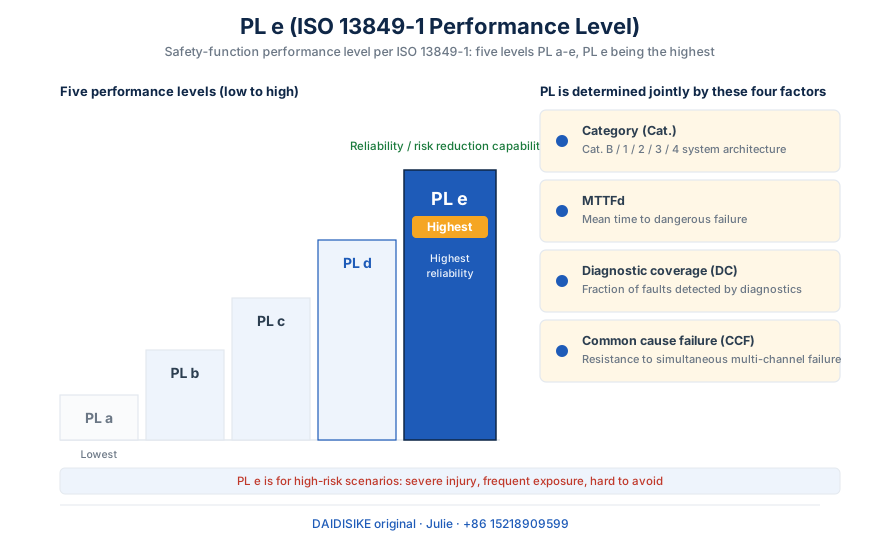
A performance level that measures the reliability of a safety control system; PL e is the highest level (Performance Level e).
ISO 13849-1 uses the Performance Level (PL) to measure how reliably a machinery safety control system carries out its safety function, from PL a (lowest) to PL e (highest). PL e represents the highest risk-reduction capability and is typically used for high-risk situations where injury is severe, exposure is frequent and the hazard is difficult to avoid. The PL is determined jointly by the system architecture (Category Cat. B / 1 / 2 / 3 / 4), the mean time to dangerous failure (MTTFd), the diagnostic coverage (DC) and common-cause failure (CCF).
For the evidence behind a claimed level, use the PL and SIL verification overview. It distinguishes a component rating from the performance of the complete safety function.
Five levels, PL a–PL ePL e is the highestDetermined by architecture / MTTFd / DC / CCF
IEC 62061 Safety Integrity Level SIL 3
A safety integrity level for a safety function. IEC 62061 covers machinery up to SIL 3; matching a PL e probability range does not make the frameworks interchangeable.
IEC 61508 defines SIL 1–4; the machinery standard IEC 62061 addresses SIL 1–3. SIL and ISO 13849 PL are separate safety-integrity frameworks. PL e and SIL 3 have corresponding average dangerous-failure probability ranges for high-demand/continuous operation, but their architectural, systematic and validation requirements must also be met. A certificate for a component is evidence with a defined scope, not proof of the whole machine safety function. Do not convert a PL label into a SIL claim without the applicable assessment.
Use the PL versus SIL framework comparison when deciding which assessment applies; a corresponding probability range is not a shortcut between the two methods.
IEC 61508 General functional safety: SIL 1–4.
IEC 62061 Machinery safety functions: SIL 1–3.
ISO 13849 PL a–e. A corresponding probability range is not complete equivalence to SIL.
Engineering checks, not a model certificate or an installation approval.
IEC 62061: SIL 1–3IEC 61508: SIL 1–4Probability range is not full equivalence
ISO 13855 Safety-Distance Formula S = K × T + C
The international standard for calculating the minimum mounting distance between a safety light curtain and the hazard point, ensuring the equipment has stopped before a person can reach the hazard.
The familiar S = K × T + C expression illustrates a safety-distance calculation, but is not a universal installation rule. The applicable ISO 13855 edition and arrangement determine the calculation, including approach direction, reaching over/under/around, detection capability and additional allowances. T must include all relevant sensing, safety logic, switching and machine stopping delays, with measured stopping performance. Do not choose K solely from a hand/body label or treat beam pitch as verified detection capability. A qualified designer must validate the actual arrangement.
The current reference is ISO 13855:2024; legacy examples on this site are explanations, not a replacement for its applicable requirements.
Arithmetic illustration only, not a DQC specification or approved mounting distance: if a verified method permits K = 2000 mm/s and C = 0, and the measured total T including every relevant delay is 0.115 s, the expression gives 230 mm. Other geometric and minimum-distance requirements may govern. No supplied product's detection capability is established by this example.
Applicable method Standard edition, approach direction, access geometry and verified detection capability.
Total stopping performance Sensing + logic + switching + machine stopping delays, verified by measurement.
Validated position Check the calculation, minimum distances and reaching over, under or around the field.
Engineering checks, not a model certificate or an installation approval.
S = K × T + CSelect the applicable calculation methodC relates to resolutionEngineer review required
Market access and application checks
A technical standard and a legal market-access obligation are not the same document. The certification evidence overview distinguishes model certificates, quality-system records and declarations.
What is the difference between a Type 2 and a Type 4 safety light curtain?
They specify different performance and fault-detection requirements for light curtains under the applicable IEC 61496 parts. Equipment type is not the safety rating of the whole machine. Do not assume Type 2 is suitable for a PL d requirement, or that adding a Type 4 device automatically creates a PL e or SIL 3 safety function. Check the model evidence and validate the complete architecture.
Are PL e and SIL 3 the same thing?
No. ISO 13849 uses PL a–e, IEC 62061 addresses machinery SIL 1–3, and IEC 61508 defines SIL 1–4. PL e and SIL 3 share a corresponding dangerous-failure probability range for high-demand/continuous operation, but architecture, systematic measures and validation requirements also apply. A matching numerical range does not make two components or complete safety functions equivalent.
How do I calculate the minimum mounting distance for a safety light curtain?
Use the method applicable to the standard edition, detection arrangement and access geometry. Include all relevant sensing, logic, switching and measured machine stopping delays. The familiar S = K × T + C expression is not sufficient by itself to check reaching over, under or around the field, minimum distances or other required allowances. A qualified designer must validate the actual installation.
Do Chinese-made safety light curtains comply with these international standards?
Country of manufacture does not establish compliance. Check the exact order code, intended safety function, declaration, applicable certificate or test report, and installation instructions. DAIDISIKE also supplies ordinary industrial detection products; do not apply a Type 4, PL e or SIL 3 claim to the entire catalog. The selected device and the complete machine safety function require separate evidence.