
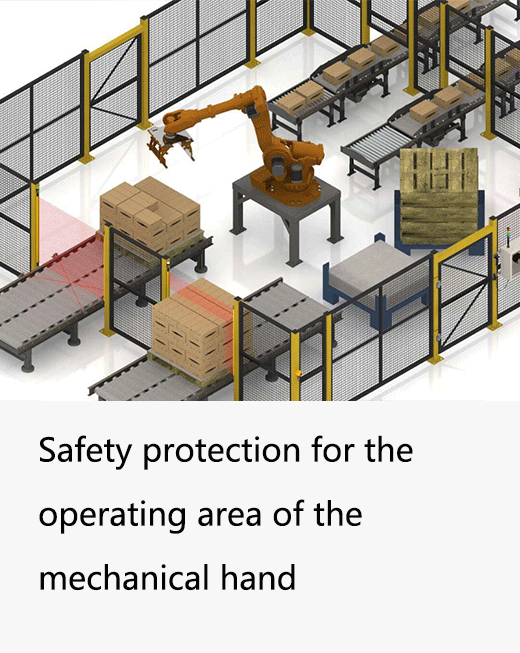
Station-by-station answer: fixed and interlocked guards suit roller nips; a validated curtain can protect a suitable loading opening; certified area scanners can monitor a floor zone when their capability meets the risk assessment. The industrial LiDAR and safety-scanner selection guide distinguishes these roles. ST27 is user-confirmed Type 3 / PL d / SIL 2; DLD, SDLD and DLDS are non-safety perception devices and cannot be the credited person-protection function.
EV battery manufacturing has scaled faster than almost any industrial process in the last decade, and a lot of the safety engineering on these lines has been improvised under schedule pressure. This article is the station-by-station version of the conversation we have with engineers planning a module or pack line. It is deliberately not a product pitch — where our own products fit, we will say so plainly, and where they do not, we will say that too.
Why a battery line is a different guarding problem
Three things make battery manufacturing distinct from, say, a general automotive assembly line.
It is fast and high-mix. Cell throughput is measured in parts per minute, sometimes per second. That speed puts pressure on every safety distance calculation, because a faster line usually means a longer machine stopping time, which means the protective device has to sit further back — and floor space on a battery line is expensive.
The hazards are not all mechanical. A press has one obvious danger: the ram. A battery line layers mechanical pinch and crush hazards on top of chemical exposure (electrolyte), electrical hazards (formation voltages), and thermal-runaway fire risk. A safety light curtain solves exactly one of those categories. Keep those scopes separate throughout the station assessment; this article does not rank observed audit findings.
Automated material flow is everywhere. Cells, trays, modules and packs move constantly, increasingly on AGVs and AMRs rather than forklifts. That means fixed-station guarding and mobile-vehicle safety have to be designed as one system. We deal with the vehicle side in a companion piece on AGV and AMR safety laser scanners; here we focus on the fixed stations.
Walking the line, station by station
1. Electrode area — coating, calendering, slitting
The front end of a cell line runs continuous webs of coated foil through rollers at speed. The dominant hazard is the nip point — the in-running gap where a roller meets the web or another roller. Nip points are unforgiving and they do not need a person to be careless; a sleeve, a glove, or a cleaning rag is enough.
Guarding here is mostly fixed and interlocked: fixed guards over the roller stacks, with interlocked access doors for threading and cleaning. A light curtain has a role at the operator-access points and at the loading and unloading of foil reels, where a person genuinely needs to reach in. For the doors themselves, a coded safety interlock switch is the right tool — see our DX series safety door locks for guard locking where the rollers must coast to a stop before the door can open.
2. Cell assembly — winding or stacking, in the dry room
Cell assembly may use a controlled dry environment. Verify the exact sensor's humidity, temperature and non-condensing limits, ESD provisions, material compatibility and approved cleaning method. Assess airlock transitions separately; a reliability value alone does not establish environmental suitability.
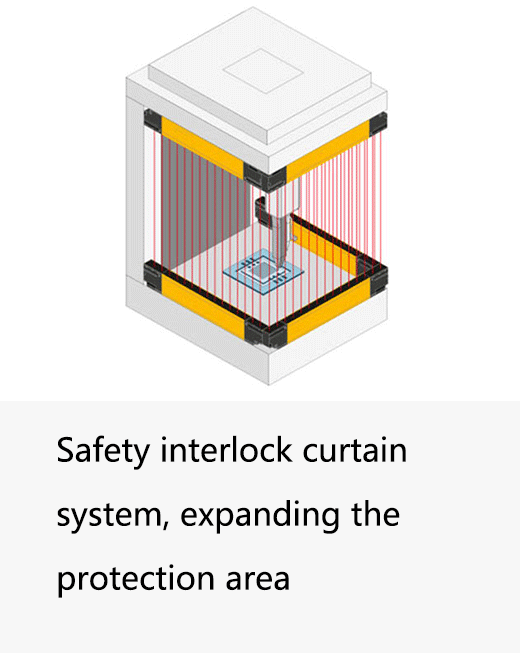
The mechanical hazards are the winding or stacking machine axes and the electrolyte-filling station. Point-of-operation light curtains with 14 mm or 20 mm resolution are typical where an operator interacts with a fixture; 30 mm access detection is typical at the automated cell-handling cells.
For a stacking-based pouch route, the pouch-cell station-by-station guarding guide follows magazine reload, filling and degassing, formation access and pack end-of-line checks as separate tasks.
3. Formation and aging — and a scope warning
This is where we have to be blunt. The formation and aging area is dominated by a fire and thermal-runaway risk. That risk is managed by gas detection, suppression, rack spacing, and electrical design. A safety light curtain does nothing for thermal runaway. If anyone on your project is treating optical guarding as part of the fire-safety answer, stop and re-scope.
What machine safety does cover in the formation area is the handling automation — the shuttles, gantries, and stacker systems that load and unload cells from the charging racks. Those have moving axes and pinch points like any other machine, and they get guarded like any other machine: interlocked enclosures, with light curtains or laser scanners at the load/unload faces.
4. Module and pack assembly — the robotic cells
This is the station everyone pictures when they think “battery line safety”: robots placing cells into modules, modules into packs, applying adhesive, fastening, welding busbars. The hazard is the robot envelope, plus the fixtures and presses inside it.
The standard answer is a guarded cell with a controlled access point. The access point gets a light curtain — body or access detection, 30-40 mm resolution — and the conveyor pass-through where modules enter and leave gets a muted section so the product passes without tripping the function while a person still cannot. Muting is powerful and routinely misconfigured; we say more about that below. For the largest cells, an area-scanning laser sensor can cover an irregular footprint that a flat curtain cannot.
5. End-of-line — testing, marking, palletizing
End-of-line stations test, label, and stage finished packs. Do not assume end-of-line hazards are minor: testing can introduce electrical hazards, and palletizing in particular has a real one: the robot stacking a heavy pack onto a pallet. Palletizing guarding has its own subtleties around response time and access detection — we wrote a separate guide on choosing light curtains for automatic palletizing systems that applies directly here.
What to spec, at a glance
| Station | Dominant hazard | Typical guarding answer |
|---|---|---|
| Electrode (coating/slitting) | Roller nip points | Fixed guards + interlocked doors; curtain at reel load/unload |
| Cell assembly (dry room) | Winding/stacking axes, filling | 14-20 mm point-of-operation curtain; 30 mm at handling cells |
| Formation & aging | Handling automation (fire risk separate) | Interlocked enclosures; curtain/scanner at load faces |
| Module & pack assembly | Robot envelope, fixtures, welding | 30-40 mm access curtain + muted pass-through; area scanner for large cells |
| End-of-line / palletizing | Palletizing robot | Access-detection curtain, response-time verified |
Treat this table as a starting point for the conversation, not a specification. Every station still needs its own risk assessment and its own ISO 13855 safety-distance calculation. The table tells you which family of device to reach for; it cannot tell you where to mount it.
The mistakes that get caught in audits
Safety distance after a process change. As an illustrative failure scenario, a line speed or payload change can alter stopping performance and invalidate the original mounting distance. Reassess affected functions whenever configuration or operating conditions change. The ISO 13855 positioning guide explains the calculation context; no audit-frequency ranking or measured customer event is asserted here.
Muting that defeats the curtain. Muting lets a pallet or module pass through a curtain without stopping the machine. Done well, it is invisible and safe. Done badly — too few muting sensors, muting windows left open too long, sensors positioned so a person can shadow the load — it becomes a hole a worker can walk straight through. Muting and blanking get confused constantly; our article on muting vs blanking is worth ten minutes before you design a pass-through.
Confusing the device rating with the system rating. A Type 4 light curtain is capable of supporting a PL e / SIL 3 function. It does not, by itself, make the function PL e. The achieved Performance Level depends on the whole chain — curtain, safety logic, and final actuator. If the contactor that actually cuts power is the weak link, the whole function is dragged down. We unpack this properly in our companion guide to Performance Level and SIL.
Optical interference from welding. Busbar welding inside a pack cell throws a great deal of light and electrical noise. A curtain with weak interference rejection will nuisance-trip, and a line that nuisance-trips gets its safety devices bypassed by frustrated operators — the worst possible outcome. Specify good optical interference immunity and read our notes on ghost trips in welding cells.
Where DAIDISIKE fits — honestly
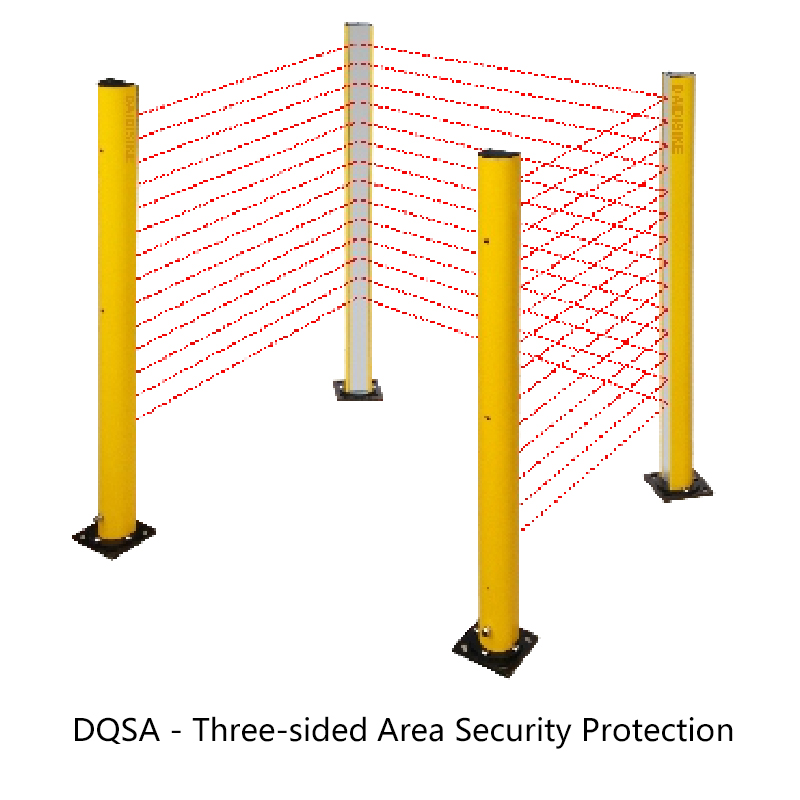
Since you may be reading this on our site, a straight answer. Evaluate the exact sensor, safety logic and final switching elements for each station rather than treating a supplier's industry coverage as application approval. The DQA exact-model light curtain options covers point-of-operation and access detection; the DQSA area protection family covers the larger handling cells; and the DA31 safety relay must be checked against its exact documented input and output functions; do not infer monitored reset or EDM from the relay name.
What we will not tell you is that one part number solves a whole battery line — that is the exact mistake we opened this article with. If you are planning a line, the most useful thing we can do is walk it with you station by station. Our engineering team does that, and we would rather scope it right than sell you a tidy bill of materials that an auditor unpicks later.
The bottom line
Reference boundaries: ISO 13855:2024 covers safeguard positioning, while ISO 3691-4:2023 concerns driverless industrial trucks and systems. Neither makes an optical guard a fire, chemical-containment or electrical-isolation measure.
A battery plant rewards engineers who resist the urge to standardize the safety design down to a single answer. Standardize the hardware platform — fewer part numbers genuinely helps spares and training. Do not standardize away the per-station risk assessment. Electrode rollers, dry-room winders, formation shuttles, and robotic pack cells are four different hazards, and the guarding only works when each one is treated on its own terms.