
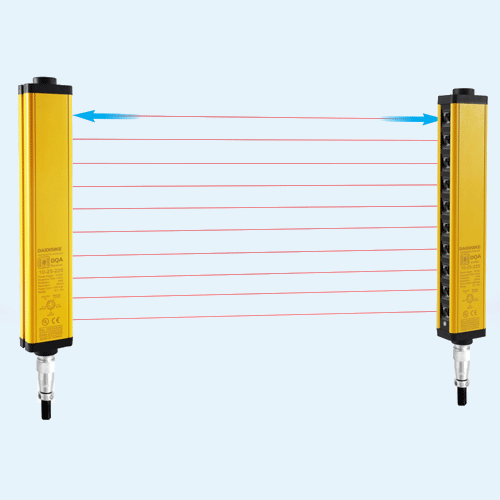
Indonesian buyers arrive here from a few clear directions: pricing a Type 4 curtain for a press shop; looking for a cheaper alternative (alternatif / pengganti) to an Omron or Autonics they already run; doing the SNI / customs / landed-cost homework before importing from China; or scoping the wider safety circuit — AGV scanner, relay, guard-locking switch, proximity sensor — for a new line. This guide answers all of those in order, in the English and Bahasa terms a procurement engineer actually searches (jual, harga, distributor), with honest certification and no invented local presence.
Where are safety sensors used in Indonesia — which estates and sectors?
Use the West Java Bekasi–Cikarang–Karawang belt and the other regions below as a procurement planning map, not a market-share ranking. A press shop needs stopping and access data; an EMS line needs small-part access and conveyor-transfer details; a wet or dusty process needs an environmental specification. Estate size or factory count does not establish which safety device a machine needs.
| Estate / region | Procurement planning cue | Application examples | Guarding questions |
|---|---|---|---|
| Jababeka (Cikarang) | Cikarang installation and service planning | Automotive, electronics, chemicals, pharma | Press/assembly guarding, finger curtains |
| KIIC (Karawang) | Karawang line-building and retrofit planning | Automotive & electronics | Stamping curtains, relays, interlocks |
| MM2100 (Bekasi) | Bekasi delivery and integration planning | Electronics, automotive, machinery | Conveyor / area guarding, proximity |
| Batam | Electronics / semiconductor backend | EMS and semiconductor equipment | Finger-protection curtains, AGV |
| Surabaya / East Java | Cement & heavy industry | Cement equipment and shipyard machinery | Heavy-machine & perimeter guarding |
| Semarang / Central Java | Textile & garment hub | Textile and garment machinery | High machine count, basic guarding |
Automotive and 2-wheeler stamping, electronics/EMS, food packaging, palm-oil processing, cement and textiles involve different hazards even when their purchase lists share sensors. Record ejection, run-down, unexpected restart and access around or under the sensing field. For palm-oil or other combustible environments, identify any hazardous-area requirement separately: an IP rating is not explosion protection. These are application examples, not customer installations or quantified market forecasts.
Who supplies safety light curtains in Indonesia — and what is the factory-direct difference?
Indonesian searches such as jual, harga and distributor often mix a manufacturer, an authorized distributor and a marketplace reseller. Ask each bidder who supplies the exact model, who handles warranty and commissioning, and which manuals and certificates accompany it. Omron, Autonics, SICK and Keyence are comparison references; verify current channel authorization directly with the brand instead of assuming a marketplace listing is a distributor resmi.
| Brand / family reference | Channel | Evidence to compare | Replacement review |
|---|---|---|---|
| Omron F3SJ-series | Confirm current manufacturer-authorized channel | Exact model certificate and manual | Compare detection capability, response and connectors |
| Autonics SFL-series | Confirm current authorization and service scope | Exact SFL order-code documentation | Do not infer resolution or rating from family name |
| SICK | Confirm local support and procurement terms | Model-specific safety data | Validate proposed DQT4 configuration |
| Keyence | Confirm quotation and support responsibilities | Model-specific safety data | Review full function, not only mounting dimensions |
Brand names are used for nominative comparison, without partnership or endorsement. DAIDISIKE is a China-based manufacturer; no Indonesian office, warehouse or appointed distributor is claimed here. Compare delivered and commissioned cost, not an assumed margin saving. The brand replacement and compatibility hub helps organize a replacement review, but a matching connector or nominal rating is not drop-in approval.
K3, SMK3 and Kemnaker: what makes Indonesian factories install guarding?
K3 is occupational safety and health; Indonesia's workplace-safety framework includes UU No. 1 of 1970 and the SMK3 management-system regulation. PP No. 50 of 2012, Article 5, makes the SMK3 obligation applicable to companies employing at least 100 workers or having high hazard potential. Check the workplace's applicable implementing requirements with a competent Indonesian K3 professional.
A management-system obligation is not a blanket instruction to buy Type 4 or proof of achieved PL e. The risk assessment must identify the safety functions and required performance, then validate sensing, logic, final switching elements and machine stopping together. Workplace K3/SMK3 is distinct from product-specific SNI or Ministry of Trade K3L controls; one assessment does not replace the others.
Press shop & stamping: which curtain, what resolution, how is it mounted?
For an Indonesian press RFQ, first establish whether the machine can stop safely before a person reaches the hazard and whether the applicable press rules permit presence-sensing protection. A light curtain is not a cure for a non-stoppable stroke, ejected material or unguarded side access. Use the safety light-curtain selection range to compare exact certified detection capability, protective height, response time and environmental limits. DQC, DQA, DQT4 and DQR names do not establish one shared Type/PL or EDM feature set.
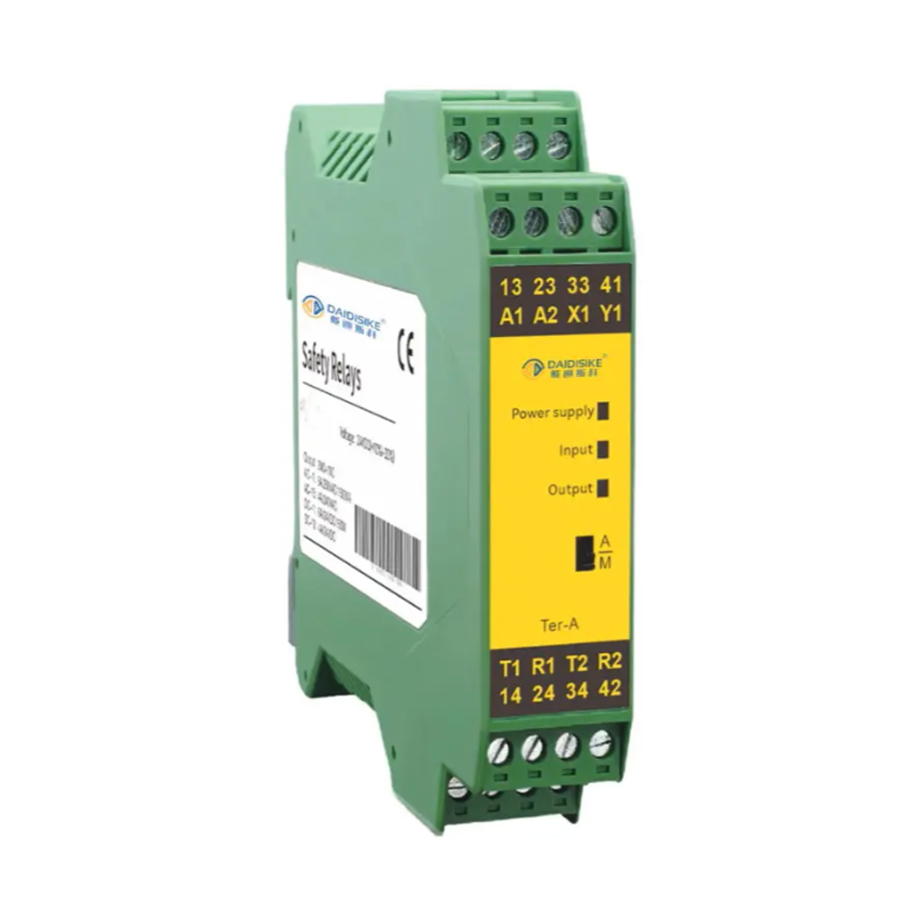
Position the curtain using the applicable method and measured total stopping response, including every device and actuator in the stop path; the ISO 13855 distance calculator illustrates a limited legacy arithmetic case, not a complete ISO 13855:2024 assessment. Route both OSSD channels to compatible, qualified safety logic. Compare the safety relay range against the required functions: a DA31 label does not prove EDM, monitored reset, muting or two-hand control. Ordinary PLC diagnostics may receive designated auxiliary status outputs only, not a raw OSSD branch or a substitute for safety logic.
Guard-locking door switches: protecting robot cells and stamping enclosures
If a person could reach hazardous motion before it stops, the assessment may require a guard to remain physically locked until a safe release condition is met. Compare the industrial interlock and guard-locking range: DX-W2 is a guard-locking candidate, whereas the DX-R1 coded magnetic interlock does not itself mechanically hold a door shut. Verify the exact variant's holding force, lock principle, monitoring, release facilities and installed safety performance. The diagram is conceptual, not proof that every option is included.
1. Check the guard and locking state using qualified safety logic before permitting hazardous motion.
2. On an access request, command a safe stop and maintain required locking until the assessed release condition is met.
3. Release only through the documented safety function; prevent unexpected restart after reclosing.
Power-to-lock versus power-to-unlock, auxiliary release and escape release are different selection questions. Do not assume every DX option provides the same features.
AGV / AMR safety scanners: the EV & electronics intralogistics wedge
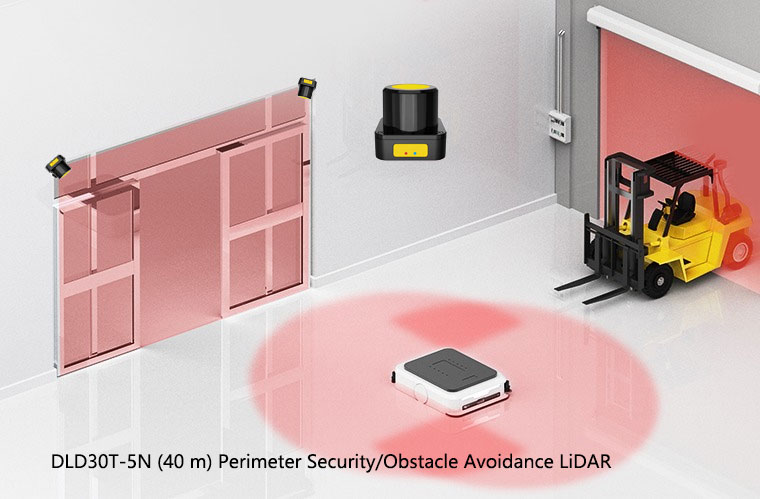
For an AGV moving material on an Indonesian EV, battery or electronics line, distinguish personnel protection from navigation. The industrial LiDAR and scanner range includes different device classes. ST27 is the confirmed Type 3, PL d, SIL 2 safety model, subject to its exact documentation and application limits. DLD, SDLD and DLDS are non-safety LiDAR and cannot provide a certified personnel-protective stop, even when connected to a safety controller. Field sizing must account for braking, payload, speed, sensing limits and the full validated stop chain.

Can I import safety sensors from China to Indonesia — MOQ, Tanjung Priok, FOB vs CIF vs DDP?
Ask for sample quantity and availability for the exact order code, then agree the bench and machine-level acceptance tests before a larger order. Compare Tanjung Priok for a West Java delivery with Tanjung Perak for East Java according to the forwarder's actual route and inland charges. Obtain a dated production and transport schedule; no fixed ocean transit, customs duration or nationwide delivery promise is established here.
Record the Incoterms edition and named place alongside the importer of record, clearance tasks and taxes. FOB and CIF are sea/inland-waterway terms; for container or multimodal delivery, ask the forwarder whether another term better matches the handover. A commercial delivery term does not waive Indonesian import eligibility or product controls.
| Incoterm | Freight / insurance | Who clears & holds licenses |
|---|---|---|
| FOB China | Buyer arranges main freight | Buyer arranges lawful import clearance and required permissions |
| CIF Tanjung Priok | Supplier covers freight + insurance to port | Buyer arranges lawful import clearance and required permissions |
| DDP | Supplier/forwarder end-to-end | Seller arranges import obligations only through a lawful, agreed importer |
Before ordering, have the importer check the exact HS classification, business/import permissions and any applicable restrictions or approvals in Indonesia National Single Window. DDP is not a workaround for missing licenses: identify a legally eligible importer and document responsibilities before shipment. Request accurate invoice, packing list, origin evidence and product descriptions; never substitute a false HS code or consignee to obtain clearance.
HS code, duty / PPN, SNI & ACFTA Form E — the import questions buyers research first
Classify each curtain, relay, switch or LiDAR by its actual function and construction against the current Indonesian tariff. Do not assign one HS heading to a mixed sensor order. Ask the broker to itemize customs value, Bea Masuk, PPN, PPh Pasal 22 where applicable, fees and the tax bases used, including any available relief. Verify the current treatment with INSW and the responsible tax/customs authorities; this page is not a tariff ruling.
A preferential ACFTA claim is conditional: Bea Cukai explains that origin, consignment and procedural requirements must be satisfied. Chinese shipment origin or possession of a Form E alone does not guarantee a zero rate; confirm the tariff line, qualifying origin and acceptable document process. Separately, have the importer or competent conformity body check current mandatory SNI/SPPT-SNI and K3L scope for the exact product. No SNI mark, exemption or automatic TÜV document availability is established by this article.
What else does DAIDISIKE supply into Indonesia — the whole safety circuit?
Build a category-separated purchase list: protective curtains and safety logic for a validated stop; interlocks or guard locking for enclosure access; a certified safety scanner where the robot assessment requires one; and inductive proximity sensors for ordinary position detection. Specify whether each output is safety-related or operational. Do not treat ordinary proximity sensors or DLD LiDAR as safety components merely because they share an order with a safety relay.
Send the machine and hazard description, required safety functions, exact model or replacement reference, detection capability, height, range, response and interface requirements, environment and quantity. Include the Indonesian delivery location and proposed terms. Request an itemized quotation, order-specific sample/MOQ and schedule, documentation list and confirmation of the importer's required approvals.
Contact DAIDISIKE → | Phone / WhatsApp +86 15218909599 · 915731013@qq.com
Sources & references
- Government Regulation PP 50/2012 — current status and SMK3 framework; Article 5 defines the applicability threshold.
- Official PP 50/2012 text — Articles 5–7 on scope, policy and risk review.
- Indonesia National Single Window — verify current tariff classification and import restrictions for each SKU.
- Bea Cukai FTA guidance — origin, consignment and procedural conditions for preference.
- Ministry of Industry certification information — product certification context; obtain exact current scope from the relevant body.
- Machine-safety standards index — keep component standards, system performance and installation validation distinct. Regional examples are planning context, not quantified market research or customer evidence.