
Most people arrive at this page from one of two searches. Either “safety laser scanner for AGV” / “AGV LiDAR supplier” — you are designing a vehicle and need the onboard safety sensor — or “SICK nanoScan3 alternative” / “cheaper safety laser scanner” — you already know the incumbent part and want a second source at a better price. This guide serves both. It explains the technology in the vocabulary the datasheets use, segments the product by the two real use-cases (certified personnel protection vs ordinary perception), benchmarks the mainstream models honestly, and tells you exactly which DAIDISIKE scanner class maps to your job — and where it does not.
What is a safety laser scanner, and how does it work?
It is a TOF (time-of-flight) optical safety device that sweeps one pulsed laser across a horizontal plane and switches OSSD outputs off when an object enters a protective zone. A rotating mirror fans a single 905 nm Class 1 laser beam across a wide arc — commonly a 270-degree scanning angle — and the device measures distance from the return time of each pulse. Firmware divides that plane into configured zones. A break in the protective field switches the dual OSSD safety outputs OFF, which the vehicle or machine safety circuit uses to stop or safely slow. Because the scanner maps free space rather than a fixed beam line like a safety light curtain, a single unit can guard an irregular floor area or the front of a moving AGV.
Protective field vs warning field — the distinction that trips buyers up
The protective field is the safety-rated stop zone; the warning field is a larger, non-safety alert zone. Both are monitored at once. On an AGV you run a short, tight protective field directly ahead — usually a few metres, because it must guarantee a stop before contact — and a longer warning field beyond it that only triggers a horn, a status output or a slow-down so people and the vehicle can react first. The warning field is where the long-range numbers live: a scanner with a 5 m protective field may carry a 20 m or even 40 m warning/measurement range. Do not confuse the two when comparing datasheets — a “40 m” scanner is almost always quoting the warning/measurement range, with a far shorter protective field. Speed- or direction-dependent selection requires the exact device's supported monitoring cases and a validated safety-related selection architecture; it is not an automatic property of every scanner.
Is a safety laser scanner the same as LiDAR? Can you use a LiDAR for AGV safety?
A safety laser scanner is a LiDAR — but a navigation LiDAR is not safety-rated and must not be the device that stops the machine. This is one of the most-searched and most-misunderstood points in the whole AGV-safety space, so it is worth being blunt. Both a safety laser scanner and a 2D navigation LiDAR use time-of-flight ranging to build a map. The difference is functional safety. A safety laser scanner is Type-rated to IEC 61496-3 with continuous self-diagnostics, a defined fault reaction and dual OSSD outputs, so it can be relied upon to command a safe stop. A general-purpose measurement/navigation LiDAR — the Pepperl+Fuchs R2000 is a classic example, and security LiDARs like OPTEX REDSCAN another — is superb for mapping, localisation and intrusion awareness but is not machine-safety rated. The correct architecture: navigation LiDAR for guidance, a separate Type 3 safety laser scanner for personnel collision protection. Never collapse the two into one non-rated sensor.
Choose the device class first: safety stop vs ordinary perception
The first purchasing decision is not range; it is whether the function protects a person. Choose the ST27 when a certified Type 3 / SIL 2 / PL d scanner and OSSD stop are required. Choose a DLD, SDLD, DLDS or JPTG perception LiDAR only for navigation, mapping, perimeter monitoring, ordinary warning or non-safety slow-down. Browse the complete industrial LiDAR scanner range after that boundary is fixed.
| Device class / job | What you optimise for | DAIDISIKE model | Headline range |
|---|---|---|---|
| Certified personnel-protection stop | Type 3, SIL 2, PL d, PNP OSSD, validated protective field | ST27 | 3 m / 5 m protective field |
| AGV / AMR obstacle avoidance | Ordinary detection, navigation support, warning or slow-down | DLD05A3 / DLD20A5 / SDLD-05A | 5 m / 20 m / 14 m working range |
| Perimeter monitoring | Long-range virtual wall or ordinary intrusion detection; not machine-safety guarding | DLD30T-5N | 30 m @90% / 10 m @10% remission in the current factory table |
DLD and SDLD range figures are working or detection ranges from their own datasheets, not certified protective-field distances. Do not compare a 20 m or 40 m perception range with the ST27's 3 m or 5 m safety-rated protective field as though they were the same measurement.
How DAIDISIKE compares with SICK, Hokuyo, Leuze, Datalogic, Omron and IDEC
Compare the ST27 with safety-rated scanners, and compare DLD/SDLD products only with other non-safety perception LiDARs. The table below collects each vendor's own published protective-field range, scan angle and zone/field-set count so you can benchmark like for like. These are the incumbents you will see on existing AGV fleets when you are searching for an alternative.
| Model | Class | Protective field | Scan / warning | Zone / field sets |
|---|---|---|---|---|
| SICK nanoScan3 | Type 3, SIL2 / Cat 3 | ~3 m (safeHDDM) | 275° | up to 128 scenarios |
| SICK microScan3 | Type 3 (safeHDDM) | Larger than nanoScan3 | 275° | Configurable |
| Hokuyo UAM-05LP | Type 3, SIL2 / PLd / Cat 3 | 5 m | 270°, 20 m warning | up to 128 field sets |
| Leuze RSL 400 | Safety laser scanner | 0–4.5 m (to ~8.25 m op.) | 270°, 20 m warning | 100 switchable pairs |
| Datalogic Laser Sentinel | Safety laser scanner | 0.05–5.5 m | 275°, up to 40 m warning | Multiple zone sets |
| Omron OS32C | Type 3 | up to 4 m (70 mm min) | 270°, 15 m warning | 70 zone-set combos |
| IDEC SE2L | Type 3, ultra-compact | 5 m | 270°, 20 m warning | Master + up to 3 slaves |
| DAIDISIKE ST27 | Type 3, SIL 2, PL d | 3 m / 5 m protective field | 276°, 10 m / 20 m warning | Up to 64 static / 256 monitoring field sets |
| DAIDISIKE DLD / SDLD range | Non-safety perception LiDAR | Model-specific working range | Model-specific scan and interface | Not comparable as a safety-scanner replacement |
ST27 ratings and ranges are model-specific DAIDISIKE specifications, supported by the product's certification documentation. DLD and SDLD products carry no Type, SIL or PL safety rating and are shown only to explain the product-class boundary. Confirm the exact ST27 designation, interface and certificate set for the destination market before freezing the safety design.
Field switching, OSSD and master/slave — the AGV integration details
Check three integration questions before ordering. First, which safe speed and field-selection architecture does the exact variant support? Do not assume every scanner accepts wheel encoders. Second, can the receiving safety input handle the OSSD test pulses and specified electrical limits? Check any DA31 relay interface against both manuals. Third, how are multiple scanners combined and validated for all hazardous motion? A wide scan angle or master/slave label does not prove 360-degree coverage or full-system safety.
ISO 13855 safety distance for a horizontal scanner field
Specify the complete stopping envelope and the applicable application standard. ISO 13855 addresses positioning relative to human approach for machinery; ISO 3691-4 addresses driverless trucks. For AGVs, include sensing/control delays, complete braking distance, load, floor, direction, switching delays and required allowances. Do not use a generic human-plus-vehicle speed formula as a complete acceptance calculation. The driverless-truck field-design guide explains what must be verified; the IEC 61496-3 explainer distinguishes product approval from integration.
One-stop safety: scanners, light curtains, relays and switches together
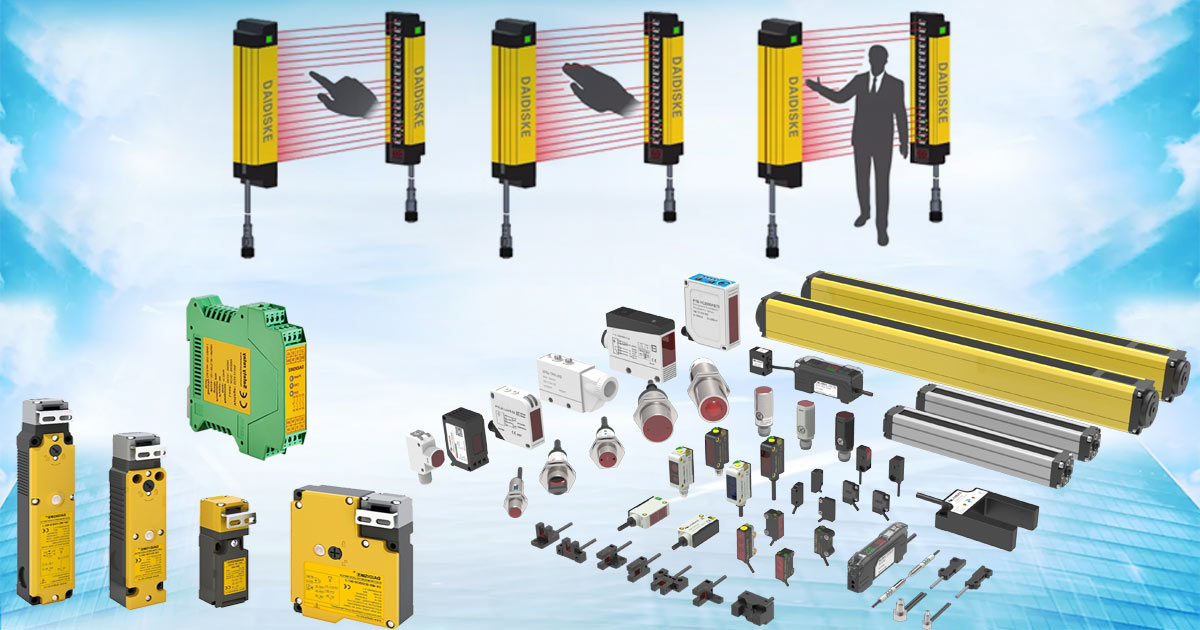
A safety laser scanner rarely ships alone. The same AGV or automated cell may also require a light curtain, relay logic and guard switches; assess each selected device separately. The DQC light curtain currently has no published Type 2 / Type 4 rating. The DA31 safety relay has manufacturer-stated PL e / SIL 3 references subject to exact-model evidence and whole-machine validation; confirm OSSD compatibility from both manuals. Review non-contact coded safety switches (DX-R1) on guards and access doors. Sourcing the scanner and the rest of the machine-safeguarding chain from one manufacturer simplifies the BOM, the documentation and the support line — which is exactly the position DAIDISIKE holds as a safety light curtain and laser scanner supplier for AGV/AMR builders and cell integrators.
Why source from DAIDISIKE — and how to get a quote
DAIDISIKE is a Chinese OEM/ODM safety-sensor manufacturer with MOQ 1 set, 3–15 day lead times and export to 20+ countries. Foshan DAIDISIKE Optoelectronics Technology Co., Ltd. has built industrial safety sensors since 2013 from a 5000 m² factory. For a safety laser scanner or AGV LiDAR enquiry, send four things: (1) onboard safety stop or ordinary perception, (2) the required protective field or working range, (3) the validated stopping time, scan angle and field switching needs, and (4) the output, network and IP environment. We will quote the ST27 for a certified personnel-protection function, or a DLD/SDLD perception model for navigation, detection or perimeter monitoring, with the correct model datasheet.
Phone / WhatsApp +86 15218909599 · email 915731013@qq.com. MOQ 1 set, 3–15 day lead time, OEM/ODM welcome.
Contact DAIDISIKE →What to request before placing an OEM order
Attach the installed model and configuration when asking for a replacement. The safety-scanner alternatives comparison is a screening guide; release an order against an agreed exact-model document set.
| Purchase requirement | Evidence to agree |
|---|---|
| Safety function and market | Exact model designation, approval scope, safety manual and applicable declaration/certificate documents. |
| Field and interface | Protective range at the required resolution, response time, wiring, supported field selection and configuration software. |
| Supply and acceptance | Accessories, software/firmware version, lead time, support and agreed incoming inspection; confirm per quotation. |
| Integration release | Vehicle/machine stopping tests, fault response and configuration record; component approval does not replace this work. |
For an AGV project in Thailand that also needs curtains or relays, use the Thailand AGV and mixed-sensor procurement checklist to separate the model-document request, importer responsibilities and site-acceptance work in the quotation.
Sources & specifications cited
- SICK nanoScan3 / microScan3 — Type 3 (IEC 61496-3) safety laser scanner, safeHDDM, ~3 m protective field, 275° scan, up to 128 monitoring scenarios (SICK published specs).
- Hokuyo UAM-05LP — Type 3, SIL2 / PLd / Cat 3, 5 m safety zone, 20 m warning, 270° FOV, 905 nm Class 1, encoder input, up to 128 field sets, master/slave, IP65 (Hokuyo published specs).
- Leuze RSL 400 — 270° scan, protective field 0–4.5 m (operating range up to ~8.25 m), warning to 20 m, 100 switchable field pairs, 2 independent protective functions (Leuze published specs).
- Datalogic Laser Sentinel — protective field 0.05–5.5 m, warning to 40 m, 275°, multiple zone sets (Datalogic published specs).
- Omron OS32C — Type 3, safety zone to 4 m (70 mm min resolution), warning to 15 m, 270°, 70 zone-set combinations, Ethernet configuration/monitoring; do not infer a safe EtherNet/IP interface.
- IDEC SE2L — ultra-compact Type 3, 270°, 5 m safety zone, 20 m warning, master + up to 3 slaves for 360° AGV coverage (IDEC published specs).
- Pepperl+Fuchs R2000 — 2-D navigation/measurement LiDAR (NOT safety-rated); OPTEX REDSCAN — perimeter/intrusion LiDAR (not machine-safety rated). Cited to illustrate the safety vs navigation distinction.
- DAIDISIKE ST27 — Type 3, SIL 2, PL d, 276° scan, 3 m / 5 m protective-field variants and PNP OSSD outputs, supported by model-specific DAIDISIKE certification documentation.
- DAIDISIKE DLD / SDLD / DLDS / JPTG — non-safety perception LiDAR ranges and interfaces from their model datasheets; not Type, SIL or PL rated and not used as personnel-protection devices.