The application: why a pallet-exit opening is the hard one to guard
At the end of a packaging line, finished pallets move through a perimeter opening while the stacking robot may remain hazardous. Opening width and height, conveyor underside, side gaps and the space behind the load determine possible person access. A light curtain without muting would normally demand the safe response when the load interrupts it; a supported muting design is one possible way to manage this material transfer, not the only guarding method.
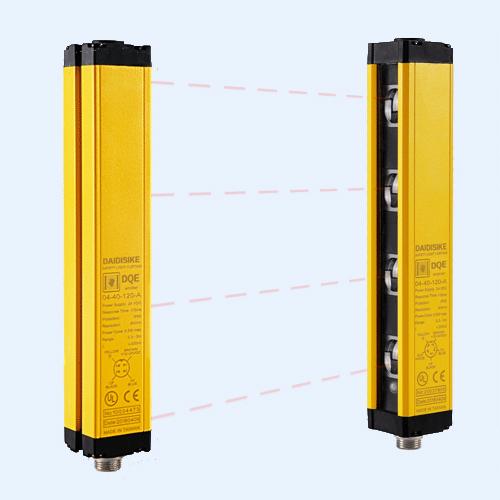
Use the safety light curtain selection category to shortlist documented sensing devices, then verify the exact controller and muting architecture. The muting versus blanking decision guide explains why a passing load is not simply a permanent blanked hole. This scenario does not assign a Type 4 rating to DQC or assume DA31 provides the required muting logic.
What exactly is muting, and how is IEC 62046 applied?
Muting is a controlled, temporary suspension of a defined protective function. It is not a bypass switch or a general maintenance override. IEC 62046:2026 covers the application of equipment for detecting persons; the exact controller manual supplies the supported muting functions and installation constraints.
- Process-derived initiation: the approved independent conditions must be satisfied; a single ordinary sensor or operator request is not a complete design.
- Geometry and access: intended loads may pass without opening an uncontrolled route beside, below, behind or on the load.
- Distinct timing limits: check sensor windows, transition delays and maximum permitted duration separately.
- Indication and diagnostics: use the required status indication and monitoring; do not assume every controller monitors a lamp.
- Defined termination and recovery: faults, stalls, reversal and power restoration require the specified safe response.
A generic four-second timeout or copied spacing values cannot replace the selected topology's installation instructions. The actual load length, minimum and maximum speed, stopping behavior and foreseeable misuse must fit the validated operating envelope.
- Protection active: interruption without valid muting requests the required safe response.
- Permitted transit: the supported sequence and geometry allow only the defined material movement.
- Protection restored: approved termination returns the function to active protection.
- Fault branch: invalid conditions invoke the specified safe state and controlled recovery, not a bypass.
Why four sensors and not two on this exit?
Sensor count is not a complete selection rule. Two-sensor crossed-beam and other arrangements have different approved direction and geometry constraints. Some support bidirectional movement; others are exit-only. A four-sensor sequence may provide additional load-occupancy information, but does not automatically make a higher-risk opening acceptable.
For the four-sensor scenario, document each permitted state transition, required overlap, maximum gap and load release condition from the exact manual. Then check smallest and largest intended loads, offset loads, reflective wrapping, stopped loads and reversal. Unexpected sequences must lead to the specified safe response, not automatic acceptance.
How do you stop a person from muting the curtain?
Combine the supported muting logic with physical access control and the machine's required safety measures. Validate foreseeable access paths, not only whether a pallet produces the expected pattern.
- Beside and underneath: check gaps, conveyor openings and reach to internal hazards throughout transit.
- Behind or on the load: address tailgating, riding and remaining in the cell after a pallet passes.
- Sensor misuse or faults: evaluate blocked, misaligned, failed or out-of-sequence sensors using the approved test method.
- Stall and reversal: define the safe reaction and controlled recovery without exposing personnel.
- Restart: clearing the opening or resetting a fault must not create an unexpected hazardous start.
Test-piece and access checks are performed with hazardous motion disabled. A competent person plans separate controlled stopping and fault validation. Nobody should enter an operating palletizer to demonstrate whether muting can be defeated.
Does the light curtain give you PLe/Category 4 — or does the whole chain?
The complete application must achieve its required performance. A curtain or controller can have declared PL/SIL capability, but that component rating is not the achieved PL of the installation. Type 4 is an IEC 61496 device classification, not automatic proof that the whole muting and stopping function reaches PL e / Category 4.
Assess sensing, muting evaluation, safety logic, final elements, diagnostics, failure data and systematic measures together. Verify required feedback and restart behavior from exact manuals. DA31 compatibility with muting, reset or EDM is not established here, and DQSRN must not be substituted where those unsupported functions are required.
Documented sensing + separate supported muting inputs → validated safety logic → suitable final elements with required monitoring → required safe state
How do you set the safety distance? ISO 13855: S = K·T + C
Muting decides when the curtain may stand down; it does nothing to the distance the curtain needs when it is live. That distance comes from the applicable ISO 13855:2024 approach and access assessment. The familiar introductory relationship is:
- K — approach parameter. Use the value and conditions of the applicable method, not a blanket hand/whole-body assumption.
- T — complete stopping chain. Include configured sensor and applicable safety logic, final-device and mechanical stopping times; validate the worst relevant operating condition.
- C — intrusion allowance in this simplified relation. Detection capability is not beam pitch, and reach-over/around or remaining presence may require additional measures.
Mount the curtain at least S back from the hazard so a hand cannot reach the danger zone before motion has stopped. If you want to work a real number for your machine, run our ISO 13855 safety-distance guide. When the curtain is not muted, it must still deliver this full distance — muting never reduces S.
The muting-to-run sequence, step by step
A normal material cycle must be defined by the approved state sequence; this outline is not a programmable controller specification:
- Without valid muting, curtain interruption requests the required safe state.
- The intended load establishes the supported conditions in the permitted order and timing.
- Muting permits only the defined transit while access-prevention measures remain effective.
- Approved load release/termination restores protection; no generic four-second duration is assumed.
- An invalid state, timeout, reversal or fault invokes the specified safe reaction; recovery follows the approved procedure without bypassing protection.
Where a DLD LiDAR fits — and where it does not
A laser scanner / LiDAR is sometimes considered instead of a curtain. Be precise about this. DAIDISIKE's DLD-series LiDAR is a 2D time-of-flight obstacle / area sensor — built for AGV/AMR navigation, obstacle avoidance and non-safety perimeter detection. It is not a type-rated functional-safety scanner (it is not an IEC 61496-3 Type 3 device) and it is not a drop-in replacement for a safety function. This scenario requires a documented protective sensing and control chain; it does not establish one from the DQC and DA31 names.
What a DLD can add is situational awareness: an area-warning or slow-down zone around the palletizer footprint, flagging that someone is approaching the cell before they ever reach the guarded opening. That is a useful non-safety layer on top of — never instead of — the rated muting curtain. If your application genuinely needs a safety-rated area scanner (for AGV personnel detection, say), that is a different, type-3-certified product class; we'll tell you so rather than overselling the DLD. See the DLD LiDAR / area-sensor page for the honest role boundary.
Bill of safety functions for the cell
| Element | Part / standard | Role in the function |
|---|---|---|
| Detection (input) | Documented curtain with required capability | Detects the specified test object across the required protective field; DQC Type 4 is not established here |
| Muting logic | Exact supported topology; IEC 62046:2026 application | Validated sequence, load geometry, timing, indication and safe fault recovery |
| Evaluation + final elements | Compatible validated safety system | Required stop, diagnostics and restart prevention; no DA31 muting/EDM/reset approval inferred |
| Distance | Applicable ISO 13855 positioning assessment; S = K·T + C is introductory | Sets how far back the curtain mounts from the palletizer hazard |
| Optional awareness layer | DLD-series LiDAR (NON-safety) | Area-warning / slow-down only; not a safety function, not a curtain replacement |
Selection & commissioning checklist
- Choose an approved topology for the actual direction, load envelope and accessible opening; do not select solely by sensor count.
- Validate person-access prevention: include beside, under, behind and on-load access.
- Record every timing setting: distinguish sensor windows, delays and maximum duration; check stalls and reversal.
- Confirm status and diagnostics: follow required indication/monitoring and fault reactions.
- Validate positioning: full stopping chain and all relevant approach paths under ISO 13855:2024.
- Verify exact interfaces: approved safety inputs, monitoring and reset; no unsupported DA31/DQSRN functions.
- Keep DLD non-safety: ordinary warning/slowdown is supplementary only.
The outcome (representative)
The intended outcome is controlled material passage with the required protection maintained against dangerous person access. That outcome must be demonstrated through the actual installation's validation; it cannot be promised from four sensors, a Type label or a relay name. Record acceptable normal cycles, faults and recovery, rather than claiming a measured throughput result or an achieved PL without evidence.
Representative engineering scenario only, not a verified customer installation. Primary sources: IEC 62046:2026, Banner EZ-SCREEN LPM muting instructions (model-specific examples, not DAIDISIKE settings), and ISO 13855:2024.