
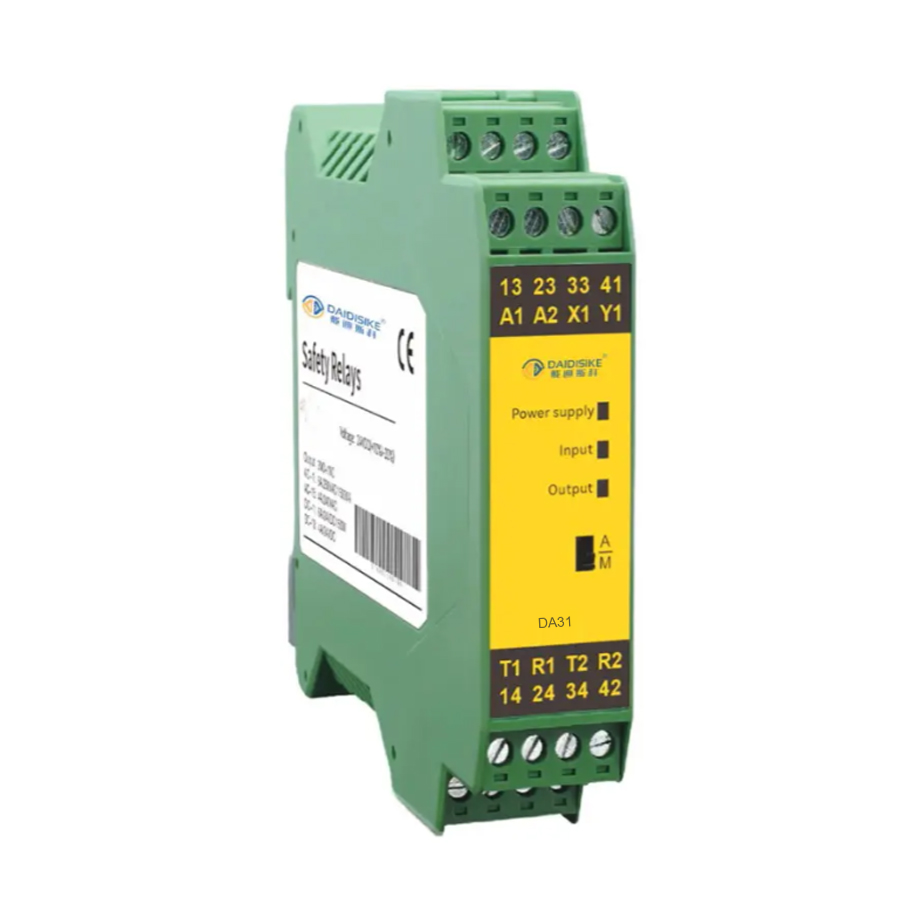
A safety relay module is the small DIN-rail device that watches your safety inputs — an emergency stop, a safety door switch, the OSSD outputs of a light curtain — through two independent channels, and de-energizes its output contacts to bring the machine to a safe state on the specified input conditions or detected faults. A suitable fixed-function relay can be a practical hardwired option for a limited set of functions; compare it with a safety PLC when logic, diagnostics or expansion requirements are more complex. The question is rarely “do I need a safety relay” — it is “which one, from whom, at what MOQ, and how soon.”
Who is the supplier — and what are the MOQ, lead time and OEM terms?
DAIDISIKE manufactures the DA31 directly, sells from MOQ 1 set with a quoted standard-product lead-time range of 3–15 days. OEM/ODM changes require a separate technical and evidence review. Foshan DAIDISIKE Optoelectronics Technology Co., Ltd. has built industrial safety sensors since 2013 from a 5000 m² factory and exports to more than 20 countries. Because we are the manufacturer and not a stocking reseller, the commercial terms that usually stall a small project are removed: you can order a single DA31 to prototype, then move to wholesale tiers for production runs, and the required declaration, certificate scope and test records should be agreed with the exact order rather than inferred from the company name.
For OEM and ODM work, discuss labels, branding, packaging and documentation separately from changes to terminals, contacts or safety logic. Engineering changes need feasibility review, validation and an assessment of the applicable certification scope; they do not automatically inherit the standard DA31 rating. Send a drawing or a sample and we quote tooling, the custom-variant MOQ and lead time. For a firm price and ship date, contact our engineering team or message +86 15218909599 directly.
Tell us the quantity, supply voltage and whether you need OEM/ODM customization. MOQ 1 set, 3–15 day lead time, factory-direct price.
Request a quote →or WhatsApp/Phone +86 15218909599Safety Relay Modules for Light Curtains
A light curtain safety relay receives the two OSSD channels from a compatible safety light curtain and switches the validated machine-stop circuit. OSSD input compatibility, reset behaviour and external device monitoring are model-specific, so confirm the exact curtain output, relay input and terminal assignment in both delivered manuals before designing the circuit. Review the DA31 safety relay module against those requirements. A standard delay relay is not a safety relay and must not be used as a substitute for this safety function.
| Selection point | DA31 model details | DQSRN model details |
|---|---|---|
| Module type | Safety relay module | Safety relay module |
| Light-curtain input | Confirm OSSD compatibility from the exact manuals | Confirm OSSD compatibility from the exact manuals |
| Manual / automatic reset | Provided as documented for DA31 | Not provided |
| EDM feedback | Not stated in current factory material; request the exact manual or select a controller with documented EDM | Not provided |
| Selection rule | Select from the required safety function and the verified device manuals; do not infer compatibility from connector shape or supply voltage alone. | |
Use the linked model pages to identify the product, then request the complete order code and delivered manual revision with the quote. Include the input device, required safety function, output loads and any required reset or monitoring functions. The two models are not interchangeable merely because their supply or contact counts match.
For the dual-channel connection sequence and the different DA31 and DQSRN function limits, see our light curtain safety relay wiring guide.
If the requirement is ordinary process timing, remote I/O or programmable sequencing, use the relay and control-module task selector to reach those separate product families. They are not replacements for a documented safety-relay function.
What exactly is the DA31, and is it really PL e / SIL 3?
The DA31 manufacturer brochure and label reference EN/ISO 13849-1 Category 4 / PL e and IEC 62061 SIL 3, with 3NO+1NC outputs and force-guided contacts, releasing in under 30 ms. The current factory material documents positively guided (force-guided) contacts, whose mechanically linked behaviour supports fault detection in an appropriate monitored circuit. Force guidance alone does not prove every fault will be detected. The S1/S2 terminal table describes input open-circuit detection and inter-channel checking; EDM feedback is not established by these drawings. Confirm diagnostic coverage and conditions in the matching manual. The safety output is three normally-open contacts; the normally-closed contact is auxiliary signalling, not a fourth safety output. Supplied illustrations differ in auxiliary and power/reset terminal numbering, so use the delivered label and matching diagram. The 3NO + 1NC arrangement also has a separate transistor signal output (<500 mA, 24 V DC) for status to a PLC.
The electrical envelope is built for real panel duty: 24 V DC supply (+10% / −20%), AC-1 contact rating 6 A / 250 VAC and DC-1 6 A / 24 VDC with a 12 A maximum switching capacity across the safety contacts, AgSnO₂ + gold-flash contact material, 80,000-cycle electrical life, −25 °C to 85 °C operation, and a flame- retardant PA66 housing of 112 × 99.5 × 22.6 mm — the slim 22.6 mm DIN width that keeps cabinet real estate down. Inputs are configurable by multifunction DIP settings. Factory examples show PNP light curtains and contact-based devices; NPN and OSSD test-pulse compatibility require the exact revision's instructions. The listed 1 kΩ–10 kΩ end-of-line resistance applies to safety-edge/mat inputs, not a resistor to add to every OSSD circuit. Confirm terminal conductor range and ferrules from the delivered instructions.
How do you wire an E-stop or light curtain using the DA31 terminal diagram?
Use the exact DA31 factory terminal diagram for the selected input and stop circuit; never transfer another brand's terminal numbers. The factory diagram documents SRC/SR for manual reset or, when linked, automatic reset. Light-curtain OSSD compatibility must be confirmed from both exact manuals. DQT4 has a documented Type 4 architecture; the current DQC and DQA pages do not publish a Type 2 or Type 4 classification, and none of these combinations should be described as pre-matched without verified documentation and system validation.
One honest note for buyers cross-referencing from a Pilz drawing: terminal numbers differ between manufacturers even when the scheme is identical, so do not assume the DA31's terminals are numbered S11/S12/S14 like a PNOZ. We supply the exact DA31 terminal map before wiring. The detailed connection guide explains the same documentation boundary and does not substitute for the delivered device manuals.
What if the safety function requires EDM or cross-fault detection?
Do not equate input inter-channel checking with EDM feedback or complete diagnostic coverage. The factory terminal table describes S1/S2 open-circuit detection and inter-channel checking, alongside force-guided contacts and the SRC/SR reset selector on that illustrated revision. EDM is not established. If your risk assessment requires contactor feedback or specific cross-fault diagnostics, obtain an exact current DA31 manual that explicitly confirms the required function or select a controller that documents it. Do not create a T1/T2 loop from an unrelated diagram.
How does the DA31 compare to Pilz PNOZ, Phoenix PSR, Sick and IDEC?
Compare only documented functions. The DA31 factory material lists 3NO+1NC, force-guided contacts, manual/automatic reset selection and sub-30 ms release. The input table describes inter-channel checking, but does not establish EDM or full diagnostic coverage. The table below is built from each vendor's own published figures. Where a number is brand-specific or we can't verify it from a public spec, it is left out rather than invented — including competitor prices, which we do not quote.
| Module | Outputs | Rating | Notes |
|---|---|---|---|
| DAIDISIKE DA31 | 3 N.O. safety + 1 N.C. auxiliary (+ transistor signal) | Cat 4 / PL e, SIL 3 | Force-guided, manual/automatic reset selector, <30 ms, 22.6 mm DIN; input inter-channel checking documented; EDM not established |
| Pilz PNOZ X2.8P (777301) | 3 N.O. + 1 N.C.; no semiconductor output | Cat 4 / PL e, SIL 3 | E-stop / guard-door monitoring; established European reference |
| Phoenix PSR-MC34 (2700540) | 3 enabling paths + 1 PNP digital signal | SIL 3 / PL e (per datasheet) | 12.5 mm model-specific PSRmini reference; not a terminal-for-terminal DA31 replacement |
| Sick RLY3-OSSD100 | Relay outputs for OSSD source | PL e (per datasheet) | Designed specifically to convert ESPE OSSD to relay contacts |
| IDEC HR1S-AC5121 | Force-guided safety relay output | Per datasheet | Compact E-stop / interlock monitoring module |
Competitor figures are from each manufacturer's public documentation. No competitor price or total-cost advantage is asserted. Always confirm the exact variant's rating against its current datasheet for your application.
For the input, reset and diagnostic checks that decide whether a replacement is feasible, see the Phoenix PSR versus DA31 function comparison and the Schmersal SRB replacement checklist. For circuit principles rather than purchasing, use the dual-channel E-stop safety relay wiring guide.
If the installed name is Preventa, start with the Preventa XPS relay versus XUSL curtain replacement checks to identify whether the item is relay logic or a light curtain before comparing input, reset, output and validation requirements.
The practical read: if you already trust a PNOZ-class architecture, the DA31 offers a documented 3NO+1NC contact set, force-guided contacts and reset selector, with factory-direct sourcing. It must not be treated as functionally identical to another module where EDM or specific diagnostic coverage is required but not established for DA31. For the deeper architecture question — relay versus a programmable safety controller — read our safety relay vs safety PLC selection guide. For a limited set of functions a relay may be suitable, but compare the complete design and validation effort rather than assuming a cost advantage.
Relay vs safety controller — and where cost actually goes
For a single E-stop, one light curtain or a couple of door switches, compare a suitable fixed-function relay with a programmable safety controller using the required functions, diagnostics, expansion and validation effort. The simplest suitable architecture is not determined by device price alone. A safety relay is hardwired and fixed-function: no programming, no validation of software, no licensing — you wire it, test the function, and document it. A safety controller or safety PLC scales to many inputs and conditional logic but carries software, configuration and validation effort. Even a small machine may need programmable safety logic for complex safe modes or diagnostics; the risk assessment and safety-function specification decide.
Is naming Pilz, Phoenix, Sick and IDEC legitimate here?
Brand names identify the products being compared; they do not establish compatibility, certification equivalence, partnership or endorsement. Compare exact ordering codes and documented functions. This page does not give a legal opinion on trademark use. We reference Pilz PNOZ, Phoenix PSR, Sick RLY3-OSSD100 and IDEC HR1S to tell you where the DAIDISIKE DA31 fits relative to parts you already know. We do not reproduce their manuals, use their logos as our own, or quote a parameter — or a price — we cannot confirm from public documentation. The DA31 figures are from DAIDISIKE's own spec sheet; the competitor figures are from theirs. There is no implied relationship between DAIDISIKE and any of these companies.