
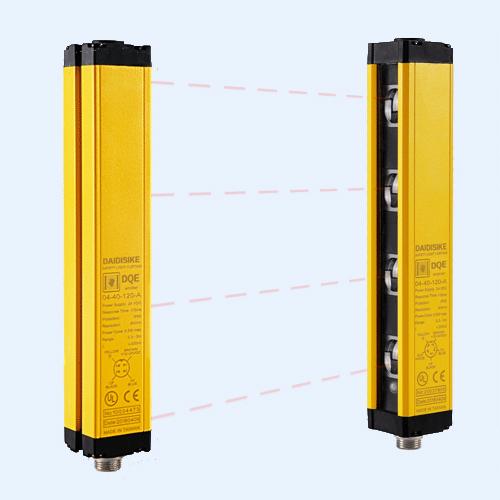
The procurement decision belongs in the safety relay selection and sourcing range. This article keeps the legacy XPS and XUSL references useful while separating the relay purchase from the light-curtain purchase. The light curtain range provides current product choices; neither category listing is an approved replacement matrix.
Start with the installed nameplate, manual revision and safety validation report. Do not transfer Schneider order numbers to DAIDISIKE parts, or treat DA31 and DA31-B as the same ordered variant without evidence. Schneider's XPSAF/XPSAFL migration note lists XPSUAF13AP for XPSAF5130, XPSAF5130P and XPSAFL5130 and includes changed wiring. Check that manufacturer-supported path before comparing a cross-brand design; even a listed successor requires installation review.
What is Preventa, and what are the DAIDISIKE equivalents?
XPS references cover different functions: E-stop or guard monitoring, compatible light-curtain inputs, delayed outputs and configurable controllers. They are not interchangeable. XPSAF5130 is a 24 V AC/DC E-stop module; an AFL curtain application must be checked against that exact manual rather than inferred from the AF name. Preserve the installed order code when gathering replacement evidence.
XUSL includes different safety types and applications: the manufacturer publishes a combined XUSL2E / XUSL4E Type 2 / Type 4 manual. The exact XUSL4E14F046N example has Type 4 classification, 14 mm detection capability, 460 mm protected height and 7.5 ms response. Other heights, hand-detection and multi-beam/muting variants have their own data; do not generalize that timing or range to the family.
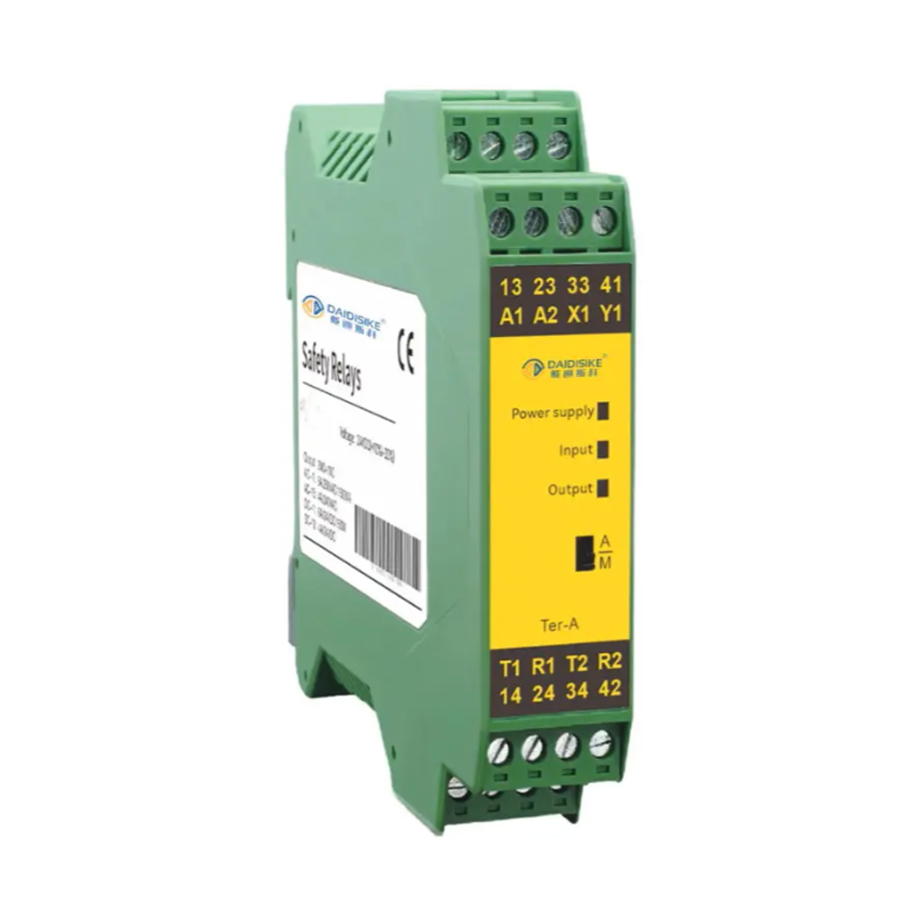
DA31 current factory material describes a 3NO+1NC force-guided relay, under 30 ms release response and a PL e / SIL 3 design target. It does not establish EDM or cross-fault monitoring. DQC / DQA data distinguish beam pitch from detection capability and do not establish a Type 4 classification; some outputs are ordinary transistor or relay contacts, not a proven OSSD pair. DQT4 has a published Type 4 architecture, but its exact detection capability, response time, approved wiring and certificate scope must accompany the ordered variant.
Which Preventa part does what? A family map before you cross-reference
Match the Preventa family to the function first; only then pick the DAIDISIKE part. The Preventa catalogue spans single relays, time-delay relays, two-hand control, configurable controllers, finger/hand/body curtains and a separate XCS interlock line. Here is the honest map of what maps to what — and, just as importantly, what does not.
| Preventa family | What it is | Anchor part numbers | DAIDISIKE answer |
|---|---|---|---|
| XPS-AF / XPS-AFL | E-stop/guard and selected ESPE monitoring variants; distinguish input functions | XPSAF5130, XPSAF5130P, XPSAFL5130 | Check Schneider's documented XPSUAF13AP migration; DA31 compatibility not established |
| XPS-AC / XPS-AK | Exact voltage, input and contact arrangement depend on order code | XPSAC1321, XPSAK351144P (identify installed label) | Review exact manuals; no automatic DA31 match |
| XPS-AT / XPS-AV | Selected configurations include delayed safety outputs | XPSAT / XPSAV: preserve full suffix | No approved DA31 delayed-function replacement established |
| XPSMC / XPSMP | Configurable, multiple-function safety control | XPSMC…, XPSMP… | Controller-class assessment, not one DA31 |
| XUSL4E finger / hand | Type 4 models with model-specific detection and timing | XUSL4E14F046N: 14 mm; 460 mm; 7.5 ms | DQT4 variant review; DQC/DQA not established Type 4 alternatives |
| XUSL4E…BB / XUSL4M | Multi-beam access and selected muting variants | XUSL4E2BB051N; XUSL4E4BB091N; verify muting order code | No automatic DQA/DQC muting equivalent; confirm approved system |
| XCS interlocks | Guard position or locking, not relay evaluation or optical intrusion | XCSDMR / XCSMP / XCSE: exact variant needed | Compare DX models separately; no assumed DA31 connection |
A shared application category is not an equivalence claim. Delayed stopping, multiple zones, muting and guard locking each require their own documented safety functions. DLD LiDAR can support non-safety perception but cannot provide the protective stop of a safety curtain or a Type 3 safety scanner.
DA31 vs Preventa XPSAF5130 — the relay side-by-side
Compare the two exact relay configurations, not their exterior. The table separates published information from facts still needed for a cross-brand proposal. An undocumented function is a selection gap, not an instruction to recreate it with an ordinary PLC or external general-purpose relay.
| Parameter | DAIDISIKE DA31 | Preventa XPSAF5130 |
|---|---|---|
| Safety evidence | Published PL e / SIL 3 design target; request exact evidence | Exact manufacturer's declaration and manual for XPSAF5130 |
| Safety contacts | Published 3 NO + 1 NC; identify safety versus auxiliary use | 3 NO; verify each contact's role and utilization rating |
| Force-guided contacts | Published; not a substitute for whole-function validation | Check exact manual |
| Input channels | Confirm approved devices, wiring and pulse behavior | E-stop input configuration per exact manual; do not infer AFL OSSD function |
| Reset / EDM | Current material shows reset selection; EDM not established | Check supported reset and feedback circuit in exact manual |
| Contact rating | Exact utilization category, load and protection needed | Use manufacturer rating for actual load, not nominal current alone |
| Response time | Published release under 30 ms; confirm conditions | Use exact worst-case release value; no unverified faster claim |
| Supply | Confirm ordered DA31 label and factory drawing | XPSAF5130: 24 V AC/DC |
| Protection / DIN space | Use actual dimensions, clearances and enclosure requirements | Use exact drawing; similar width is not interchangeability |
| Functions | OSSD acceptance and cross-fault capability need written evidence | Do not conflate AF, AFL or other XPS functions |
| Sourcing | Current written quotation, documents and delivery confirmation | Manufacturer-supported successor and authorized sourcing review |
Relay release time matters in E-stop, gate and optical protective functions. Include its worst-case delay in the complete stop analysis; do not call a timing difference immaterial. Also compare pulse-compatible inputs, reset behavior, feedback monitoring, short-circuit detection, utilization category, service conditions and failure behavior. Supply voltage and contact count alone cannot authorize a replacement.
DQC / DQA / DQT4 vs Preventa XUSL — the curtain side-by-side
Compare detection capability before comparing mounting dimensions. The DQA/DQC factory table's 10 mm pitch corresponds to 18 mm detection, so it does not establish a 14 mm finger-curtain replacement. The following table deliberately separates known model data from missing evidence; a safety relay cannot upgrade an unclassified curtain.
| Parameter | DAIDISIKE DQC | DAIDISIKE DQA | DAIDISIKE DQT4 | Preventa XUSL4E (typical) |
|---|---|---|---|---|
| Safety classification | Not established Type 4 from available documentation | Not established Type 4 from available documentation | Published Type 4 architecture; exact evidence required | XUSL4E14F046N: Type 4 |
| Detection capability | 10 mm pitch corresponds to 18 mm detection in factory table | Use factory detection table, not pitch | Confirm actual detection; 7.5 mm pitch is not resolution | 14 mm for XUSL4E14F046N; 30 mm on specified hand models |
| Response time | Published ≤15 ms; exact variant/mode | Published ≤15 ms; exact variant/mode | Use documented maximum for ordered configuration | 7.5 ms for XUSL4E14F046N only |
| Range | Use exact ordered range | Do not infer a 50 m protective range | Use exact manual | XUSL4E14F046N: 0–3 m or 1–6 m by cabling |
| Outputs | Transistor variants; no assumed safety OSSD pair | Transistor or relay variants; identify actual interface | OSSD/feedback capability per exact manual | XUSL4E14F046N: two PNP OSSDs |
| Protection / body | Published IP65; not cleanroom or washdown evidence | Published IP65; confirm ordered enclosure | Exact drawing and environmental rating | Use exact manufacturer's enclosure/dimension data |
| Connector | Factory variant-specific drawing | Factory variant-specific drawing | Factory variant-specific drawing | Exact XUSL connector assignment; no pin transfer |
| Muting / body protection | Not established by standard DQC output | Not established by ordinary multi-beam hardware | Only documented approved configuration | Specific multi-beam/muting models, not all XUSL4E |
Detection plane → validated separation → nearest reachable hazard
- Detection capability d
- Manufacturer's specified detectable object size, not beam pitch.
- Total time T
- Sensor + logic + outputs/final elements + machine stopping time and required allowances.
- Geometry
- Check reaching over, under and around, whole-body access and restart prevention.
How does the EDM / OSSD wiring carry across from Preventa to a DA31?
Transfer requirements, not terminal numbers. An exact XUSL OSSD pair needs a safety input explicitly compatible with its test pulses and fault behavior. Do not equate DQC or DQA transistor contacts with safety OSSDs. Current DA31 material does not establish EDM or cross-fault monitoring; obtain the exact manual or select a controller with the required documented functions. Keep both safety channels separate and do not branch them into ordinary PLC inputs.
Documented safety sensor → compatible safety evaluator → validated final elements
Where the evaluator supports EDM, approved contactor mirror NC contacts are monitored in series as its manual specifies. Reset is a separate, deliberately controlled function. Use a designated auxiliary status output for ordinary PLC diagnostics.
Where do the DX door locks and the DLD LiDAR fit — and where do they not?
Interlock, relay and optical sensor roles must stay separate. Compare DX and XCS guard devices by exact coding, locking behavior, release arrangements, holding force and documented safe interface. A shared guard application does not establish ISO 14119 coding type, PL/SIL or a compatible DA31 connection. Use the guard interlock and locking range as a separate selection task.
DLD-series LiDAR is non-safety perception equipment, not a source of safety OSSDs or a substitute for a protective stop. No approved Preventa scanner replacement is established here. If the task requires a safety scanner, compare that device class separately: ST27 is confirmed Type 3, PL d, SIL 2, but its manual and application validation remain necessary. Do not invent equivalence from scan range.

What to match before you swap any Preventa part for a DAIDISIKE one
Collect the full safety requirements, not only six catalog numbers. Keep the installed drawings and configuration report with the replacement proposal so each changed function can be checked.
- Function: E-stop, guard monitoring, ESPE, delayed stop, muting or multiple independent zones.
- Inputs: exact safe interface, channel independence, pulse compatibility, fault detection and manufacturer-approved connections.
- Outputs: safety versus auxiliary contacts, utilization category, load protection and final elements.
- Supply and fit: exact ordered voltage, dimensions, clearance, environmental limits and terminal drawing.
- Evidence: required PLr/SIL, exact product declaration/certificate scope, reset, EDM where required and validation report.
- Curtain geometry: detection capability, protected height, range, approach paths and access/restart prevention.
- Stopping: total worst-case time, measured machine stopping performance and applicable ISO 13855 separation.
Send the installed nameplate and complete requirements for a documented proposal using the DA31 product information and the exact curtain manual. Do not order on an assumed pairing. The same evidence-first method applies to Pilz PNOZ comparisons and Guardmaster comparisons. Review changed geometry with the ISO 13855 safety-distance guide.
Is naming Schneider, Preventa and the XPS/XUSL part numbers legal?
Brand and model names identify the products being compared; no endorsement or approved interchangeability is implied. Advertising and trademark requirements depend on the market. For example, the EU comparative-advertising directive sets conditions including objective, verifiable and non-misleading comparison; it is not blanket authorization for every claim. Telemecanique Sensors is now part of YAGEO following the 2023 sale. Preserve third-party order codes as references only and obtain appropriate legal review for market-specific advertising.
Sources & specifications cited
- Schneider: XPSAF/XPSAFL replacement and wiring changes (updated May 2026).
- Telemecanique: XUSL4E14F046N datasheet, exact sensor values used here.
- Schneider: completion of Telemecanique Sensors sale, 31 October 2023.
- ISO 13855:2024, positioning of safeguards.
- DAIDISIKE current DA31 and DQT4 product material and DQA/DQC factory instruction table; model-specific gaps remain explicitly identified above.