Keyence & Sick Safety Light Curtain Alternatives: A Buyer’s Guide to Quality Equivalents
Consider a damaged light curtain on a stopped production line. Maintenance needs a replacement, but the urgent question is not only availability: can the proposed unit preserve the validated safety function? Keep the machine secured while its protection is unavailable.
Capture the original part number, controller configuration and wiring before requesting alternatives. Price and lead time should be confirmed in a current quotation, not inferred from a brand or sourcing channel.
A Keyence safety light curtain alternative or SICK replacement candidate can be evaluated, but it is not automatically equivalent. Start with the safety light-curtain range and selection criteria, then request the exact model's documents before engineering approval.
The Factory-Direct Sourcing Model
Factory-direct sourcing changes the purchasing route, not the safety requirements. Compare quotations on the same scope: matched transmitter and receiver, cables, brackets, safety logic, documentation and commissioning responsibilities.
As a Chinese safety sensor manufacturer, DAIDISIKE can receive an application and replacement enquiry directly. Request a written model proposal with evidence for each critical requirement. A lower price or shorter supply chain does not demonstrate equal fault behavior, optical performance or certification.
Head-to-Head: Matching the Specs That Matter
Compare order codes rather than family names. Keyence GL-R, SICK deTec and Omron F3SG contain variants with different detection capabilities, lengths, functions and interfaces. A candidate must satisfy the required safety function and the installation constraints:
- Response time: compare the maximum response in the actual cascade, scan or operating mode. Add safety logic and machine stopping delays and reassess the mounting distance. Sensor response alone never means immediate machine shutdown.
- Detection capability: match the documented detectable object size, not beam pitch. Check effective protective height, end zones, range and reach-over or reach-around access; a 40 mm label is not a universal body-protection specification.
- Safety evidence: request the declaration, applicable test or approval documents and exact model rating. CE marking is not a synonym for Type 4 or a universal third-party certificate. Verify the required Type and PL/SIL independently.
- Environment: compare temperature, vibration, ingress protection and approved cleaning or protective accessories. An IP rating alone does not establish oil, coolant or chemical compatibility.
For an installed GuardShield system, the GuardShield point-of-operation versus perimeter replacement checks first separate fine-resolution protection at the danger point from body-access detection, before comparing a candidate.
Evidence gate: approve, redesign or hold
- Safety rating or interface undocumented: hold the proposed substitution; do not infer equivalence from dimensions.
- Rating documented but timing, functions or geometry differ: assess redesign and recalculate the safety distance.
- Critical requirements matched: proceed to controlled installation and validation, not automatic production release.
The DQC catalogue pageexplicitly leaves Type/PL unpublished and output architecture subject to confirmation. For comparison, consult Keyence GL-R specificationsand the SICK deTec4 Core manualfor their exact product scopes. None establishes a cross-brand approval.
The Dealbreaker: Is it “Plug-and-Play”?
Connector shape is only one compatibility check. A change can affect supply, output pulse evaluation, fault detection, reset timing, external device monitoring and required controller configuration.
Treat drop-in replacement as an engineering conclusion that requires documented evidence, not a product-family claim.
Standardized Connectors and Outputs
Resolve these checks before connecting the new transmitter and receiver. Do not reuse a cable merely because it can be screwed into the housing:
- M12/M8 connectors: compare pin assignment, coding, conductor count, supply, cable length and accessory requirements in both manuals. Replace or adapt cabling only through a documented, approved wiring design.
- Safety outputs: verify the exact approved OSSD or safe communication interface, pulse characteristics and compatible safety input. PNP/NPN transistor polarity alone is not proof of OSSD. An ordinary PLC input is not a protective-stop evaluator; use a separate diagnostic output for ordinary PLC status.
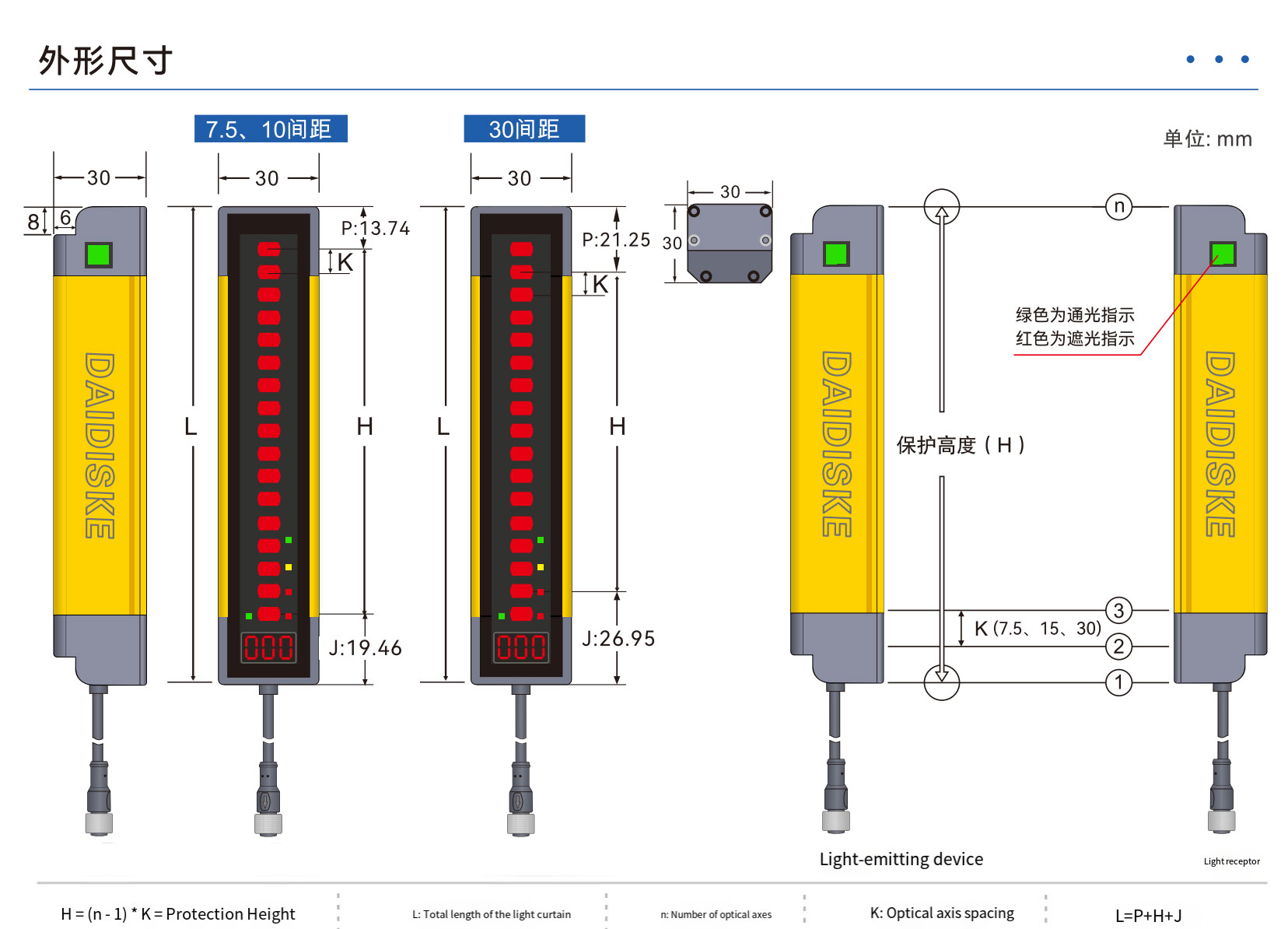
- Mounting: check bracket dimensions, secure fixing, optical axis and effective field position. A similar housing can shift the detection plane or create an access gap.
Discontinued equipment also needs the original manufacturer's migration constraints. The Panasonic SF-series replacement review shows why an official successor can still require a complete assembly change, and why a family label is not an approved cross-reference.
Stop Waiting. Start Running.
Restore production only after the replacement design has been reviewed and validated. Include detection checks, required stop and restart behavior, fault response and stopping-distance verification. Record who is responsible for approval and for updating the machine file.
If you have a failed sensor, send the replacement enquiry to DAIDISIKE. We can review a candidate and identify missing documents; this is not a promise of immediate compatibility, certification or delivery.
Content updated: 2026-09-06.