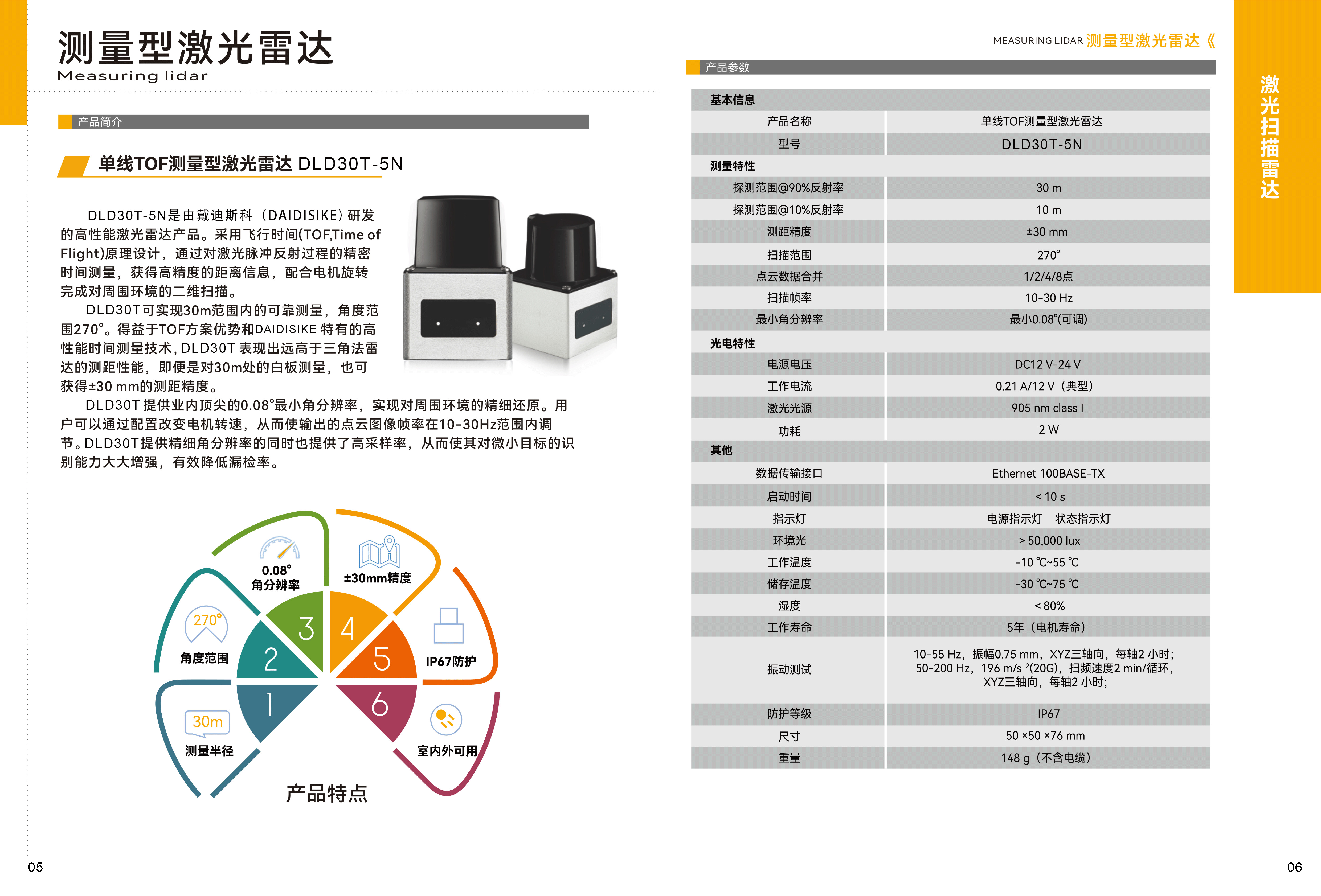
Range correction: DLD30T-5N is rated 30 m at 90% remission and 10 m at 10% remission, not 40 m. The historical URL is retained. The first image is the original factory parameter sheet, not a new product photograph; the remaining scene images are illustrative and do not demonstrate personnel-protective safety.
The DLD30T-5N is an economical, industrial-grade obstacle avoidance LiDAR with a maximum scanning frequency of 30Hz. It can be applied in industrial automation, perimeter security and other scenarios.
The DLD30T-5N is an economical industrial laser ranging sensor designed for precise, non-contact distance measurement in demanding environments. It features an adjustable 10–30Hz scan rate, IP67 sealing against water and dust, and a 905nm Class 1 eye-safe laser. The factory parameter table rates detection at 30m on 90%-remission targets and 10m on 10%-remission targets, with ±30mm ranging accuracy across a 270° scan. Measurement data is transmitted over a 100BASE-TX Ethernet interface, so it connects directly to industrial PCs and navigation controllers.
Product Introduction
The DLD30T-5N series industrial laser ranging sensor offers a cost-effective solution for high-precision distance measurement. Its motor speed is configurable so the point-cloud frame rate can be set anywhere between 10Hz and 30Hz, with a minimum angular resolution of 0.08° and selectable 1/2/4/8-point cloud data merging. Key features include a compact design (50 × 50 × 76mm), lightweight construction (148g), an operating temperature range of −10°C to +55°C (storage −30°C to +75°C), humidity below 80%, and strong ambient light resistance (above 50,000 lux). It runs from a DC12–24V supply at 2W (0.21A at 12V typical), starts up in under 10 seconds and uses a 905nm laser. This sensor is ideal for industrial automation, robotics, AGV/AMR systems, gate controls, and parking facilities, ensuring accurate ranging even in challenging conditions like varying reflectivity or daylight exposure.
The DLD30T-5N is a measurement/perception LiDAR, not an IEC 61496 certified safety component; do not use it as a personnel-protective safety device. No Type, SIL or PL rating is published for this model. Compare the LiDAR model groups and safety-versus-perception boundary before selecting a device.
Product Application Scenarios
Industrial Automation: Used for precise positioning, object detection, and process monitoring in manufacturing lines.
Robotics: Enables robots to measure distances for navigation, obstacle avoidance, and manipulation tasks.
AGV/AMR Systems: Supports autonomous guided vehicles and mobile robots in warehouses for path planning and collision prevention.
Gate Systems: Applied in access control barriers, such as toll gates or security gates, for vehicle or object detection.
Parking Garages: Facilitates level monitoring, vehicle positioning, and space management in multi-level parking structures.
Product Working Principle
The DLD30T-5N operates on the Time-of-Flight (ToF) laser ranging principle. It emits a pulsed laser beam (905nm wavelength, Class 1 safe) toward the target. The sensor measures the time it takes for the light to reflect back from the target and return to the receiver. Distance is calculated using the formula: Distance = (Speed of Light × Time of Flight) / 2. Because the returned signal strength depends on the target surface, range is rated per remission: 30m on 90%-remission targets and 10m on 10%-remission targets. The original table lists ±30mm ranging accuracy; validate the actual target and operating conditions rather than inferring remission from colour or superiority to another measuring principle. Rotating the module sweeps a 270° plane, and every scan point (distance plus angle) is streamed over the 100BASE-TX Ethernet interface, so navigation, SLAM and mapping software receives raw point-cloud data rather than pre-processed switching signals.
Frequently Asked Questions
What is the maximum detection range of the DLD30T-5N LiDAR?
The factory parameter table rates the DLD30T-5N at 30 m on targets of 90% remission (reflectivity) and 10 m on targets of 10% remission. The former 40 m claim is incorrect. Select for the actual target size, remission, angle and operating environment; do not infer a fixed remission value from an object's colour or material alone. The table lists ±30 mm ranging accuracy and a 270° scan.
Is the DLD30T-5N a safety-rated laser scanner under IEC 61496-3?
No. DLD30T-5N is a measurement/perception LiDAR, not a certified IEC 61496-3 Type 3 safety scanner; no Type, SIL or PL rating is published for this model. Its 905 nm Class 1 laser classification does not establish functional safety. Personnel protection requires an appropriate safety-rated device and a validated complete safety function, including field sizing under the applicable machine or vehicle requirements.
What angular resolution and scan rate does the DLD30T-5N offer?
The factory table specifies a minimum adjustable angular resolution of 0.08°, an adjustable scan rate of 10–30 Hz and selectable merging of 1/2/4/8 points. These figures alone do not guarantee detection of a particular post, shelf leg or person at a given distance. Confirm permitted setting combinations and test actual target size, remission, geometry and motion; this remains ordinary measurement, not personnel protection.
What output and communication interfaces does the DLD30T-5N provide?
The DLD30T-5N transmits measurement data — distance and angle for every scan point — over a 100BASE-TX Ethernet interface, so it feeds navigation, SLAM and mapping software directly rather than driving switch contacts. Start-up time is under 10 s. If your control system needs plain switching outputs instead of point-cloud data, the DLD05A3 (5 m) and DLD20A5 (20 m) NPN/PNP series are the correct choice.
Can the DLD30T-5N work outdoors and as a SICK or Pilz scanner alternative?
The factory table lists IP67, ambient-light resistance above 50,000 lux, an operating range of −10 °C to +55 °C, storage −30 °C to +75 °C and humidity below 80%. These specifications do not establish all-weather detection, pressure-wash suitability or immunity to rain, fog, glare and dirty optics. Assess the actual environment and target. Compare DLD30T only for ordinary measurement/perception duties; it is not a substitute for a safety-rated SICK or Pilz scanner where personnel protection is required.