
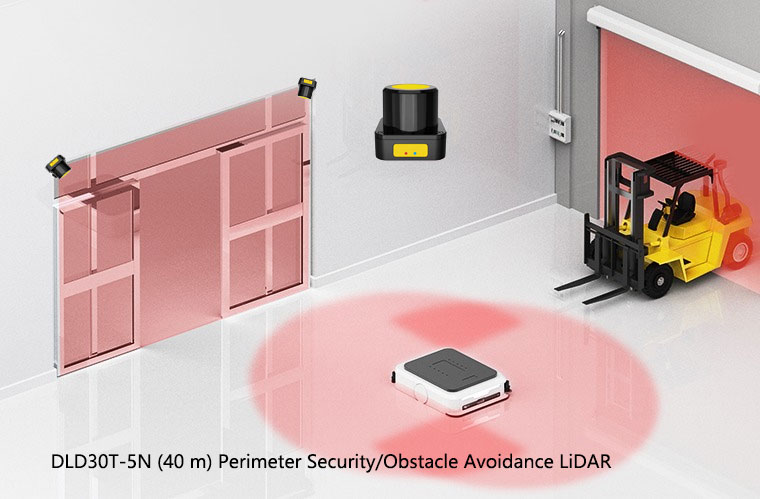
LiDAR has become one of the most marketed terms in factory automation, and that is exactly why buyers get burned. The word covers everything from a cheap mapping sensor to a certified protective device, and the datasheets do not always make the difference obvious. So before any discussion of range or fields, start with the question that actually matters.
The decision that comes first: safety or navigation
There are two fundamentally different classes of industrial LiDAR, and confusing them is the costliest mistake in this category.
A safety laser scanner is a certified protective device. It is built and type-tested to IEC 61496-3, it provides a documented safety interface, commonly redundant OSSD outputs, and it is designed, documented and rated to stop a machine before a person is injured. It can be part of a safety function with a defined Performance Level or SIL.
Read the IEC 61496-3 safety-rating requirements when checking the certificate and manual. The device rating does not certify the complete vehicle or machine installation.
A navigation-only LiDAR is a sensing device. It maps, it localises (SLAM), it gives a vehicle general obstacle awareness. It is genuinely useful and often very accurate — but it is not evidence of a safety-rated function, and it must never be the layer you rely on to keep people safe without documented safety capability. The hard rule: navigation data may help a vehicle drive; personnel protection needs a documented safety function and its validated output path. Some safety-rated scanners also supply non-safety navigation data. An AGV can carry both types of device — navigation LiDAR for the route, a safety scanner for the protective field — and on a well-designed vehicle it does. What it cannot do is let the navigation sensor stand in for the safety one.
Protective fields and warning fields
In a typical horizontal installation, a 2D safety laser scanner monitors a zone near the floor. Its field layout depends on the model and the application; protective and warning fields are often nested, but need not share one universal shape:
- The protective field is the safety-critical zone. An intrusion meeting the specified detection capability and operating limits initiates the safety reaction through the documented interface and stop chain.
- A warning field, where supported, is often a larger outer zone. An intrusion there triggers a non-safety reaction first — slow down, sound a horn, flash a light — before a hard stop is needed.
Catching an approach in the warning field and easing off, instead of waiting for a protective-field hard stop, is what keeps an AGV or a cell productive rather than constantly slamming to a halt. A capable scanner supports multiple field sets that switch with the situation — for example a longer protective field when an AGV drives fast and a shorter one when it slows or turns.
Do not rely on the warning-field slowdown to justify a smaller protective field. Any speed-dependent reduction must use a validated safety-related speed and field-selection function, including its switching delays and fault response.
Choosing the range
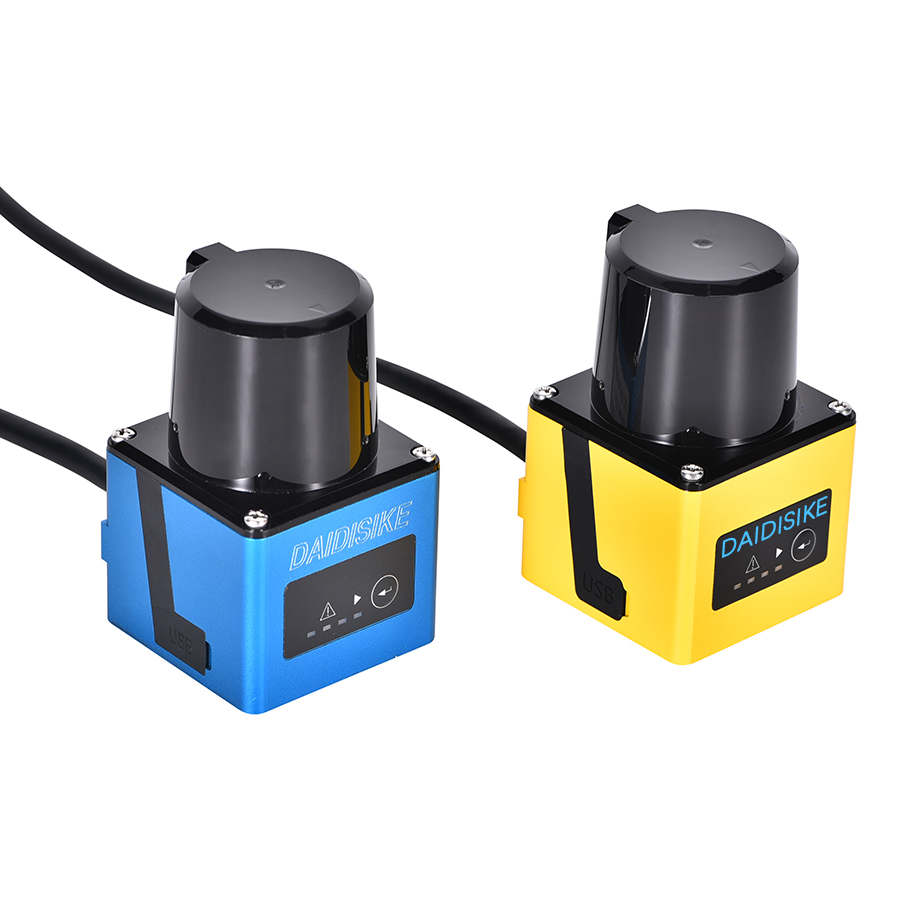
Range should follow the application, not ambition. For a certified safety scanner, the documented protective field must cover the validated stopping distance and required allowances. For a DLD-series perception LiDAR, choose enough working range for obstacle detection, mapping or perimeter monitoring; that range is not a safety rating.
| Range class | Typical use | DAIDISIKE example |
|---|---|---|
| ~5 m | Compact AGV obstacle avoidance, tight aisles | DLD05A3 |
| ~14 m | AGV obstacle awareness and ordinary area monitoring | SDLD-05A TOF scanner |
| ~20 m | Longer-look AMR obstacle detection and larger monitoring areas | DLD20A5 |
| 30 m at 90% remission / 10 m at 10% remission | Fixed perimeter security, vehicle lanes, boundaries | DLD30T-5N perimeter LiDAR |
For a model-level decision using verified DLD specifications, see the DLD05A3 and DLD20A5 range comparison.
The other specs that matter
- Scan angle — the angular field of view, often around 270°. It must cover every direction a hazard can come from for that mounting position.
- Response time — how quickly an intrusion becomes a stop command. It feeds directly into the safety distance, the same way light-curtain response time does.
- Detection capability — the smallest object, and the lowest-reflectivity object, the scanner is guaranteed to detect. A leg in dark trousers is a harder target than a bright test piece.
- IP rating and environment — an indoor obstacle-avoidance scanner and an outdoor perimeter scanner are different product classes. Match the rating to where the unit will actually live, including rain, fog and dust tolerance.
- Interfaces and field switching — OSSD safety outputs or certified safety communication for the protective function, with compatible safety-related field-selection inputs where required. Ordinary Ethernet data does not establish a safe interface.
A selection brief to send with your enquiry
| Decision | Information to provide | Evidence to request |
|---|---|---|
| Safety or perception | People exposed to hazards, or navigation/object detection only | Exact model certificate and safety manual for a protective function |
| Range and coverage | Vehicle/cell footprint, approach paths, load overhang and blind zones | Protective-field limit separately from warning/detection range |
| Stopping and switching | Worst-case measured stop, speed/direction states and controller interface | Configured response time, selection delays and integration requirements |
| Targets and environment | Smallest relevant target, reflectivity, temperature, condensation and ambient light | Documented detection and environmental limits; approved accessories |
| Handover | Installation layout, responsible integrator and acceptance criteria | Configuration record, validation results and maintenance instructions |
If the route crosses a freezer doorway, use the dedicated cold-storage AMR scanning and condensation checklist before accepting an operating-temperature claim. A storage-temperature rating or an added heater alone does not prove suitability for cold-room safety use.
Scanner or light curtain?
A last point, because the two devices are often weighed against each other. They guard different shapes. A safety light curtain guards a plane — a defined opening someone passes through. A laser scanner guards an area — a floor zone, open access, moving vehicles. A machine with a clear access opening usually wants a light curtain; an open-footprint cell or a mobile robot wants a scanner; many installations use both. Decide by the shape of the space and every route a person can take to the hazard — not by which technology is newer.
Choose the class first, the range to the stopping distance second, the fields and environment rating third. Do it in that order and an industrial LiDAR scanner is a straightforward, reliable purchase — do it backwards, starting from a range number, and you risk either wasted budget or, far worse, a machine that is not actually safe.