
AGV & AMR Obstacle Avoidance: Which Safety LiDAR Scanner Range to Choose (5m vs 20m)
AGV and AMR integrators have to match obstacle-detection range to route geometry, payload, target conditions and the vehicle's measured response and braking performance. A larger range can give the controller earlier information, but range alone does not create a safety-rated stop.
A bumper reacts only after contact, while a 2D LiDAR can report an obstacle before contact and support warning or slow-down logic. The DLD series is designed for this industrial detection role. Its standard NPN/PNP switching outputs are not dual OSSD outputs, so the DLD must not be used as the personnel-protection device in a safety-related stop function.
This guide compares DLD05A3 and DLD20A5 within the DAIDISIKE industrial obstacle-avoidance LiDAR range. It focuses on the verified 0.05–5 m and 0.05–20 m working ranges, scan settings, zone groups and controller interfaces, while keeping obstacle avoidance separate from certified personnel protection.
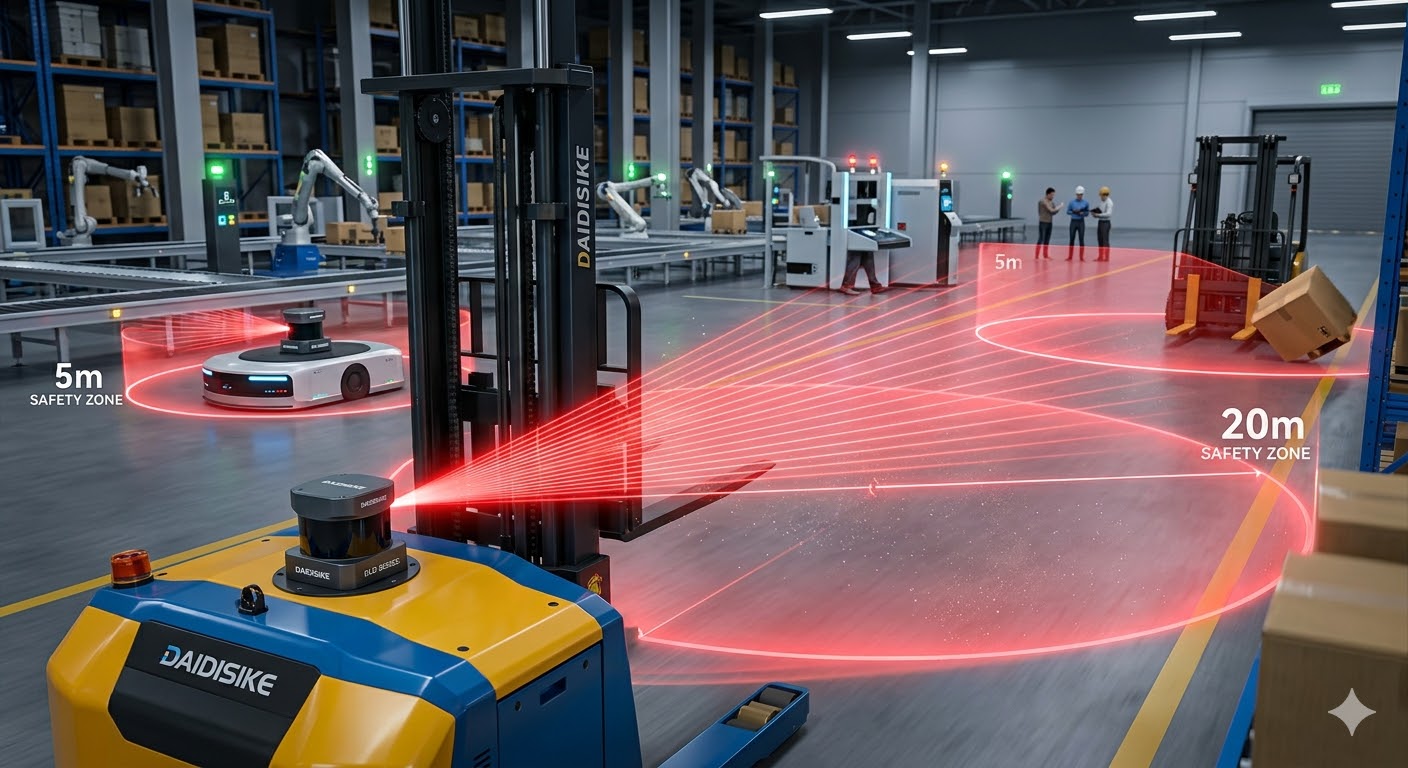
Range Matters: More Than Just a Specification
For anyone picking an AGV obstacle avoidance sensor, range is only one selection input. The useful detection distance must also account for scan frequency, controller processing, communication, mechanical braking, target reflectivity, mounting position and the vehicle's route.
A practical engineering check considers the complete response chain:
Sensor response + communication and controller processing + braking delay + measured mechanical stopping distance.. The result must be validated on the real vehicle under the intended payload, floor and operating conditions.
Higher payloads and lower-friction floors can extend stopping distance, while tight aisles can make an unnecessarily large zone impractical. DAIDISIKE therefore offers 5 m and 20 m DLD models with standard NPN or PNP versions for different controller input circuits.
DLD05A3: 0.05–5 m for Compact Routes
The DLD05A3 has a verified working range of 0.05–5 m. Consider it when the route and verified system response fit within a compact detection area, for example:
- Tight Spaces: Perfect for compact AMRs and service robots navigating hospital corridors, restaurants, or narrow warehouse aisles where a large scanning range would constantly be pinging off walls and causing unnecessary stops.
- Compact Routes: Applications where the measured stopping performance, target conditions and operating layout have been checked against the available 5 m working range.
- Configurable Zone Monitoring: Sixteen stored zone groups, each with three zones, can support route-specific warning and obstacle-detection logic.
DLD20A5: 0.05–20 m for Longer Routes
The DLD20A5 extends the verified working range to 0.05–20 m. It can provide earlier obstacle information across longer routes, but the 20 m figure is a detection range, not a certified personnel-protection field. Typical use cases include:
- Larger or Faster Mobile Platforms: Use the longer range only after the complete detection, control and braking response has been measured and validated.
- Long Corridor Clarity: This range lets an AMR detect route obstacles earlier, giving the standard controller more time to apply the configured warning or slow-down response.
- Area & Perimeter Detection: The longer working range can also support non-safety monitoring around equipment or across indoor industrial areas.
DLD05A3 vs DLD20A5: 5 m / 20 m Selection Table
| Model | Working range | Scan angle | Scan frequency | Angular resolution | Measurement error | Zone storage | Output versions | Protection rating | Safety-rated personnel protection |
|---|---|---|---|---|---|---|---|---|---|
| DLD05A3 | 0.05–5 m | 270° | 15 / 30 Hz | 0.1° / 0.3° | ±30 mm | 16 groups × 3 zones | NPN or PNP versions | IP65 | No |
| DLD20A5 | 0.05–20 m | 270° | 15 / 30 Hz | 0.1° / 0.3° | ±30 mm | 16 groups × 3 zones | NPN or PNP versions | IP65 | No |
At the typical setting, response time is about 66 ms at 30 Hz and about 134 ms at 15 Hz; longer adjustable settings are also available. For a deployment example that separates standard navigation warning zones from a certified protective stop, see the two-layer AGV/AMR LiDAR integration case.
Choosing NPN or PNP Outputs
DLD05A3-3N and DLD20A5-5N provide standard NPN sinking outputs; DLD05A3-3P and DLD20A5-5P provide standard PNP sourcing outputs. Select the version that matches the input common and wiring rules of the AGV/AMR controller.
Built for the Factory Floor, Not a Laboratory
Any engineer knows an optical sensor is only as good as its ability to ignore “noise.” In a real-world factory, cheap LiDARs fail constantly. The DAIDISIKE DLD series is engineered to stand up to the typical real-world conditions that knock lesser sensors offline:
| Environmental Challenge | The DAIDISIKE Solution |
|---|---|
| Ambient Sunlight (Lux) | The published ambient-light resistance is greater than 15,000 lux. Verify detection stability with the actual target reflectivity, mounting angle and lighting at the site. |
| Airborne Dust & Particles | The housing is rated IP65. Keep the optical window clean and validate performance in the real dust, smoke or condensation conditions; IP65 does not guarantee visibility through airborne contamination. |
| Crosstalk (Other AGVs) | When several scanners share an aisle, test the planned mounting positions and crossing routes as a fleet. No crosstalk-immunity claim should replace an application test. |
Secure Your Fleet’s Future with DAIDISIKE
Designing a reliable obstacle avoidance system doesn't have to drive up your Bill of Materials (BOM). Factory-direct sourcing eliminates multi-tier distribution margins on imported sensors. Instead of just buying a specification, focus on the application: use the 5 m DLD05A3 where a compact working range fits and the 20 m DLD20A5 where earlier, longer-range obstacle information is needed. Match the NPN or PNP version to the controller, then verify zone logic and vehicle response under real operating conditions.
Are you an AGV manufacturer or a factory automation integrator looking to genuinely upgrade your mobile robot's “eyes”? Contact DAIDISIKE today. Our engineering team can help you select the working range and configure obstacle-detection zone groups, or specify ST27 when the application requires a Type 3, PL d / SIL 2 personnel-protection scanner.