
ST27 Safety Laser Scanner — Type 3 ESPE for AGV & Machine Guarding
A safety-rated scanning LiDAR (AOPDDR per IEC 61496-3) that stops the machine when a person enters the hazardous area — wired straight into your safety relay or safety PLC through PNP OSSD outputs.
- Type 3 (IEC 61496-1) · SIL 2 (IEC 61508) · Cat. 3 / PL d (ISO 13849)
- 3 m or 5 m protective field, specified at worst-case 1.8% remission
- 276° panoramic scan, 0.1° resolution, 30 Hz
- Six variants: OSSD, OSSD + Ethernet, or Profinet
- Only 405 g and 80 mm square — built for mobile platforms
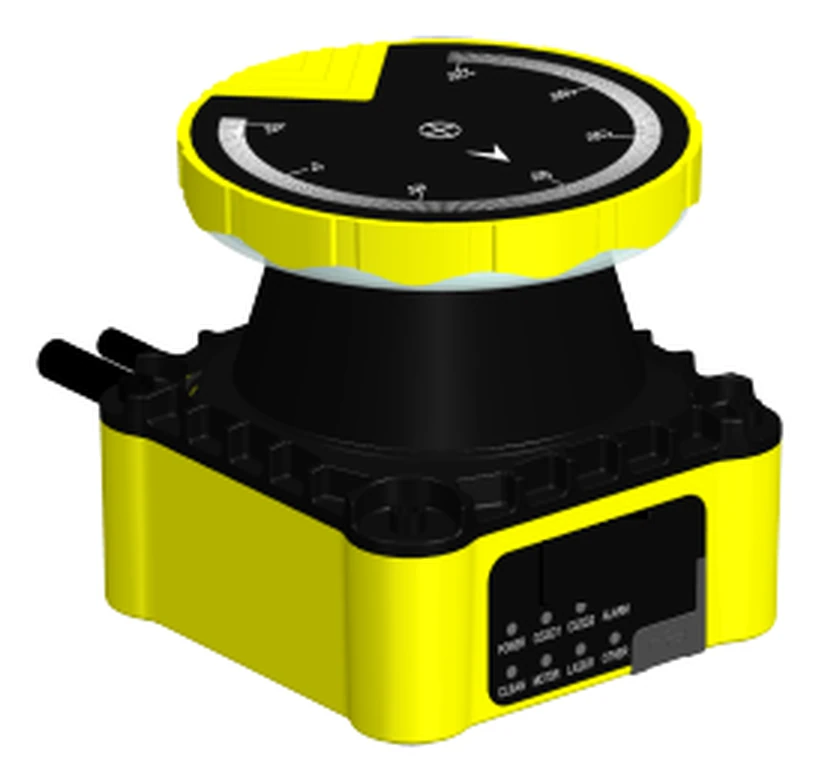
A Protective Device, Not Just a LiDAR
Most scanning LiDARs measure. The ST27 protects: it is electro-sensitive protective equipment of the AOPDDR class defined by IEC 61496-3, rated Type 3, SIL 2 and Category 3 / Performance Level d. When anything enters the configured protective field, the PNP OSSD safety outputs switch off within the configured 100 ms response time — a signal your safety relay or safety PLC can legally act on as part of a machine safety function. A measuring LiDAR, whatever its range, carries no Type, SIL or PL rating and cannot take that role.
The numbers are quoted the way a safety engineer needs them. The 3 m and 5 m protective fields are specified at 1.8% remission — the worst case, standing in for deep black work clothing — so the figure you feed into ISO 13855 is the honest one. The longer warning field (10 / 20 m at 10%) and measuring range (40 / 60 m at 70%) are published separately and carry no safety function, so there is never ambiguity about which distance protects a person.
For integrators, the practical wins are physical: at 405 g in an 80 × 80 × 79.5 mm cube drawing under 4 W, the ST27 fits the payload, footprint and battery budget of compact AGV bases where bulkier scanners will not — while still sweeping 276° of the plane at 0.1° angular resolution.
Three Fields, Three Jobs
Original DAIDISIKE schematic: the OSSD stop belongs exclusively to the inner protective field; the warning field buys you throughput, and the measuring range is data.
Choosing Among the Six Variants
| Model | Protective / Warning / Measuring | Interface | Pick it when… |
|---|---|---|---|
| ST27-03S | 3 m @1.8% / 10 m @10% / 40 m @70% | PNP OSSD | Hardwired stop into a safety relay, no network data needed |
| ST27-03D | PNP OSSD + Ethernet | Same stop signal, plus field status & diagnostics over Ethernet | |
| ST27-03P | Profinet | The scanner should appear as a station on a Profinet line | |
| ST27-05S | 5 m @1.8% / 20 m @10% / 60 m @70% | PNP OSSD | Longer safety distance, direct OSSD wiring |
| ST27-05D | PNP OSSD + Ethernet | Fleet AGVs where commissioning data matters | |
| ST27-05P | Profinet | 5 m field on a Profinet architecture |
Start from the safety distance your ISO 13855 calculation demands — not from the largest number on the page. If S exceeds 5 m, tell us; the correct answer may be a different safeguarding concept rather than a bigger scanner. Default accessories: ST-BZM12-1M power cable, ST-RJ45YCX-1M network cable (D models), L-bracket 116 × 93 × 90 mm on request.
Engineering Data
| Safety classification | Type 3 (IEC 61496-1) · SIL 2 (IEC 61508) · Cat. 3 / PL d (ISO 13849) — AOPDDR per IEC 61496-3 |
|---|---|
| Scan angle / resolution / rate | 276° · 0.1° · 30 Hz |
| Response time | 100 ms (configurable) |
| Object resolution | 70 mm at maximum protective-field radius |
| Distance deviation / repeatability | ±2 cm · ±4 mm @1σ |
| Safety-calculation constants | Extension distance ZR = 350 mm · Tolerance zone TZ = 65 mm |
| Safety output (OSSD) | PNP, ON: max 100 mA, VOUT ≥ VCC − 2 V; OFF: < 1 mA; overcurrent protected. Auxiliary PNP output with same ratings |
| Field configuration | 6 static input sets (12 pcs) · 4 dynamic sets (8 pcs) · 4 contour-detection fields · up to 64 static / 256 monitoring field sets |
| Laser | 905 nm, Class 1 (IEC 60825-1:2014) |
| Supply / consumption / start-up | 24 V DC ±20% · < 4 W no load · 10 s typical power-up |
| Mechanical | 80 × 80 × 79.5 mm · 405 g · yellow housing · IP65 |
| Environment | −10 °C to +50 °C operating (window free of frost/misting) · 35–95% RH · 3000 lux ambient (incandescent) · vibration/shock 5M1 per IEC 60721-3-5 |
| EMC / design standards | EN 61326-1:2013, EN 61000-4 series · IEC 61496-1:2020, IEC 61496-3:2019, UL 61496-1:2021, IEC 61508:2020, IEC 62061, ISO 13855 |
Figures not published by the factory (PFHd, TM service life, OSSD response-time option list) are deliberately absent — ask us and we will confirm in writing rather than guess. Contamination of the optics window is the leading field-failure cause; the ST27 carries a window-contamination indicator, and any configuration change requires the acceptance test to be repeated.
Where It Earns Its Keep
AGV / AMR Travel Paths
Speed-linked protective fields sized per ISO 13855 with braking distance, 350 mm reflector allowance and vehicle overhang included.
Robot & Machine Cells
One corner-mounted 276° scanner replaces fencing runs and multiple curtains for horizontal hazardous-area guarding.
Cell Access Openings
Vertical protective plane across an entrance, with contour-detection fields watching a fixed reference to catch misalignment.
Warn-Then-Stop Zones
Outer warning field slows the machine or sounds a horn; the OSSD stop only fires on the inner protective field — fewer nuisance stops.
Engineer & Buyer FAQ
Which ST27 model code do I order — how do the six versions differ?
Read the code as ST27-0X-Y. The middle digits set the protective-field radius: 03 = 3 m and 05 = 5 m, both specified at 1.8% remission. The last letter sets the interface: S = PNP OSSD only, D = PNP OSSD plus an Ethernet port for diagnostics and configuration, P = Profinet. Range and interface combine freely, and all six variants share the identical 80 × 80 × 79.5 mm IP65 housing, 405 g weight and 24 V DC supply, so changing variant never forces a new bracket or cabinet layout.
Why does the ST27 datasheet quote three different distances (5 m / 20 m / 60 m)?
Because they describe three different jobs. Only the protective field (3 m or 5 m, measured at the worst-case 1.8% remission — roughly deep black clothing) may be used in the ISO 13855 safety-distance calculation. The warning field (10 m or 20 m at 10% remission) is for slow-down or alarm signals, and the measuring range (40 m or 60 m at 70% remission) is plain distance data. Sizing a protective field from the 20 m or 60 m figures is a design error.
What goes into the safety-distance calculation for a horizontal ST27 field?
Use S = K × T + C + ZR + TZ per ISO 13855, with K = 1600 mm/s, T = the 100 ms scanner response time plus your machine stopping time, C = 1200 − 0.4 × H (floor 850 mm, H = scan-plane height), ZR = 350 mm whenever a retro-reflector sits within 6 m of the field, and TZ = 65 mm tolerance zone. The manual's worked case (H = 300 mm, stopping time 200 ms) lands at 1975 mm, inside a 3 m field. The final safety distance remains the integrator's responsibility and must be verified by a qualified safety engineer.
Is the ST27 suitable for finger or hand detection at a point of operation?
No. Its object resolution is a fixed 70 mm at the maximum protective-field radius — a leg-and-body detection capability. Point-of-operation guarding that must catch a hand (30 mm) or finger (14 mm) belongs to a safety light curtain such as our DQC or DQA series. We would rather tell you this before you order than after your risk assessment fails.
How does dynamic field switching work on an AGV?
The ST27 stores up to 64 static field sets and 256 monitoring field sets, driven by 6 sets (12 pcs) of static and 4 sets (8 pcs) of dynamic input configuration. Your vehicle controller selects a long protective field for straight-line speed and a short one for turning or docking, with a switching delay under 50 ms. The selection signal must come from a trustworthy source such as a safe encoder or safety PLC — a wrong field at high speed silently destroys the safety distance.
What certification paperwork can you provide for the ST27?
Send us the exact model code and your target market through the inquiry form and we will supply the certification documentation that exists for that designation — we state the design and test basis (IEC 61496-1:2020 / 61496-3:2019, IEC 61508:2020, ISO 13855, IEC 60825-1:2014, EN 61326-1 EMC series) and we do not make claims we cannot document. For EU machine builds, raise the EU-Type Examination question with us in writing before you freeze the design.
What are the MOQ, lead time and OEM options for the ST27?
MOQ is 1 set, so you can qualify a single sample before fleet rollout. Typical lead time is 3–15 days depending on variant and quantity; Profinet (P) versions can take longer, which we confirm in writing with the quotation. OEM/ODM cooperation (labelling, cable length, bracket kits with the ST-BZM12 / ST-RJ45YCX accessories) is available for volume programs — factory-direct from China with export documentation.
Safety Light Curtain — Customer Cases
Real installations from DAIDISIKE clients. Click any case to view in full. Filter by scenario to quickly find a similar setup.