
IP69K-Class Washdown Safety Light Curtains for Food, Dairy and Beverage Processing — An Engineering and Hygienic-Design Guide
Content updated:
Choose a food-line light curtain against the actual cleaning exposure and machine risk assessment. IP67/IP68 immersion and IP69/IP69K hot-jet tests are different; none establishes chemical compatibility, hygienic cleanability or a safety performance level. DQR is catalogued as IP68, not verified here as IP69K or food-contact approved. Obtain exact-model test conditions, materials and installation limits before selection.
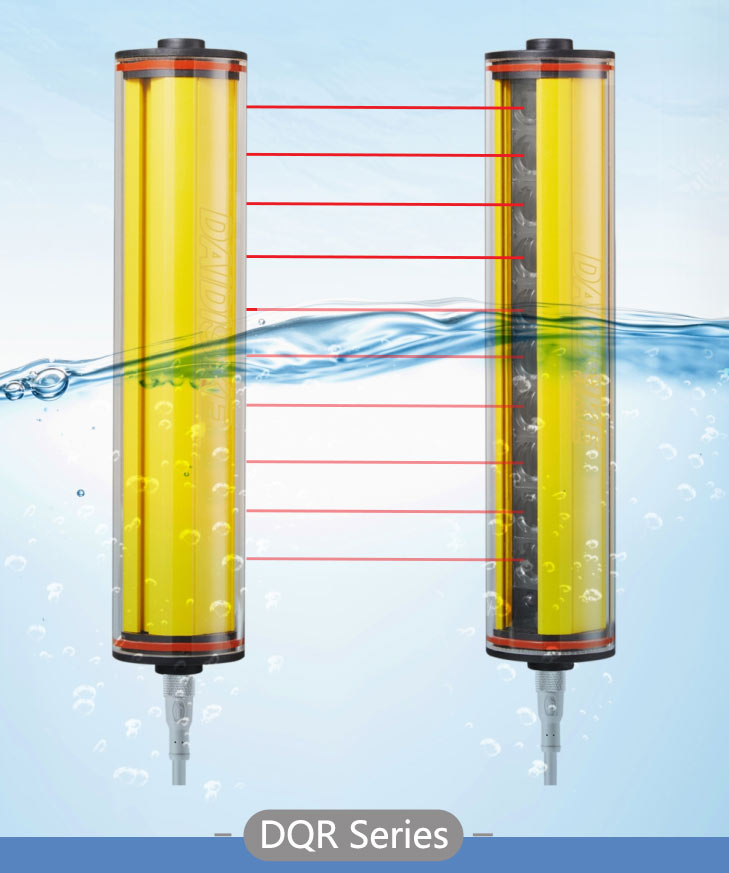
Food-line sensors may encounter product residue, cleaning chemicals, water jets and thermal cycling. A trip after cleaning warrants investigation of the optical window, alignment, wiring, connectors and seals; timing alone does not prove ingress. Keep the machine in a safe state while checking the manufacturer's diagnostic procedure, and do not bypass the protective function to keep production running.
This guide connects food-line cleaning requirements with the safety light curtain selection range. It covers enclosure tests, compatibility evidence, cleanable mounting and distinct meat, dairy, beverage and frozen-food applications. Selection requires both documented functional-safety suitability and environmental suitability; one does not prove the other.
1. The IP65 / IP67 / IP68 / IP69K hierarchy — what each test actually does
The IP code under IEC 60529 has two digits. The first is protection against solids (0 to 6, with 6 being dust-tight). The second is protection against water (0 to 9). The confusing part is that the water digits are not a strict hierarchy — they describe different tests, not increasing severity. A device tested to IP67 (immersion) is not automatically protected against IP69K (high-pressure spray). Specify each exposure that actually occurs; do not infer one water test from another.
| Code | What it tests | Typical food-industry use |
|---|---|---|
| IP65 | Water-jet enclosure test under specified conditions; not a hot-pressure cleaning or chemistry test. | Dry zones, packaging downstream of the wash area, control panels with internal sensors. |
| IP67 | Temporary immersion under the depth and duration conditions specified in IEC 60529. | Use only where the actual exposure also meets the manufacturer's stated limits; immersion alone does not qualify jets or cleaners. |
| IP68 | Continuous immersion at conditions agreed between manufacturer and user (typically deeper or longer than IP67). | An immersion requirement where the stated depth/duration is relevant; separately verify foam, spray and cleaning chemistry. |
| IP69K | Specified high-pressure, high-temperature water-jet test under ISO 20653; IEC 60529 uses IP69. Check the cited test standard and edition. | Candidate enclosure evidence for direct hot-pressure washdown, subject to actual nozzle distance, temperature, pressure, chemistry and installed connector conditions. |
Two practical points get missed:
- IP69K does not establish IP68 immersion performance. Request separate ratings when both exposures occur; match the report to the complete installed assembly.
- Ingress testing is not a service-life promise. Chemical compatibility, seal ageing, cable connections and repeated cleaning require their own evidence and inspection plan.
2. The cleaning-chemistry reality — evidence for the complete wash cycle
Record the plant's approved cleaning programme before specifying exposed equipment. A process-internal CIP cycle is not automatically the exposure at a nearby safety sensor; survey splash, foam and external washdown separately. The following list is a procurement-input checklist, not a cleaning recipe:
- Pre-rinse: record water temperature, pressure, nozzle distance and exposed surfaces.
- Alkaline cleaning: record the named product, working concentration, contact time and temperature from the plant's approved programme.
- Intermediate rinse: record drainage and potential retained chemicals at connectors or brackets.
- Acid cleaning, where used: identify the exact cleaner and material restrictions rather than assuming all acid cleaners behave alike.
- Final rinse: identify immersion or pooling that requires a separate enclosure assessment.
- Sanitisation: obtain the approved disinfectant and compatibility data. Follow its label and the food-safety team's validated process.
Meat, dairy and beverage plants use different cleaning programmes and may have different exposure zones on the same line. Give the sensor supplier the complete programme, including cleaner identity and repeated temperature changes. Do not substitute a generic concentration or an IP number for a written compatibility check.
The materials decisions that follow from this:
| Component | Evidence to request | Failure mode to evaluate |
|---|---|---|
| Housing body | Exact alloy, surface finish and cleaning-compatibility statement | Corrosion or coating loss under the specified cleaner and exposure. |
| Front window | Exact transparent material/coating and approved cleaning agents | Crazing, clouding, stress cracking and reduced optical performance. |
| Housing gasket | Exact elastomer compound and compatibility data for the complete cleaning cycle | Swelling, hardening, compression-set change or loss of sealing; a polymer family name is not approval. |
| End-cap seal | Documented seal design, replacement interval and service procedure | Chemical and thermal-cycle degradation; no generic lifetime follows from the retention method. |
| Connector | Specified mating connector, seal, torque and installed ingress rating | Ingress at an incorrectly matched, damaged or improperly tightened connection. |
| Cable | Exact cable-jacket compound, chemical/temperature limits and any relevant contact declaration | Jacket damage, strain at bends and contamination traps along the routing. |
For DQR, request the exact supplied housing, window, gasket and connector specifications. IP68 in the catalogue does not verify FKM seals, a particular alloy, chemical resistance or food-contact suitability.
3. Hygienic mounting — the rules the BRCGS auditor checks
A sealed housing alone does not pass a hygienic-design audit. The mounting layout decides whether water drains away or pools, whether biofilm grows on top surfaces, and whether the cleaning crew can reach every face with a foam lance. EHEDG Doc 8 and the 3-A Sanitary Standards lay out the principles; the practical mounting rules for a safety light curtain on a food line are:
- Drainage: avoid pooling while retaining the manufacturer's permitted orientation, protective field and alignment. No universal slope is specified here.
- Connectors: choose approved sealed connections and routing that limits retained water; verify mating parts and tightening instructions.
- Brackets: use documented corrosion-resistant, cleanable materials compatible with the cleaning programme.
- Access: provide sufficient cleaning and inspection space, or an appropriately sealed hygienic interface. Validate the actual clearance rather than assuming a universal 12 mm rule.
- Fasteners and joints: minimise crevices using an approved hygienic design. Do not add sealant to a protective device without manufacturer approval.
- Labels: preserve required identification and warnings while reviewing cleanability; do not relocate safety labels arbitrarily.
4. Application notes by sub-sector
Meat processing
At slicers, mixers and packaging-cell entrances, assess product residue and the actual foam/rinse programme. Select windows and seals against documented compatibility, and make all exposed mounting surfaces cleanable. Do not repair housing seams with an improvised silicone bead: preserve the device's approved construction and safety performance.
Dairy filling lines
Distinguish the filling machine's internal CIP circuit from external cleaning at the protective sensor. Survey splashes, retained chemicals and temperature cycling at connectors. A removable splash shield may reduce exposure only if its cleaning access and effect on the protective field have been assessed; it does not upgrade the enclosure's IP rating.
Beverage bottling
At bottle handling and packing cells, line speed does not determine the light curtain's safety distance by itself. Use measured worst-case machine stopping time, the complete protective-system response and the applicable ISO 13855 calculation. Preserve reach-over/under protection while assessing spray from washers and the compatibility of mounting hardware.
Frozen-food and ready-meal packaging
Cold rooms, freezing zones and ready-meal lines require different operating-temperature and cleaning limits. Verify the exact sensor's temperature range, condensation behaviour and permitted start-up conditions. A generic insulated enclosure or sight-glass is not an approved way to extend the range: any optical cover must be expressly permitted and assessed for detection and reflections.
5. The regulatory frame — EHEDG, FDA, 3-A, BRCGS
EHEDG (European Hygienic Engineering and Design Group)
EHEDG's hygienic-design guidance addresses equipment and manufacturing environments according to intended use. Its GL 8 principles support cleanability assessment; certification and test scopes must be checked for the exact equipment. The public test-method guidance also states that the food manufacturer remains responsible for a process-specific cleaning regime. A certificate is not a guarantee for every application.
FDA 21 CFR (US food contact)
US food-contact suitability depends on each relevant substance and its intended conditions of use, not merely the words PC, FKM or food grade. FDA lists several possible regulatory bases, including regulations and effective Food Contact Notifications. Assess possible migration/contamination and obtain the relevant supplier documentation; this article does not establish FDA approval of DQR. In the EU, Regulation (EU) No 10/2011 applies to plastic food-contact materials within its scope, not all rubber or silicone components.
3-A Sanitary Standards (dairy)
3-A Sanitary Standards, Inc. administers applicable equipment standards and authorization to display the 3-A Symbol. Verify the exact equipment and authorization in its current certificate database; a supplier saying 3-A compatible is not equivalent to authorization. No DQR 3-A authorization is established here.
BRCGS (Global Standard for Food Safety)
BRCGS food-safety certification concerns a site's food-safety system and the applicable audit requirements. An IP rating is not BRCGS approval of a sensor, nor a promise that an installation will pass an audit. Agree equipment cleanability, access, condition monitoring and contamination controls with the plant's food-safety team using the applicable standard edition.
6. Common installation mistakes
Mounting the device flush against a panel
A flush mounting can create inaccessible contamination traps unless the interface is intentionally and appropriately sealed. Establish cleanable access using the actual tools and validated cleaning method. Do not treat a fixed 12 mm standoff as a universal acceptance criterion.
Upward-pointing connectors
Review water retention at the connector and cable routing. Only change sensor orientation within the manufacturer's installation instructions and after checking coverage, alignment and safety distance; do not simply flip a protective device to move the cable exit.
Wrong gasket chemistry
Obtain the exact elastomer compound and compatibility evidence for the plant's cleaner, temperature and contact time. FKM and EPDM names alone are not safe defaults across every chemical mixture. Use only approved replacement seals and maintenance procedures.
Painted brackets in the splash zone
Corrosion or coating damage on brackets can create contamination and alignment risks. Select the approved material/finish for the actual exposure and inspect it under the plant's maintenance programme. No universal three-month failure time or single acceptable alloy is assumed.
Confusing IP67 and IP69K
State the exact water exposures, required test standards, cleaning chemicals and installed connector configuration. If both immersion and hot-pressure jets occur, obtain evidence for each. A shield may reduce a documented exposure but cannot turn IP68 into IP69K.
7. The DAIDISIKE DQR family — neutral product reference
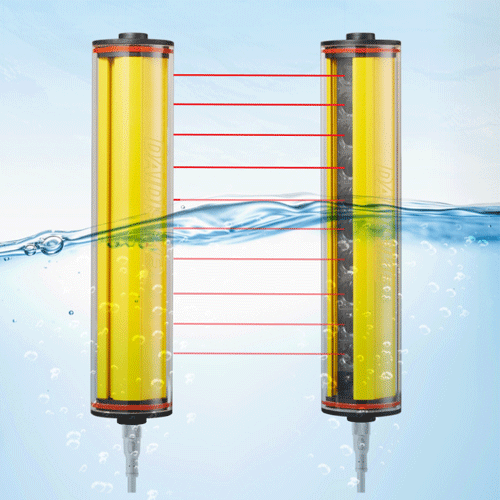
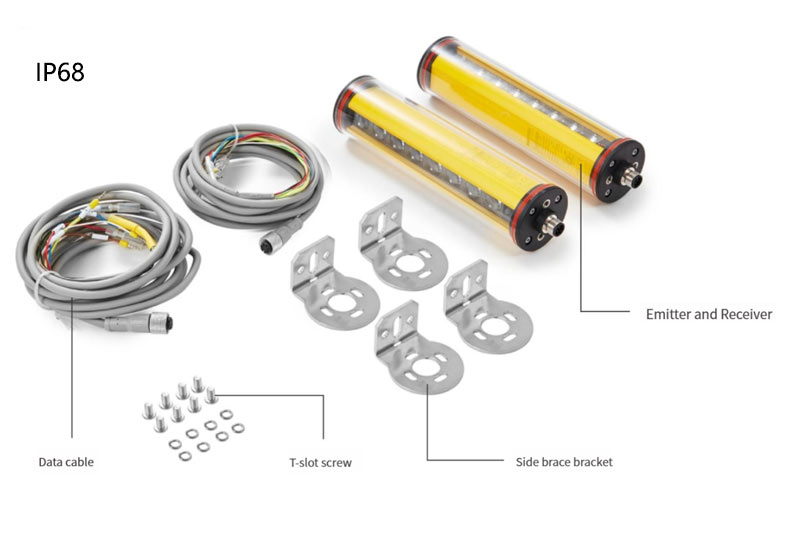
The DQR waterproof light curtain is an IP68 catalogue option to assess, not a blanket food-line approval. Request the exact order-code datasheet, ingress-test conditions, material/connector details, detection capability, response time and applicable safety documentation. Beam spacing is not itself certified object resolution, and the family name alone does not establish Type 4 or a system PL.
DQR may be considered where its documented environmental limits and safety characteristics meet the application. Do not assume food-contact status, chemical compatibility, a temperature range or a maintenance lifetime from IP68. Direct hot-pressure washdown requires its own evidence; if the necessary conditions are not documented, select an appropriately qualified device or redesign the exposure with validated guarding.
To talk through a specific food-line application, share the CIP chemistry and the planned mounting position with our engineering team at our contact page or look at the DQR waterproof safety light curtain, ingress-protection background article and the broader DAIDISIKE safety light curtain family to see where the DQR sits relative to the standard DQE, DQC, DQO, DQT and DQT4 series.
8. Frequently asked questions
What is the difference between IP67, IP68 and IP69K for a safety light curtain?
IP67 and IP68 address immersion under their specified conditions. IP69 under IEC 60529 and IP69K under ISO 20653 address specified high-temperature, high-pressure water jets. Do not infer immersion, cleaning-chemical compatibility or service life from a jet rating, or a jet rating from IP68. Request the exact test standard, conditions and installed connector configuration.
Is IP69K mandatory for food-processing safety sensors?
There is no universal food-sensor IP69K requirement established by this guide. Select enclosure evidence for the real exposure and applicable plant specifications. Direct hot-pressure washdown needs relevant jet-test and compatibility evidence; a splash shield does not upgrade an IP68 rating.
What cleaning chemistries does a food-grade safety light curtain need to survive?
Use the plant's approved cleaning programme: named cleaners, working concentrations, temperatures, contact times, rinse conditions and repeated exposure. Obtain written compatibility for the exact housing, window, elastomer, connector and cable. This guide does not prescribe a chemical cleaning recipe.
Where should a safety light curtain be mounted on a food-processing line to stay clean?
Use a cleanable, drainable installation within the protective device's permitted orientation. Assess brackets, interfaces, cable routing and access with the plant's hygienic-design team, while preserving detection coverage and safety distance. No universal slope or 12 mm clearance is asserted.
Can the DAIDISIKE DQR safety light curtain be used in food processing?
Consider DQR only where the exact supplied model's safety and environmental documentation meets the application. Its catalogue IP68 statement does not establish IP69K, chemical compatibility, food-contact approval, FKM seals or a particular service life. Obtain the relevant reports before relying on it in a wash zone.
What is EHEDG and does it certify safety sensors?
EHEDG publishes hygienic-design guidance and operates equipment certification schemes. Check the exact certificate and test scope. Its public test guidance does not promise performance in every application; the food manufacturer must establish a suitable cleaning regime for its process.
What FDA and EU regulations apply to plastic or elastomer parts on a food-line safety sensor?
Food-contact status depends on the substance, intended contact and conditions of use. FDA provides several regulatory pathways; a polymer family name is insufficient. EU Regulation 10/2011 concerns plastic materials within its scope and does not automatically cover rubber or silicone. No DQR food-contact approval is established here.
Can a standard IP65 safety light curtain survive washdown in a food plant?
IP65 alone does not establish suitability for hot-pressure jets, immersion or cleaning chemicals. It may be considered only where the actual exposure is within the documented limits. Do not infer a failure date or safe washdown regime from the ingress code alone.
What housing and gasket materials should a washdown safety light curtain use?
Request exact materials and compound-level compatibility rather than assuming a food-grade default. Assess corrosion, optical-window damage, seal changes and cable/connector deterioration against the actual cleaning programme. FKM, EPDM, stainless steel and aluminium each require application-specific evidence.
How long will a food-grade safety light curtain last under daily CIP and washdown?
No universal lifetime follows from an IP rating. Use documented cleaning limits, inspection and replacement instructions, and assess the installed assembly over its intended duty. Remove damaged or suspect equipment from protective service through the plant's safe maintenance process.
Does a meat plant need a different safety light curtain than a dairy or beverage line?
The machine hazards and cleaning exposure differ by line and zone. Meat residue removal, dairy cleaning circuits, beverage handling and frozen-food temperature changes need separate input data. Retain the same evidence-based selection process without assuming one enclosure or seal compound suits every sub-sector.
Related reading
IP65 / IP67 / IP69K — ingress protection deep dive
The wider context for IP ratings across welding, oil-mist and washdown environments.
DQR IP68 vs MK IP65 — when each fits
The decision between standard splash protection and full waterproof in the DAIDISIKE range.
Outdoor safety light grating
The outdoor cousin of the food-environment specification — same IP discipline, different threat model.
References
For intended-use evidence, see FDA food-contact regulatory status, EHEDG test-scope limits and 3-A authorization verification.
- IEC 60529 — Degrees of protection provided by enclosures (IP Code) — Definitions of IP65, IP67 and IP68 test methods.
- ISO 20653 — Road vehicles. Degrees of protection (IP code). Protection of electrical equipment against foreign objects, water and access — Source of the IP69K high-pressure, high-temperature spray test.
- EHEDG — Hygienic Design Guidelines — EHEDG Doc 8 (Hygienic Design Principles) and Doc 13 (Open Processing Equipment) define the hygienic-design rules applied to food-line components.
- FDA 21 CFR Part 175 — Indirect food additives: adhesives and components of coatings — US food-contact regulations for adhesives and coatings.
- FDA 21 CFR Part 177 — Indirect food additives: polymers — Relevant polymer provisions depend on composition and intended use, not a generic material label.
- Regulation (EU) No 10/2011 — Plastic materials and articles intended to come into contact with food — EU plastic food-contact rules; material scope and conditions differ from US provisions.
- 3-A Sanitary Standards — Detailed sanitary-design standards primarily for dairy equipment, widely referenced in food-line design.
- BRCGS Global Standard for Food Safety — Apply the edition and audit scope relevant to the food-manufacturing site; an IP rating is not site certification.
- IEC 61496-2:2020 — Active opto-electronic protective devices (light curtains) — Product-level AOPD requirements; obtain exact-model evidence rather than inferring a Type rating.
This article is general engineering and hygienic-design guidance for the food and beverage sector, not a substitute for the cited standards themselves, a competent risk assessment for your specific machine, or a hygienic-design assessment by a qualified third party. Always confirm IP-rating, gasket chemistry and material compatibility with the manufacturer's published specification against your plant's actual CIP recipe before relying on a sensor in a wash zone.