
IP68 Waterproof Safety Light Curtain DQR vs. IP65 Standard Protection MK
Content updated:
A practical selection & installation guide using two representative DAIDISIKE families.
Use the light curtain family selection guide for detection capability and protective-height choices, then this comparison for environmental fit. For cleaning-zone decisions, see immersion versus high-pressure washdown evidence. Never suppress a protective beam interruption simply because it resembles a droplet.
DQR: verify the exact IP68 immersion depth, duration, temperature and connector configuration. Obtain separate evidence for jet cleaning, chemicals and outdoor optical conditions.
MK: compare its compact mounting and optical synchronisation against the required safety performance and environment, not price alone.
Response time, output type, protective height and controller compatibility must come from the exact order code. Do not transfer one family's limits or functions to another.
Mode boundary: a function that ignores an interrupted beam changes detection. Use only a documented, permitted protective mode with validated detection capability; never emulate it in ordinary PLC code.
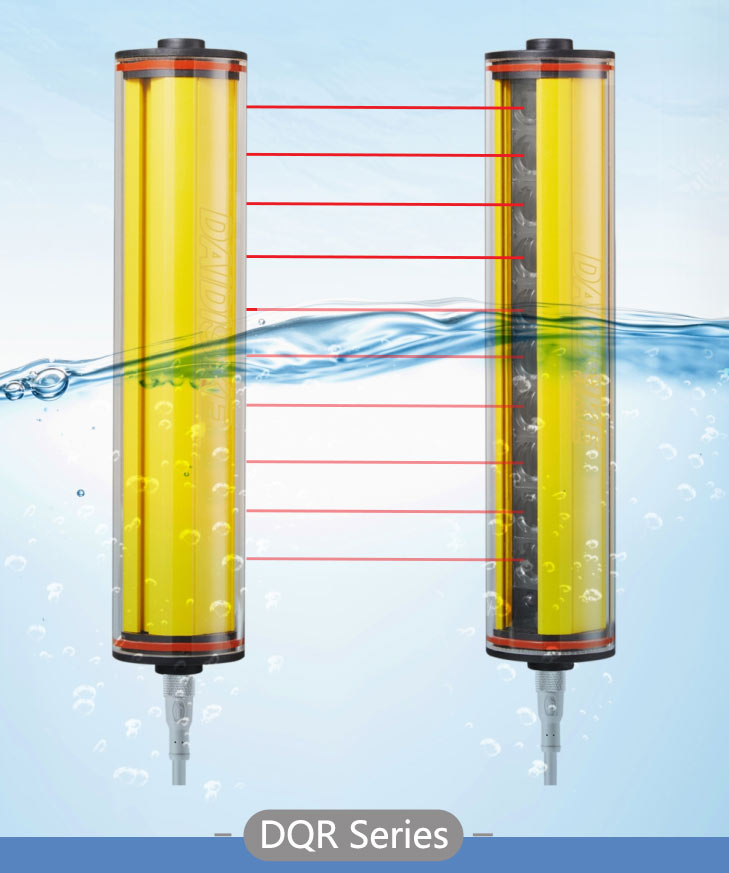
1) Why IP ratings and environment fit matter
- IP68: dust-tight with immersion protection under manufacturer-specified conditions; it does not itself establish washdown, weather, condensation or optical suitability.
- IP65: dust-tight and water-jet resistant. Suited to indoor lines without continuous immersion or heavy washdown.
- Takeaway: compare DQR and MK against the actual water, chemical, light and temperature exposure and required safety performance. Neither outdoor sun nor oil mist is qualified by an IP code alone.
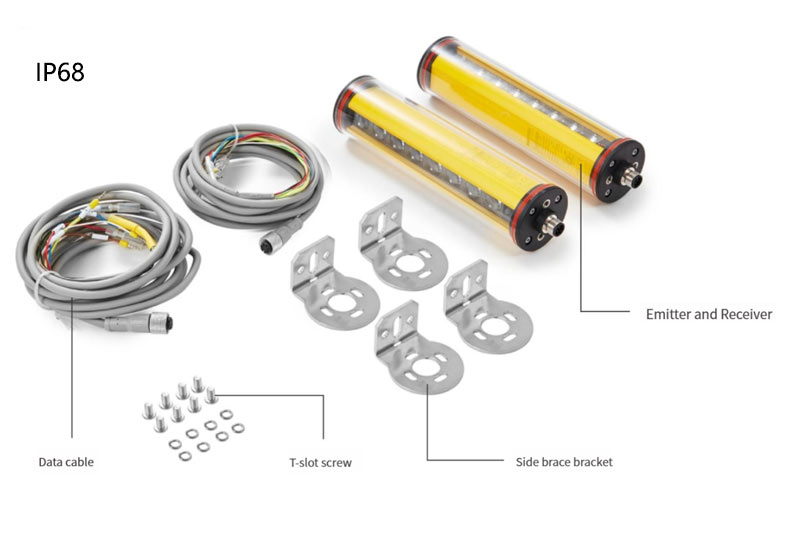
2) DQR (IP68): verify the specified immersion conditions
2.1 Construction & waterproofing highlights
- Sealed and ruggedized: deep sealing around core electronics to block ingress and resist corrosion.
- Environmental limits: verify the exact housing, temperature range, vibration and outdoor-exposure documentation; IP68 alone does not establish them.
- Connector evidence: confirm the supplied connector, alloy, seal, mating part and tightening instructions; M12 alone does not establish marine or cleaning suitability.
- EMC & optical immunity: verify the exact test limits and installation rules. IP68 does not establish welding-arc, strobe or direct-sun immunity.
2.2 Core performance (typical)
Note: IP68 reflects the waterproof customization and positioning of the DQR family. Final shipped parameters follow the nameplate and order.
2.3 Outdoor / wet-area installation checklist
- Drip loop on cables: stop rainwater from tracking into the connector.
- Seal & torque: use the specified mating connector, seals and tightening torque. Do not add generic gaskets or sealant to modify a protective device.
- Reflective surfaces: preserve the exact manual's reflective-surface clearance along the full field. Repositioning or approved shielding must preserve protective separation and be followed by the specified test-piece check.
- Mount & de-vibe: spring washers on brackets help avoid long-term wind-induced beam jitter.
- Drainage & waterline: if not intended for immersion, mount above pooling level; for immersion, ensure cables/connectors also meet immersion grade.
- Power & grounding: follow plant standards for PE/0V bonding to improve surge/Lightning immunity.
- Routine checks: in salt-spray/chemical atmospheres, inspect terminals and seals and replace wear parts on schedule.
- Mode choice: investigate optical interruption and contamination first. A beam-ignore mode may be used only if expressly supported and validated for the required protective function.
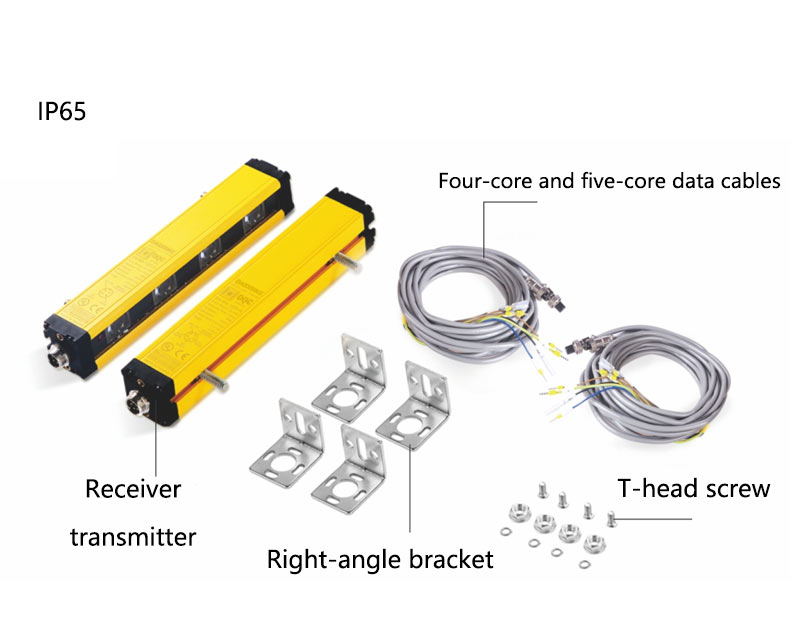
3) MK (IP65): the compact, value-driven indoor choice
3.1 Design notes
- Optical sync: no extra sync wire between transmitter/receiver—simpler wiring.
- Small cross-section: about 25 × 23 mm, easy to fit in tight enclosures.
- Easy to install & service: quick testing, tidy cabling, clean look, low upkeep.
3.2 Typical performance & where it fits
- IP65: dust-tight and water-jet resistant for most indoor lines without standing water.
- Response: ≤ 15 ms; wide coverage of beam pitches/heights similar to DQR.
- Outputs/indicators: NPN/PNP; multicolor LEDs for power/tx/rx/occlusion—very technician-friendly.
- Assembly and packaging cells, electronics, dispensing/labeling/sorting/testing—dry indoor duty.
- Cost-sensitive machines that don’t require heavy washdown but need reliable interlocking.
4) “Dual-beam validate, single-beam ignore”
4.1 What it does
The term describes a logic concept that would require two adjacent beams to be interrupted before changing output. That means a single blocked beam is no longer sufficient: detection capability and safety assumptions change. Do not implement this as an ordinary PLC filter, and do not assume DQCA/DQCA2 or DQR provides an approved protective mode without the exact safety manual.
4.2 Why it helps
- Ignoring beam interruptions may mask a contamination symptom but also changes detection. No availability benefit is established unless the exact protective mode is permitted and validated.
- Measure any availability benefit only after the protective function has been validated; no improvement is guaranteed.
4.3 Boundaries
- Minimum detectable size increases: not suitable for “finger-protection” applications. If finger/hand protection is required, choose the appropriate resolution and validate per standards.
- Any logic change must be risk-assessed and verified before use.
5) Side-by-side specs & quick selection
| Aspect | DQR (IP68) | MK (IP65) |
|---|---|---|
| Protection | IP68 — specified immersion; jet/chemical/optical evidence separate | IP65 — indoor dust + water jets |
| Environment & I/O | Exact housing and connector evidence required | Standard connectors; indoor-first |
| Nuisance control | Do not ignore a protective beam without an explicitly permitted, validated mode | Do not emulate protective beam suppression in ordinary control logic |
| Form factor | More robust build, shock-tolerant | Smaller, easier placement |
| Common ground | Check exact response time, detection capability, protective height and output interface. Controller compatibility and safety performance require their own documentation. | |
Quick picks: shortlist DQR for a documented immersion requirement and MK for a compatible compact installation. Confirm environmental exposure and the complete safety function before deciding; nuisance trips require diagnosis, not automatic beam suppression.
6) Safety distance & compliance essentials
- ISO 13855: use the complete applicable 2024 positioning method and documented sensor/logic plus measured machine stopping time. The historical S = K × T + C expression is not the full calculation for every geometry; include all relevant reach and uncertainty allowances.
- Control system: select qualified safety logic compatible with the exact protective output and validate the required PLr/SIL. A controller name does not establish achieved performance.
- Validation & inspection: perform test-rod/plate checks, E-stop/interlock tests, and record stop time to verify S. Maintain routinely.
- EMC & grounding: follow plant grounding/shielding rules to improve surge immunity and stability.
7) Typical applications
Where DQR shines (IP68)
- Outdoor wash systems, car-wash bays, gates/barriers, fenced entry monitoring
- Food/seafood packaging only after cleaning, condensation and temperature limits are confirmed; IP68 alone is not steam or hot-jet qualification
- Machining/saw stations with coolant splash; mining/building-materials outdoors
Where MK is at home (IP65)
- Assembly/packaging cells, electronics, dispensing/labeling/sorting/testing
- Cost-sensitive indoor equipment requiring dependable interlocking
8) FAQ
Can it really run while submerged?
Only under the exact manufacturer's specified immersion conditions and approved operating arrangement. IP68 ingress protection does not alone validate optical person detection underwater, hot-pressure washdown or connector compatibility.
Does dual-beam validate affect safety level?
Ignoring a single blocked beam changes detection capability and safety assumptions. Do not use or emulate such a mode without explicit device documentation, applicable safety evidence and validation of the complete function and separation distance.
What about bright sunlight outdoors?
Check the selected model's ambient-light limits and reflective clearances. Use approved shielding and verify the complete field after installation; an ingress rating is not sunlight or welding immunity.
How can I shorten the safety distance?
Use documented response times and measured stopping performance, then apply the appropriate approach and reach allowances. A finer declared detection capability may reduce one allowance but does not authorize a closer position without full validation.
Will both families talk to my controller/PLC?
Confirm the exact output configuration and qualified safety-input compatibility. NPN/PNP or a matching connector alone is not enough; ordinary PLC inputs are for auxiliary diagnostics, and required safety functions cannot be inferred from DQCA/DQCA2 naming.