
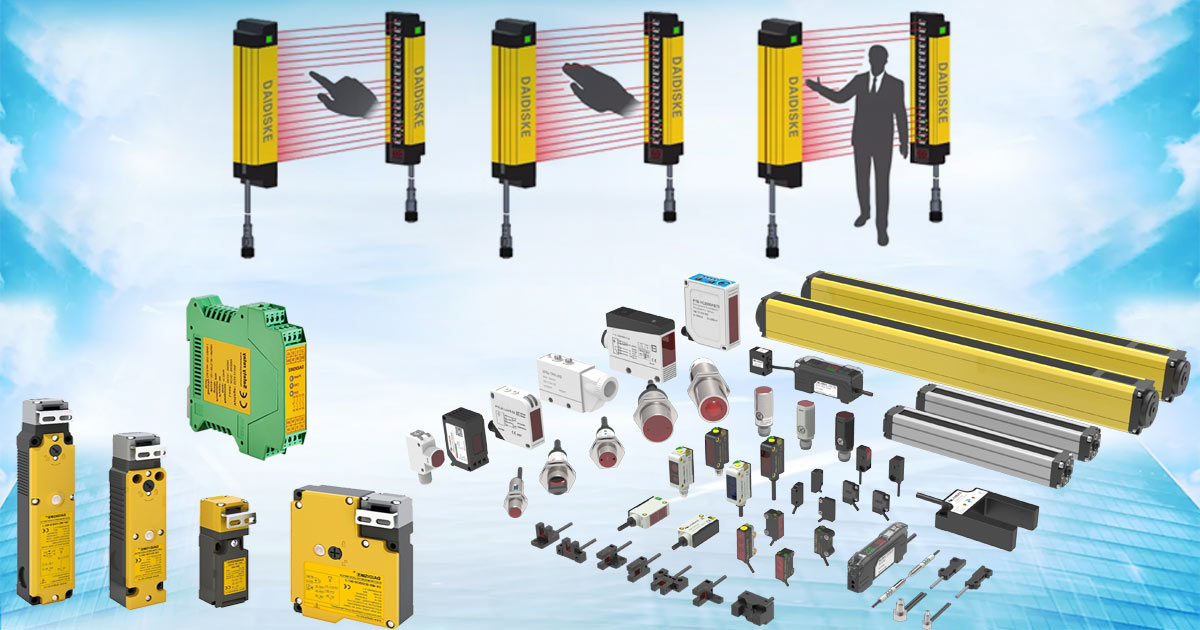
The safety light curtain selection category is the device-family starting point; this article handles the narrower Panasonic migration evidence. Keep the original machine's safety file, curtain/controller labels and current manuals together. An obsolete part does not lower the required protection.
Replacement review goes beyond Type/PL, detection capability, range and OSSD polarity. Include protective height and edge geometry, full configured response, pulse tolerance, cable and connector assignments, reset, EDM, muting/blanking, cascades and environmental limitations. A faster sensor or a matching connector alone does not approve the swap.
- Exact Panasonic code known? If not, identify the emitter, receiver, cables and accessories before proposing a match.
- Controlled migration guidance available? Follow its whole-assembly constraints; do not replace only one side of a pair.
- Candidate evidence complete? Missing safety or interface data means hold, not “equivalent pending re-pin.”
- Differences assessed and validated? Release only after the modified machine's safety function is accepted.
Which Panasonic SUNX light curtains are discontinued?
Panasonic's discontinuation pages list these families and order-code-specific substitutions, including SF4D entries. The SF4B Ver.2 notice gives September 30, 2022 and explicitly warns against replacing only the main unit or parts. SF4B includes finger as well as hand and arm/foot variants. SF4D, SF4C and SF4B-C have current official product pages; verify regional availability and exact replacement accessories when ordering.
How does a DAIDISIKE DQC replace a Panasonic SF4B?
A DQC replacement is not established by this guide. The installed SF4B code determines its detection geometry and required safety documentation; the family is not hand-only. The published DQC material does not establish an equivalent Type 4 / PL e rating or approved dual-OSSD/EDM interface.
Review the DQC product data and its evidence boundary without treating a hand-guard label as a safety cross-reference. If documented Type 4 capability is required, the catalogued DQT4 Type 4 candidate is a separate review path. Obtain its exact detection capability, range and response data, confirm approved safety-input compatibility, and validate the modified machine. Do not assume a pin adapter or bracket change preserves the original function.
What is the DAIDISIKE equivalent of the Panasonic SF4D (finger protection)?
SF4D-F is the finger variant, with a declared 14 mm opaque-object capability at 10 mm beam pitch. Panasonic specifies 0.2–7 m short mode and 0.8–12 m long mode for this variant; the hand and arm/foot versions have different ranges. Standalone OFF response is at most 10 ms, while connected arrangements use the specified longer value. The catalogue's unchanged-pitch L/U-corner claim excludes SF4D-F.
The DQA catalogue lists pitch choices but states that Type/PL/SIL documentation is not published. Therefore it cannot be mapped to SF4D-F by a “10–30 mm” label. Likewise the DQO edge-coverage option needs an actual protected-field drawing and safety evidence; a blind-spot-free marketing name does not establish an equivalent edge.
What replaces the discontinued Panasonic SF2B (Type 2)?
Panasonic lists SF2B Ver.2 as discontinued. Its current global specifications note the Type 2 limit of PL c / SIL 1 under the revised light-curtain standards; older labels or regional pages must not be generalized into current selection permission. Use the exact migration entry and required performance, not merely the level of the old part.
A Type 4 candidate can require substantial changes to interfaces, geometry and validation; it is not an automatic DQC/DQA upgrade. The Type 2 versus Type 4 guide separates equipment classification from achieved application performance. Retain a lower-integrity option only where the current risk assessment and applicable requirements permit it.
What about the SF4C ultra-slim and SF4B-C compact curtains?
These Panasonic families address compact installation constraints; their exact detection variant, output configuration, body depth, connector access and protective-field drawing still matter. A device that fits the frame is not automatically a functional match. No DQC or DQT4 drop-in equivalence is established.
Measure the actual mounting envelope, not only housing width. Include bracket projection, cable bend space, nearest detectable point and inaccessible zones at the ends. Where space does not allow a candidate's required separation or coverage, redesign the mounting or select a different documented device instead of accepting a smaller safety distance.
Washdown and outdoor review: why an IP number is not enough
The local DQR / DQRF product data distinguishes plain DQR at IP65 from DQRF with the waterproof cover at IP68. It does not publish a safety Type/PL rating for this series. Neither the larger number nor the product name proves a Panasonic replacement.
Immersion, water jets, hot high-pressure cleaning and chemical exposure are different conditions. Confirm tested assembly, cover and connector conditions, permitted cleaning agents, temperature and sunlight limits. Outdoor functional-safety use needs explicit device approval and application validation; IP68 alone is not evidence for it.
Panasonic SUNX → DAIDISIKE cross-reference table
This table is a review queue, not a replacement approval. It preserves the family comparison while making each missing evidence gate explicit. Consult the linked exact-model documents rather than inferring common specifications across a series.
| Panasonic / SUNX model | Type / class & status | Resolution / range (published) | DAIDISIKE match |
|---|---|---|---|
| SF4B Ver.2 | Discontinued Type 4 family; exact variant required | Finger, hand and arm/foot options; not hand-only | DQC not established equivalent; review documented candidate and whole migration assembly |
| SF4D / SF4D-F | Current official Type 4 / PL e / SIL 3 family | Finger mode differs from hand/arm range and corner-coverage claim | DQA pitch alone insufficient; DQT4 needs complete exact-model data |
| SF2B Ver.2 | Discontinued Type 2; revised standard limit noted by Panasonic | Exact installed variant and required performance determine migration | No automatic DQC/DQA upgrade or generic Type 2 substitute approved |
| SF4C | Current official compact Type 4 family | Check installed detection variant, body depth and output configuration | Mechanical fit plus safety evidence needed; no assumed DQC/DQT4 match |
| SF4B-C | Current official compact Type 4 family | Verify exact protective height, range and connector drawing | Candidate only after full function and interface review |
| SF4B-G Ver.2 | Discontinued robust Type 4 family | Follow specific Panasonic migration and mounting instructions | DQRF cover is not proof of an equivalent safety or environmental function |
Across brands, retain the same evidence hierarchy: exact device documentation first, application compatibility second, validated modification last. The Keyence/SICK buyer evidence guide explains the hold/redesign/validate decision, while the four-brand replacement guide covers other installed families. Neither page supplies approval for an unidentified Panasonic unit.
Is naming Panasonic and SUNX legal, and how is the comparison kept honest?
Panasonic and SUNX names identify the products being discussed; this article does not imply endorsement, affiliation or established compatibility. Comparative-advertising and trademark requirements depend on the market and use. For example, EU Directive 2006/114/EC requires comparative claims to meet conditions including objective, verifiable comparison and avoiding confusion. This article is not legal clearance for an advertisement.
Engineering claims must be traceable to exact public specifications or controlled supplier documents. Where DQC/DQA/DQR safety evidence is missing, the comparison says so; it does not infer a certificate, test agency, universal CE status or achieved machine performance.
Replacing a discontinued Panasonic SF4B, SF2B or SF4B-G?
Send the full emitter/receiver order codes, installed accessories, required Type/PL or SIL, detection capability, protective-field drawing and controller/manual versions. Include the stopping assessment and required reset, monitoring or muting functions. A quotation can identify candidates and missing evidence; it is not an approved replacement or a guaranteed price/delivery promise.
Contact DAIDISIKE engineering · Phone / WhatsApp +86 15218909599
Sources & specifications cited
- Panasonic SF4B Ver.2 discontinuation and exact-code migration
- Panasonic SF2B Ver.2 specification and revised-standard note
- Panasonic SF4B-G Ver.2 migration
- Panasonic SF4D variant-specific specifications and cautions
- Panasonic SF4C and SF4B-C current family pages
- IEC 60529 enclosure protection scope
- EU comparative advertising Directive 2006/114/EC, Article 4