
Cold-chain automation is having its moment. The market for AMRs in cold-chain warehousing reached USD 512.4 million in 2025 and is forecast at USD 585.7 million in 2026, on its way to USD 2,018.6 million by 2036 at a 13.2% CAGR (Fact.MR). The wider cold-storage market is projected to hit roughly USD 198 billion by 2030, led by Asia-Pacific and automation (Mordor Intelligence). When a robot vendor demos a smooth pick run in a comfortable showroom, that is the easy half. The freezer is the half that bites.
A useful diagnostic scenario is a robot that stops after crossing from a freezer into a warmer zone. Frost or condensation is one possible cause, but timing alone does not establish the fault. Read the diagnostics and inspect the optical cover under safe maintenance conditions before changing firmware or fields. This is an illustrative troubleshooting scenario, not a reported customer test.
How cold is a cold-storage warehouse, really?
Cold storage is not one temperature; it is a stack of them, and the coldest room sets your spec. Chilled rooms sit a few degrees above freezing. Frozen-storage rooms commonly run at or below 0 °F (−18 °C). Deep-freeze applications — ice cream, some seafood, certain pharmaceuticals — go down to about −30 °C; US tiers are often cited as freezer −10 to 14 °F and deep-freeze near −30 °C (MFWC, MIDCOM). The point for a scanner engineer is blunt: design to the coldest room the AMR enters, and to the temperature swing it sees crossing into ambient, never to an average. A device that is fine on a chilled dock can be a paperweight in the deep-freeze pick face two doors away.
Why does an ordinary indoor safety scanner fail below zero?
Two checks matter. The first is the rating. As a documented indoor example, SICK's nanoScan3 instructions specify −10 °C to +50 °C operation, with an IP65 enclosure per IEC 60529. Drive an AMR carrying one of those into a −25 °C aisle and you are below the validated minimum. The installation is outside the stated operating conditions; do not rely on the published safety performance there without manufacturer approval for the exact arrangement.
The second way is water, and it is the one people underestimate. A Type 3 safety laser scanner is an AOPDDR — an active opto-electronic protective device responsive to diffuse reflection — under IEC 61496, and it works by reading faint diffuse reflections of its own laser. Put frost or a condensation film on the emission window and those reflections can be scattered or blocked. Protective shutdowns or impaired detection may result; continued operation is not evidence of safe detection. Manufacturer guidance is explicit here: the optics window must be kept free of condensation, and the monitored area free of fog and vapour, or function may be impaired (SICK S300 instructions, ReeR). Operating humidity is typically specified up to about 95% RH — with no condensation permitted. That last clause is the whole problem in a freezer.
Where does the condensation actually come from?
From the robot doing its job. An AMR in a cold-chain building does not stay in one climate; it shuttles between a −25 °C freezer, a chilled staging area and a warm, humid dock. Every time it leaves the cold and enters warm moist air, the cold scan window is below the dew point of that air, and water condenses on it — the cold-drink-sweating-in-summer effect, on the one surface the scanner cannot afford to have wet. Back in the cold, that film freezes to frost.
This challenge is described in Stow's multi-climate AMR entry for the ProMat 2023 innovation awards: the supplier identifies condensation during cold-to-warm transitions and describes regulated component temperatures as part of its design. That is a third-party application example, not proof of suitability for a DAIDISIKE model. And the damage is not only optical: moisture that works its way inside a housing can corrode and short-circuit components over time, even on a sealed, IP-rated device (Barcoding, RMS Omega). A scanner that survives the cold can still die slowly of the water the cold creates.
Can a scanner see through freezer fog?
Not a standard indoor one — and the documentation says so plainly. Indoor safety scanners require the monitored area to be free of smoke, fog, vapour and air impurities. Fog is suspended water droplets that scatter the laser, and this scatter can affect detection or lead to protective stops. Freezer aisles may fog wherever cold air meets warmer infiltration around doors and dock seals.
Outdoor-rated devices illustrate why the exact limits matter. SICK's outdoorScan3 documentation gives −25 °C to +50 °C operation and fog conditions expressed as meteorological optical range (MOR), including a 50 m reference limit. MOR describes visibility through the air, not the scanner's protective-field range. Denser fog and particles can still cause shutdowns. An outdoor rating does not approve a −30 °C freezer, condensation on the window, or every field configuration. Check the selected model's operating instructions rather than treating “fog filtering” as unlimited immunity.
What actually keeps the optics clear — heated windows
Heating can reduce condensation by maintaining an optical surface above the local dew point. But cold-storage barcode hardware and personnel-protection scanners are different equipment classes. Zebra's RS6100, for example, is rated to −30 °C (−22 °F) with its extended battery; that fact neither establishes a heated-window specification nor qualifies a safety laser scanner for the same environment. A clear barcode image is not a validated protective function. Evaluate any proposed heater against the safety scanner's own instructions and approved installation conditions.
The engineering checks include cold startup, the full transition cycle and loss of environmental control, not just steady operation. An improvised heated enclosure with a transparent front can change the optical path. SICK's nanoScan3 instructions explicitly prohibit an additional front screen. Do not fit a film, heater or window in that path as a generic retrofit. If no approved arrangement meets the environment, change the device or the safeguarding concept with the machine-safety designer.
What else mitigates it — acclimatisation and zone discipline
Acclimatisation means allowing equipment to approach its new environment gradually. A waiting-time suggestion for a handheld barcode device is not a commissioning rule for an AMR, and there is no universal 30-minute delay that proves a safety scanner ready. Review transition airlocks or vestibules, unnecessary climate crossings, warm-up requirements and diagnostic readiness with the device and vehicle manufacturers. The protective function must remain effective throughout the route; never mute it merely to cross a foggy doorway. A safe stop and an approved recovery procedure are required when the intended protection is unavailable.
How do I read a scanner spec for a freezer job?
Read three things, in order, and do not let a glossy slide substitute for any of them.
- Operating temperature range. The minimum has to be at or below the coldest room the robot enters. An indoor −10 °C device does not cover a −25 °C aisle, full stop. Storage temperature is not the same as operating temperature — check the operating figure.
- Condensation and humidity clause. Read the exact limit; nanoScan3 is one example specifying up to 95% RH without condensation. IP65 and a humidity percentage do not grant permission for a wet or frozen scan window. Check the climate transition, not only the steady room humidity.
- Fog and airborne-water behaviour. If the aisle fogs, check the approved fog conditions and expected protective response; do not use a device where its manual prohibits operation.
The honest version of this advice cuts against easy selling, so I will say it directly: if a supplier quotes you a −30 °C number without a datasheet line and a stated test condition behind it, treat the number as marketing until proven otherwise. Cold ratings are validated, not asserted.
Cold-storage scanner evidence checklist
Use this comparison to separate a published device fact from a project assumption. These are document examples, not interchangeable products or a recommendation to install an indoor device in a freezer.
| Evidence | Published example | Decision for a freezer AMR |
|---|---|---|
| Operating vs storage temperature | nanoScan3: operation −10 °C to +50 °C; storage −25 °C to +70 °C [1]. | A storage limit is not an operating approval for a −25 °C aisle. |
| Window condition and humidity | nanoScan3: ≤95% RH, non-condensing [1]. S300 instructions exclude condensation at the emission window [2]. | Check the cold-to-warm transition; an IP rating alone does not address it. |
| Outdoor fog capability | outdoorScan3: operation −25 °C to +50 °C; specified fog conditions use MOR, not protective range [3]. | Do not infer −30 °C approval or unlimited fog immunity. |
| Extra window or heater | nanoScan3 instructions prohibit an additional front screen [1]. | Require model-specific approval; do not copy a barcode-scanner retrofit. |
| DAIDISIKE product boundary | ST27: Type 3 / PL d / SIL 2. DLD30T-5N and SDLD-05A: non-safety perception devices. | No −30 °C safety suitability is claimed here for any of these models; request the exact supporting documentation. |
Sources: [1] nanoScan3 I/O instructions; [2] S300 instructions; [3] outdoorScan3 documentation. Check the current revision for the exact order code before design.
- Cold zone: confirm operating limits and cold-start readiness for the selected device.
- Warm/humid crossing: check whether window temperature falls below the local dew point; record condensation and diagnostics.
- Return to cold: inspect for retained moisture or frost and verify the approved protective response before normal operation.
This is not a wiring diagram, test result or permission to operate outside a device rating. Include loss of any approved heating or environmental control in the project validation plan.
Once the environment is documented, use the industrial LiDAR selection guide for range and safety-versus-navigation requirements to make the remaining selection checks without confusing detection range with a certified protective field.
Where DAIDISIKE scanners fit — and where they need checking
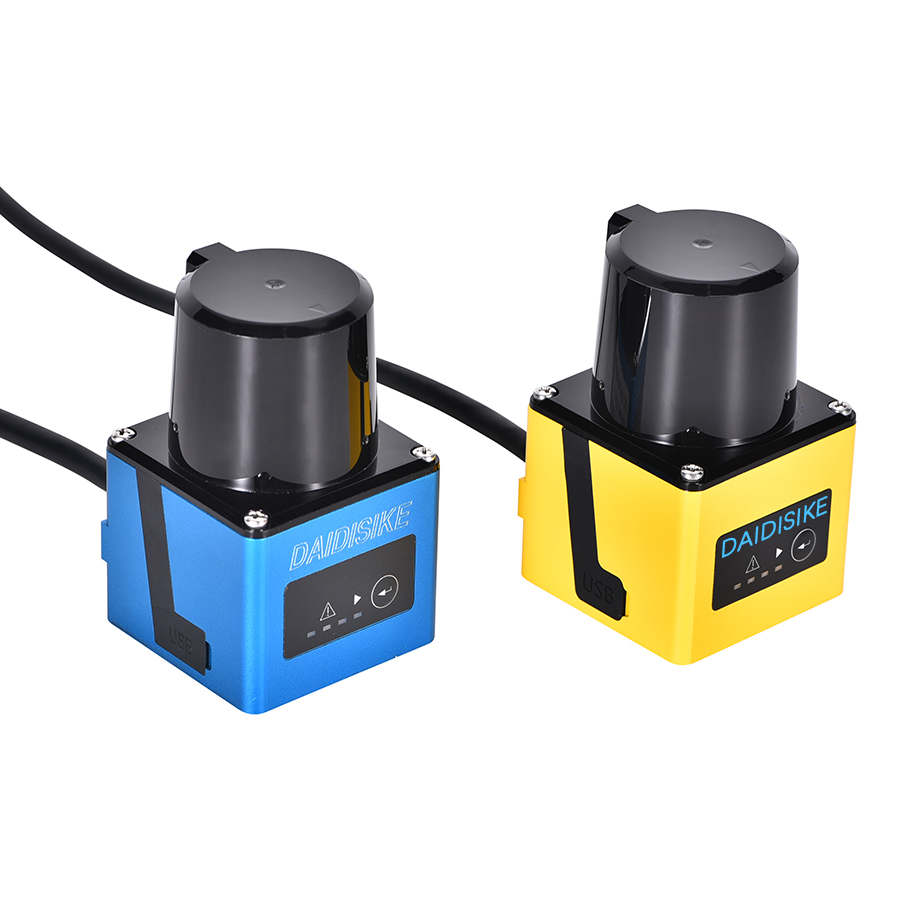
A straight answer, since you are on our site. DAIDISIKE builds the DLD-series scanning LiDAR — including the DLD30T-5N perimeter and obstacle-avoidance LiDAR — 30 m at 90% remission / 10 m at 10% remission and the SDLD-05A 14 m time-of-flight scanner — for non-safety obstacle avoidance and perimeter detection on AGVs and AMRs, not as personnel-protection scanners. For a freezer or cold-storage deployment, the operating temperature, IP rating and any heated-optics arrangement have to be confirmed against your actual coldest zone and the climate transitions the robot makes. I am not going to print a deep-freeze rating here that we have not validated for your duty cycle. Tell us the coldest room, the zone crossings and the cycle time, and we will tell you what is in spec and what requires manufacturer-approved environmental control or a different device. That is the responsible way to specify cold-chain safety hardware, and it is how we would want our own line treated.
For personnel protection, the ST27 Type 3 safety laser scanner is a separate safety-rated series (PL d / SIL 2). Those classifications do not establish freezer suitability. This page makes no −30 °C approval or heated-accessory claim for ST27; confirm environmental limits, the exact configuration and the complete safety function before specifying it.
References & sources cited
- Fact.MR — AMRs for Cold Chain Warehousing Market 2026–2036 — USD 512.4 M (2025) to USD 2,018.6 M (2036), 13.2% CAGR.
- Mordor Intelligence (PR Newswire) — Cold storage market ~USD 198 B by 2030 — APAC- and automation-led, ~12.5% CAGR.
- ProMat 2023 innovation-award entry — Stow Multi-Climate AMR — condensation on optics across climate zones as a core challenge.
- SICK nanoScan3 I/O operating instructions — Design section restrictions; ambient data table: −10 °C to +50 °C operation, non-condensing humidity and IP65. Public document consulted for these facts, not a full standards audit.
- SICK outdoorScan3 product information — IEC/TS 62998-certified, −25 °C to +50 °C, fog filtering via HDDM.
- SICK outdoorScan3 Core I/O operating instructions — fog and particles can still reduce availability; field configuration and response-time conditions remain model-specific.
- SICK S300 operating instructions — project-planning requirements for clear monitored space and no condensation on the emission window.
- ReeR safety guide — safety laser scanners (Type 3 AOPDDR, IEC 61496) — optics-window and air-clarity requirements.
- Zebra — RS6100 barcode scanner to −30 °C with extended battery — a barcode-device example, not evidence for a safety-scanner heater or certification.
- MIDCOM — cold-storage scanner guidance — cold-storage tiers, acclimatisation, heated holders.