
DQSRN Multi-Input Safety Relay Module
Four safety input types, one part number: set the DIP switches and the same DIN-rail relay supervises an E-stop, a light curtain, a guard door or a two-hand station.
- DIP-selectable inputs: E-stop / OSSD / door interlock / two-hand
- 3 N.O. + 1 N.C. forcibly guided contacts, AgSnO2 + gold plating
- Response under 30 ms from trigger to contact opening
- EN ISO 13849-1 Cat. 4 / PL e functional-safety design reference
- DC 24 V, 2.9 W, 45 mm standard DIN housing
One Relay Where Panels Used to Need Four
Most machine panels accumulate safety relays the same way: one model for the E-stop chain, another to expand a light curtain's OSSD pair, a third for the guard door, sometimes a fourth for a two-hand station. Each is a separate line on the BOM, a separate spare on the shelf, and a separate chance to fit the wrong one. The DQSRN collapses that list: a DIP switch on the module selects which of the four input classes it monitors, and the rest of the wiring stays conventional.
Downstream, the module behaves like a classic force-guided safety relay. Two internal channels cross-check the selected input, and the output stage — three N.O. safety contacts plus one N.C. auxiliary — opens in under 30 ms. Contact metallurgy is AgSnO2 with 0.2 µm gold plating, so the same set that switches a 240 VAC contactor coil (AC-15 4 A) also holds up a 10 mA / 5 V PLC status signal without film buildup.
Two monitoring variants exist — one for transistor/OSSD signals, one for volt-free N.C. switches — plus the DQSRP dedicated two-hand version. It is also the catalog-listed controller for DAIDISIKE's DQSA passive curtains and JT14 safety mats. For ultra-slim panels, see the 22.6 mm DA31 safety relay module instead.
Typical Wiring Concept
On-Module Function Selection
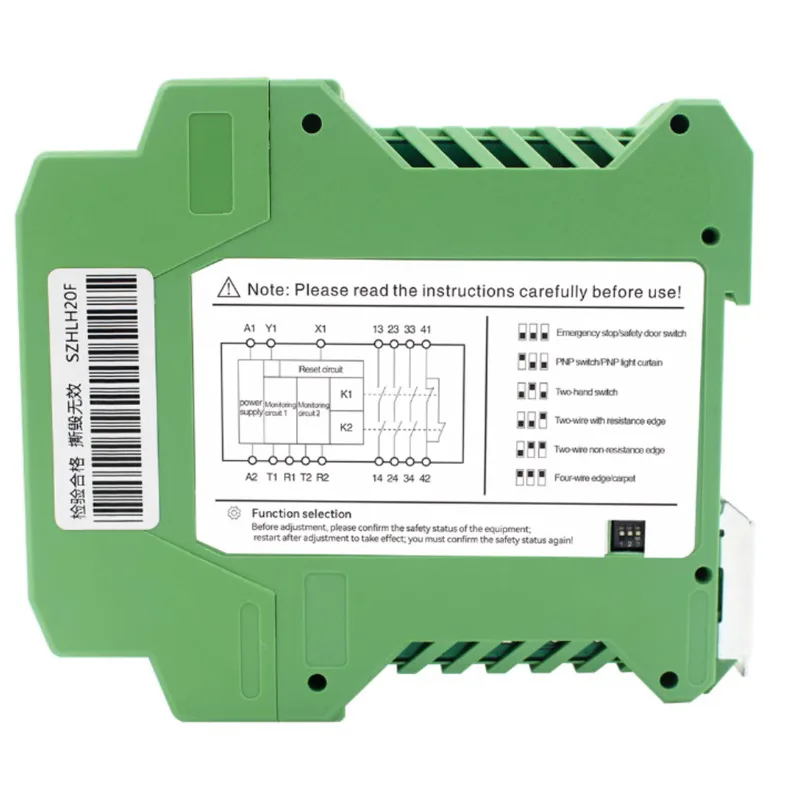
The side label carries the internal circuit and the DIP-switch table — set the mode with the machine confirmed safe, then re-verify the safety function after any change.
Technical Specifications
| Input modes | 4, DIP-switch selectable: E-stop button / light curtain OSSD (single or dual-channel PNP) / safety door interlock / two-hand control device |
|---|---|
| Functional safety | EN ISO 13849-1 Category 4 / PL e — functional-safety design reference; IEC 61508 SIL 3 — functional-safety technical reference |
| Output contacts | 3 N.O. safety + 1 N.C. auxiliary, forcibly guided (positively driven) |
| Contact material | AgSnO2 with 0.2 µm gold plating |
| Contact ratings | AC-1 6 A / 250 VAC; AC-15 4 A / 240 VAC; DC-1 6 A / 24 VDC; 12 A max |
| Minimum load | 10 mA / 5 V |
| Response time | < 30 ms, input trigger to contact opening |
| Supply | DC 24 V, +10 % / −20 %, approx. 2.9 W |
| Housing / mounting | 45 mm wide, standard DIN rail, IP30 (see revision note below) |
| Variants | Transistor/OSSD monitoring; N.C.-switch monitoring; DQSRP (dedicated two-hand). Confirm the exact variant code with the factory when ordering. |
The values above follow the DAIDISIKE catalogue/datasheet revision for this module. A newer catalogue revision lists different figures for some items (contact ratings AC-15 5 A/250 V and DC-13 6 A/24 V, response < 15 ms, IP50, 117 × 100 × 22.5 mm, ≤ 3 W, relay life ≥ 1,000,000 operations), so please confirm the contact rating, response time, housing dimensions and IP rating for the revision you are ordering. Operating temperature range is not stated in the factory documentation. Certification details (CE, TÜV and similar) are not stated either — contact the factory for certification documents. DQSRN does not provide manual reset, automatic reset or external device monitoring (EDM), so those functions must not be specified for this module. If the machine safety function requires reset supervision or contactor feedback, select a safety controller that explicitly documents those functions. Cross-fault detection is not documented and must not be assumed.
Typical Applications
Press & Press Brake Safety Chains
Monitors E-stop buttons or two-hand stations on punch presses, hydraulic presses and press brakes, opening the drive contactors within 30 ms.
Contact Multiplication for OSSD Curtains
Turns a light curtain's two transistor OSSD channels into three forcibly guided N.O. contacts able to drive contactors and valves a transistor output cannot.
Guard-Door Interlocking
Supervises N.C. door-interlock switches on machine tools and automated lines, with the N.C. auxiliary contact reporting status to the PLC.
Passive Device Integration
Catalog-listed controller for DQSA passive light curtains, and the documented companion relay for JT14 safety mats (passive dry-contact devices).
Frequently Asked Questions
How does one DQSRN replace four different dedicated safety relays?
A bank of DIP switches on the module selects which input class it supervises: E-stop pushbutton, safety light curtain OSSD (single- or dual-channel PNP), safety door interlock switch, or a two-hand control device. Panel builders therefore stock a single part number and set the mode at commissioning, instead of holding a separate relay type for each safety device on the machine.
What do the output contacts offer, and why does forcibly guided design matter?
The output stage carries three normally-open safety contacts plus one normally-closed auxiliary contact. The mechanically linked (forcibly guided) construction guarantees N.O. and N.C. contacts can never be closed together, so if a safety contact ever welds shut, the auxiliary contact reveals it instead of the fault staying hidden.
Can the same contacts switch both contactor coils and PLC signal inputs?
Yes — that is the point of the AgSnO2 contact material with 0.2 µm gold plating. The rated loads run from AC-1 6 A/250 VAC, AC-15 4 A/240 VAC and DC-1 6 A/24 VDC (12 A maximum) all the way down to a reliable 10 mA at 5 V minimum load, so a low-level PLC status input on the N.C. contact will not suffer from contact-film dropout.
What safety level does the DQSRN target?
The module is designed with EN ISO 13849-1 Category 4 / Performance Level e as its functional-safety design reference and IEC 61508 SIL 3 as its functional-safety technical reference. Remember that the achieved PL of a complete safety function depends on every device in the chain — sensor, logic and actuators — not on the relay alone. Certification details (CE, TÜV and similar) are not stated in the current factory documentation; please contact the factory for certification documents.
DQSRN or DA31 — which should I order?
Choose DQSRN when you want one module that can be switched between E-stop, OSSD, door-interlock and two-hand inputs, in a standard 45 mm DIN housing. Choose the DA31 safety relay module when panel width is critical (22.6 mm ultra-slim) or you prefer a dedicated single-purpose e-stop relay. For a two-hand-only station with no mode switching, the sibling DQSRP is the dedicated variant.
How is DQSRN wired to a light curtain with PNP OSSD outputs?
Set the DIP switches to the documented OSSD mode and land OSSD1 and OSSD2 on the two monitored input channels according to the delivered wiring diagram. DQSRN does not provide manual/automatic reset or EDM feedback terminals; if either function is required, use a safety controller that explicitly provides it. Include the confirmed relay response in the complete ISO 13855 stopping-time calculation.
What are the MOQ, OEM options and lead time for export orders?
Small trial quantities are accepted — export customers typically start with a sample batch for panel validation. OEM labelling and carton customization are available for volume orders. Lead times vary with quantity and variant (OSSD-monitoring vs N.C.-switch monitoring), so ask for a current schedule with your enquiry.