
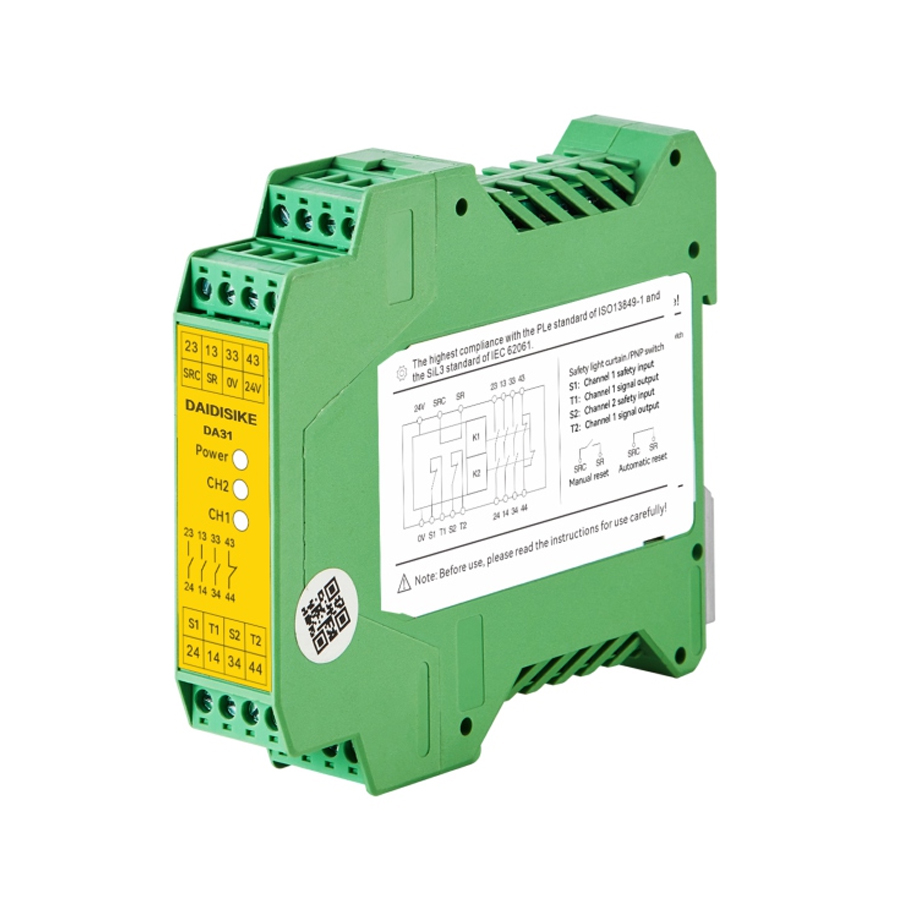
We keep cross-reference notes for the brands customers most often arrive with, and in the European interlock-and-relay world Schmersal is one of them. The inquiries land two ways: someone has a discrete SRB301LC or SRB200 on a DIN rail and wants a like-for-like substitute, or someone has a configured PROTECT SRB-E doing several jobs at once and assumes any “safety relay” will swap straight in. Those are two very different conversations, and this page is honest about both. Everything here is built the way we build every cross-reference — from Schmersal's own published specs and our own DA31 datasheet, never from a copied manual.
Record the complete Schmersal order number, operating-mode settings and installed schematic. Compare inputs, output type/count/load, reset/feedback, safety data, response and installation conditions. DA31 is only a candidate when every required function is documented; missing evidence is not a compatible match.
What is an SRB, and what is the DAIDISIKE DA31?
A safety relay evaluates the inputs and fault conditions documented for its model and mode. Force-guided internal contacts support particular fault detection, while external-device monitoring checks downstream switching devices through a supported feedback circuit. Neither function automatically establishes the other or the complete machine Performance Level.
The SRB range includes classic relays, multifunction SRB-E modules and EXi variants. Their functions and ratings are model-specific. DA31 manufacturer data lists dual-channel input, three N.O. safety contacts plus one auxiliary N.C. contact, below-30-ms release response and a 22.6 mm body. It does not establish SRB-family reset, cross-circuit detection or EDM parity.
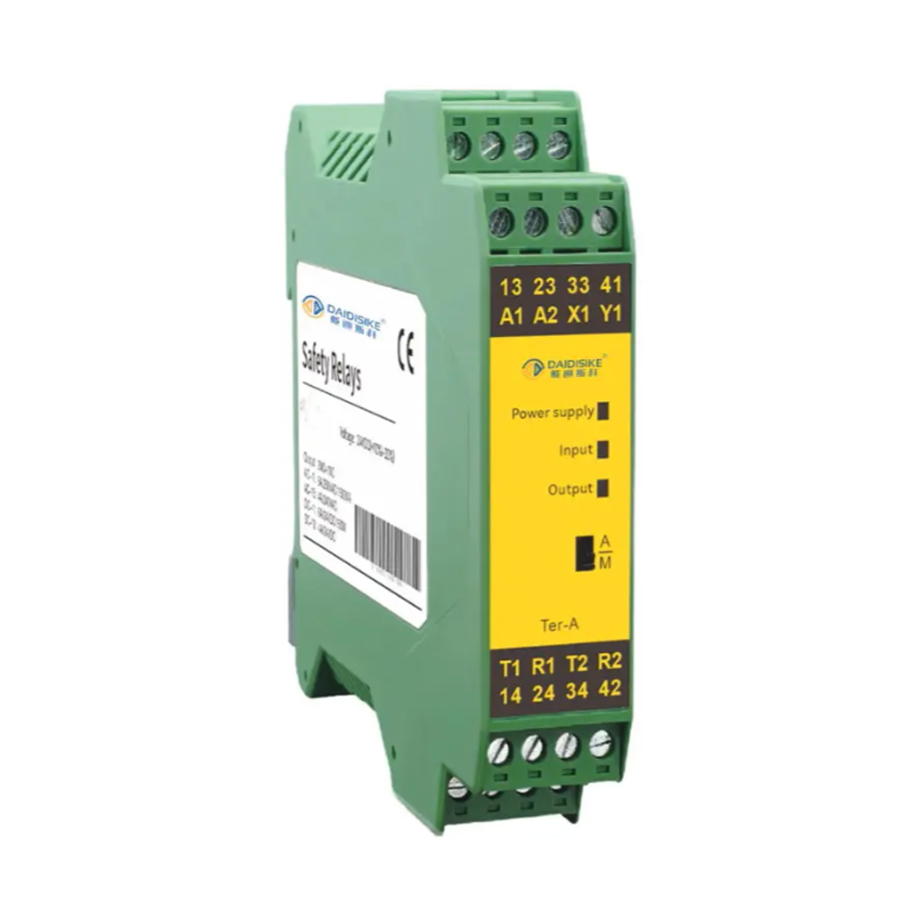
A compatible safety input feeds documented safety logic, whose safety outputs control the selected final switching devices. Where the design requires EDM, their prescribed feedback returns to a controller documented to evaluate it and inhibit restart on a detected fault.
This is not terminal wiring. DA31 EDM and monitored-reset support remain unconfirmed; no terminal names or competitor functions transfer to it.
Which Schmersal SRB does what? A family map before you cross-reference
Match the SRB family to the function first; only then decide whether a single DA31 is even the right shape of answer. The SRB catalogue is broad because it covers discrete relays, a configurable multi-function platform, and ATEX variants. Here is the honest map of the real families and a few anchor models.
| Schmersal SRB family | What it is | Anchor models | DA31 the right answer? |
|---|---|---|---|
| SRB classic (single-function) | Discrete electromechanical safety relays, one function each, up to Cat. 4 / PL e / SIL 3 | SRB301LC, SRB201LC, SRB200, SRB 301AN, SRB 031MC/031LC, SRB-400CS | Candidate only; input/reset/feedback must be verified |
| PROTECT SRB-E (configurable) | Family options include selected applications, delay and expansion; input/output counts and configured response are model-specific | SRB-E-201ST, SRB-E-204ST, SRB-E-204PE, SRB-E-301MC, SRB-E-402ST | Candidate only after the complete function and diagnostic requirements are documented |
| SRB-E-204PE input expander | Four-sensor input expansion; 2 semiconductor safety outputs rated 2 A in the cited catalogue | SRB-E-204PE | No equivalent expansion function; DA31 transistor signalling is not a safety output |
| SRB-E two-hand | Adds two-hand control evaluation to ISO 13851 / EN 574 | SRB-E-201ST: documented type IIIC mode | No established equivalent two-hand function; verify required type and timing |
| SRB200EXi / SRB101EXi (ATEX) | Intrinsically safe evaluation; exact apparatus and installation-area conditions apply | SRB200EXi-1A, SRB200EXi-1R, SRB101EXi-1A/1R | No — DA31 is not Ex-rated; keep the Ex device |
| PROTECT SELECT | Configurable application system; compare every used input and output function | PROTECT SELECT | No — multi-function; scope a controller |
The family map identifies functions that must be retained. A single-function SRB may justify comparing DA31, but it does not establish equivalence. Do not replace an SRB-E delay, specialized two-hand evaluation, semiconductor safety output, EXi function or PROTECT SELECT configuration with an assumed generic relay function.
DA31 vs a classic single-function Schmersal SRB — the side-by-side
The table is an engineering checklist, not a verified 1:1 cross-reference. Use the installed SRB manual and the applicable DA31 manual; unresolved reset or feedback requirements prevent a simple replacement.
| Parameter | DAIDISIKE DA31 | Schmersal SRB classic (e.g. SRB301LC / SRB201LC / SRB200) |
|---|---|---|
| Safety class | Manufacturer-listed PL e / SIL 3; complete circuit must be assessed | Up to Cat. 4 / PL e / SIL 3 |
| Output contacts | 3 safety NO + 1 auxiliary NC; separate signal transistor | Per model (e.g. NO safety contacts + signalling) — check label |
| Contacts force-guided | Yes (positive-guided) | Yes |
| Input channels | Dual-channel; cross-circuit detection requires manual evidence | Single / dual-channel |
| EDM (external device monitoring) | Not established in current DA31 specification | Yes |
| Reset | Verify applicable manual; monitored-reset equivalence not established | Auto / monitored-manual per model |
| Contact rating | AC-1 6 A/250 VAC, DC-1 6 A/24 VDC; 12 A max across contacts; AgSnO2+0.2 µm Au; 80,000-cycle life | Per Schmersal datasheet |
| Response time (release) | < 30 ms | Per Schmersal datasheet |
| Supply | 24 V DC (+10% / −20%), 2.9 W | Per model (24 V DC / AC variants) |
| DIN width | 22.6 mm | Per model |
| Typical functions | E-STOP, safety gate / interlock, light-curtain (OSSD) monitoring | E-STOP, safety gate, light-curtain monitoring (single-function) |
| Sourcing | Factory-direct quote; confirm quantity and delivery in writing | Schmersal distributor channel |
Where the Schmersal column reads “per Schmersal datasheet,” that is deliberate — we will not put a number in a Schmersal column unless it is published, and exact contact count, switching current and response time vary by SRB model. Pull them from your unit's label and confirm against Schmersal's own datasheet. Every figure in the DA31 column is from DAIDISIKE's published spec.
Evaluate the selected safeguard, documented safety logic, final switching devices and machine response as one function. Required architecture, reliability, diagnostic coverage, common-cause and systematic-failure measures all contribute to the achieved integrity.
A component rating does not approve the whole machine. Verify each required diagnostic and restart function; do not assume DA31 external-device monitoring.
What about the configurable PROTECT SRB-E? Where the DA31 stops
SRB-E features vary by exact variant. The Schmersal SRB-E-201ST/201LC/301ST manual distinguishes output and operating-mode arrangements. Do not assume every -ST means relay outputs, every device has a time selector, or all variants share one input count. Read the full model, mode and timing settings before assessment.
DA31 safety outputs are relay contacts, with a separate transistor output for signalling. A signalling transistor is not a semiconductor safety output. Its product specification lists input modes including two-hand control, but this does not prove the particular SRB-E two-hand type, timing or anti-tie-down behaviour. Configurable logic, delay, diagnostics and restart requirements must be matched in an approved design.
- ATEX / Zone 2: the Schmersal SRB200EXi / SRB101EXi are intrinsically-safe Ex devices. The DA31 is not Ex/ATEX/IECEx rated and must never be installed in a hazardous (explosive-atmosphere) area. There is no DAIDISIKE counterpart — keep the Ex unit.
- Response time & stopping distance: use each exact SRB-E model and configured function’s maximum response time. DA31 manufacturer data lists <30 ms for the module, not the machine. Reassess the complete measured worst-case stopping time and applicable protective distance after any logic change; do not assume timing parity.
How does the response-time gap affect my safety distance?
Compare documented worst-case stopping-chain response for the exact configurations. Two published less-than limits do not establish an actual 20 ms change. A relay swap must preserve the required emergency-stop performance and, for presence-sensing safeguards, the required separation distance.
S = (K × T) + C
In this simplified expression, S is separation distance and T includes the applicable complete stop-chain time. As a purely mathematical illustration, an additional 0.02 s at K = 2000 mm/s adds 40 mm; this is not a measured SRB-to-DA31 difference or a universal mounting instruction. Select the applicable method and configuration in the ISO 13855 guide, then use documented response data and measured machine stopping performance.
What to match before you swap any Schmersal SRB for a DA31
Six requirement groups start the assessment; collect the full installed-unit manual and schematic. This is the same discipline we apply to every brand cross-reference.
- Safety function — identify the selected documented E-STOP, gate or OSSD function. One DA31 is not assumed to combine all three. Two-hand, off-delay, expansion or independent zones require a device explicitly documented for those functions.
- Input channels — single-channel, or the architecture and fault diagnostics required by the risk-assessed function. Two channels alone do not establish the required integrity.
- Output type, count & rating — relay contacts vs semiconductor (DA31 safety outputs are contacts; transistor signal output is non-safety), how many NO enabling and any NC signalling contact, and switching current. DA31 = 3NO+1NC, AC-1 6 A / DC-1 6 A, 12 A max across contacts.
- EDM / reset — is external device monitoring used, and is reset automatic or monitored-manual? These functions require the applicable DA31 manual; DIP settings alone do not establish EDM or monitored-reset behavior.
- PL / SIL target — from your risk assessment (DA31 is PL e / SIL 3). And the response time, if a trip device is upstream (recompute EN ISO 13855 with <30 ms).
- DIN width & supply & area — panel space (DA31 is 22.6 mm), 24 V DC supply, and confirm it is not a hazardous (Ex) area.
Send those six off your installed safety relay for a documented DA31 assessment; unresolved requirements may mean it does not fit — for instance, if you actually need a configurable controller, a semiconductor-output module, a two-hand unit, an off-delay, or an Ex-rated device. If the existing Schmersal SRB is paired with a guard-door interlock, note that the sensor and logic must be assessed together. A DX-R1-B sensing candidate or DX-D6 guard-locking candidate needs its own exact-variant manual, interface and supporting safety data; matching a relay does not approve the connected interlock. The wider method and the other brand cross-references — such as our Pilz PNOZ alternatives and Allen-Bradley Guardmaster alternatives — live in the safety relay manufacturer guide.

Is naming Schmersal and SRB legal, and how do you keep this honest?
Schmersal and SRB names identify the comparison targets, with no affiliation or endorsement implied. This is not a legal opinion or a compatibility declaration. Use primary manufacturer documentation for each exact model, and retain missing DA31 diagnostic or specialist-function evidence as an unresolved engineering requirement.
Sources & specifications cited
- Schmersal — safety relays (SRB) overview — classic SRB single-function modules (SRB301LC, SRB201LC, SRB200) up to Cat. 4 / PL e / SIL 3.
- Schmersal — PROTECT SRB-E configurable safety relays — see the exact-model catalogue tables: -201ST has a documented type IIIC two-hand mode; -204PE is an input expander with two 2 A safety outputs. Do not transfer these functions across suffixes.
- Schmersal — SRB200EXi / SRB101EXi intrinsically-safe (ATEX) variants — Zone 2 gas-Ex; no DAIDISIKE counterpart.
- DAIDISIKE DA31 safety relay datasheet — PL e / SIL 3, 3NO+1NC force-guided contacts and dual-channel input; EDM/monitored reset not established; AC-1/DC-1 6 A, 12 A max, AgSnO2+0.2 µm Au, 80,000-cycle life, 24 V DC 2.9 W, 22.6 mm DIN, <30 ms.