
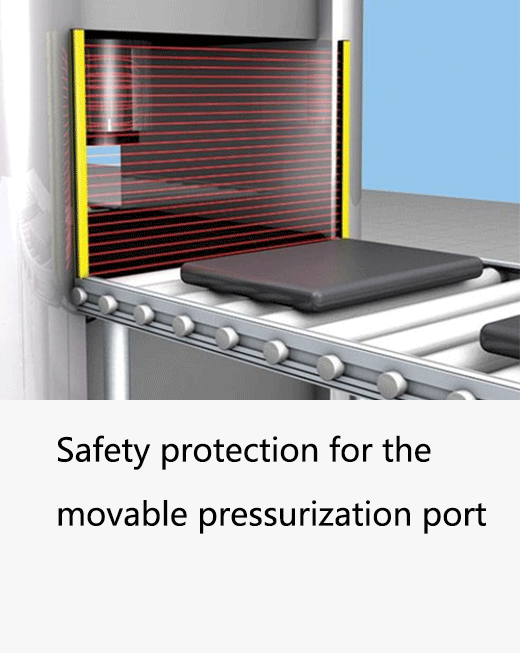
Start with the machine type, clutch, brake and risk assessment rather than a product number. The machine safety standards index separates legal and technical references; the press photoelectric protector range is a selection step only after the safeguarding method is established.
This article is a plain-English walk-through of the regulation as it stands in 2026, focused on the parts that matter when a light curtain is on the table. It is written for plant safety managers, maintenance engineers, and the buyers writing the purchase order. It is general engineering guidance — not legal or compliance advice — and a real compliance assessment for a specific press has to be signed off by a qualified machine-safety professional.
What 1910.217 actually covers (and what it doesn’t)
29 CFR 1910.217 is titled simply Mechanical power presses. The scope is in 1910.217(a)(1): it applies to mechanical power presses that transmit force mechanically to cut, form, or assemble metal or other materials by tools or dies. It does not cover several machines that people often assume it does, and the distinction matters for buyers:
- Hydraulic and pneumatic presses — different scope. They fall under 1910.212 (general machine guarding) and ANSI B11.2. The safety logic is similar but the specific clauses are not.
- Press brakes — not mechanical power presses under 1910.217. OSHA has issued letters of interpretation making this explicit, and press brakes get their own treatment under ANSI B11.3 and our companion guide on press brake light curtains.
- Forging presses, hot-metal presses, ironworkers, and several others — explicitly excluded by the scope of ANSI B11.1 and by 1910.217 itself. Different machine, different rule.
If you are not certain your machine is a mechanical power press under 1910.217, start by reading 1910.217(a) and (b) carefully before specifying any guarding. The scope question determines which regulation governs the install.
The part-revolution / full-revolution split
This is the single most important distinction in 1910.217 for anyone considering a light curtain, and it is not optional.
A full-revolution clutch press, once tripped, cannot be stopped mid-stroke — the clutch is mechanically engaged for a full crankshaft revolution and the slide will complete its cycle whether you want it to or not. A part-revolution clutch press uses a friction clutch that can be disengaged at any point in the stroke, and a properly maintained brake will stop the slide.
A light curtain works by detecting an intrusion and commanding a stop. On a full-revolution clutch press there is no stop to command — the machine is going to finish the stroke. OSHA is unambiguous on this: a presence sensing device may not be used as point-of-operation guarding on a full-revolution clutch press for normal production. It is both an unsafe practice and a 1910.217 violation. If your press has a full-revolution clutch, your permitted guarding method must be assessed specifically for that machine. A Type A gate or appropriately designed fixed enclosure may be considered; do not assume Type B gates or two-hand control/trip modes are interchangeable. A light curtain cannot stop that stroke.
The first question on any retrofit conversation, therefore, is: does this press have a part-revolution clutch? If not, the conversation about light curtains is over before it starts. If yes, read on.
Point-of-operation guarding under 1910.217(c)(3)
1910.217(c)(3) is the clause that permits presence sensing devices as point-of-operation guarding, and (c)(3)(iii) lays out what the device has to do. The substance, in plain English:
- The device shall protect the operator by preventing or stopping normal stroking of the press if the operator’s hand or any part of the body is inadvertently placed in the point of operation.
- The device shall be interlocked into the control circuit so that slide motion will be stopped if any part of the operator’s body is within the sensing field during the downstroke.
- The device shall not be used as a tripping means to initiate slide motion, except where used in total conformance with 1910.217(h) — the PSDI clause, covered below.
- The device shall be constructed so that a failure within the system does not prevent the normal stopping action from being applied when required, but does prevent the initiation of a successive stroke until the failure is corrected. This is the control reliability requirement, expanded in 1910.217(b)(13).
- Supplemental guarding shall be used to protect all areas of access to the point of operation that are not protected by the presence sensing device.
The supplemental guarding requirement is the one that catches retrofit installs. A single light curtain across the front of a press leaves the sides, back, and often the top wide open. Fixed barriers, additional curtains, or interlocked guards have to close those routes, or the installation is non-compliant on the day it is commissioned.
The 63 in/s safety distance formula
1910.217(c)(3)(iii)(e) gives the safety distance formula specifically for presence sensing devices on mechanical power presses:
Where Ds is the minimum safety distance from the sensing field to the point of operation in inches, Ts is the stopping time of the press in seconds measured at approximately the 90° position of crankshaft rotation, and 63 in/s is OSHA’s hand-speed constant.
A few practical points that the bare formula does not show:
- Preserve the regulation's definition of Ts, and ensure the engineering assessment includes every relevant sensing, logic, clutch/brake response and deterioration allowance. Do not substitute the curtain datasheet response for a measured press stopping time.
- The stopping time has to be measured, not assumed. A press brake-system monitor (required by 1910.217(b)(14) where (c)(5) applies, with separate PSDI provisions) and a periodic stop-time test on the actual press are the practical way to do that.
- ANSI B11.19-2019 gives a more granular safety-distance calculation aligned with ISO 13855, with terms for object resolution and approach geometry. Modern practice is to use the ANSI B11.19 method on a new install and verify that the answer still meets or exceeds the OSHA minimum. We cover the international version in our ISO 13855 safety-distance guide.
- Any change to the press changes the calculation. A new die that increases stroke length, a worn brake, a faster cycle — all of these change Ts, and the safety distance has to be re-verified.
Control reliability under 1910.217(b)(13)
Apply the conditions in 1910.217(c)(5), including hand feeding or removal at the point of operation with the listed safeguards on a part-revolution press. Those provisions invoke control reliability under (b)(13) and brake monitoring under (b)(14). Check the actual mode and applicable clauses rather than treating one product label as proof of the complete installation.
OSHA’s definition of control reliability: “The device, system, or interface shall be designed, constructed and installed such that a single component failure within the device, interface or system shall not prevent the normal stopping action from being applied to the press when required, but shall prevent initiation of a successive stroke until the failure is corrected.”
Evaluate the complete safety-related path against the specified failure and stop requirements. A certified sensor, compatible safety logic, correctly selected final switching or valve elements and required brake monitor must work together. A DA31 safety relay module is not an automatic substitute for a validated press control system; confirm its documented input, feedback and reset capabilities.
The mapping from OSHA control reliability to international standards is worth understanding because it comes up constantly on imported machines:
| Concept | OSHA / ANSI (US) | IEC / ISO (international) |
|---|---|---|
| Safety control system reliability | Control reliability per 1910.217(b)(13); ANSI B11.19-2019 control function categories | ISO 13849-1 Performance Level (PL d / PL e); IEC 62061 SIL (SIL 2 / SIL 3) |
| Light curtain product standard | ANSI/UL 61496 parts 1 & 2 (Type 4) | IEC 61496-1 / -2 (Type 4) |
| Press safety standard | OSHA 29 CFR 1910.217; ANSI B11.1-2009 (R2020) | EN ISO 16092 series |
| Safeguarding methods | ANSI B11.19-2019 | EN ISO 13855, EN ISO 14119 |
ISO/IEC device evidence is useful, but the table is not a legal equivalence chart. Demonstrate the actual control-reliability behavior and stopping performance through the final clutch/brake controls.
PSDI — the special case under 1910.217(h)
Presence Sensing Device Initiation (PSDI) is a mode where the light curtain not only protects the operator but also initiates the next press stroke when the operator clears the sensing field. The curtain becomes the trip device, not just the guard. It is attractive in high-volume work because the operator does not have to release a two-hand control between parts.
1910.217(h) governs PSDI and the requirements are notably stricter than ordinary point-of-operation guarding:
- Part-revolution clutch only. Full-revolution presses are explicitly excluded.
- No walk-through geometry. A press configuration that would let a person enter, pass through, and become clear of the sensing field into the hazardous portion of the press is not permitted in PSDI.
- Minimum object sensitivity not greater than 1.25 inches (31.75 mm). This maximum object-sensitivity value does not mean a device can detect a small finger; verify the actual detection capability and all PSDI conditions.
- Certified and validated safety system. Section 1910.217(h)(11) and Appendix A distinguish manufacturer design certification from employer installation certification. Both require validation by an OSHA-recognized third-party validation organization. Employer recertification and recognized third-party revalidation are required at least annually thereafter.
- Normal production only. PSDI may not be used for die-setting or maintenance — those operations have to fall back to the standard safeguarded mode under 1910.217(a) through (g).
Decide whether PSDI is actually needed before specifying it. Ordinary presence-sensing safeguarding does not authorise clearing the field to start a stroke. PSDI is a separate engineering project with the recognized validation and recurring certification duties above, not a configuration tweak.
Five compliance review points
The following are inspection questions, not a claim of measured customer audit frequency. Record evidence for each on the actual press.
1. Light curtain on a full-revolution press
The single most serious finding. Someone retrofits an older full-revolution clutch press with a curtain — sometimes because the part-revolution rule is not understood, sometimes because the original clutch type was misidentified. The installation is unsafe on day one. The fix is either a clutch and brake conversion (a substantial mechanical retrofit) or a different safeguarding method appropriate to a full-revolution press.
2. Safety distance no longer holds
The press was validated at commissioning. Five years later the brake is worn, Ts is longer, and the curtain is mounted at the same distance it was on day one. The installation drifted out of compliance quietly. A periodic stop-time test — required in practice by 1910.217(e) inspection and maintenance — catches this.
3. No brake monitor, or a brake monitor that isn’t working
Apply 1910.217(c)(5) to the actual operating mode: it invokes the control-reliability and brake-monitor requirements for specified hand-feeding or hand-removal at the point of operation using the listed safeguards on part-revolution presses. Paragraph (b)(14) requires the monitor to prevent a successive stroke when stopping performance no longer supports the required safety distance, with the specified Type B gate/top-stop provisions. PSDI has additional requirements under (h)(5). A required monitor must be functional; do not treat a curtain product label as proof of these checks.
4. Supplemental guarding missing on the sides or back
The classic retrofit error. One front-mounted curtain, nothing else. The auditor walks around to the back, points at the open access path, and the conversation ends. Fixed barriers, additional curtains, or interlocked guards have to close every path to the point of operation.
5. Treating Type 4 as “the whole answer”
Verify the exact curtain evidence and compatible circuit instead of treating Type 4 as approval. Control reliability concerns the complete safety function and the fault behavior required by the regulation, not simply a claim that every individual part is redundant.
A 1910.217 compliance checklist for buyers
Before issuing a purchase order for a light curtain on a US mechanical power press, the buyer and the engineering lead should be able to answer all of the following:
| Question | Where it lives in 1910.217 | What “yes” looks like |
|---|---|---|
| Is this press a part-revolution clutch press? | (b)(7), (c)(3) | Friction clutch, slide stops mid-stroke on brake command |
| Does exact device evidence meet the required protective performance? | (c)(3)(iii); 1910.217(b)(13) sensing layer | Applicable device certificate and instructions, compatible output and verified failure response |
| Has Ds = 63 in/s × Ts been measured? | (c)(3)(iii)(e) | Documented stop-time test, curtain mounted at or beyond Ds |
| Is a brake monitor fitted and active? | (b)(14) | Brake monitor wired into control circuit, periodically tested |
| Is the whole safety chain control-reliable? | (b)(13) | Redundant, self-monitored logic through to force-guided contactors |
| Are all access paths to the point of operation guarded? | (c)(3) | Front curtain + side / back fixed barriers or curtains; no unguarded path |
| If PSDI: full 1910.217(h) compliance? | (h), Appendix A | OSHA-recognized third-party validation of the certified PSDI safety system, ≤ 1.25 in object sensitivity, no walk-through geometry |
How OSHA, ANSI B11.1 and ANSI B11.19 fit together
A short word on the hierarchy, because it comes up on every procurement call.
OSHA 29 CFR 1910.217 is the legal floor. It is a federal regulation, enforceable by inspection and citation, and a US press has to comply with it. The text has not been substantively updated in many years — it predates a lot of the modern engineering vocabulary — but it is still the rule.
ANSI B11.1-2009 (R2020) is the consensus standard for mechanical power presses. It is not law, but it is the document the industry treats as current good practice. ANSI B11.1 incorporates risk assessment, modern safeguarding language, and the technical detail that 1910.217 lacks. OSHA inspectors routinely reference it under the General Duty Clause where the federal rule is silent.
ANSI B11.19-2019 is the safeguarding standard. It defines performance criteria for light curtains, laser scanners, two-hand controls, interlocked guards and the rest. The 2019 revision pulled in safety-distance content aligned with ISO 13855, including reaching-over and reaching-through geometry that 1910.217 simply does not address.
The right practical posture, in 2026, is to design to ANSI B11.1 and ANSI B11.19 as current good practice while making sure the install also satisfies OSHA 1910.217 as the legal minimum. They do not conflict on the substantive points — part-revolution only, control reliability, supplemental guarding, brake monitoring — but the ANSI standards give you the engineering detail you need to actually execute the design.
Where DAIDISIKE fits — straight answer
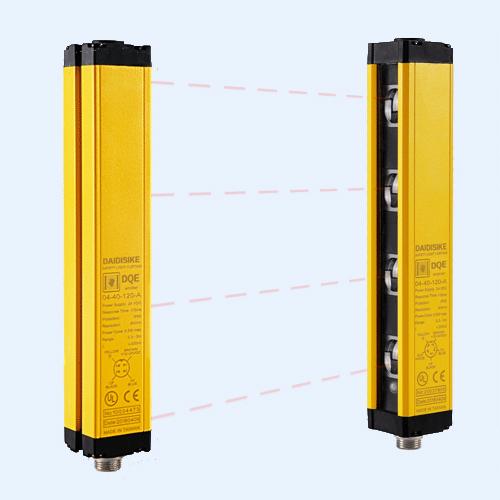
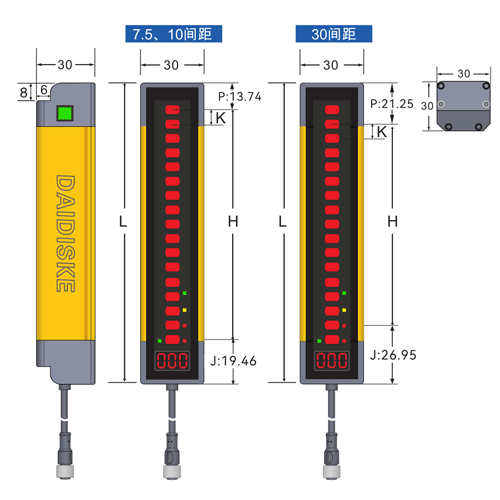
Since you are reading this on our site, a plain account. DAIDISIKE is a long-established Foshan-based industrial safety sensor manufacturer. Compare exact light-curtain specifications and documents, including the DQC product information, against the required sensing function. Adding a DA31 module and brake monitor does not itself establish OSHA compliance; the complete press architecture must be assessed and validated.
What we will not tell you is that buying our hardware makes a press 1910.217-compliant by itself. It does not. The clutch type, the brake condition, the supplemental guarding, the documented stop-time test, the wiring of the whole safety chain, and the operator training all have to be right. Our engineering team is happy to walk a press with a US customer and scope the install properly, and we would rather do that than sell a tidy bill of materials that an OSHA inspector unpicks later. You can reach us through our contact page.
Edition check: the B11 publisher lists B11.19—2019 (R2024) on its scope page. Historical edition references in this overview are not a promise that they govern a particular new installation; confirm the exact current publisher listing and applicable requirements before release.
The bottom line
29 CFR 1910.217 is an old regulation that does a small set of things very clearly: it limits presence sensing devices to part-revolution clutch presses, it gives an explicit safety distance formula, it demands control reliability and a brake monitor, it carves out PSDI as a separate and stricter mode, and it requires that every unguarded access path be closed by supplemental means. A single front curtain does not demonstrate compliance with all of these requirements.
For a US press install in 2026: start from the clutch type, read 1910.217 alongside ANSI B11.1-2009 (R2020) and ANSI B11.19-2019, measure the stopping time, build the whole chain control-reliably, close every access path, and document all of it. Do that and the light curtain is the easy part of the project.
Related reading
How to Use a Press Brake Light Curtain
Press brakes are not mechanical power presses — different rule set, different setup.
Punch Press Safety Light Curtain Retrofit
Retrofitting an older punch press to a Type 4 curtain — what changes and what doesn't.
DAIDISIKE DQC Safety Light Curtain
DQC hand-protection product information; verify the exact output variant and certification evidence.