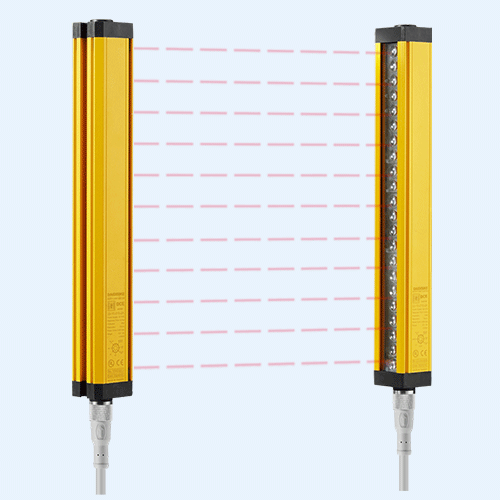
What resolution should I choose for finger, hand or body protection?
Match the resolution to the smallest body part that can reach the hazard: 10 mm for finger protection, 20 mm for palm protection, and 30/40 mm for hand-arm or body presence. The DCE offers 10/20/30/40 mm, so a single series covers presses, injection-molding machines and perimeter guarding without changing supplier.
What safety type / performance level does the DCE carry?
The DCE is a through-beam opto-electronic protective device (AOPD) — a product category designed with reference to IEC 61496 and to the machinery-safety standards ISO 13849 / ISO 13855. DAIDISIKE has not published a type classification (Type 2 / Type 4) or a performance level for the DCE series, so none is claimed here; request the current test documentation from the factory before specifying the DCE into a rated safety function. Where a documented Type 4 / PL e / SIL 3 device is required, use the DQT4 series.
Can the DCE replace an Omron, SICK or Keyence safety light curtain?
In many cases yes, mechanically. The DCE covers the common resolutions (10/20/30/40 mm) with NPN/PNP transistor outputs, so it drops into the same safety loop. Confirm the mounting length, the resolution and the required operating distance against the unit being replaced, and where the original carried a certified Type/PL rating confirm the equivalent documentation with the factory. See our Keyence/SICK alternatives buyer's guide linked below.
How is the DCE wired?
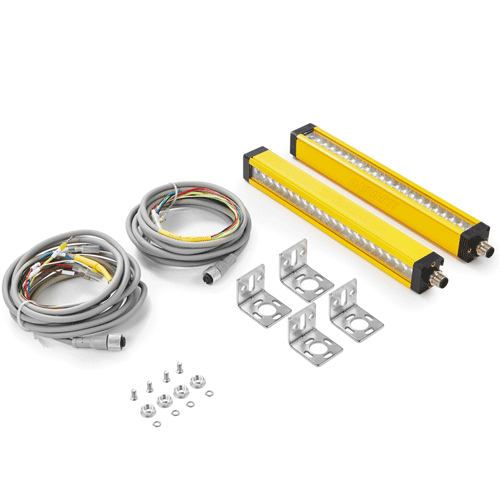
The DCE uses two 7-core cables, bringing out power and the NPN/PNP-selectable safety outputs. Feed the outputs into a dual-channel safety relay or safety PLC input, and route the feedback loop through forcibly-guided contacts so a welded contact is caught on restart. See our OSSD NPN/PNP wiring with EDM guide.
How do I read a DCE model number?
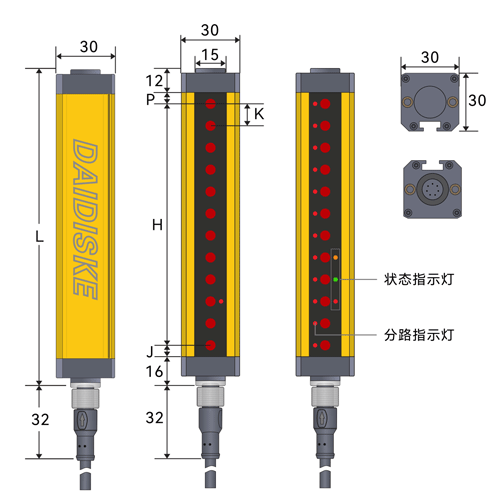
DCE + beam count + "/" + beam pitch + "-" + protective height. For example DCE72/40-2840 is 72 beams at 40 mm pitch giving a 2840 mm protected height — the largest in the series. Protective height is always (beam count − 1) × pitch, the distance from the first beam to the last beam. Small-beam-count models at 30 mm pitch carry a Q suffix (DCE04/30-90Q through DCE12/30-330Q).
How do I calculate the minimum safety distance for the DCE?
Use ISO 13855: S = K × T + C, where K = 2000 mm/s (hand-speed constant), T is the machine stop time plus the curtain response time, and C is the intrusion factor derived from the resolution. The DCE response time is not published in the catalogue data — obtain the confirmed figure from the factory before you calculate T. Our ISO 13855 safety distance calculator works out the rest from your resolution and stop time.