
MQ Essence Edition — Slim-Profile Safety Light Curtain, Optical Sync
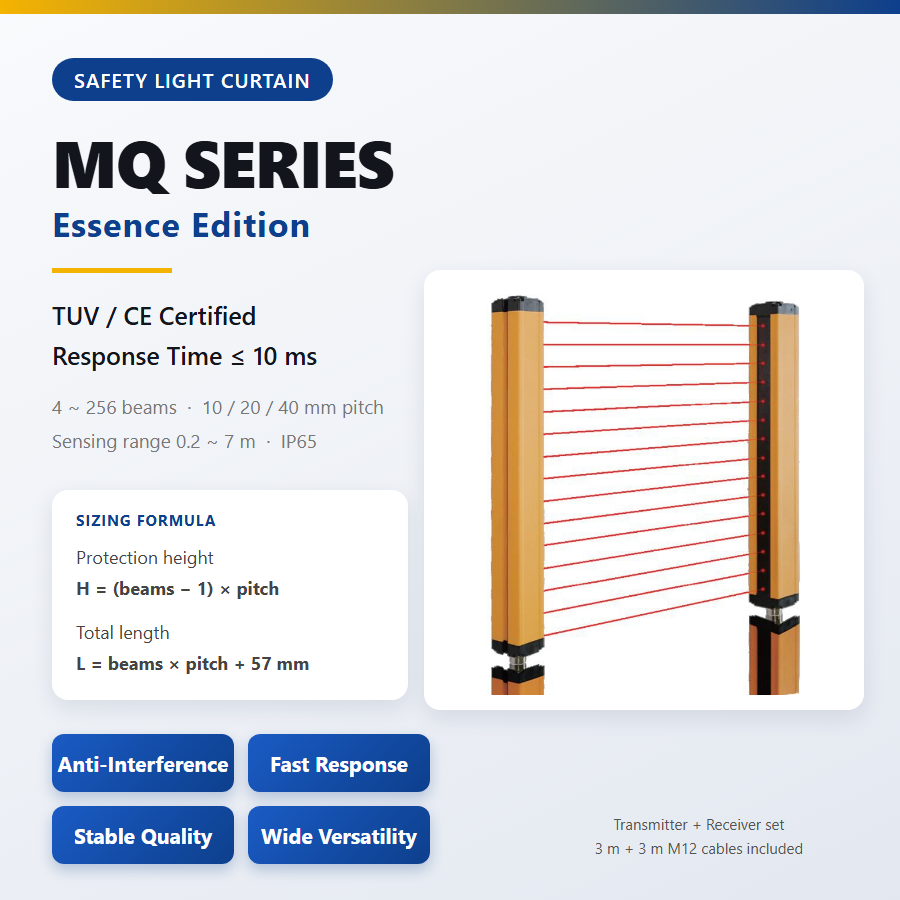
A through-beam transmitter/receiver pair in one of the slimmest housings of its class, engineered around a synchronisation trick that deletes an entire cable: timing travels inside the beam, so nothing is wired between the two units.
- 29 × 30 mm extruded profile — fits tight press uprights and guard frames
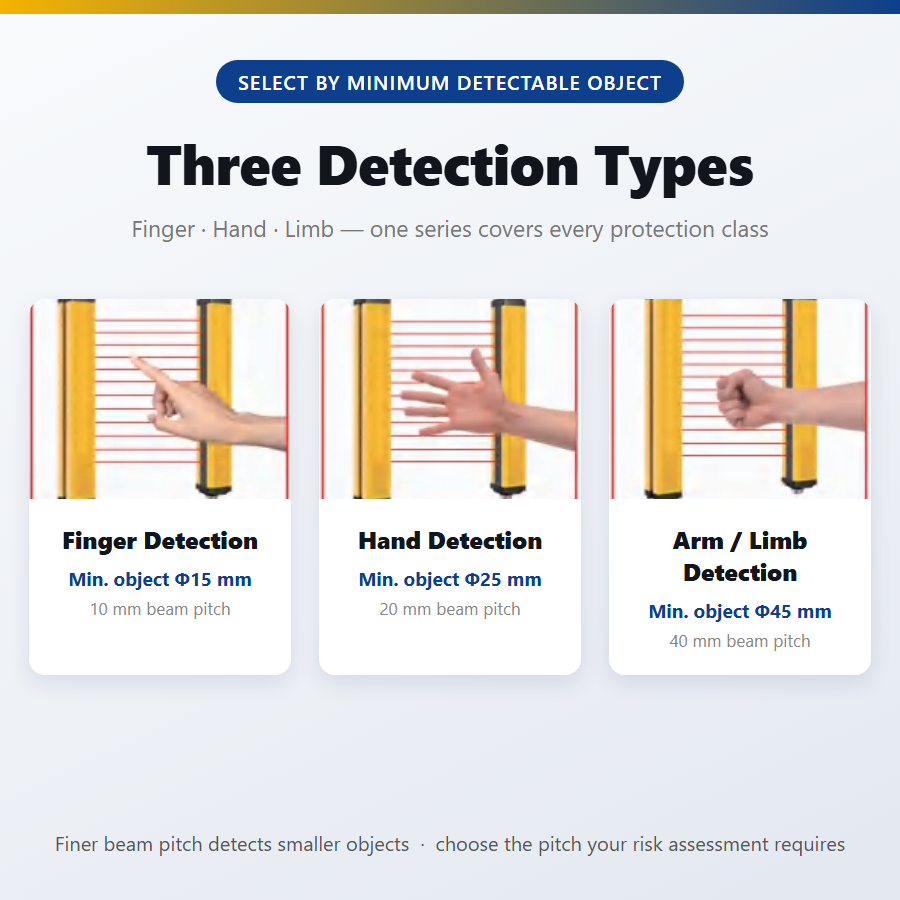
- Pitches 10 / 20 / 40 mm → finger, hand, arm/body detection classes
- 4–256 beams · sensing bands from 0.2 m to 7 m · response ≤ 10 ms
- Optical sync: zero conductors TX↔RX, separate 24 V supplies allowed
- M12 plug-and-play with factory-fitted 3 m cables · IP65 · TUV/CE
Built for the Machines Where Space and Wiring Time Are the Constraints
Ten-plus years of field iteration across metal forming, packaging and plastics machinery shaped the MQ into a very specific tool: the curtain you fit when the mounting slot is narrow, the electrician has twenty machines to finish, and the environment throws welding flash and inverter noise at the optics. The 29 × 30 mm extrusion goes where bulkier barriers do not; the M12 aviation connectors on factory-fitted 3 m cables remove field termination entirely; and the onboard CPU self-check watches the curtain itself — sync loss, weak received light, drive circuit faults, cable faults — and annunciates rather than hides them.
The optical synchronisation deserves its headline: a narrow-angle emitter and cyclic scanning algorithm lock transmitter and receiver through the light path alone. No sync core, no extra conduit, and — uniquely useful on wide machines — the two units can run from separate 24 V DC supplies on opposite side panels. A wire-synchronised variant (code W) exists for specifications that demand it. Ambient light immunity is rated at 10,000 Lux, with coded scanning rejecting adjacent-curtain crosstalk.
Model Selection Tables — All 87 Standard Models
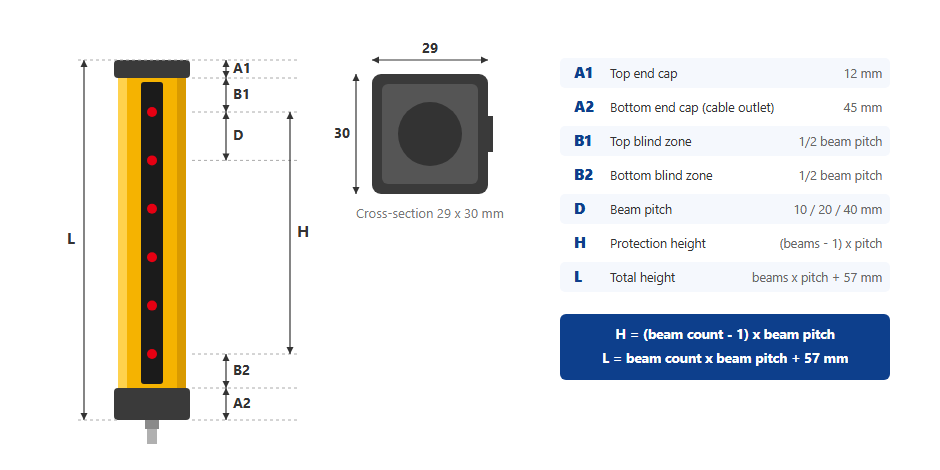
Model numbers read MQ + beam count N / pitch K − protection height H: MQ22/10-210 is 22 beams at 10 mm pitch guarding a 210 mm height. Two formulas generate the whole family — H is (N − 1) × K measured beam centre to beam centre, and the housing length L is N × K + 57 mm, the 57 mm being the 12 mm top cap plus the 45 mm bottom cap with the cable outlet. Pick the pitch from the body part that can reach the hazard, then read down to the first protection height that covers your opening. If you are still choosing a resolution class, the selection guide walks the decision, and the effective protective height explainer covers why H is measured centre-to-centre.
Φ15 mm minimum detectable object — the finger-detection class. Specify 10 mm pitch wherever an operator's fingers can enter the hazard zone itself: die spaces on small presses, punch tooling, manual insertion fixtures.
| Model | Beam pitch K (mm) | Number of beams N | Protective height H (mm) | Housing length L (mm) |
|---|---|---|---|---|
| MQ04/10-30 | 10 | 4 | 30 | 97 |
| MQ06/10-50 | 10 | 6 | 50 | 117 |
| MQ08/10-70 | 10 | 8 | 70 | 137 |
| MQ10/10-90 | 10 | 10 | 90 | 157 |
| MQ12/10-110 | 10 | 12 | 110 | 177 |
| MQ14/10-130 | 10 | 14 | 130 | 197 |
| MQ16/10-150 | 10 | 16 | 150 | 217 |
| MQ18/10-170 | 10 | 18 | 170 | 237 |
| MQ20/10-190 | 10 | 20 | 190 | 257 |
| MQ22/10-210 | 10 | 22 | 210 | 277 |
| MQ24/10-230 | 10 | 24 | 230 | 297 |
| MQ26/10-250 | 10 | 26 | 250 | 317 |
| MQ28/10-270 | 10 | 28 | 270 | 337 |
| MQ30/10-290 | 10 | 30 | 290 | 357 |
| MQ32/10-310 | 10 | 32 | 310 | 377 |
| MQ34/10-330 | 10 | 34 | 330 | 397 |
| MQ36/10-350 | 10 | 36 | 350 | 417 |
| MQ38/10-370 | 10 | 38 | 370 | 437 |
| MQ40/10-390 | 10 | 40 | 390 | 457 |
| MQ42/10-410 | 10 | 42 | 410 | 477 |
| MQ44/10-430 | 10 | 44 | 430 | 497 |
| MQ46/10-450 | 10 | 46 | 450 | 517 |
| MQ48/10-470 | 10 | 48 | 470 | 537 |
| MQ50/10-490 | 10 | 50 | 490 | 557 |
| MQ52/10-510 | 10 | 52 | 510 | 577 |
| MQ54/10-530 | 10 | 54 | 530 | 597 |
| MQ56/10-550 | 10 | 56 | 550 | 617 |
| MQ58/10-570 | 10 | 58 | 570 | 637 |
| MQ60/10-590 | 10 | 60 | 590 | 657 |
| Model | Beam pitch K (mm) | Number of beams N | Protective height H (mm) | Housing length L (mm) |
|---|---|---|---|---|
| MQ04/20-60 | 20 | 4 | 60 | 137 |
| MQ06/20-100 | 20 | 6 | 100 | 177 |
| MQ08/20-140 | 20 | 8 | 140 | 217 |
| MQ10/20-180 | 20 | 10 | 180 | 257 |
| MQ12/20-220 | 20 | 12 | 220 | 297 |
| MQ14/20-260 | 20 | 14 | 260 | 337 |
| MQ16/20-300 | 20 | 16 | 300 | 377 |
| MQ18/20-340 | 20 | 18 | 340 | 417 |
| MQ20/20-380 | 20 | 20 | 380 | 457 |
| MQ22/20-420 | 20 | 22 | 420 | 497 |
| MQ24/20-460 | 20 | 24 | 460 | 537 |
| MQ26/20-500 | 20 | 26 | 500 | 577 |
| MQ28/20-540 | 20 | 28 | 540 | 617 |
| MQ30/20-580 | 20 | 30 | 580 | 657 |
| MQ32/20-620 | 20 | 32 | 620 | 697 |
| MQ34/20-660 | 20 | 34 | 660 | 737 |
| MQ36/20-700 | 20 | 36 | 700 | 777 |
| MQ38/20-740 | 20 | 38 | 740 | 817 |
| MQ40/20-780 | 20 | 40 | 780 | 857 |
| MQ42/20-820 | 20 | 42 | 820 | 897 |
| MQ44/20-860 | 20 | 44 | 860 | 937 |
| MQ46/20-900 | 20 | 46 | 900 | 977 |
| MQ48/20-940 | 20 | 48 | 940 | 1017 |
| MQ50/20-980 | 20 | 50 | 980 | 1057 |
| MQ52/20-1020 | 20 | 52 | 1020 | 1097 |
| MQ54/20-1060 | 20 | 54 | 1060 | 1137 |
| MQ56/20-1100 | 20 | 56 | 1100 | 1177 |
| MQ58/20-1140 | 20 | 58 | 1140 | 1217 |
| MQ60/20-1180 | 20 | 60 | 1180 | 1257 |
| Model | Beam pitch K (mm) | Number of beams N | Protective height H (mm) | Housing length L (mm) |
|---|---|---|---|---|
| MQ04/40-120 | 40 | 4 | 120 | 217 |
| MQ06/40-200 | 40 | 6 | 200 | 297 |
| MQ08/40-280 | 40 | 8 | 280 | 377 |
| MQ10/40-360 | 40 | 10 | 360 | 457 |
| MQ12/40-440 | 40 | 12 | 440 | 537 |
| MQ14/40-520 | 40 | 14 | 520 | 617 |
| MQ16/40-600 | 40 | 16 | 600 | 697 |
| MQ18/40-680 | 40 | 18 | 680 | 777 |
| MQ20/40-760 | 40 | 20 | 760 | 857 |
| MQ22/40-840 | 40 | 22 | 840 | 937 |
| MQ24/40-920 | 40 | 24 | 920 | 1017 |
| MQ26/40-1000 | 40 | 26 | 1000 | 1097 |
| MQ28/40-1080 | 40 | 28 | 1080 | 1177 |
| MQ30/40-1160 | 40 | 30 | 1160 | 1257 |
| MQ32/40-1240 | 40 | 32 | 1240 | 1337 |
| MQ34/40-1320 | 40 | 34 | 1320 | 1417 |
| MQ36/40-1400 | 40 | 36 | 1400 | 1497 |
| MQ38/40-1480 | 40 | 38 | 1480 | 1577 |
| MQ40/40-1560 | 40 | 40 | 1560 | 1657 |
| MQ42/40-1640 | 40 | 42 | 1640 | 1737 |
| MQ44/40-1720 | 40 | 44 | 1720 | 1817 |
| MQ46/40-1800 | 40 | 46 | 1800 | 1897 |
| MQ48/40-1880 | 40 | 48 | 1880 | 1977 |
| MQ50/40-1960 | 40 | 50 | 1960 | 2057 |
| MQ52/40-2040 | 40 | 52 | 2040 | 2137 |
| MQ54/40-2120 | 40 | 54 | 2120 | 2217 |
| MQ56/40-2200 | 40 | 56 | 2200 | 2297 |
| MQ58/40-2280 | 40 | 58 | 2280 | 2377 |
| MQ60/40-2360 | 40 | 60 | 2360 | 2457 |
29 standard models at 10 mm pitch · 87 across the series. H = (N − 1) × K, beam centre to beam centre; L = N × K + 57 mm, end cap to end cap. Intermediate beam counts and 62–256-beam builds are made to order — send the opening height you need to cover.
Beam counts 62–256, non-standard pitches, shielded cable (S20n), cross-beam scanning (X) and custom cable lengths (Cn) are built to order. Full ordering code example: MQ-2010NC03E = 20 beams · 10 mm pitch · NPN output · C normally-closed logic · 03 the 1–3 m range band · E top-and-bottom brackets. Range bands run 01 (0–1 m) · 03 (1–3 m) · 05 (1–5 m) · 07 (1–7 m) — order the band that brackets your actual TX–RX separation, not the largest one.
Two Synchronisation Modes, One Detection Behaviour
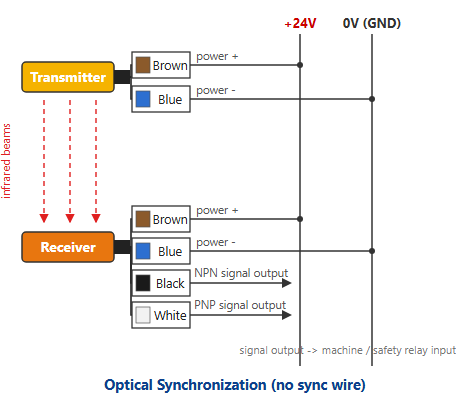
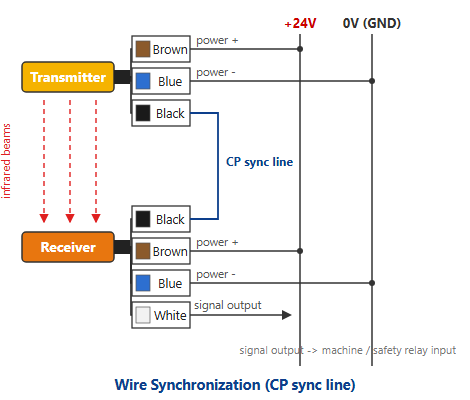
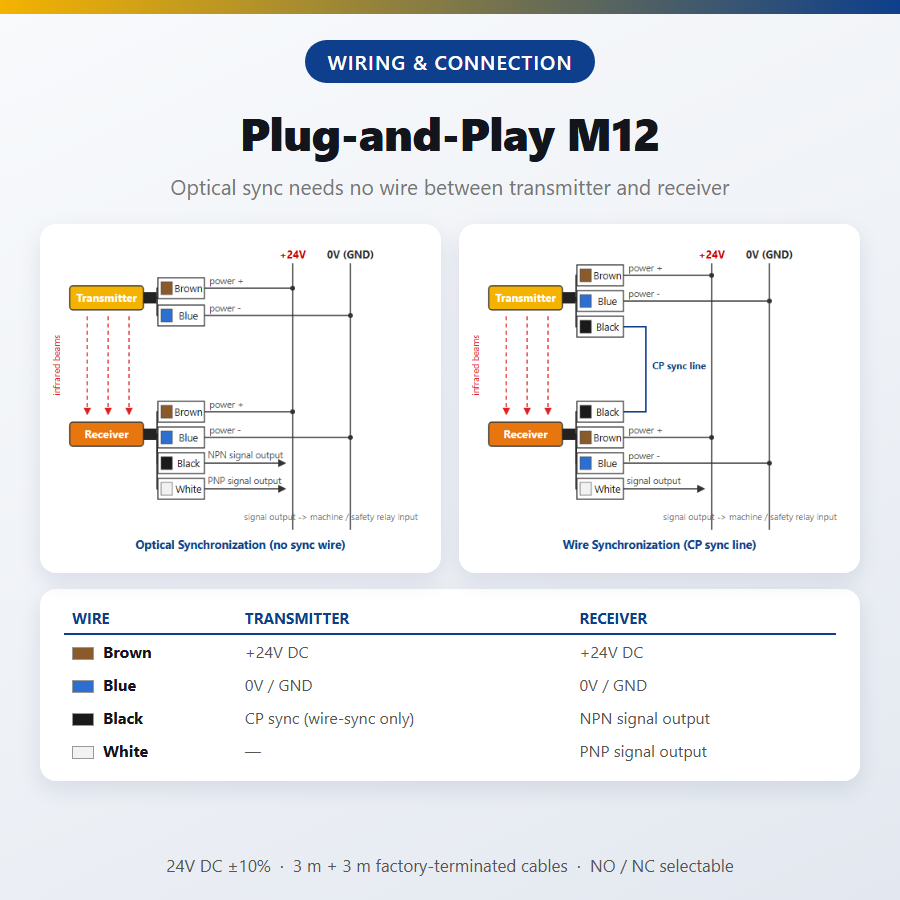
Every through-beam curtain must keep transmitter and receiver scanning in lock-step; the MQ offers two ways to do it. The standard units use cyclic optical synchronisation: timing rides inside the modulated beam itself, so no conductor of any kind runs between the two housings — and the two units may be powered from separate 24 V DC supplies on opposite sides of the machine. The wire-sync version (order code W) instead carries timing on a dedicated CP conductor; it exists for specifications that mandate a hard-wired sync channel, and it requires both units on a shared supply. Detection behaviour — pitch, response, output logic — is identical either way.
Wiring: One Output, Ordered to Match Your Input Card
The receiver switches a single output channel, ordered as NPN (sinking) or PNP (sourcing) in normally-open or normally-closed logic. Order NC unless a specification says otherwise: with NC logic a cut cable, lost supply or unplugged M12 reads exactly like an intrusion, and the machine stops — the failure mode lands on the safe side. Which polarity you need is a property of your PLC input card or safety relay input, not of the curtain; the NPN/PNP wiring guide shows both hookups terminal by terminal, and the safety-relay wiring page covers the downstream loop into a relay such as the DA31.
Physically there is nothing to terminate in the field: both units ship with factory-fitted 3 m cables ending in direct M12 aviation connectors, with reverse-polarity protection on the supply and short-circuit protection on the output already built in.
Engineering Data
| Curtain type | Through-beam, matched TX/RX pair (never mix sets) |
|---|---|
| Cross-section | 29 × 30 mm extruded aluminium |
| Beam pitch / min. object | 10 mm → Φ15 · 20 mm → Φ25 · 40 mm → Φ45 |
| Beam count | 4, 6, 8 … 256 (even numbers) |
| Sensing distance | 0.2–7 m, ordered by band: 01 (0–1 m) · 03 (1–3 m) · 05 (1–5 m) · 07 (1–7 m) |
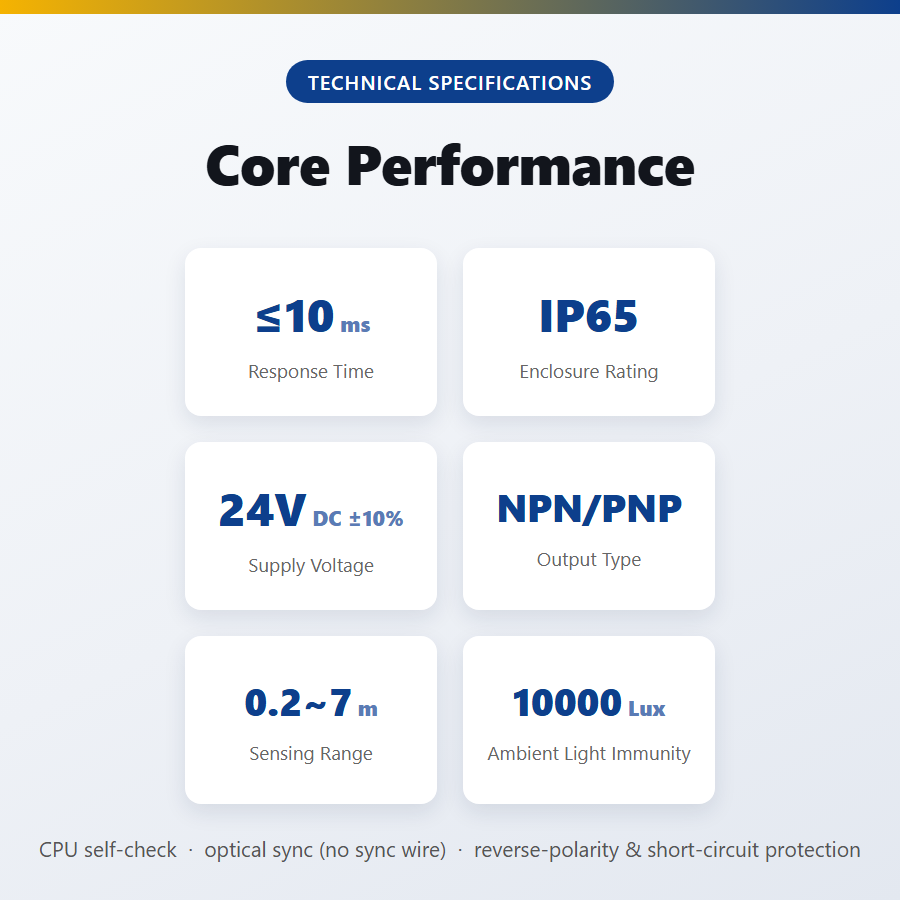
| Response time | ≤ 10 ms |
| Supply | 24 V DC ± 10 %, 3–8 W |
| Output | NPN or PNP, NO or NC — one output connected per installation |
| Synchronisation | Optical by default (no TX–RX wire; separate supplies permitted); wire sync via CP conductor, code W (shared supply mandatory) |
| Ambient light immunity | 10,000 Lux |
| Insulation resistance | ≥ 100 MΩ |
| Circuit protection | Reverse-polarity (supply) + short-circuit (output) |
| Wiring | Factory-terminated 3 m cable per unit, direct M12 aviation connector |
| Environment | IP65 · −10 to +55 °C operating · −40 to +70 °C storage · 35–85 %RH |
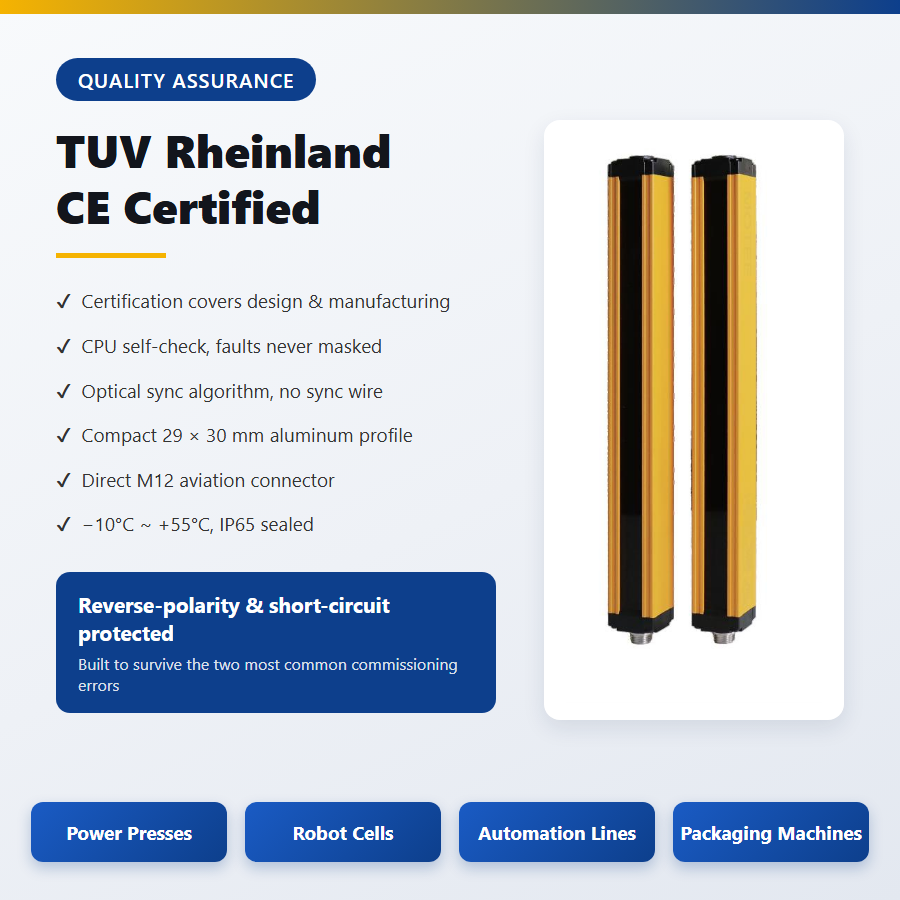
| Certification | TUV / CE (per series manual — certificate scope supplied on request) |
| Mounting | Top-and-bottom brackets (code E, default) or L-type side brackets (code L) |
Downloads
PDFMQ Series Technical Manual & Installation Guide (English)
22 pages: full model selection tables for all three pitches, dimension formulas, wiring for both synchronisation modes, 12-point installation guide, commissioning test procedure, troubleshooting matrix, maintenance schedule.
0.54 MBPreview PDF in a new tabBrowse MQ documents
Need the full 87-model list as data? The Export all models (CSV) button in the selection table above generates it in one click. For every other series manual, see the safety light curtain range.
Where the MQ Fits — and Where to Specify DQT4 Instead
Stated plainly, the way we state every rating on this site: the MQ manual certifies TUV/CE across design and manufacturing and documents the CPU self-check architecture, but it does not print an IEC 61496 Type class or an ISO 13849 PL, and the output is a single switching channel, not a dual OSSD pair. For duties where the risk assessment lands at PL c and the specification does not demand a stated Type rating, the MQ's economics and installation speed are hard to argue with. Where the paperwork requires a printed Type 4 architecture and dual channels, specify the DQT4 family — or send us the PLr and opening size and let the factory confirm the MQ certificate scope in writing first.
Hookup details — sync-mode wiring, NC-logic reasoning, blind-zone placement, the anti-interference layout for adjacent curtains and the commissioning rod test — live in the dedicated MQ wiring & integration guide, with five vector diagrams drawn from the manual.
Engineer & Buyer FAQ
Which machines is the MQ series intended for?
High-cycle manual feeding stations where a physical guard would kill productivity: small press dies and punch tooling on the 10 mm pitch, press brakes and stamping feed openings on the 20 mm pitch, and perimeter or pass-through duty on the 40 mm pitch. The slim 29 × 30 mm profile is specifically meant for tight press uprights and existing guard frames.
How do I read the MQ model number?
MQ + beam count + pitch, then output, logic, range band and bracket. MQ2010 is 20 beams at 10 mm pitch; a full ordering code like MQ-2010NC03E adds NPN output, NC logic, the 1–3 m range band and top-and-bottom brackets.
What protection heights do the standard tables cover?
The tabulated range is 4 to 60 beams per pitch: 30–590 mm at 10 mm pitch, 60–1180 mm at 20 mm, and 120–2360 mm at 40 mm. Beam counts up to 256 are built to order. Housing length is always beam count × pitch + 57 mm.
Is the MQ rated Type 4?
The manual states TUV/CE certification covering design and manufacturing, and describes a CPU self-check architecture — but it does not print an IEC 61496 Type class or ISO 13849 PL, and the output is a single switching channel rather than a dual OSSD pair. If your risk assessment requires a stated Type 4 device, request the MQ certificate scope before ordering, or specify the DQT4 family, whose Type 4 architecture is stated explicitly.
What ships in the box?
A factory-matched transmitter/receiver pair with 3 m cables and direct M12 aviation connectors already fitted, mounting brackets (top-and-bottom type E by default or side type L), the complete fixing kit, and the instruction manual. Pairs are matched — units from different sets must not be mixed.
Can the cable length or shielding be customised?
Yes — custom cable lengths order with the Cn suffix, a shielded-cable version with S20n, and cross-beam scanning with X. Non-standard beam counts (62–256) and pitches are also built to order with the protection height, sensing distance and machine input type stated in the inquiry.
Should I order optical sync or the wire-sync (W) version?
Order optical sync unless a written specification demands a hard-wired synchronisation channel. Optical sync removes the TX–RX cable entirely and allows separate 24 V supplies for the two units, which simplifies retrofits and wide machines. The W version carries timing on a CP conductor and requires both units on one shared supply; its detection behaviour is otherwise identical.
Is there an English manual for the MQ series?
Yes — the 22-page English technical manual is downloadable free from this page (0.54 MB PDF). It contains the complete model tables for all three pitches, the dimension formulas, wiring diagrams for both synchronisation modes, a 12-point installation guide, the commissioning test procedure and a troubleshooting matrix.