
How to Choose the Effective Protective Height of a Safety Light Curtain — Using DAIDISIKE DQA & DQT as Examples
Content updated:
Goal: help engineers and buyers determine the right effective protective height for a safety light curtain so the opening is fully guarded and the device fits your machine. The method below is based on DAIDISIKE’s DQA/DQT families and uses the catalogue beam-span convention:
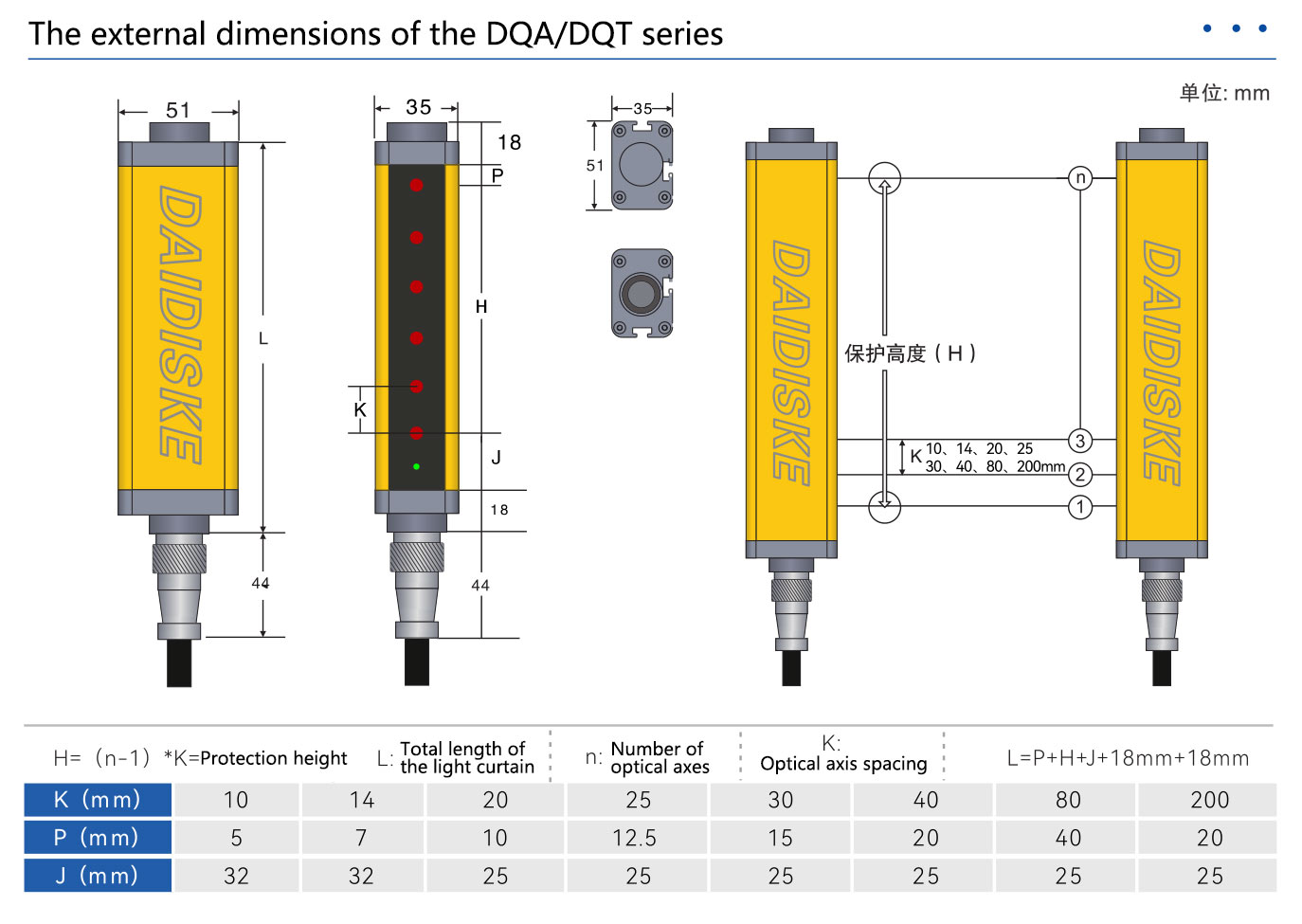
H = (n − 1) × Kwhere H = effective protective height, n = number of beams, K = beam pitch. Declared detection capability is a separate specification and must not be inferred from pitch alone.
Compare the light curtain resolution and protective-height options after defining the opening and access paths. ISO 13855:2024 addresses safeguard positioning; a correct beam-count calculation alone does not establish safe positioning or prevent reaching over, under or around the field.
1) What exactly is “H” and what it is not
Effective protective height (H) is the active sensing field height formed by the outermost usable beams. When an object blocks any beam, the curtain switches its OSSD outputs and the machine must stop. H does not include the top/bottom mechanical margins of the housing.
For DAIDISIKE light curtains, H is determined by the beam count and spacing: H = (n − 1) × K. For example, with K = 14 mm and n = 30, H = 14 × 29 = 406 mm.
2) Selection workflow (5 steps)
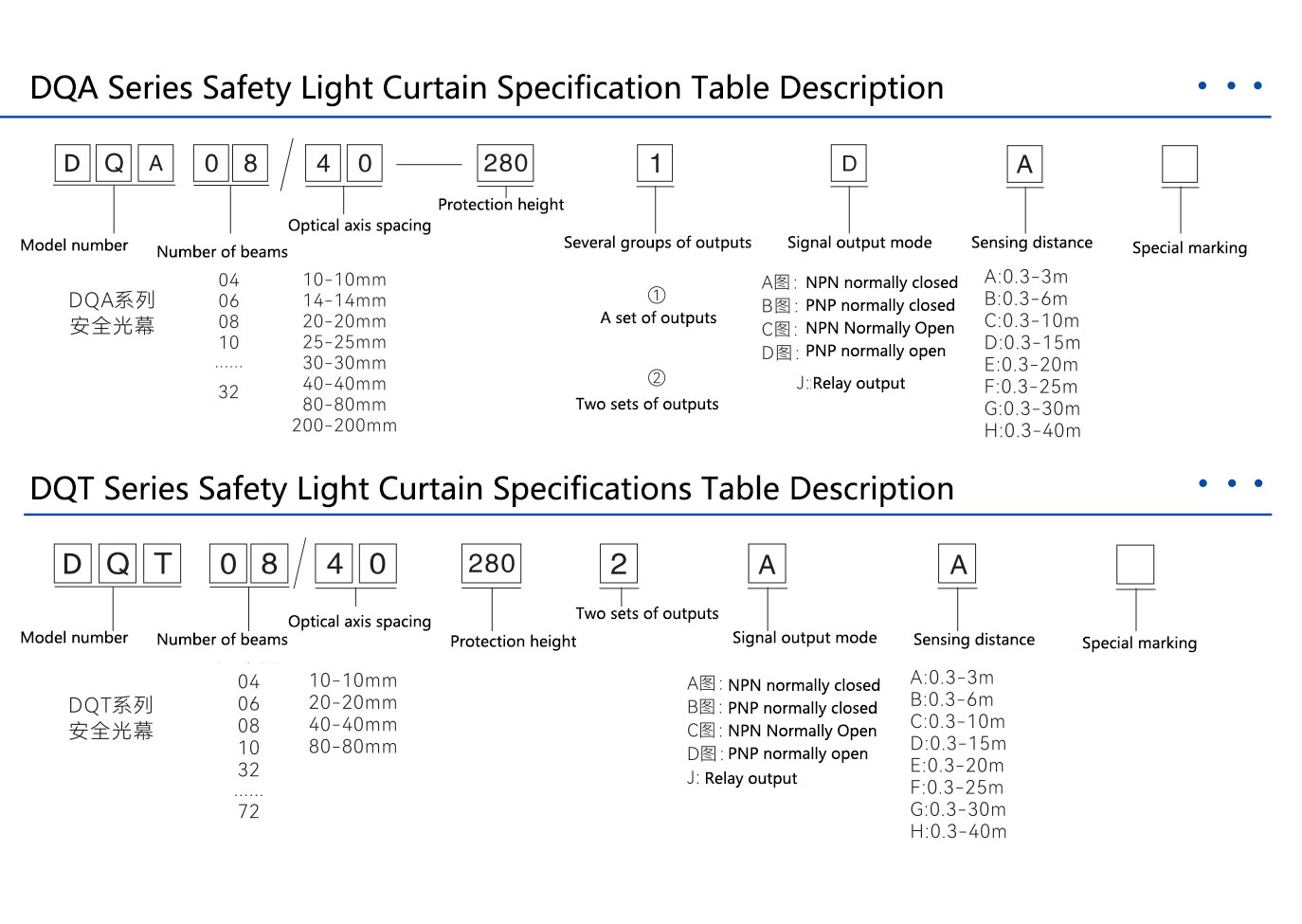
- Define the protection objective (choose K): Check declared finger/hand detection capability or the relevant whole-body beam arrangement; pitch alone is not an application approval. Check the chosen family and beam-count range against its current model table; do not assume DQT is limited to coarse beams.
- Measure the opening that must be blocked by the field. This is the minimum required protective height
Hreq. - Compute the beam count: use
n = ⌈Hreq / K⌉ + 1. (Always round up so the field fully covers the opening.) - Pick the nearest catalog model in the DQA/DQT list with that n and K. If the exact beam count is not offered, select the next larger H.
- Verify mechanical fit: the overall product length is approximately
L = P + H + J + 18 mm + 18 mm. Ensure mounting space allows the housing, brackets, and cable bend radius.
3) Worked examples with DQA/DQT
These are dimensional examples, not approved press or cell designs. Confirm model availability, declared detection capability, machine stopping capability and the applicable machine-specific safeguarding requirements before procurement.
Example A — Finger protection on a small press
- Assumed catalogue pitch for this dimensional example: K = 14 mm. Finger protection requires separately documented detected-object capability; no DQA-14 order code is established by this example.
- Measured opening to cover: Hreq = 400 mm.
- Beam count:
n = ⌈400/14⌉ + 1 = 29 + 1 = 30. - Result: H = 14 × (30 − 1) = 406 mm. Select only an available model whose documented active field and detection capability satisfy the requirement; the arithmetic does not establish a catalogue order code.
Example B — Hand protection on a power press throat
- Assumed pitch: K = 30 mm. Verify the exact model's hand-detection capability separately before using this dimensional result.
- Hreq = 720 mm.
n = ⌈720/30⌉ + 1 = 24 + 1 = 25→ use the next available size if catalog uses even counts, e.g. n = 26.- Result: H = 30 × (26 − 1) = 750 mm field (covers the opening with margin).
Example C — Perimeter/body detection on a large cell
- Assumed pitch: K = 40 mm. Whole-body entry coverage still depends on the actual field position, detected-object capability and bypass prevention.
- Hreq = 1,600 mm.
n = ⌈1600/40⌉ + 1 = 40 + 1 = 41→ choose next catalog size n = 42.- Result: H = 40 × (42 − 1) = 1,640 mm.
Example D — High opening with coarse resolution
- Assumed pitch: K = 80 mm. This dimension calculation does not approve an aisle-protection layout or its beam geometry.
- Hreq = 1,200 mm →
n = ⌈1200/80⌉ + 1 = 15 + 1 = 16. - Result: H = 80 × 15 = 1,200 mm.
4) Mechanical fit: P / J and total length L
DAIDISIKE drawings show two small fixed margins outside the active field:
- P — top offset from housing edge to the first active beam.
- J — bottom offset from the lowest beam to housing edge.
Typical values (from DQA/DQT dimension tables) are around P ≈ 5–40 mm depending on K, and J ≈ 25–32 mm. Always check the exact datasheet for the selected model. These margins matter when you must align the field with a guard opening or table surface.
L ≈ P + H + J + 36 mm (adds 18 mm end caps at top and bottom). Verify bracket space and cable exit.5) Practical tips & checks
- Choose the detection capability first, then use the catalogue pitch for height calculations. Fine and coarse pitches are not interchangeable guarding approvals.
- Round up, never down. When
Hreq/Kis not an integer, take the next larger beam count. - If the catalog lists even beam counts only, pick the next even n above your calculation.
- Mind mirrors and muting: mirrors don’t change H but increase alignment and cleaning needs; muting/blanking doesn’t relax H requirements.
- Check positioning separately under the applicable ISO 13855:2024 method. The historical S = K × T + C expression uses K for approach speed, not the beam pitch K in this article. Height arithmetic alone is not a complete protective-distance calculation.
6) Quick reference table (K & typical P/J)
| Beam pitch K (mm) | Typical top offset P (mm) | Typical bottom offset J (mm) | Main series | Typical use |
|---|---|---|---|---|
| 10 | 5 | 32 | DQA | High-risk finger zones |
| 14 | 7 | 32 | DQA | Finger guarding (global mainstream) |
| 20–30 | 10–15 | 25 | DQA | Hand/palm guarding |
| 40 | 20 | 25 | DQT | Body/area detection |
| 80 | 40 | 25 | DQT | Perimeter/aisle entry |
| 200 | Confirm drawing | Confirm drawing | DQA | Special beam arrangement; verify application |
FAQ
Q1. Does H need to equal the opening height exactly?
A. No. H must be greater than or equal to the opening. When your calculation lands between catalog sizes, select the next larger H.
Q2. If I change K, do I have to recalc everything?
A. Yes. K directly multiplies into H via H = (n − 1) × K. Changing K changes the required n; whether the family changes depends on the actual catalogue options. Recheck declared detection capability and safety positioning separately.
Q3. Do P and J change the effective height?
A. P and J are mechanical margins; they do not add to H. Use them to check fit and to set the field exactly where protection is needed.