
What Is a Safety Light Curtain?
Global Supplier of Industrial Sensors for Automation & Long-Range Perimeter Security
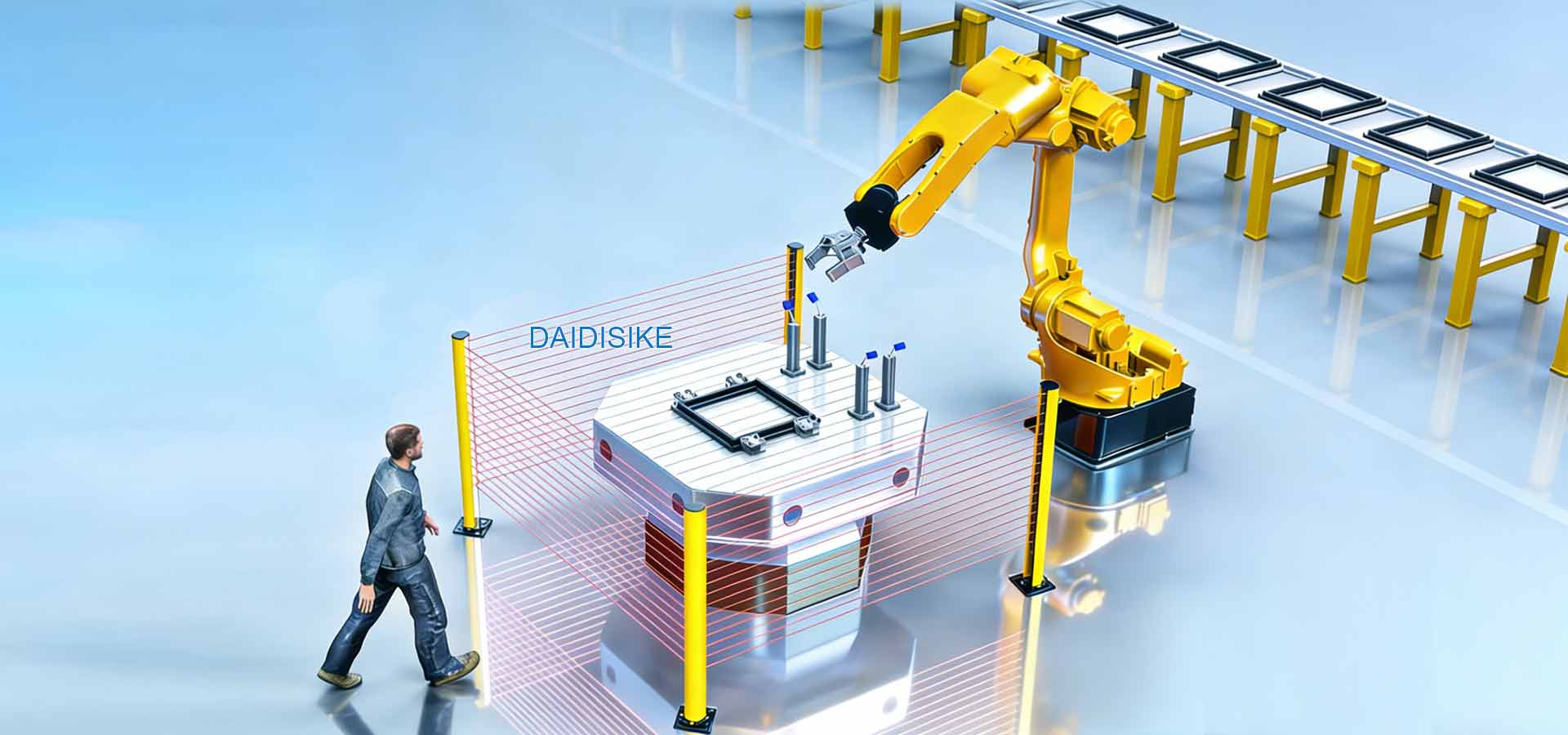
A safety light curtain uses infrared beams for contactless detection at a defined opening. It is a sensing part of a machine protective function, not a physical barrier: a person can cross its plane, and objects or fragments can pass through. Whether it can replace or complement a guard depends on the exact machine, hazard and validated stopping arrangement.
Safety light curtains are used on suitable presses, robotic cells and packaging lines where the applicable machine requirements permit them. Correct detection, safety-control integration and stopping distance are all necessary; the device alone cannot guarantee accident prevention.
When you are ready to compare available series by detection capability, protective height, range and environment, browse safety light curtain sensors in the main product category.
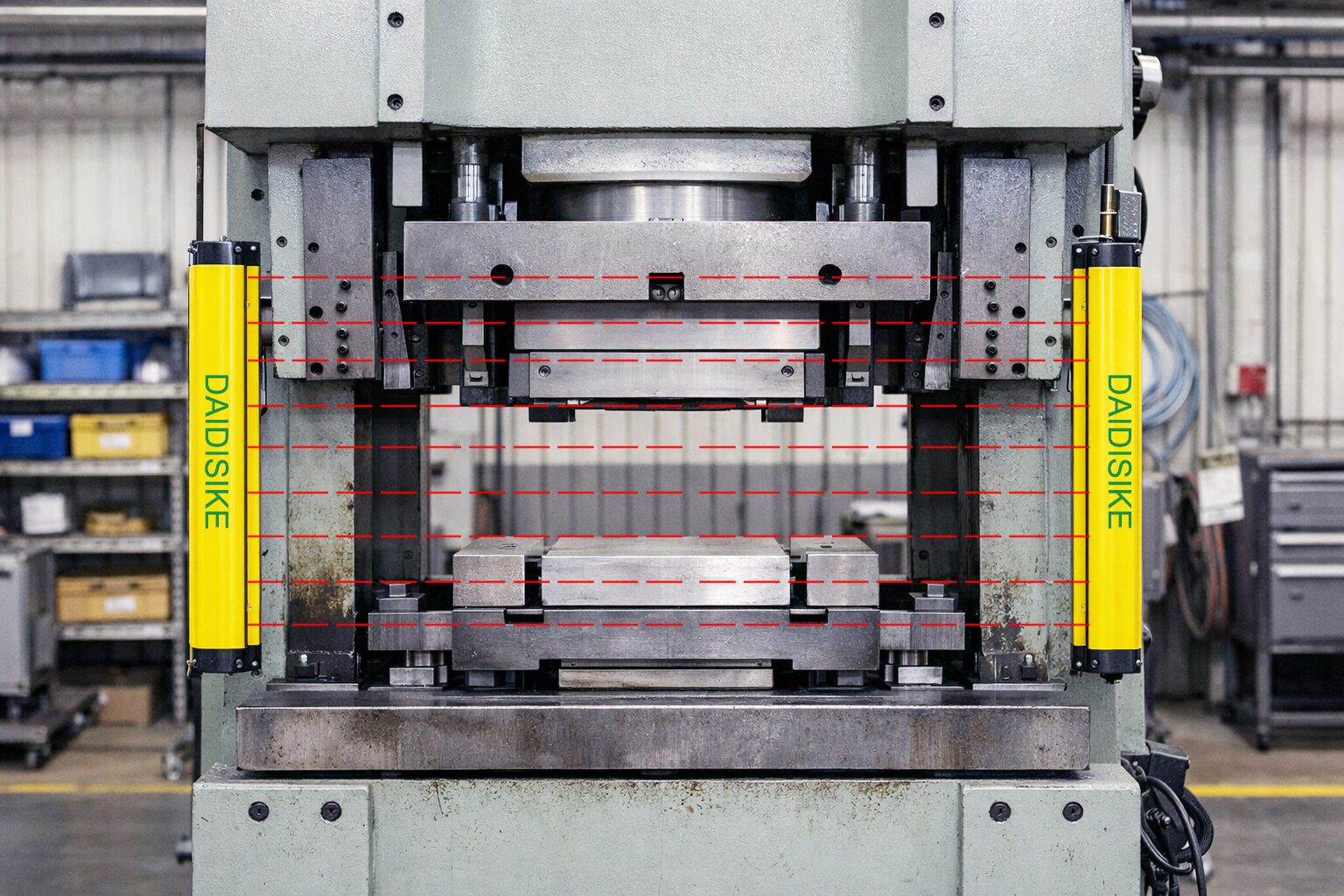
Images on this page illustrate access-guarding concepts, not a certified installation, measured separation or customer acceptance test. A press must have an eligible stopping mechanism and retain all other required safeguards.
Core Principle: An Invisible Infrared Safety Barrier
The setup includes an Emitter (Transmitter) that emits numerous parallel, modulated infrared light beams, and a Receiver that watches over these beams. Positioned opposite each other, they form an unseen light barrier.
When the specified detectable object interrupts the protective field, the receiver changes its documented safety output state. The compatible safety control system then commands the validated machine stop; neither detection nor stopping is instantaneous.
This basic yet dependable principle of "obstruct the light, halt the machine" describes the intended sequence, not a guarantee of instant mechanical stopping. Following clearance, restart behaviour may require a monitored manual reset or another validated method, depending on the risk assessment and exact control design.
Resolution Options for Different Protection Levels
| 2.5 mm / 5 mm pitch examples | Non-safety object measurement; not personnel protection | DAIDISIKE DQL / DQM Series |
| 14 mm detection capability | Finger-size test-piece detection | Only in an eligible, validated safeguarding arrangement |
| 20 mm / 30 mm detection capability | Hand-access applications, subject to geometry | Exact documented test piece and separation required |
| 40 mm and larger, model-specific | Do not infer body detection from pitch alone | Beam heights, gaps and all access paths require assessment |
| Perimeter beam arrangement | Beam count/heights and documented rating, not a universal detection size | DAIDISIKE DQSA Series |
Read the table correctly: detection capability, beam pitch and perimeter-beam spacing are different quantities. The DQL/DQM row describes non-safety measurement equipment, not a finer personnel-protection option. For the transmitter/receiver and output-interface detail, read the safety light curtain sensor explanation.
Main System Components
- Emitter: generates the model-specific modulated infrared beam sequence.
- Receiver: monitors each beam continuously to detect interruptions.
- Safety evaluation: an approved compatible safety relay or safety PLC evaluates the documented protective output and commands the final switching elements. DQCA/DQCA2 controller names do not by themselves establish a safety rating; an ordinary PLC is not the protective stop logic.
Operational Sequence
| Normal Operation | With beams clear, no detected fault and required reset/feedback conditions satisfied, the safety system may enable operation. Beam clearance alone does not start the machine. |
| Interruption Detection | A blocked beam changes the selected device's documented output state within its specified response time. |
| Safety Stop | The documented safety outputs are evaluated by the safety PLC or relay, which commands the validated machine stop. |
| Restart Control | Reset and restart behaviour must follow the risk assessment, selected device functions and validated control design. |
Time Delay Relay Modules for Non-Safety Auxiliary Functions
A general-purpose delay relay may receive a separate status signal for a non-safety auxiliary alarm, indicator, event log or process timing function. It must remain outside the personnel-protection decision path. It must never perform the protective stop or delay a personnel-protection stop command.
Modules such as B2J0601 or E4J0101 are ordinary timing/control products, not safety relays or safety PLCs. Use them only when the risk assessment permits a separate non-safety auxiliary function.
1. Keep the Safety and Auxiliary Paths Separate
- Protective path: Wire the curtain's documented safety outputs to the appropriate safety relay or safety PLC and validated final switching devices.
- Auxiliary path: A designated auxiliary/status output may drive a non-safety alarm or timer without affecting the stop path. Do not branch raw OSSD channels to an ordinary PLC or timer as a substitute.
- No delayed stop: Never place B2J0601, E4J0101 or another ordinary timing relay between the protective output and a motor contactor, safety relay or safety PLC input.
2. Permitted Auxiliary Examples
- Alarm timing: Hold a non-safety beacon or buzzer for a defined interval after a separately available status event.
- Process timing: Time a material-handling or diagnostic action that has no personnel-protection function.
- Verification: Confirm voltage, polarity and load limits from both model manuals and verify that auxiliary failure cannot defeat or postpone the protective stop.
3. Safety Boundary
Any timing inside a safety function requires a safety-rated device whose documented function and certificate cover that use. An ordinary delay module can never carry the protective stop or intentionally delay the stop that protects a person.
Primary engineering references
IEC 61496-1:2020 and IEC 61496-2:2020 address ESPE requirements; ISO 13855:2024 addresses positioning. The SICK deTec4 Core operating instructions illustrate model-specific OSSD, restart and protective-field checks; their pinout is not transferable to another brand.
Frequently Asked Questions
What is a safety light curtain and how does it protect operators?
A safety light curtain is an opto-electronic protective device that places a screen of modulated infrared beams across a machine opening. When a hand or body interrupts the beams, the device changes its documented safety outputs so the validated machine safety circuit can command a stop.
What standards apply to safety light curtains?
The main standards are IEC 61496-1 and -2, which define Type 2 and Type 4 devices, ISO 13849-1 for Performance Level, and ISO 13855 for safety distance. The required Type and Performance Level come from a risk assessment of the specific machine.
What resolutions are available and what do they protect?
Common documented detection capabilities include 14 mm for finger-size and 20–30 mm for hand-access applications. Beam pitch is not the guaranteed detection capability. Coarse or multi-beam perimeter layouts need separate beam-height and access checks. Finer detection can reduce an intrusion allowance but does not remove reach-over or full stopping-distance requirements. DQL/DQM measurement gratings are non-safety devices.
How fast does a safety light curtain respond?
Response time varies by series, beam count and configuration and must be taken from the exact model documentation. It feeds into the ISO 13855 safety-distance calculation together with the remaining control response and measured machine stopping time.
Where are safety light curtains used?
They can safeguard defined access openings on suitable presses, robot cells, packaging and assembly equipment where the machine-specific requirements allow them and the hazard stops before a person can reach it. They do not contain ejected material, prevent all access around a field, or replace required physical guarding. A light curtain detects access; it does not mechanically restrain a person.