
What is a Safety Light Curtain Sensor?
How Do Safety Light Curtains Work?
Why do factories use safety light curtain sensors? At an eligible machine opening, contactless detection can allow access without repeatedly moving a guard. The sensor does not replace every physical barrier: it cannot contain fragments, block entry or make a slow-stopping hazard safe at an inadequate distance. This guide explains the transmitter/receiver pair, documented output interface and detection capability so that those requirements can be checked against a particular machine.
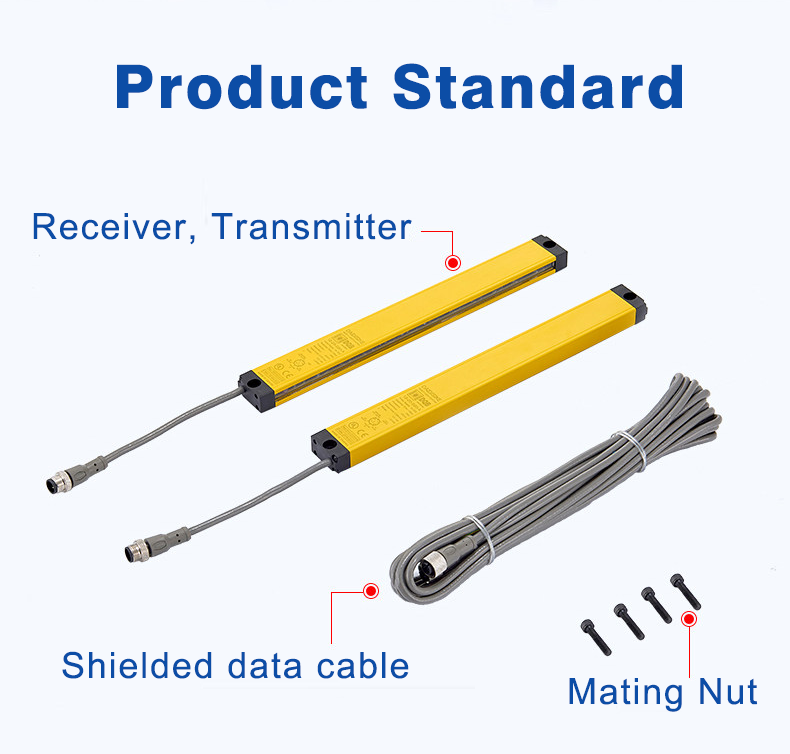
The core definition of the safety light curtain sensor
A safety light curtain sensor uses modulated through-beam infrared optics, not infrared convection. The transmitter and receiver form a detection plane across an opening. When the specified detectable object interrupts that plane, the receiver changes its protective output state. A compatible safety relay or safety PLC evaluates that output and commands the validated stop through the final switching elements. An ordinary PLC signal is not a substitute, and clearing the beams is not automatic permission to restart.
Second, the working principle of safety light curtain sensor
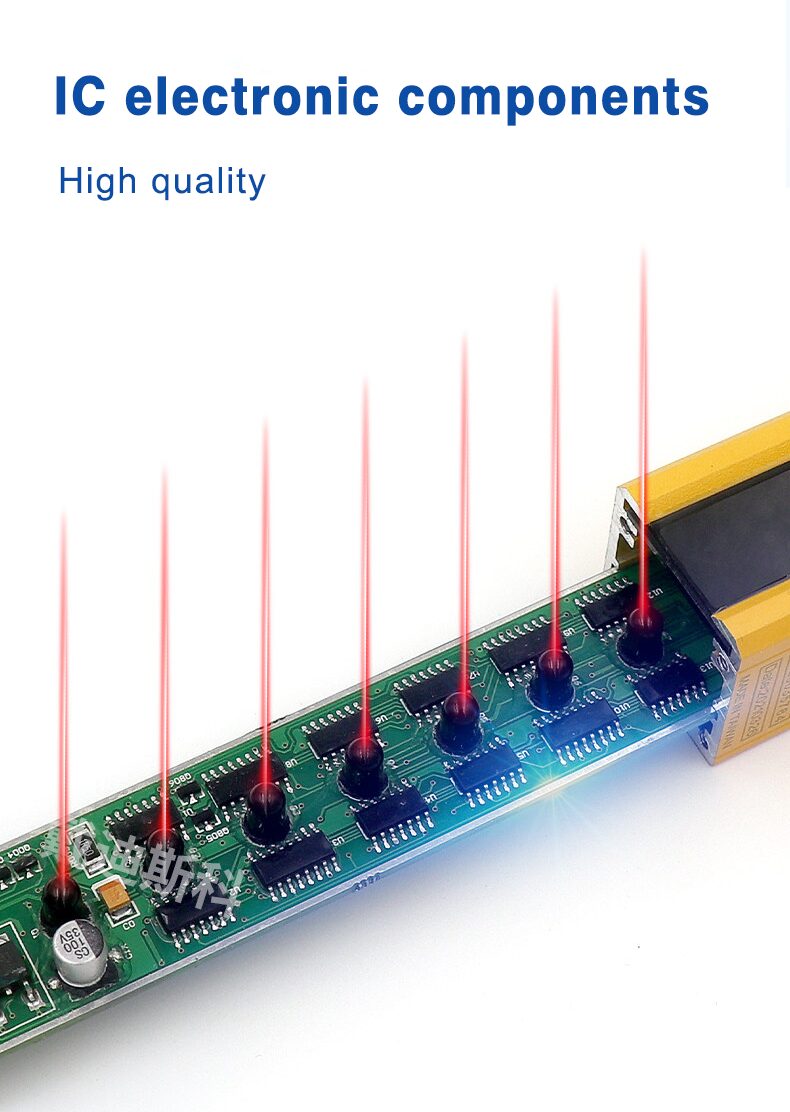
- The transmitter continuously emits a modulated invisible infrared beam;
- Receiver is synchronised with transmitter, receives beam in real time and builds a continuous light curtain protection zone;
- If the finger, arm, body or other object enters the shield zone and blocks part or all of the beam, a signal interruption occurs in the receiver;
- The documented safety outputs feed approved safety inputs; OSSD channels, where present, must remain independent and their test pulses must be compatible with the evaluator;
- When the object is completely clear, output restoration and restart behaviour follow the selected model, risk assessment and validated control design.
Thirdly, the main types of safety light curtain sensors
1. Classified into categories according to safety level according to IEC 61496 standard
Type 2: IEC 61496 defines its test and fault-detection requirements. Suitability cannot be reduced to a “low risk” label; it must follow the machine risk assessment and required performance of the complete safety function.
Type 4: IEC 61496 applies more stringent fault detection and fault-tolerance requirements. Do not infer a specific internal channel design or complete-system PL/SIL solely from the Type label; verify the exact model certificate and integration.
Review the Type 2 and Type 4 light curtain differences before selecting a series, and verify the classification for the exact ordered model against the machine risk assessment.
2. Classified based on detection capability (resolution)
- Finger protection (documented 14 mm capability): detects the specified test-piece size; not proof that 14 mm beam pitch is equivalent;
- Palm protection type (20-30mm resolution): adapted to common hand protection contexts;
- Body/perimeter protection: verify the specified beam heights, spacing and access geometry; a 40 mm label alone does not establish full-body protection.
3. Other special types
Environment-adapted models need exact enclosure, temperature, ambient-light and cleaning specifications. IP65/IP67 describe different water tests, not immunity to deposits on the optical window. Long-range models must meet their documented optical operating range, separately from the protective field-to-hazard distance. DQL/DQM detection and measurement gratings are non-safety measurement devices; measurement functionality does not imply personnel protection.
Fourth, the main use of safety light curtain sensors
Safety light curtains are used in suitable industrial applications; the examples below are not automatic model approvals. Confirm stopping eligibility and all other required safeguards before selection. The main access tasks include:
In industrial automation, the key protection scenes are:
- Stamping equipment: punching machine, shearing machine, bending machine, etc., to shield operator's hands from accidental activity;
- Industrial robots: detect crossing of an eligible protective plane and command the required safe state before the person reaches the hazard; retain required containment, other access guards and presence/restart measures;
- Automated production lines: packaging machines, conveyor belts, injection moulding machines, etc., imported and exported materials protection;
- Storage logistics: automated loading and unloading areas, defined stationary access to material-handling cells, not automatic protection of an AGV travel path;
- Machine tools: metal processing machine tool access detection; this does not provide electrical isolation or containment of ejected material.
Fifth, the safety light curtain sensor selection guide
Selection should incorporate itself with the selected scene, taking into account the 8 core factors:
| Factor | Description |
|---|---|
| Protection height | documented protected field plus all reach-over/under/around and pass-through access checks |
| Resolution | documented detection/test-piece size, not beam pitch; perimeter layouts need separate assessment |
| Protection distance | separate optical operating range from minimum field-to-hazard distance |
| Response time | use the exact model value in the complete stop-time calculation |
| Safety level | derive the required IEC 61496 Type and PL/SIL from the risk assessment |
| Environment | exact dust/water, cleaning media, temperature, ambient light and optical-window limits |
| Certification | verify the valid certificate scope for the exact model and configuration |
| Brand selection | Compare the exact SICK, KEYENCE, Banner or DAIDISIKE model documentation, not a brand-level replacement claim |
For order-specific documentation, compare safety light curtain models and detection capabilities. This commercial range is distinct from the basic light-curtain definition and the detailed interface discussion here.
Three interfaces that must not be confused
| Interface | Permitted role | Evidence needed |
|---|---|---|
| Documented dual OSSD | Separate channels to an approved safety input | Pulse compatibility, fault behavior, response and exact manual |
| Relay/contact protective output | Only the documented safety function and circuit | Contact roles, safety classification and final-element arrangement; two contacts alone are not proof |
| Ordinary NPN/PNP or designated auxiliary status | Process detection or diagnostics, not an assumed protective stop | Voltage/load compatibility; no raw OSSD branching to an ordinary PLC |
Precautions for Installation and Maintenance
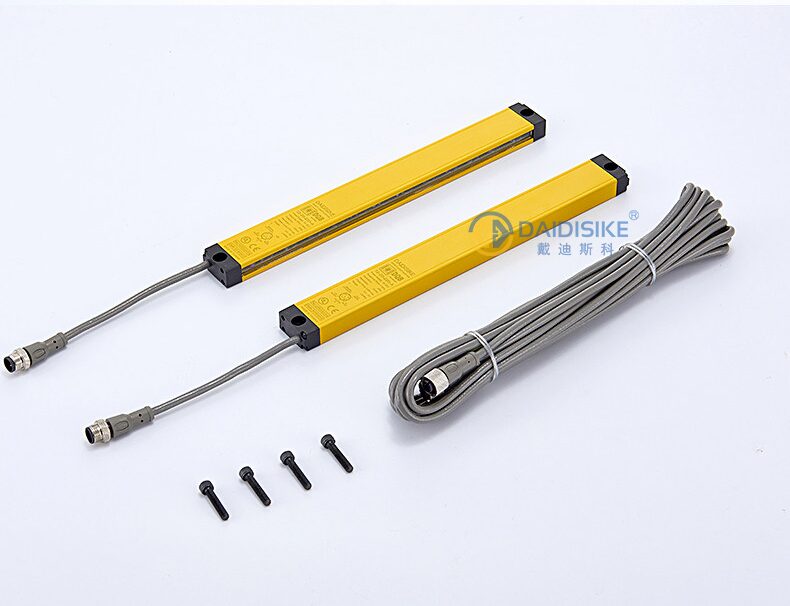
Installation Points
- Align the transmitter/receiver with the exact manual and bracket procedure; an ambient-light incidence angle is not an allowable misalignment angle;
- Calculate and validate the minimum distance using full worst-case sensor, logic, final switching and measured machine stopping time, plus all approach and bypass paths;
- Meet the model-specific ambient-light, cross-talk and reflective-surface limits; use only approved shielding or coding that does not create undetected access;
- Keep firmly in place to avoid any vibration from moving or false triggering.
Maintenance Recommendations
- With hazardous motion disabled and under the approved test plan, check the whole field and boundaries with the specified test piece; clean optical windows only by the approved method;
- Set inspection intervals from the manual, risk assessment and conditions; validate the complete protective function and restart behavior before return to service;
- Record the fault log, and promptly troubleshoot loose wiring, unstable power supply, etc.
Documentation behind the sensor explanation
IEC 61496-1:2020 and IEC 61496-2:2020 define ESPE requirements; ISO 13855:2024 covers safeguard positioning. The SICK deTec4 Core manual is a primary example of model-specific OSSD and protective-field checks, not a wiring diagram for every brand.
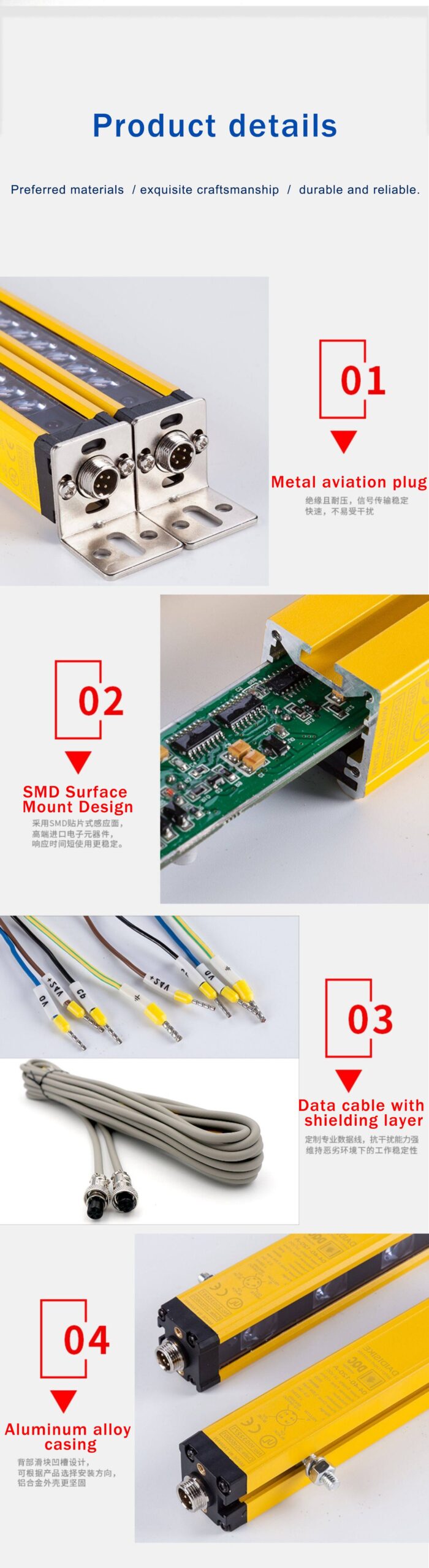
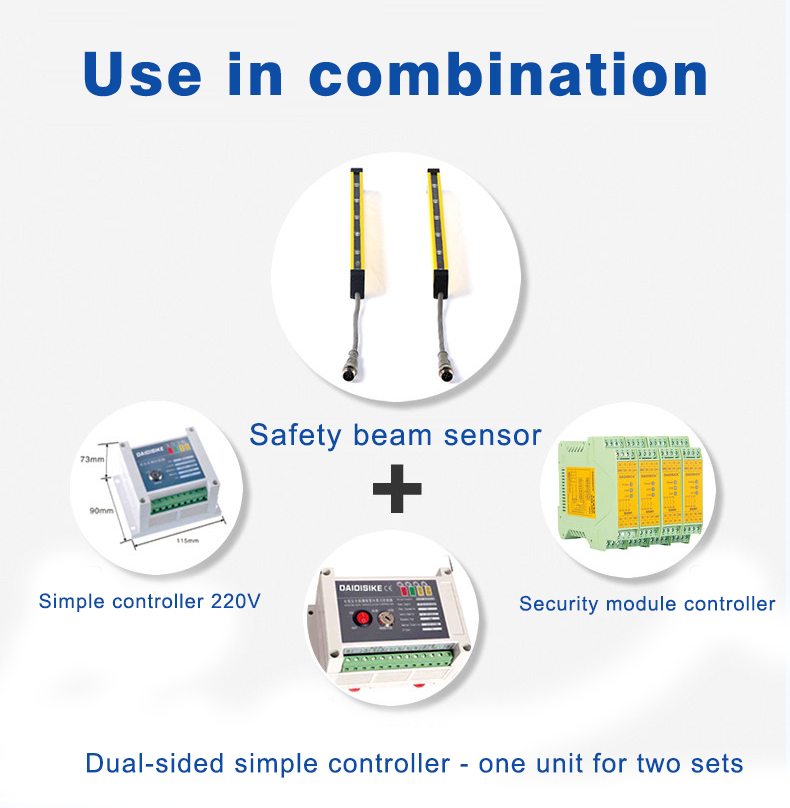
The retained pictures show product construction, accessories and a historical controller combination. They are not Type 2/Type 4 comparison charts, distance calculations, hydraulic-press acceptance tests or transferable wiring diagrams. The controller combination image does not establish DQCA/DQCA2 safety certification or interchangeable control units.
Summary
A safety light curtain sensor contributes detection and a documented protective output to a complete machine-safety function. Its transmitter/receiver pair, detection capability and interface must match the risk assessment, machine stopping performance and installation geometry. It is not mandatory or suitable for every factory hazard, and uninterrupted production is not a guaranteed outcome. Retain required physical guards and validate the complete system after installation or change.