
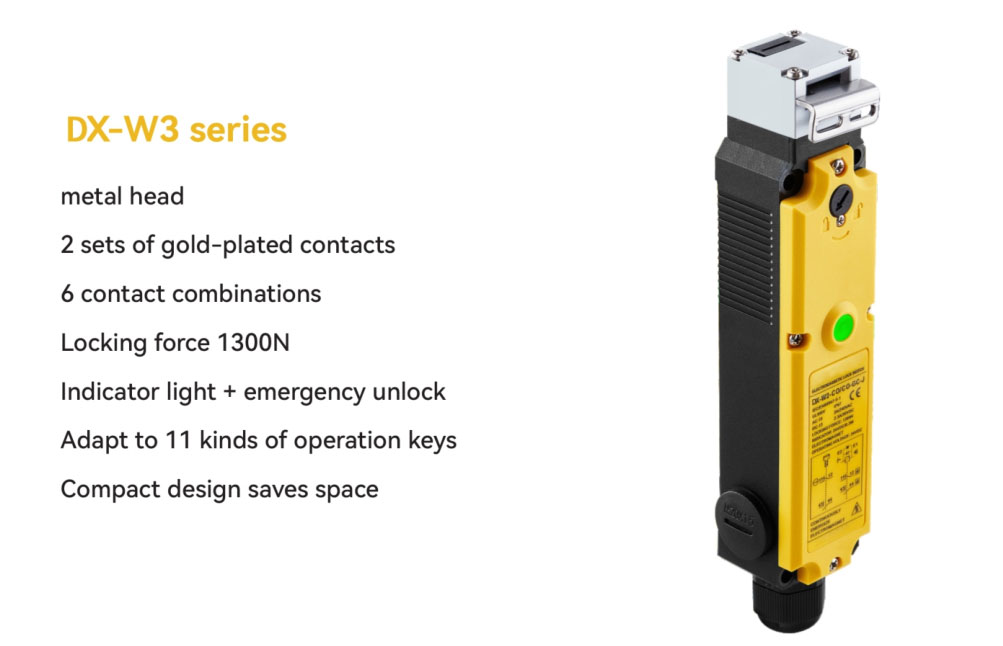
DX-W3 Compact Guard Locking Switch
Full 1300 N guard locking in the smallest DX-W body — with a choice most compact locks don't offer: put the contacts in the head or in the body, wherever your cable actually runs.
- 1300 N holding force, DC24V solenoid, IP67
- 2 gold-plated contact blocks — 6 codes, 12 models
- Head- or body-compartment wiring placement
- GD / GC locking logic on every code
- Direct mounting on the DXL safety door bolt
Right-Sizing Guard Locking
Most guard doors on packaging machines, small assembly cells and single-station tools need exactly one thing from their door lock: hold the door shut until the hazard stops, and prove it on one or two safety channels. Specifying a large multi-contact lock for that job wastes panel space and budget. The DX-W3 was cut down for precisely this duty — the same locking mechanism and 1300 N holding force as its bigger siblings, with a two-block contact system that matches simple circuits instead of dwarfing them.
The unusual freedom here is where those contacts sit. Codes like 2C/ put both NC channels in the head compartment; /2C puts them in the body; C/C splits them. Since head and body face different directions once the switch is mounted, this choice decides which side your gland and loom exit — a small thing on paper, a real difference inside a crowded packaging frame.
Need more channels later? The DX-W2 (4 blocks, 14 codes) and DX-W5 (6 blocks) share the same keys, logic and mounting philosophy, so an upgrade does not restart your design.
Head vs Body Contact Placement
Original schematic — compartment proportions are illustrative.
Technical Specifications
| Holding force | 1300 N |
|---|---|
| Contacts | 2 gold-plated contact blocks; 6 NC/NO configurations |
| Model count | 12 (6 codes × GD/GC), all metal head (J) |
| Locking versions | GD = solenoid-locked, mechanical release; GC = mechanically locked, solenoid release |
| Solenoid supply | DC24V ±10 % |
| Mechanical life | 1,000,000 operations |
| Forced separation | ≥60 N (manual override) |
| Protection | IP67 |
| Actuator keys | DX-K series (11 models), preparation clearance 1-3.5 mm |
| Bolt compatibility | Mounts directly on DXL safety door bolt pre-drilled pattern |
| Data not published for this model | Electrical life cycle count and operating temperature range — confirm with the factory if these are hard specification requirements |
| Certification note | Certification documents available on request |
The 12 Ordering Codes
| Contact code | Head / body contacts | GD version | GC version |
|---|---|---|---|
| C/C | 1NC / 1NC | DX-W3-C/C-GD-J | DX-W3-C/C-GC-J |
| /2C | — / 2NC | DX-W3-/2C-GD-J | DX-W3-/2C-GC-J |
| 2C/ | 2NC / — | DX-W3-2C/-GD-J | DX-W3-2C/-GC-J |
| CO/ | 1NC+1NO / — | DX-W3-CO/-GD-J | DX-W3-CO/-GC-J |
| O/C | 1NO / 1NC | DX-W3-O/C-GD-J | DX-W3-O/C-GC-J |
| /CO | — / 1NC+1NO | DX-W3-/CO-GD-J | DX-W3-/CO-GC-J |
Typical Applications
Packaging Machine Doors
Small cells with single- or dual-channel circuits get full 1300 N locking without oversized contact stacks.
CNC Guard Doors
Holds the guard through spindle run-down; IP67 shrugs off coolant spray.
Tight-Panel Machines
Head-only or body-only contact placement lets the cable exit face your existing trunking.
DXL Bolt-Gate Assemblies
Bolts directly onto the DXL door bolt for robot-cell fence gates.
Cost-Sensitive OEM Builds
The entry point to guard locking in the DX-W platform — two contacts, one solenoid, done.
Washdown / Oil-Mist Areas
IP67 sealing and gold-plated contacts maintain signal integrity in wet or misted zones.
Frequently Asked Questions
What does 'compact' actually buy me over the DX-W2?
A smaller body and a simpler bill of materials. The DX-W3 keeps the same 1300 N holding force, metal head, GD/GC locking logic, DX-K key compatibility and IP67 sealing as the DX-W2, but carries 2 contact blocks instead of 4. If your circuit needs one or two channels, you stop paying for — and stop wiring around — contacts you will never terminate.
What is the head-versus-body contact placement about?
The six contact codes place blocks either in the head compartment (e.g. 2C/), the body compartment (e.g. /2C) or one in each (C/C). Electrically they are equivalent; mechanically they decide where your cable loom lands on the switch. On machines with tight column spacing or pre-routed trunking, ordering the compartment that faces your cable tray removes an entire service loop.
Which code do I order for a standard dual-channel safety circuit?
Either DX-W3-2C/ (both NC contacts in the head) or DX-W3-/2C (both in the body), in GD or GC per your fail-safe logic. Land the two NC channels on a DQSRN or DA31 safety relay. If you want one safety channel plus a door-status signal to the PLC instead, pick CO/, /CO or O/C.
GD or GC on the DX-W3 — how do I decide?
Identical logic to the rest of the platform: GD is solenoid-locked with mechanical release (power loss releases the guard), GC is mechanically locked with solenoid release (power loss keeps it locked). Choose GC when the hazard outlives a power failure — coasting loads, hot zones — and GD when a de-energised machine is a safe machine.
Can I combine the DX-W3 with a mechanical door bolt?
Yes — this is one of its signature uses. The DXL safety door bolt is pre-drilled to accept the DX-W3 directly, producing a fence-gate assembly where the operator physically bolts the door and the switch simultaneously locks and reports it. No custom brackets or field drilling are involved.
Which figures are published for lifetime and environment — and which are not?
Published: 1,000,000 mechanical operations, IP67, DC24V ±10 % solenoid, 1300 N holding force, ≥60 N forced separation, gold-plated contacts. Not separately published for this model: electrical (contact-switching) life and operating temperature range — if either is a hard requirement in your specification, confirm with the factory before ordering, or specify the DX-W2, which documents 150,000 electrical operations and -20 °C to +60 °C on the same platform.
How do I put together a first trial order?
Pick the contact code and GD/GC version per door, add one DX-K key per door (choose geometry from the key selection table on our DX-K page), and note whether a DXL bolt combination is wanted. Small evaluation quantities are generally workable; certification documents are available on request. Contact the factory for current MOQ, pricing and lead time.
PDF & 3D CAD Downloads
Browse all downloads3D CAD MODELS
Find the file for your exact model
Open the download center with the named series selected. Search your full model, check the file details and download the matching STEP file.
Confirm the document and CAD file match your exact ordered version before installation or mechanical design. Contact us if your model is not listed.
Specs reviewed by Engineer Cai, Senior Application Engineer. See certificates.
Safety Light Curtain — Customer Cases
Real installations from DAIDISIKE clients. Click any case to view in full. Filter by scenario to quickly find a similar setup.
Press Guarding · Safety Light Screen
Robot Cell · Safety Light Barrier
Anti-Interference · Adjacent Installations
Access Gate · Guarding Light Curtain
Workstation · Compact Light Screen
Packaging Line · Machine Safety Light Curtain
Large Opening · Multi-Beam Safety Device
Assembly Conveyor · Photoelectric Light Curtain
Detection · Safety Light Array (Measurement)
Area Guarding · Safety Light Grid