
DXL Mechanical Safety Door Bolt
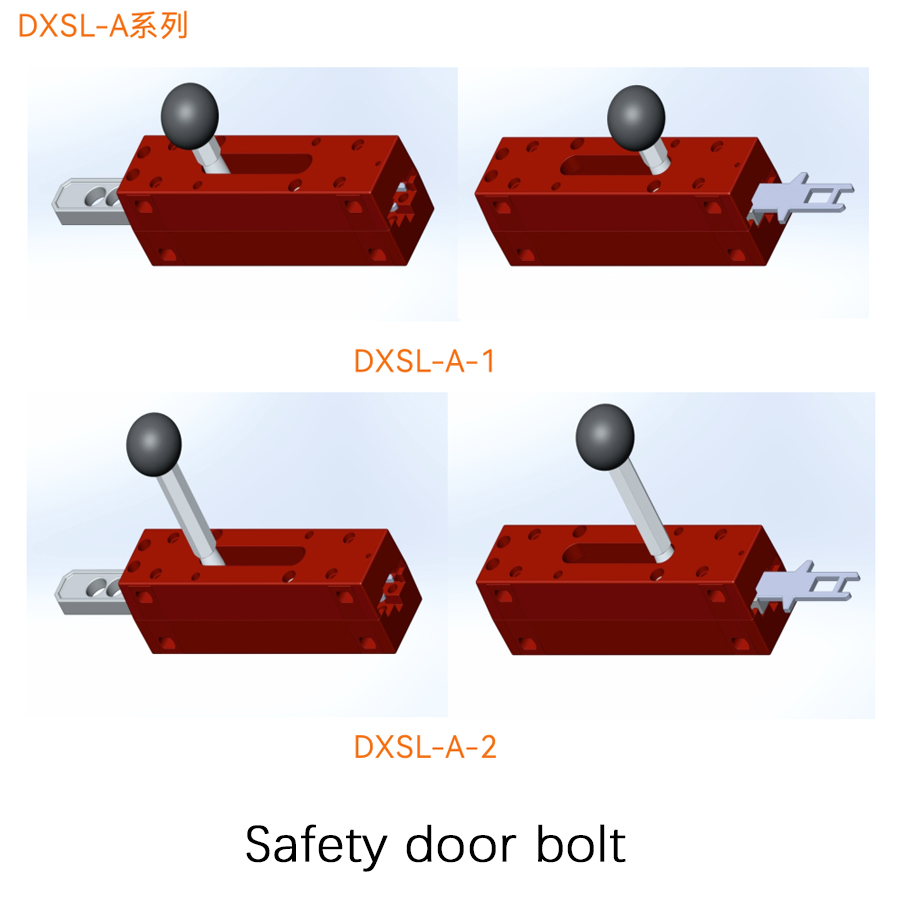
The hardware half of a proper fence-gate locking point: a million-cycle slide bolt that positions and holds the gate — pre-drilled so your DX interlock switch bolts straight on.
- 48 mm bolt travel; accepts 1-10 mm door gaps
- Rated 1,000,000 mechanical operations
- Mounts DX-W2 / W3 / D2 / D3 switches — no field drilling
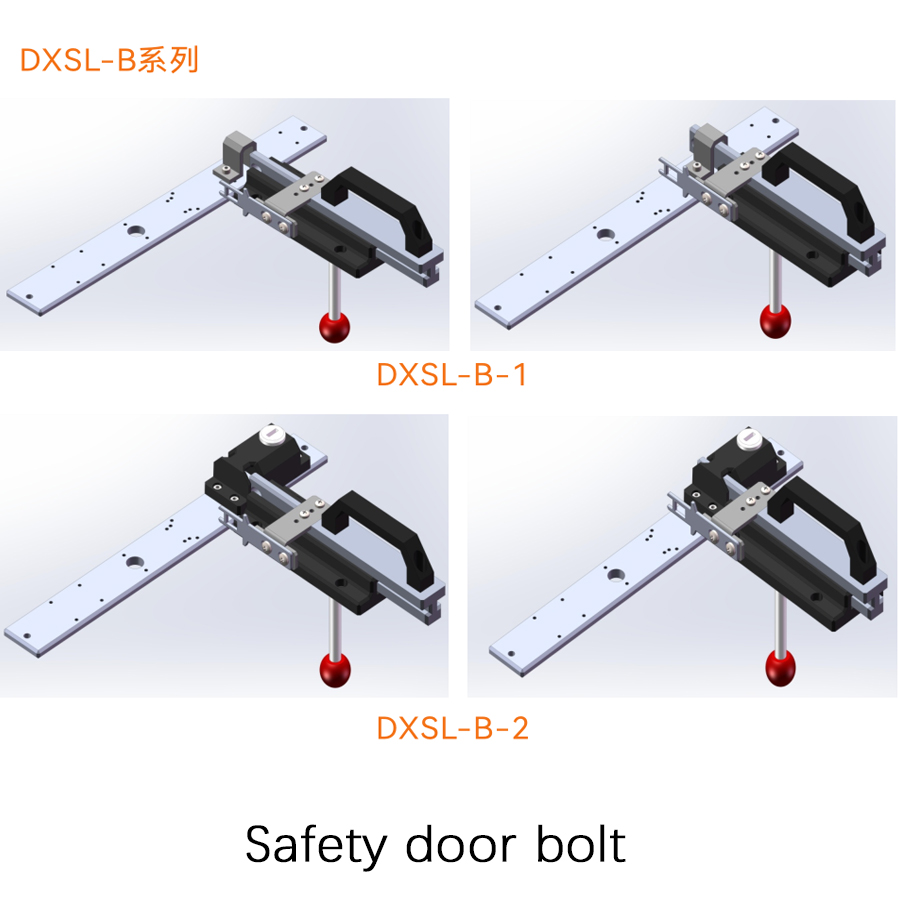
- Zinc-alloy (DXL-A) or aluminum-alloy (DXL-B) bodies
- Five variants for different widths and handle reach
Why Gates Need a Bolt and a Switch
An interlock switch alone does not make a good fence gate. Wire mesh doors flex, profile gates rattle, and a switch head was never meant to be the thing that mechanically registers a door in its frame. The DXL splits the job properly: a 48 mm slide bolt takes the mechanical role — locating the gate, holding it against vibration, tolerating 1-10 mm of built-in gap error — while the interlock switch mounted on the bolt's pre-drilled pattern does what it is good at: reporting to the safety circuit.
The pattern accepts four switch families directly. Pair with a DX-D2/D3 for monitoring-only gates, or a DX-W3 / DX-W2 solenoid lock when the gate must stay shut through coast-down. The result is the classic two-stage sequence: the operator throws the bolt, the switch proves it, and the DQSRN or DA31 safety relay lets the line run.
Some catalog pages print the family as DXSL — the A/B body styles and variant structure are the same product line described here.
Bolt Travel & Switch Position, Schematically
Original schematic — proportions and the switch/actuator linkage are illustrative; use the datasheet drawings for fabrication.
Technical Specifications
| Output | None — purely mechanical bolt; electrical monitoring via mounted DX switch |
|---|---|
| Bolt travel | 48 mm |
| Door gap range | 1-10 mm |
| Mechanical life | 1,000,000 operations |
| Switch mounting provision | Pre-drilled for DX-W2 / DX-W3 / DX-D2 / DX-D3 |
| DXL-A construction | Zinc-alloy base and slide handle + stainless steel handle; 0.6 kg |
| DXL-A handle rod | A-1 = 79 mm; A-2 = 106 mm |
| DXL-B construction | Aluminum-alloy base and slide handle + stainless handle + plastic ball knob; Ø15 mm rear release hole |
| DXL-B mounting plate | B-1 / B-2 = 326 mm; B-3 = 305 / 284 mm |
| Holding-force rating | Not published for the bolt mechanism — use a DX-W solenoid lock (1300 N) where a quantified figure is required |
Variant Chooser
| Variant | Body | Distinguishing spec | Pick it when… |
|---|---|---|---|
| DXL-A-1 | Zinc alloy | 79 mm handle rod | Tight clearance around the gate frame |
| DXL-A-2 | Zinc alloy | 106 mm handle rod | More reach past frame profiles |
| DXL-B-1 / B-2 | Aluminum alloy | 326 mm mounting plate, ball knob, rear release hole | Standard profile-fence hole spacing |
| DXL-B-3 | Aluminum alloy | 305 / 284 mm mounting plate | Narrower frame hole patterns |
DXL-B Series
Typical Applications
Robot-Cell Fence Gates
Bolt + DX-W3 solenoid lock = a gate that is physically held and electrically proven closed.
Press & CNC Line Guard Gates
1-10 mm gap tolerance suits fabricated steel-mesh and profile gates around production lines.
Aluminum-Profile Fencing
B-series mounting plates (326 / 305 / 284 mm) align with common profile-fence hole spacing.
Two-Stage Door Securing
Operator bolts the door first; the mounted interlock then verifies closure to the safety circuit.
Interlock Retrofits
Add electrical monitoring to a mechanical-only gate using the pre-drilled switch pattern — no new drilling.
Standardized Gate Hardware
Five variants cover different widths and handle reaches with one bolt family across the plant.
Frequently Asked Questions
The DXL has no wires — what is it actually for in a safety system?
It is the mechanical positioning-and-holding half of a gate locking point. The slide bolt physically registers and holds the fence door; the pre-drilled pattern on its base then accepts a DX-W2, DX-W3, DX-D2 or DX-D3 interlock switch whose actuator key rides on the bolt assembly. The bolt gives the door its mechanical integrity, the switch gives the safety circuit its signal — deliberately separate jobs.
Which switch should I pair with the DXL on a robot-cell gate?
If entering the cell while the robot coasts is the hazard, mount a solenoid-locking DX-W3 (compact) or DX-W2 (more contacts) so the bolt cannot be operated until the controller releases the lock. If the hazard stops immediately and you only need a door-closed signal, a DX-D2/D3 monitoring switch is sufficient and cheaper. In both cases wire the NC channels to a DQSRN or DA31 safety relay.
DXL-A or DXL-B — how do the two body styles differ in practice?
DXL-A uses a zinc-alloy base and slide with a stainless handle (0.6 kg); its two variants differ in handle-rod length, 79 mm (A-1) versus 106 mm (A-2) for extra reach around frame profiles. DXL-B moves to an aluminum-alloy base and slide, adds a plastic ball knob for grip and a Ø15 mm rear release hole, and offers three mounting-plate widths (326 mm on B-1/B-2, 305/284 mm on B-3) to line up with existing fence-frame hole patterns without field drilling.
How much door-to-frame gap can the bolt tolerate?
The mechanism is rated for gaps of 1 to 10 mm, which absorbs typical fabrication and installation scatter on welded or aluminum-profile fence gates. The bolt travel is 48 mm; check that this stroke covers the engagement your gate geometry requires before ordering.
Can the DXL be opened from inside the cell?
DXL-B variants include a Ø15 mm rear release hole as an inside-release provision. Whether that satisfies your trapped-person requirement depends on the risk assessment — for controller-supervised release, combine the bolt with a solenoid-locking switch that has its own rear unlock option, such as the DX-W2 with the DX-W2-L kit.
Does the DXL itself carry a holding-force rating?
No holding-force figure against forced opening is published for the bolt mechanism — its published data covers gap range, travel and the 1,000,000-operation mechanical life. Where the specification demands a quantified resistance figure, use a solenoid guard lock (DX-W2/W3/W5, 1300 N) as the holding element and treat the DXL as door hardware. One catalog note: the bolt family also appears under the DXSL marking in some brochure pages — same product line.
How do I order, and can the switch come pre-matched?
Specify the variant (DXL-A-1, A-2, B-1, B-2 or B-3) per gate, and if you want the bolt-plus-interlock combination, add the DX switch model on the same order — the factory supplies the pair that fits the pre-drilled pattern. Small trial quantities are generally workable; contact the factory for current MOQ, pricing and lead time.
3D CAD Downloads
Browse all downloadsFind the file for your exact model
Open the download center with the named series selected. Search your full model, check the file details and download the matching STEP file.
Confirm the document and CAD file match your exact ordered version before installation or mechanical design. Contact us if your model is not listed.
Specs reviewed by Engineer Cai, Senior Application Engineer. See certificates.
Safety Light Curtain — Customer Cases
Real installations from DAIDISIKE clients. Click any case to view in full. Filter by scenario to quickly find a similar setup.