
Two questions decide every guard-door device: does the door need to be held shut, and how hard is the switch to defeat? Pizzato and Fortress answer those two questions with broad ranges — Pizzato from the unlocked ST sensor to NG guard-locking variants with different rated-force data, Fortress from the modular tGard control-station interlock up to the configurable amGardpro range. This page maps those ranges onto the DAIDISIKE DX series, built the same way our other cross-references are: from each vendor's own published specifications, not from anyone's manual or marketing.
A blunt point first. A “Pizzato alternative” is not a part number you look up and drop in. It is a match on four things — guard-locking vs monitoring-only, ISO 14119 type and coding level, holding force, and output scheme (OSSD / safety contacts, EDM, series wiring) — followed by re-bracketing and a fresh ISO 13855 reach check. These comparisons begin the assessment; the complete redesigned function still requires validation. Where they diverge — an unmet rated-force requirement, a TUV-mandated certificate, an integrated control station — we say so plainly rather than pretend parity.
Guard locking vs non-contact monitoring: which problem are you solving?
Guard locking depends on whether a hazard can be reached before the machine becomes safe. Measure stopping performance and assess access geometry, other hazards and power-loss behaviour. A plain interlock initiates a stop but does not physically retain the guard. Any delayed or standstill-based release must be implemented by a suitable documented safety function, not inferred from a generic relay or PLC.
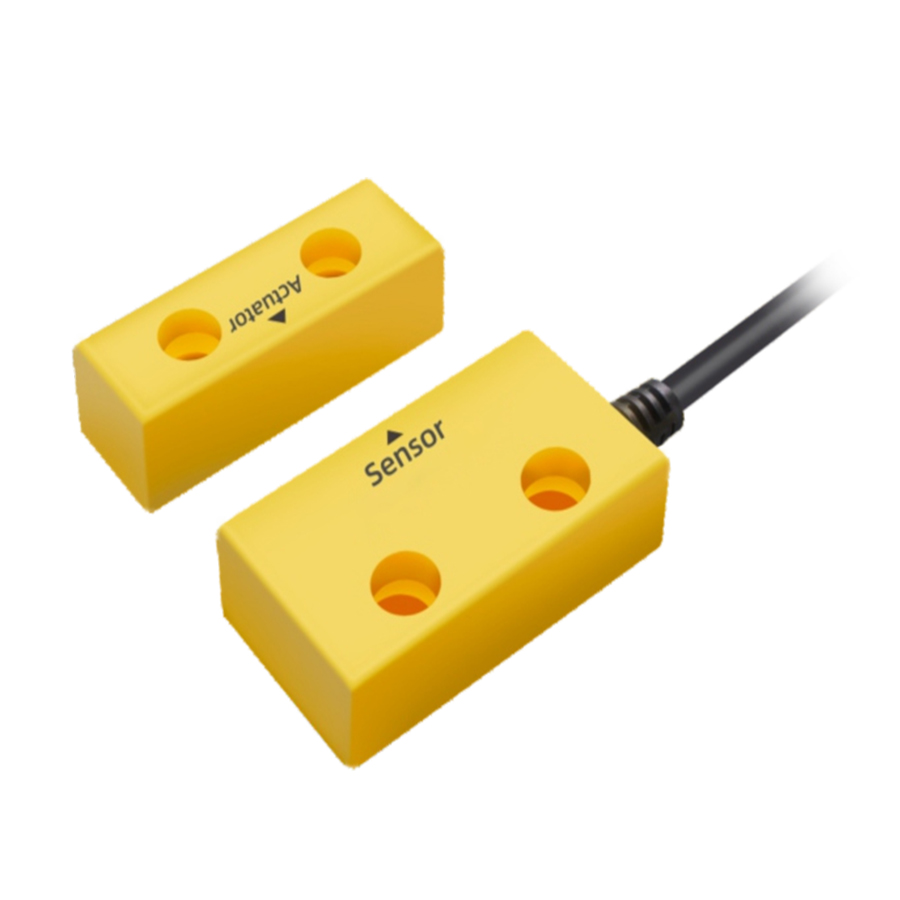
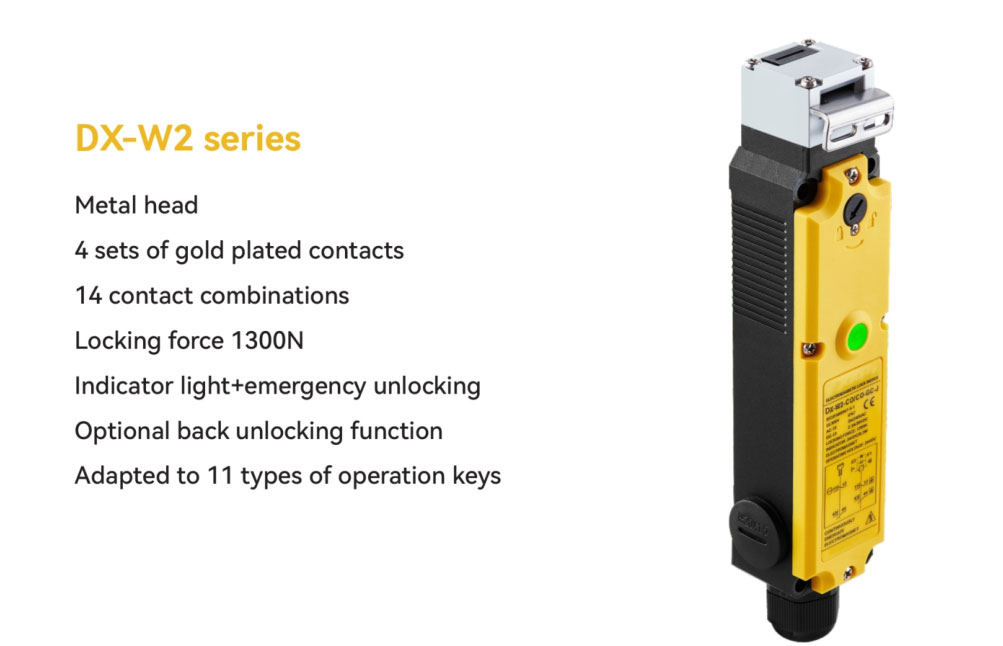
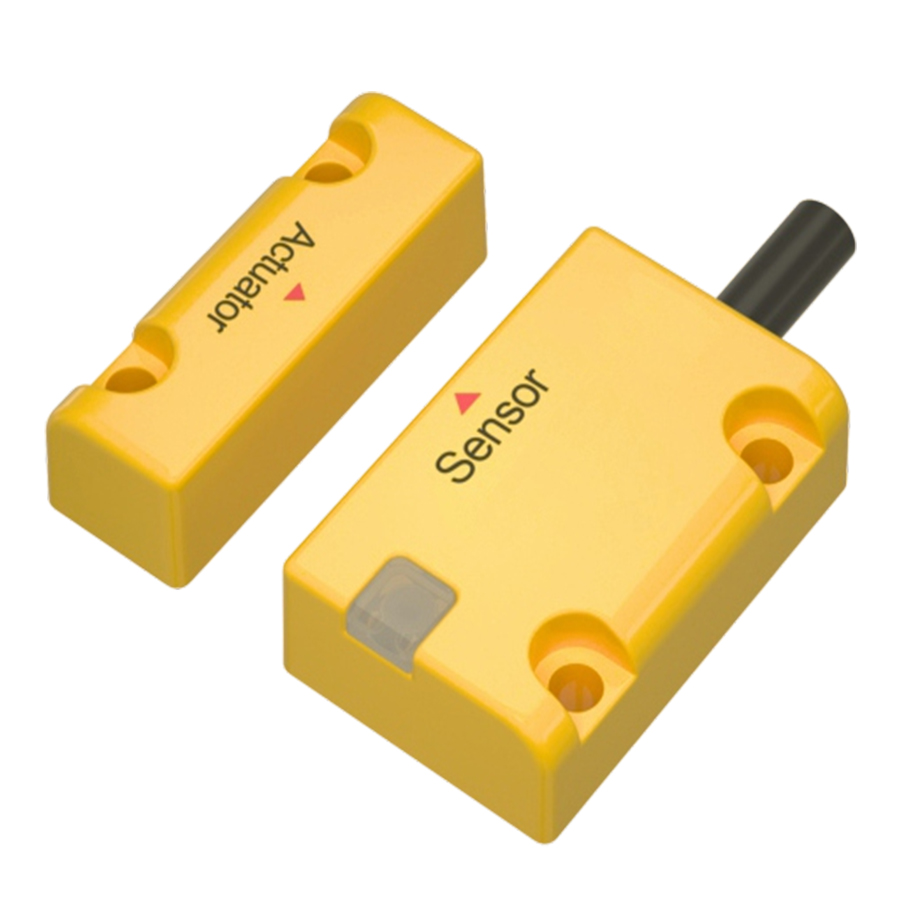
DAIDISIKE splits the same way the competitors do. The DX-R1 is the monitoring-only device (magnetic coded, ISO 14119 Type 4), a candidate for a documented unlocked-guard sensing application, not a verified ST equivalent. The DX-W2 is a guard-locking family with variant-specific holding force and ratings. DX-D6 is a separate transistor-output guard-locking design; do not transfer DX-W2 force, contact or enclosure ratings to it, and the DXL-B safety door bolt is the mechanical bolt-style retention companion for double-leaf doors.
What is the DAIDISIKE equivalent of a Pizzato ST RFID sensor?
The DX-R1 matches the ST on non-contact, ISO 14119 Type 4, coded operation; technology, interface, actuation and safety-document differences still require a full comparison. Pizzato's ST D series is an RFID-coded non-contact safety sensor to ISO 14119 Type 4, rated IP67, offered with low-coding (D0T) and high-coding (D1T) actuators; the ST H series is the high-coding RFID variant. RFID lets the sensor read a unique transponder code from the actuator, which is why Pizzato can offer the low/high coding split directly in the part number.
DX-R1 manufacturer data describes coded-magnetic Type 4 sensing. Verify its exact coding level, actuation tolerance, outputs, fault response and permitted series circuit against the installed ST model. Type 4 does not automatically mean high coding or identical protective behaviour. Price comparison follows the technical assessment; no direct functional swap is established.
What replaces the locking Pizzato NS, NG, FS and FG switches?
Separate the required locking function from the manufacturer’s family name. Pizzato NS, NG, NX, FS and FG contain different technologies, sizes and order-specific functions; FD includes separate-actuator switches without guard locking. NG’s cited catalogue labels 9750 N as maximum actuator force F1max, not a generic design holding-force rating. Compare the exact switch’s rated FZh, locking principle, lock-position monitoring, outputs and safety data before assessing a DX candidate. There is no established family-wide NS/NG/FS/FG replacement.
DX-W2 manufacturer data includes variants with holding force up to 1300 N. Verify the selected unit, force definition, locking principle, lock monitoring and safety data; do not apply the family maximum to every order. A matching separate-actuator form does not prove FS, FG or NS equivalence. Obtain supporting documents before any required certification comparison.
What is the DAIDISIKE answer to Fortress tGard and amGard?
Compare the complete Fortress configuration. tGard combines interlocking with configurable control-station functions; amGard configurations can add other guard-access and locking requirements. mGard is a trapped-key/key-transfer system. Neither a separate DX-W2 lock nor a mechanical DXL-B bolt reproduces an integrated control station or trapped-key sequence. Use the applicable Fortress model documents to define every function that must be retained.
A DX-W2 can be assessed only for the specific locking function supported by its selected variant. First obtain rated force, locking and release behavior, lock-monitoring contacts and relevant safety data. Do not compare headline force numbers with different definitions or choose by a “light door” label. Quote cost and lead time only after the required configuration is established; no savings or full tGard/amGard equivalence is asserted here.
How much holding force does the door actually need?
Determine the force at the installed lock from the actual guard design. Include foreseeable pulling, pushing, dynamic loads, assisted motion and the mounting load path. Neither a light-looking door nor a generic 1000 N assumption establishes suitability. Compare rated holding force with rated holding force: the cited NG catalogue labels 9750 N as maximum actuator force F1max, so obtain the applicable FZh before using that number in a design comparison.
Use the exact DX-W2 rated force and installation conditions to assess the proposed door. If the required retention, monitoring or power-loss behaviour is not documented or sufficient, the candidate is unsuitable regardless of component price. The assessment must also address the guard structure, hinges/slides and fasteners.
Cross-reference table: Pizzato / Fortress → DAIDISIKE DX
A starting map from public specs, not a drop-in part number. Always confirm against your installed unit's datasheet and a fresh ISO 14119 / ISO 13855 assessment.
| Competitor device | Function | Key published spec | DAIDISIKE match |
|---|---|---|---|
| Pizzato ST D / ST H | RFID coded, no lock (monitoring) | ISO 14119 Type 4; IP67; D0T low / D1T high coding | DX-R1 (magnetic coded, ISO 14119 Type 4) |
| Pizzato NS | RFID + solenoid, separate actuator + lock | Cat 4 / SIL 3 / PL e | DX-W2 candidate; exact rated force/function must be verified |
| Pizzato NG | Heavy RFID guard locking | 9750 N F1max in cited catalogue; obtain rated FZh and exact-model I/O | No parity product — stays Pizzato (heavy) |
| Pizzato FS / FG | Mechanical, separate actuator + solenoid lock | IP67; FS thermoplastic, FG metal/rotating head | DX candidate only after exact-model function assessment |
| Pizzato FD | Metal-body separate actuator, no lock | Interlock without locking | DX-R1 / DX-D-series (monitoring) |
| Fortress tGard | Guard locking + integrated control station | Configuration-specific force and integrity; see current tGard instructions and coding option | No whole-system match; assess locking separately |
| Fortress amGardpro / amGardS40 | Heavy-duty guard locking | Verify exact range, actuator, rated FZh and supported safety function; no family-wide force claim | No parity product — stays Fortress (heavy) |
| Fortress mGard | Trapped-key / key-transfer interlock | Mechanical key transfer | No equivalent: DXL-B is not a trapped-key sequencing system |
Is naming these brands legal, and how is the comparison kept honest?
Pizzato and Fortress names identify comparison targets, with no affiliation or endorsement implied. This article is not a legal opinion or compatibility declaration. Use the exact manufacturers’ manuals and available supporting documents; no TÜV testing or certification parity is promised for a DX variant.
Send us the door type, the run-down time, the required ISO 14119 type and coding level, and your output scheme, and we can assess a DX-R1, DX-W2 or DX-D6 candidate — or tell you plainly to keep a heavy Pizzato NG or Fortress amGard. Our wider method and the other brand cross-references live in the brand replacement & compatibility guide, and there is a worked door-lock example in our double-leaf guard-door application guide.
Sources & specifications cited
- Pizzato Elettrica — safety devices (ST, NS, NG, NX, FS, FG, FD) — RFID coded sensors, guard-locking switches, ISO 14119 Type 4.
- Fortress Interlocks — tGard, amGardpro, amGardS40, mGard — guard locking, retention force, TUV category ratings.
- Current tGard range distinguishes coding-dependent integrity; tGard operating instructions distinguish F, FZh and F1max. Compare the same force definition for the exact configuration.
- Fortress mGard — trapped-key sequencing; a DXL-B bolt does not reproduce this system.
- ISO 14119 — interlocking devices associated with guards; type classification (Type 1–4), coding levels, foreseeable manual force.
- IEC 60947-5-1 — control circuit devices and switching elements; basis for the DAIDISIKE DX-W2 contact rating.