
DX-D6 Series Safety Door Switch — Mechanical Locking and Electromagnetic Locking
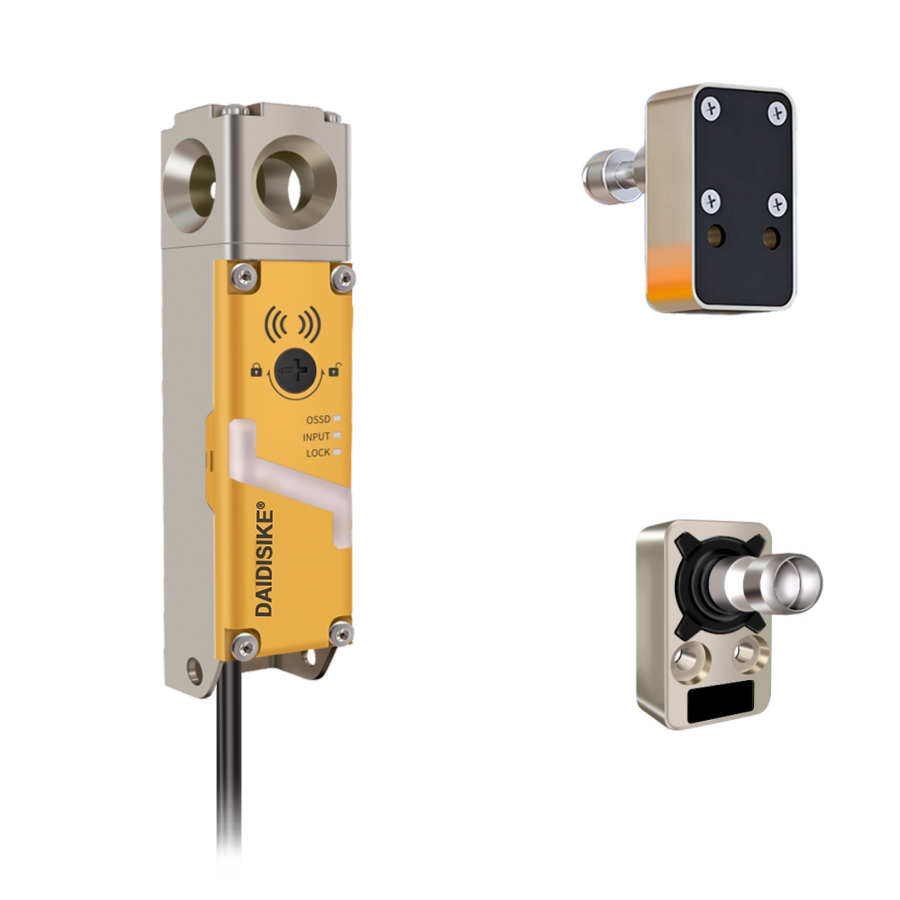
- All-metal structure: sturdy, safe and durable.
- Multiple functions: mechanical locking + electromagnetic locking with status monitoring.
- Coding methods: unique and universal coding available.
- Redundant dual output: prevents safety hazards from single-circuit failure.
- Cascaded connection: multiple switches in series on one safety input reduce controller I/O points.
- Compact appearance: 30 × 30 mm cross-section.
- Flexible installation: mounts directly on aluminum frames ≤ 30 mm.
- Suitable for: security doors, security windows, isolated areas.
- Applications: automated production lines, robot cells, hazardous test areas.
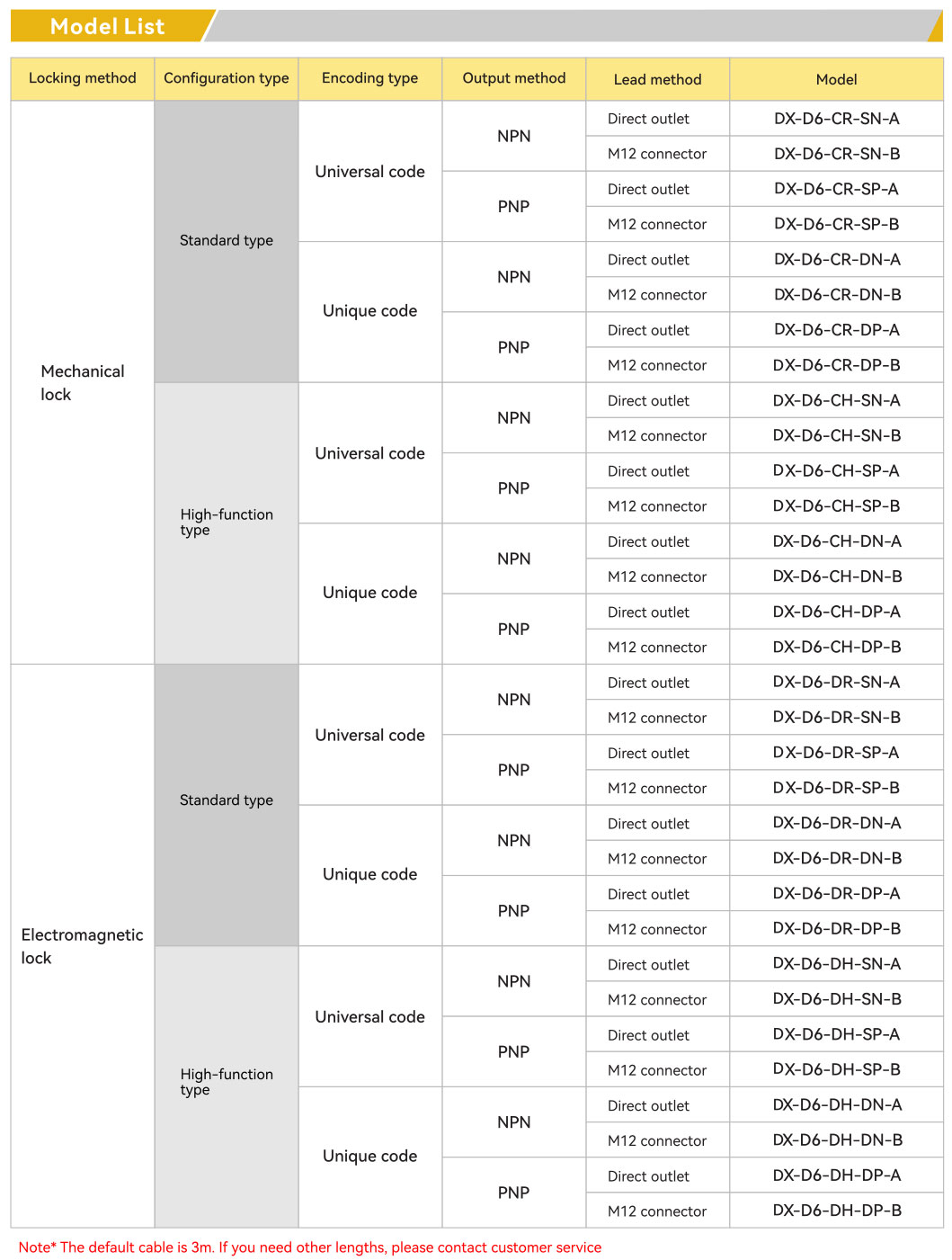
- Model range: 32 variants — C/D locking logic, R standard / H advanced, S/D coding, 2×NPN or 2×PNP, 3 m pre-wired lead or M12 connector.
Technical Parameters
| Parameter | Value |
|---|---|
| Design reference | ISO 14119 interlocking & coding design principles |
| Certification | CE (certification documents on request) |
| Structure | All-metal body; guard locking + position monitoring in one device |
| Cross-section | 30 × 30 mm (mounts directly on aluminium extrusion ≤ 30 mm) |
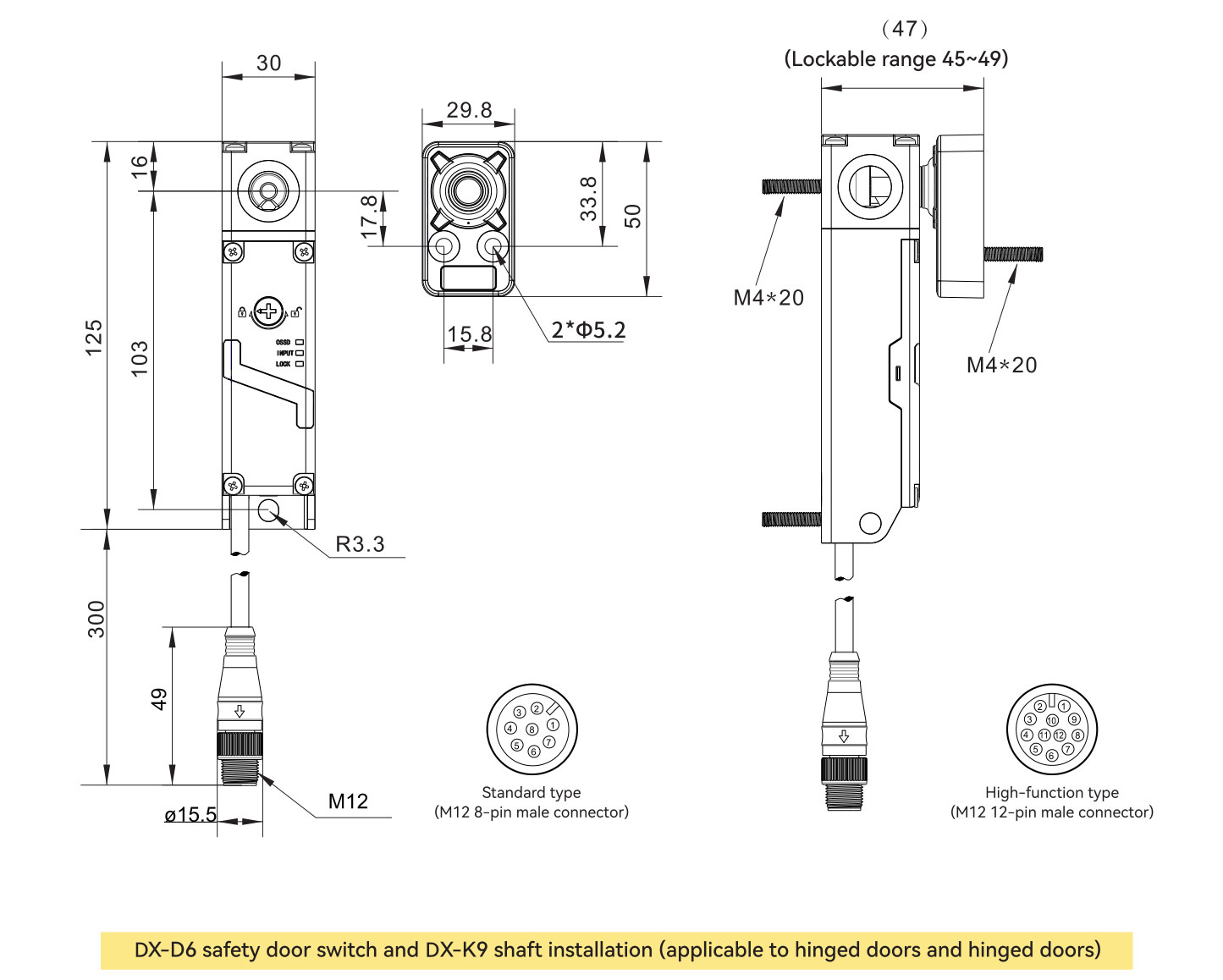
| Overall dimensions | 125 × 30 × 50 mm (switch body); two Ø5.2 mm mounting holes, M4 × 20 screws supplied |
| Actuator lockable range | 45 – 49 mm (nominal 47 mm) |
| Lock head material | Zinc alloy |
| Safety output | Redundant dual transistor output — N = NPN ×2 / P = PNP ×2 |
| Status indicators | OSSD (output), INPUT, LOCK and door-status LEDs — red when unlocked, green when locked |
| Locking | |
| Locking logic | C = mechanical locking / solenoid release (power-to-release); D = solenoid locking / mechanical release (power-to-lock) |
| Holding force Fzh (locking force) | 2000 N |
| Cascade connection | Cascadable in series — reduces controller input points (max. units: contact factory) |
| Mechanical service life | Contact factory |
| Response time | Contact factory |
| Coding & actuators | |
| Coding | S = universal coding / D = unique coding |
| Actuator (operating key) | DX-K9S (universal) / DX-K9D (unique) |
| Mounting brackets | DX-K9-L, DX-K9-L1 (rotary, hinged doors, left / right opening); DX-K9-T1, DX-K9-T2 (slide, sliding doors, left / right opening) |
| Power supply & connection | |
| Operating voltage | DC 24 V (tolerance: contact factory) |
| Power consumption | Contact factory |
| Connection | A = pre-wired lead, 3 m standard / B = M12 male connector — 8-pin on the standard version, 12-pin on the advanced-function version (300 mm pigtail) |
| Function version | R = standard / H = advanced function |
| Environmental resistance | |
| Enclosure protection rating (IP code) | Contact factory |
| Operating ambient temperature / humidity | Contact factory |
| Vibration / shock resistance | Contact factory |
1) Positioning & Use Cases
DX-D6 is an industrial guard door interlock with electromagnetic locking, built for machine tools, robot cells, packaging / assembly lines, and high-risk isolation zones. It keeps the door locked while hazards remain and permits opening only after a verified safe state.
2) Key Engineering Advantages
- Dual safety mechanism: mechanical interlocking + electromagnetic locking prevents premature access.
- Safety-chain ready: compatible with safety relays / PLCs, dual-channel monitoring.
- Mis-operation resistant: door / lock status indication and actuator-presence detection minimize false releases.
- Ruggedized for industry: sealed housing, vibration-resistant, oil & dust tolerant; heavy-duty mounting options.
- Service-friendly: front access wiring, clear terminal markings and intuitive LEDs shorten commissioning time.
- Standards-driven: interlocking and coding scheme designed with reference to ISO 14119; CE marked (certificates & test reports on request).
- System solution: integrates with DAIDISIKE light curtains, E-stops, door sensors and safety relays.
3) Typical Control Logic
- Interlock + Stop: open / unsafe door → safety relay opens → machine enters safe stop.
- Unlock release: only after safe-state confirmation + enable signal → magnet releases → door can open.
- Re-start prevention: opening the door breaks the safety circuit; re-start requires closing the door and a deliberate reset.
4) Detailed Specifications
Housing & Mechanics
- Structure: all-metal body, zinc-alloy lock head
- Cross-section: 30 × 30 mm; overall 125 × 30 × 50 mm
- Fixing: two Ø5.2 mm holes, M4 × 20 screws; actuator lockable range 45–49 mm
- Mounts directly on aluminium extrusion up to 30 mm — no adapter plate
- Door type: hinged (rotary brackets) / sliding (slide brackets), left- and right-opening
Locking Performance
- Locking type: power-to-lock (D) / power-to-release (C) versions
- Holding force: 2000 N
- Combined guard locking and position monitoring in one device
- Mechanical life: contact factory
Sensing & Outputs
- Redundant dual output: 2 × NPN or 2 × PNP transistor
- Single-circuit failure does not lead to loss of the safety function
- Coding: universal (S) or unique (D) actuator coding
- Output current rating / response time: contact factory
Electrical
- Supply: DC 24 V (tolerance: contact factory)
- Power consumption: contact factory
- Connection: A = 3 m pre-wired lead / B = M12 male connector (8-pin standard, 12-pin advanced)
- Indicators: OSSD, INPUT and LOCK LEDs plus a door-status light — red unlocked, green locked
- Function version: R standard / H advanced
Environment
- IP rating: contact factory
- Operating temperature / humidity: contact factory
- Vibration / shock: contact factory
Accessories
- Actuators: DX-K9S (universal coding) / DX-K9D (unique coding)
- Rotary brackets: DX-K9-L, DX-K9-L1 (hinged doors)
- Slide brackets: DX-K9-T1, DX-K9-T2 (sliding doors)
- Standard cable length 3 m
Standards & Compliance
- Designed with reference to ISO 14119 (interlocking devices associated with guards)
- CE marked — certificates and test reports on request
- Formal PL / SIL classification: request current certification documents
Model Range
- 32 sensor variants: DX-D6-[C/D][R/H]-[S/D][N/P]-[A/B]
- C = mechanical lock, solenoid release; D = solenoid lock, mechanical release
- R = standard, H = advanced function
- S = universal coding, D = unique coding; N = 2×NPN, P = 2×PNP
5) Selection & Integration Tips
- Choose locking logic (power-to-lock vs. power-to-release) based on machine inertia and risk category.
- Match output type with safety relay / PLC inputs (NPN / PNP / dry contact / OSSD); wire both channels independently.
- Route cables away from power lines; use shielded cabling and proper grounding; consider a dedicated 24 VDC supply.
- Validate stopping time and compute safety distance per ISO 13855; document periodic functional tests.
6) Installation & Maintenance
- Align the actuator with the lock head; ensure recommended insertion depth and use anti-loosening hardware.
- Verify terminal mapping and LED states on first power-up; test door / lock contacts and reset behavior.
- Establish inspection intervals for wear, alignment and contamination; maintain logs as part of the safety lifecycle.
Frequently Asked Questions
What safety standards does the DX-D6 safety door switch relate to?
The interlocking and coding scheme of the DX-D6 follows the design principles of ISO 14119 (interlocking devices associated with guards): universal-coded and uniquely-coded actuator versions are offered, and the uniquely-coded version accepts only its paired actuator. The switch is CE marked. It uses redundant dual-channel transistor outputs so a single circuit failure does not lead to loss of the safety function, and it supports both power-to-lock and power-to-release guard-locking logic. For a formal Performance Level / SIL classification, request the current certification documents from the factory — the level achieved in service also depends on the complete circuit, including the safety relay and wiring.
How much holding force does the DX-D6 guard locking switch provide?
The DX-D6 delivers a holding force (Fzh) of 2000 N, keeping the guard door locked while a hazard such as machine inertia or run-down motion remains. That is roughly 50 % more than the mechanical-contact DX-W2/W3/W5 solenoid locks in the same family, which is why the DX-D6 is the pick for machine-tool and robot-cell doors. For the rated mechanical life and latch engagement tolerance, contact the factory.
What is coded actuation and can DX-D6 units be cascaded?
The DX-D6 supports both unique and universal coding (actuators DX-K9D and DX-K9S), so uniquely-coded versions resist defeat by spare actuators, following ISO 14119 design principles. Multiple units can be cascaded in series on one safety circuit, reducing controller input points across multiple guard doors. For the maximum number of units in one cascade, contact the factory.
Can the DX-D6 replace a Euchner, Pilz or SICK RFID safety interlock?
In most cases yes. The DX-D6 is an all-metal 30 × 30 mm guard-locking switch with redundant transistor safety outputs and a DC 24 V supply, so it integrates with the same safety relays and PLCs as Euchner, Pilz, SICK or Schmersal interlocks. Match the coding level, locking principle and actuator orientation to the unit being replaced, and confirm the environmental ratings against the factory datasheet before a like-for-like swap.
What ingress protection and environmental range does the DX-D6 have?
The DX-D6 has an all-metal body designed for machine tools, robotic cells and isolated hazardous areas. The ingress protection rating, operating temperature and humidity range, and vibration and shock figures are currently being re-confirmed with the factory — request the latest datasheet before specifying the switch for a demanding environment.
PDF Documents
Browse all downloadsConfirm the document and CAD file match your exact ordered version before installation or mechanical design. Contact us if your model is not listed.
Specs reviewed by Engineer Cai, Senior Application Engineer. CE & RoHS compliant — see certificates.
Safety Light Curtain — Customer Cases
Real installations from DAIDISIKE clients. Click any case to view in full. Filter by scenario to quickly find a similar setup.
Press Guarding · Safety Light Screen
Robot Cell · Safety Light Barrier
Anti-Interference · Adjacent Installations
Access Gate · Guarding Light Curtain
Workstation · Compact Light Screen
Packaging Line · Machine Safety Light Curtain
Large Opening · Multi-Beam Safety Device
Assembly Conveyor · Photoelectric Light Curtain
Detection · Safety Light Array (Measurement)
Area Guarding · Safety Light Grid