
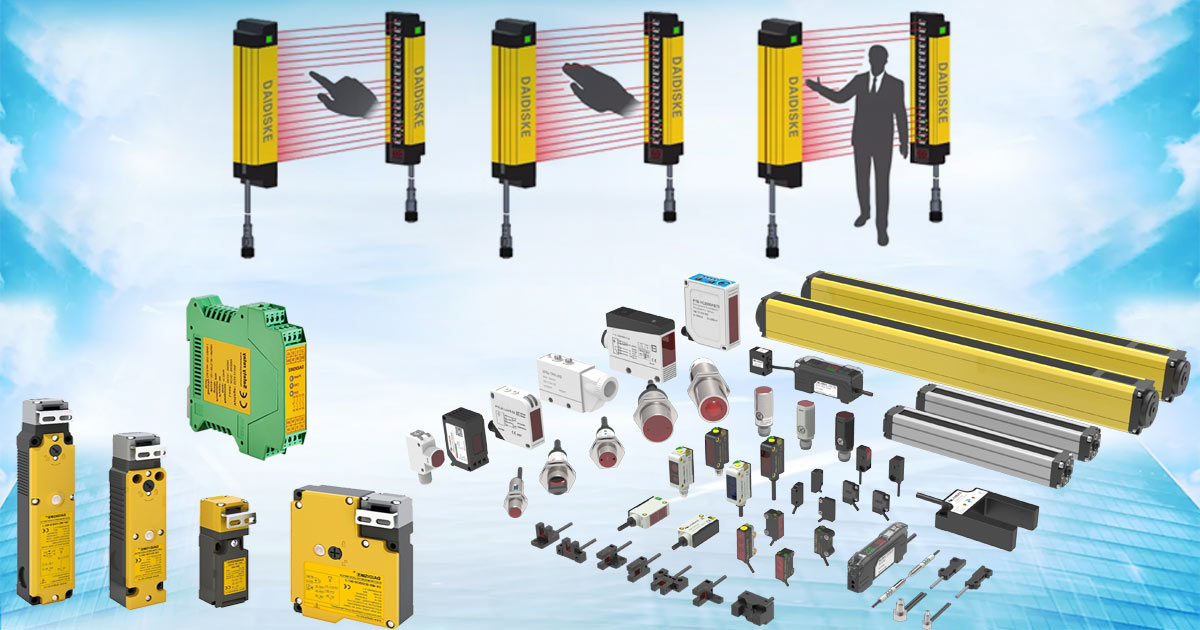
We keep cross-reference notes for the brands customers most often arrive with on safety door switches — and after the light-curtain brands, the two names that come up the most are Euchner and Schmersal. So here is the same treatment we give the curtains, built the same way: from each manufacturer's own published specifications, not from anyone's manual, and with no invented part numbers.
One blunt point before the detail. A “replacement” for a safety interlock is not a part number you look up and drop in. It is a match on a handful of facts — ISO 14119 type and coding level, whether guard locking is required (and if so, the holding force and power-to-lock vs power-to-unlock principle), the PL / SIL target, the output and series-wiring scheme — followed by a fresh risk-assessment check. These checks start the assessment; the complete changed function still needs validation. Get them wrong and no badge change makes it safe. Everything below is about getting them right.
How is a safety door switch chosen? The three questions that decide it
Before any brand cross-reference, three facts decide which DAIDISIKE product you land on: is it coded non-contact, mechanical, or guard-locking? ISO 14119 — the standard for interlocking devices associated with guards — is the spine of this whole exercise. It tells you the type (1/2 mechanical, 3/4 non-contact), the coding level (low 1–9 codes, medium 10–1000, high over 1000), and whether the device locks the guard or just senses it. Sort your installed switch into one of three buckets and the rest follows.
- Coded non-contact, no lock (Type 4) — Euchner CES-AR, Schmersal RSS16 / RSS36 / RSS260 / CSS. These are candidates for comparison with the DAIDISIKE DX-R1.
- Mechanical tongue, coded (Type 2) — Schmersal AZ16, AZ17. Preserve their exact positive-opening contact function; a transistor-output DX-D6 guard lock is not a mechanical-contact equivalent.
- Guard-locking interlock — Euchner MGB / CET / CTP, Schmersal AZM200 / AZM400. These are a door signal plus a lock: the DX-R1 (or a tongue switch) handles the position signal, while a DX-series lock and a DA31 safety relay must not be assumed to provide the required lock monitoring or release function; obtain an approved design.
What replaces a Euchner CES coded non-contact switch?
Start with the exact CES model and actuator coding. CES configurations differ in output evaluation, coding, series connection and diagnostics. DX-R1 can be compared as a non-contact sensing candidate, but its coding level, actuation distances, safety data and controller compatibility must satisfy the existing design; Type 4 alone is insufficient.
Record the CES order number, actuator, circuit and any teach-in or series-wiring requirements. Obtain the DX-R1 manual and corresponding data before deciding whether rewiring and mounting changes can preserve the required function. No fixed price saving or direct functional swap is established here.
What replaces a Schmersal RSS16, RSS36, RSS260 or CSS?
RSS and CSS require exact-model comparisons. Schmersal RSS260 variants have different coding options, and CSS uses a different sensing principle; neither family should be assigned a universal high-coding level. The RSS260 operating instructions show why the complete model and actuator matter.
For a DX-R1 candidate, compare coding and defeat-prevention measures, output interface, response time, environmental ratings and the permitted series circuit. Any claimed diagnostic coverage or achieved PL belongs to the complete validated function. Obtain current quotes after technical acceptance, not on the assumption that every Type 4 switch performs identically.
What replaces a Euchner MGB, CET or Schmersal AZM200 / AZM400 guard lock?
Guard locking needs evidence for both retention and safe monitoring. Euchner MGB2 has L1/L2 locking-principle variants, as shown in its MGB2 catalogue. Schmersal describes AZM400 as a bistable motor-driven bolt system with FZh = 10,000 N. These functions cannot be assumed from a door-position sensor and a generic lock.
A proposed DX-series guard-locking system must document guard-closed and lock-engaged detection, release conditions, holding force, power-loss response, escape/emergency release and the required safety data. The DX-R1 only supplies its documented sensing role. The DA31 specification does not establish EDM or a standstill/delayed unlock function. Do not describe the combination as an MGB or AZM replacement until the complete architecture is verified.
What replaces a Schmersal AZ16 or AZ17 tongue switch?
AZ16 and AZ17 are coded mechanical tongue-switch families. Their exact contact arrangement, actuation and mounting must be retained or redesigned. The DX-D6 product reference describes guard locking with redundant transistor outputs, not a matching set of positive-opening mechanical contacts. It must not be offered as a terminal-for-terminal substitute.
That said, if you are refreshing a line anyway, a tongue switch is the one place worth considering an upgrade rather than a like-for-like swap: moving from a Type 2 mechanical tongue to a Type 4 coded non-contact DX-R1 removes the actuator insertion wear point, but still requires alignment within documented actuation tolerances. Treat that as a design change with its own risk assessment, not a drop-in.
Cross-reference: which DAIDISIKE product matches which?
The table is a shortlist of functions to investigate, not approved substitute part numbers. Door position, lock engagement and safe release must be preserved separately. Exact-model manuals and validation determine acceptance.
| Original switch / interlock | ISO 14119 class | Function | DAIDISIKE match |
|---|---|---|---|
| Euchner CES-AR | Type 4 coded non-contact (RFID) | Door interlock, no lock, PL e | DX-R1 sensing candidate; full interface and safety-data check required |
| Euchner CET / CTP / CTM | Type 4 transponder + guard locking | Interlock with guard locking | No equivalent established; guard-locking design required |
| Euchner MGB / MGB2 | Type 4 RFID + guard locking, SIL 3 | Locking force, L1/L2 principle and escape release vary by exact configuration | No equivalent established; verify complete guard-locking function |
| Schmersal RSS16 / RSS36 | Type 4 RFID; coding level model-specific | Compact coded non-contact, PL e | DX-R1 (confirm coding level) |
| Schmersal RSS260 | Type 4 RFID coded | Series and diagnostic limits depend on the exact 8-pin/SD configuration | DX-R1 candidate; verify coding and series diagnostics |
| Schmersal CSS | Type 4 pulse-echo; coding level model-specific | Coded non-contact sensor | DX-R1 sensing candidate; no direct equivalence established |
| Schmersal AZM200 / AZM201 | Non-contact solenoid guard locking | Guard-locking interlock | No equivalent established; guard-locking design required |
| Schmersal AZM400 | Bistable motor-driven bolt; verify exact variant | ~10,000 N holding, ST/ST2 | No equivalent established; verify complete guard-locking function |
| Schmersal AZ16 / AZ17 | Type 2 mechanical tongue, coded | Positive-opening tongue interlock | No direct mechanical-contact substitute established; DX-D6 requires a different documented design |
The pattern is consistent: the German families split into three roles — coded non-contact sensing, mechanical tongue sensing, and guard locking — and each proposed DAIDISIKE candidate must be assessed against its documented role. Where a holding force or coding level was load-bearing in the original assessment, that remains one of several requirements to preserve. The method is the same one we use for the light-curtain brands; the wider set lives in the brand replacement & compatibility guide.
Why source the DX-R1 from DAIDISIKE — and is the comparison honest?
Euchner and Schmersal names identify comparison targets, with no affiliation or endorsement implied. This is not a legal opinion or compatibility declaration. Competitor features and DAIDISIKE capabilities need their own exact-model evidence; missing lock-monitoring or coding data cannot be filled by analogy.
Ask DAIDISIKE for current supply terms, the exact DX variant and its available supporting safety documents. Neither a quote nor an IEC/ISO reference establishes certification parity. No TÜV test, specific certificate, lead time or price saving is promised by this comparison.
Send us the original model, the ISO 14119 type/coding level, your PL/SIL target, the output/series scheme and — for locks — the holding force and power-to-lock/unlock principle. Our engineers can assess an exact DX candidate and identify unresolved or incompatible requirements.
Contact DAIDISIKE · Phone / WhatsApp +86 15218909599
Sources & specifications cited
- Euchner — safety engineering (CES, CET, CTP, MGB) — transponder/RFID coded switches, MGB guard locking, ISO 14119 Type 4.
- Schmersal — safety switchgear (RSS, CSS, AZM200, AZM400, AZ16, AZ17) — model-specific non-contact coding, guard-locking variants, tongue switches.
- ISO 14119 — Safety of machinery: interlocking devices associated with guards (types, coding levels, fault masking with ISO/TR 24119).