
DX-W5 Multi-Contact Guard Locking Switch
One door point, six contact blocks: multi-channel safety monitoring plus full PLC status from a single 1300 N guard lock — with a dual-voltage solenoid for export cabinets.
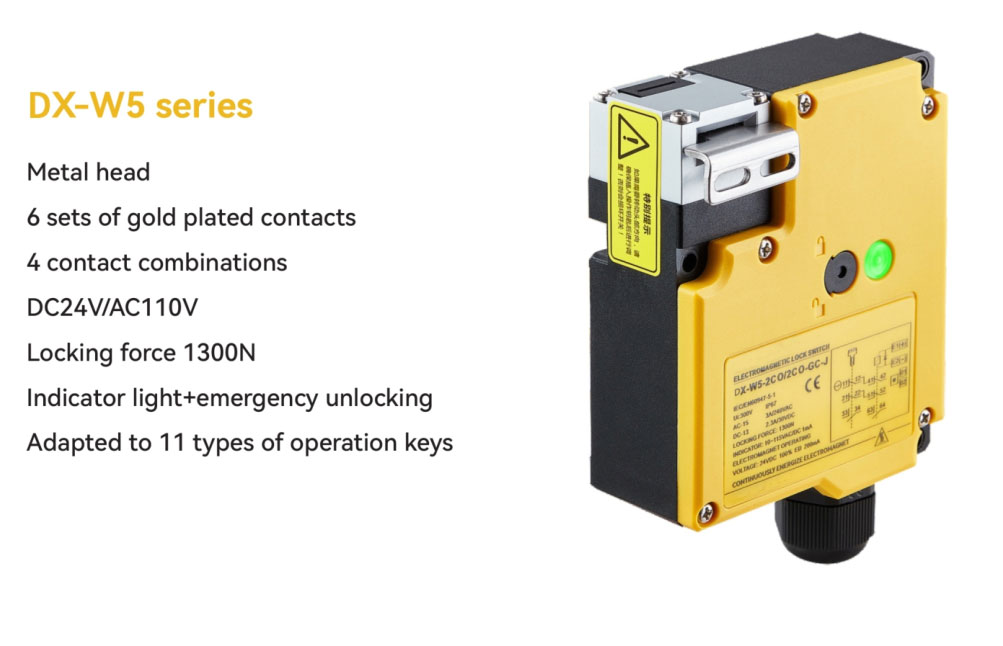
- 6 gold-plated silver-alloy contact blocks, 4 configurations
- 1300 N holding force; GD / GC locking logic
- Solenoid 24 V DC or 10-115 V AC/DC + indicator light
- IP67; electrical life > 150,000 operations
- Optional front / side emergency release
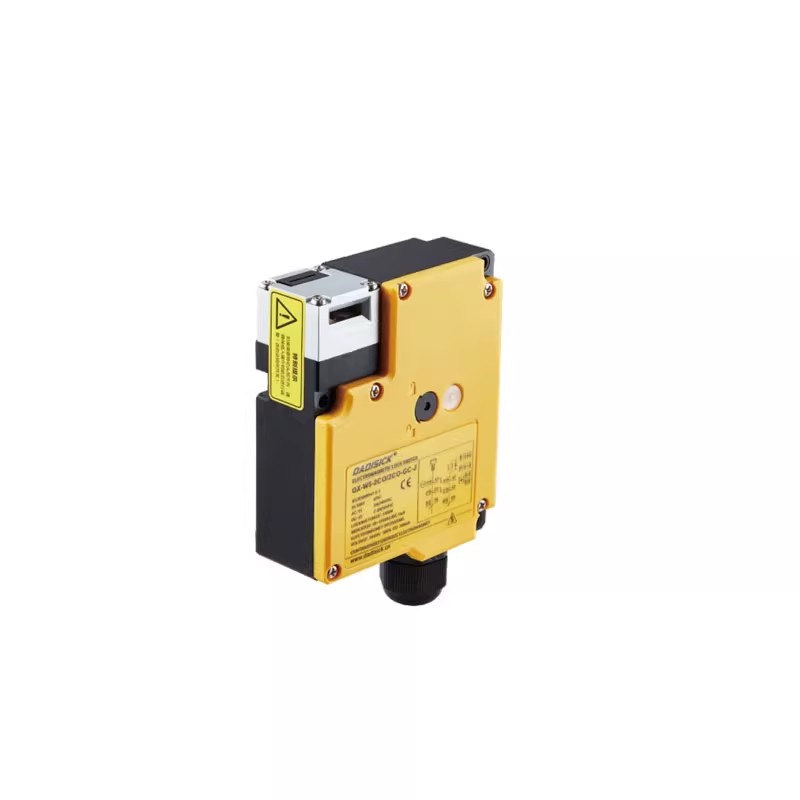
The Status-Rich End of the DX-W Platform
Every fence gate on an automated line is really two conversations: a safety conversation with the relay ("closed and locked?") and a production conversation with the PLC ("who opened which door, and is the andon right?"). Most compact door locks only have contacts for the first. The DX-W5 carries six gold-plated silver-alloy contact blocks so a single device can hold both conversations at once — dual- or triple-NC safety channels and NO status bits, straight off the door, no expansion relay in the panel.
Around that contact system it is a full member of the DX-W platform: 1300 N holding force, GD/GC locking logic, IP67 sealing, DX-K actuator keys, and a lock-state indicator light at the door. Its solenoid is the flexible one of the family — 24 V DC or 10-115 V AC/DC — which is why export machine builders often standardise on it. For simpler doors, the DX-W3 (2 blocks) or DX-W2 (4 blocks) cost less per point; for RFID coding and 2000 N, step to the DX-D6.
Six Blocks, Two Conversations — Wiring Concept
Original wiring concept for the 2CO/2CO code — terminal designations and channel allocation must follow the datasheet and your circuit design.
Technical Specifications
| Holding force | 1300 N |
|---|---|
| Contact system | 6 gold-plated silver-alloy contact blocks; configurations 2CO/2CO, 3C/2CO, 2CO/3C, 3C/3C |
| Order codes | 8 (4 configurations × GD/GC), metal head (J), M20 conduit entry (G) |
| Locking versions | GD = solenoid-locked, mechanically released; GC = mechanically locked, solenoid-released |
| Solenoid supply | 24 V DC or 10-115 V AC/DC |
| Indicator light | 10-115 V AC/DC |
| Electrical life | > 150,000 operations |
| Contact rating | Adds DC-13 250 V / 2.7 A tier to the platform's standard rating |
| Protection | IP67 |
| Emergency release | Front or side release available as factory option |
| Actuator keys | DX-K series (11 models); preparation clearance 1-3.5 mm |
| Data not published for this model | Mechanical life count, forced-separation force/travel, operating temperature range — request from factory if required |
| Certification note | Certification documents available on request; achieved PL/Category is a property of the complete circuit |
The Eight Order Codes
| Configuration | Head / body contacts | GD version | GC version |
|---|---|---|---|
| 2CO/2CO | 2NC+1NO / 2NC+1NO | DX-W5-2CO/2CO-GD-J | DX-W5-2CO/2CO-GC-J |
| 3C/2CO | 3NC / 2NC+1NO | DX-W5-3C/2CO-GD-J | DX-W5-3C/2CO-GC-J |
| 2CO/3C | 2NC+1NO / 3NC | DX-W5-2CO/3C-GD-J | DX-W5-2CO/3C-GC-J |
| 3C/3C | 3NC / 3NC | DX-W5-3C/3C-GD-J | DX-W5-3C/3C-GC-J |
Series Features
Typical Applications
Automated Line Fence Gates
Safety channels, lock feedback and PLC status from one device per gate — no expansion relay.
Machine-Tool Access Panels
1300 N holds the panel through coast-down; the indicator light shows lock state at the door.
Robot Cell Enclosures
>150,000 electrical operations for doors cycled every pallet or every changeover.
Relay-Based Control Panels
Six hard contacts feed redundant relay circuits directly — a fit for non-bus legacy architectures.
Mixed-Voltage Export Machines
One part number covers 24 V DC and 10-115 V AC/DC cabinets across markets.
Multi-Door Lines with Mixed Logic
GD on doors safe at power loss, GC on doors that must stay locked — same contact layout.
Frequently Asked Questions
When is a 6-contact door lock genuinely worth it?
Whenever one fence door has to talk to more than one system. A typical automated-line gate needs: two NC channels to the safety relay for the door, one or two NC channels for lock monitoring, an NO contact for the line PLC's door-status bit, and another NO for the andon/HMI display. That is six signals — which normally means a 2- or 4-contact switch plus an expansion relay in the panel. The DX-W5 delivers all of them from the single device on the door.
How do the four contact configurations differ?
The code is [head compartment]/[body compartment] with C = NC and O = NO. 2CO/2CO gives 2NC+1NO on each side — balanced safety plus status. 3C/2CO and 2CO/3C bias one compartment toward pure NC channels. 3C/3C is all-NC: six safety-capable channels for series architectures or multi-relay circuits. Every configuration is available in GD and GC, so contact choice never constrains locking logic.
What does the dual-voltage solenoid option change in panel design?
The solenoid accepts 24 V DC or 10-115 V AC/DC, and the built-in indicator light likewise runs on 10-115 V AC/DC. Export machine builders shipping the same cabinet design to markets with different control voltages can keep one door-lock part number instead of maintaining regional variants or adding a dedicated transformer for the lock circuit.
What is the DC-13 250 V / 2.7 A rating tier for?
DC-13 is the inductive DC utilization category — relay and contactor coils. On top of the platform's standard DC-13 rating, the DX-W5 adds a 250 V/2.7 A tier, giving headroom when the interlock's contacts drive higher-voltage DC control circuits directly rather than a 24 V relay input. As always, keep motor and heater loads on contactors.
Does the DX-W5 have an emergency release?
A front or side emergency release is available as a factory option — specify it when the risk assessment identifies a trapped-operator scenario, so personnel inside the cell can mechanically release the 1300 N lock. Note the mounting side at order time; it is not a field retrofit.
Which lifetime and environmental figures are published, and which need factory confirmation?
Published: electrical life greater than 150,000 operations, IP67 sealing, 1300 N holding force, gold-plated silver-alloy contacts. Not separately published for this model: mechanical life cycle count, forced-separation force/travel and operating temperature range. If your specification requires those numbers documented, request them from the factory or consider the DX-W2, which publishes 1,000,000 mechanical cycles and -20 °C to +60 °C on the same platform.
How does the DX-W5 combine with safety relays for higher-level architectures?
Wire the NC door and lock channels into a DQSRN or DA31 safety relay; the relay performs cross-monitoring, and the achieved Performance Level or Category belongs to the complete circuit — relay, wiring and switch together — not to the door lock alone. The all-NC 3C/3C code is popular here because it feeds two independent relays from one door.
What details finalize an export order for the DX-W5?
Contact configuration (2CO/2CO, 3C/2CO, 2CO/3C or 3C/3C), GD or GC locking, solenoid voltage (24 V DC or 10-115 V AC/DC), the optional emergency release and its position, plus one DX-K actuator key per door. All eight standard codes ship with metal head and M20 conduit entry; confirm with the factory if a cable (X) or plastic-head (S) variant is required. Small trial orders are generally workable — contact the factory for MOQ and lead time.
PDF & 3D CAD Downloads
Browse all downloads3D CAD MODELS
Find the file for your exact model
Open the download center with the named series selected. Search your full model, check the file details and download the matching STEP file.
Confirm the document and CAD file match your exact ordered version before installation or mechanical design. Contact us if your model is not listed.
Specs reviewed by Engineer Cai, Senior Application Engineer. See certificates.
Safety Light Curtain — Customer Cases
Real installations from DAIDISIKE clients. Click any case to view in full. Filter by scenario to quickly find a similar setup.
Press Guarding · Safety Light Screen
Robot Cell · Safety Light Barrier
Anti-Interference · Adjacent Installations
Access Gate · Guarding Light Curtain
Workstation · Compact Light Screen
Packaging Line · Machine Safety Light Curtain
Large Opening · Multi-Beam Safety Device
Assembly Conveyor · Photoelectric Light Curtain
Detection · Safety Light Array (Measurement)
Area Guarding · Safety Light Grid