
DX-K Actuator Keys for Safety Interlock Switches
The tongue side of every DX interlock: 11 key models that let one switch family fit flat doors, edge-mounted doors, heavy slamming doors and out-of-true retrofit frames.
- Fits DX-W2 / W3 / W5 locks and DX-D2 / D3 switches
- Fixed T, L, extended T/L + rubber-buffered versions
- Adjustable K5 / K6 / K8 for on-site alignment correction
- ±1 mm slot tolerance; hinged doors R > 300 mm
- Sold with switches or alone as maintenance spares
Why the Key Deserves Its Own Selection Step
A tongue-operated interlock is only as reliable as the part that actually moves — the actuator key bolted to the door. It absorbs every slam, carries the alignment error of the whole door assembly, and is the component that gets bent when a trolley clips the guard. That is why the DX-K series is specified separately from the DX-W2, DX-W3, DX-W5 and DX-D2/D3 switch bodies: the right key geometry is a door-by-door decision.
The range breaks into three tiers. Fixed keys (K1 T-type, K2 L-type, K3 extended T, K4 extended L) suit doors machined to tolerance. Buffered keys (the D suffix) add a rubber pad for doors that close hard. Adjustable keys (K5, K6, K8) put alignment screws on the key itself, so an out-of-true frame is corrected at the door rather than by re-drilling brackets. There is deliberately no DX-K7 in the numbering.
Model Selection Table
| Model | Geometry | Buffer pad | Adjustment | Pick it when… |
|---|---|---|---|---|
| DX-K1 | T-type | — | Fixed | Flat door face, controlled tolerances |
| DX-K1D | T-type | Rubber pad | Fixed | Same, with door-slam cushioning |
| DX-K2 | L-type | — | Fixed | Key mounted on the door edge at 90° |
| DX-K2D | L-type | Rubber pad | Fixed | Edge mounting on hard-closing doors |
| DX-K3 / DX-K3D | Extended T | — / pad | Fixed | Thicker or offset door frames |
| DX-K4 / DX-K4D | Extended L | — / pad | Fixed | Offset edge-mount situations |
| DX-K5 | Adjustable | — | Horizontal (angle screw) | Slight horizontal misalignment on site |
| DX-K6 | Adjustable | — | Horizontal + vertical | Deviation in both axes |
| DX-K8 | Adjustable | — | H + V, head presses 3 mm & rotates 90° | Awkward insertion angles |
RFID-coded actuators DX-K9S / DX-K9D (with DX-K9-L/L1/T1/T2 brackets) belong exclusively to the DX-D6 switch and do not interchange with the mechanical keys above.
Where These Keys Work Every Day
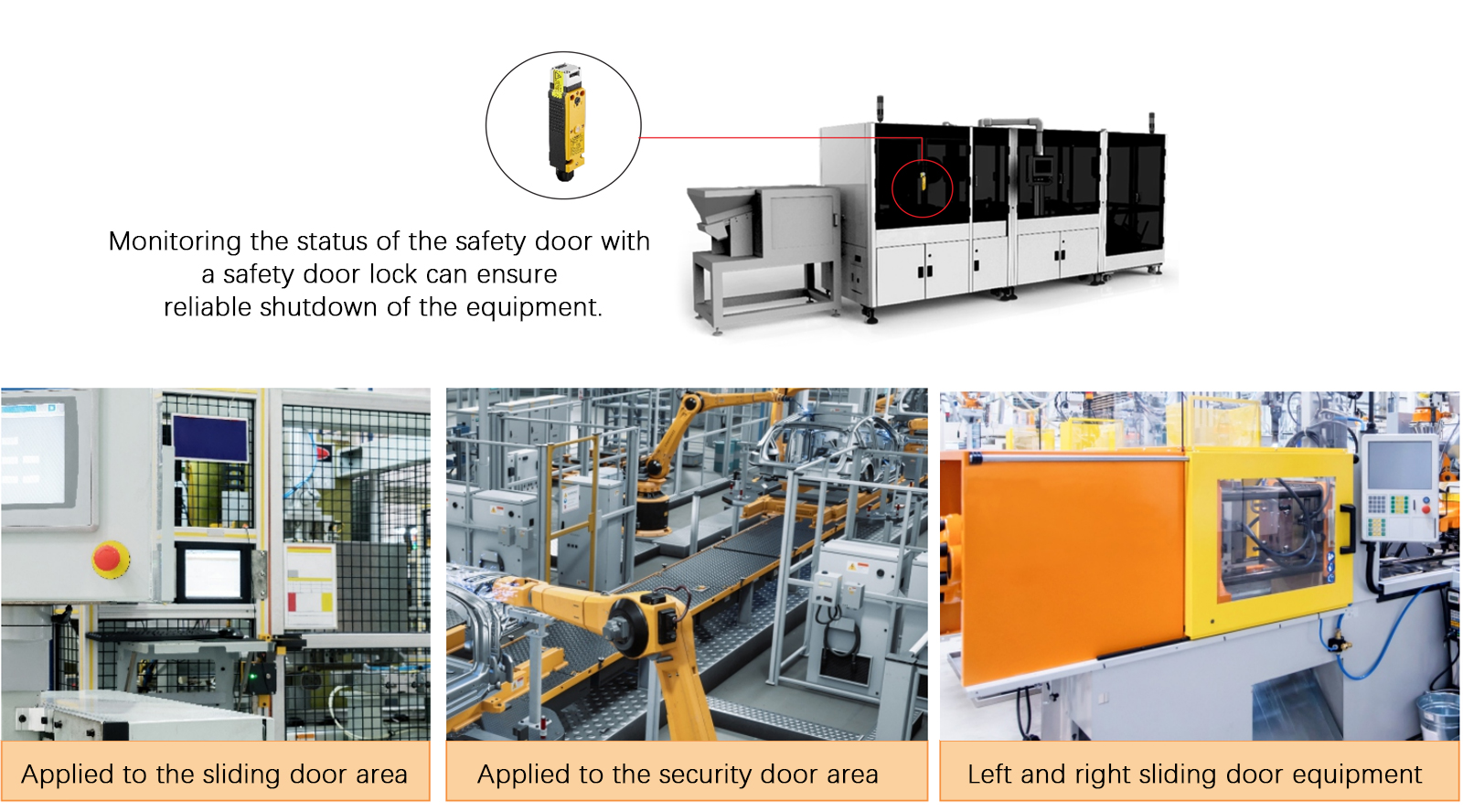
Every door in these scenes carries the same two-part logic: a switch body on the fixed frame, a DX-K key on the moving door. The interlock signal feeds a DQSRN or DA31 safety relay that supervises the machine's stop circuit.
Typical Applications
CNC Enclosure Hinged Doors
Fixed T/L keys on controlled-tolerance doors; the R>300 mm swing spec matches typical machine-tool access doors.
Field-Assembled Fence Gates
Adjustable K5/K6/K8 absorb the alignment scatter of on-site welded or bolted perimeter fencing.
Spare-Parts Standardization
One key range covers both locking (W2/W3/W5) and non-locking (D2/D3) switches — fewer SKUs on the shelf.
Heavy or Fast-Closing Doors
Buffered K1D-K4D variants cushion door-slam impact before it reaches the switch head.
Retrofit Key Replacement
Like-for-like geometry matching lets maintenance swap a worn tongue without touching wiring or brackets.
OEM Accessory Line Items
Panel builders quote the exact key part number on the same PO as the switch bodies.
Frequently Asked Questions
The tongue on my guard door is bent — can I order just the key without a new switch?
Yes. DX-K keys are supplied as a standalone accessory/spare-parts line. Identify the geometry of the damaged key (T, L, extended T, extended L, buffered, or one of the adjustable types), order the matching DX-K model, and the switch body on the frame stays untouched. This is the normal maintenance path — the key takes the mechanical abuse and is designed to be the replaceable part.
Which DX-K models fit which switches?
The mechanical DX-K1 through DX-K8 range (11 models, no K7) fits DX-W2, DX-W3 and DX-W5 guard-locking switches and DX-D2/DX-D3 interlock switches. The only difference between families is the preparation clearance machined before fitting: 1-3.5 mm for the DX-W group, 1-2.5 mm for the DX-D group.
When should I pay extra for an adjustable key instead of a fixed one?
When you cannot guarantee ±1 mm key-to-slot centering at installation time. Field-assembled fence doors, retrofits on worn frames and doors that will be re-hung all fall into this category. DX-K5 corrects horizontal deviation via an angle screw, DX-K6 corrects both horizontal and vertical, and DX-K8 adds a head that presses in 3 mm and rotates 90 degrees for awkward insertion angles.
What do the D-suffix versions (K1D/K2D/K3D/K4D) change?
They add a rubber buffer pad to the same base geometry. Every door slam transmits impact through the key into the switch head; on heavy doors or fast closers the pad absorbs part of that shock, which protects both the key and the switch head over the million-cycle life the switch bodies are rated for.
Do these keys work with the DX-D6 door switch?
No. The DX-D6 uses its own RFID-coded actuator system (DX-K9S universal-coded or DX-K9D uniquely-coded, with DX-K9-L/L1/T1/T2 brackets). Mechanical DX-K1-K8 keys and the DX-K9 RFID system are not interchangeable in either direction — a point worth double-checking on mixed purchase orders.
What geometry data do I need to check before specifying a key for a hinged door?
Three numbers: the door swing radius must exceed 300 mm; the key must center on the switch slot within ±1 mm; and the preparation clearance between key tip and switch face must be 1-3.5 mm (DX-W switches) or 1-2.5 mm (DX-D switches). If the swing radius is tighter than R300, consult the factory before ordering — no cataloged DX-K variant covers smaller radii.
How are DX-K keys usually purchased — with the switch or separately?
Both. New machine builds normally add the key model to the same purchase order as the switch bodies (one key per door, plus recommended spares). Maintenance buyers order keys alone. Small trial quantities are workable; for current pricing, MOQ and lead time contact the factory through the contact page.
3D CAD Downloads
Browse all downloadsFind the file for your exact model
Open the download center with the named series selected. Search your full model, check the file details and download the matching STEP file.
Confirm the document and CAD file match your exact ordered version before installation or mechanical design. Contact us if your model is not listed.
Specs reviewed by Engineer Cai, Senior Application Engineer. See certificates.
Safety Light Curtain — Customer Cases
Real installations from DAIDISIKE clients. Click any case to view in full. Filter by scenario to quickly find a similar setup.