中文官网

DLD-100D Single-Line TOF Scanning Laser Radar — 100 m Class

A long-range 2D perception LiDAR for integrators who need one compact sensor to watch a whole aisle, gate, lane or fence line — indoors or out.

  • 100 m @90% reflectivity · honest 40 m rating @10%
  • ±20 mm accuracy, tightening to ±10 mm inside 15 m
  • 280° or full 360° coverage by variant
  • Multi-echo processing for dust, rain and fog
  • IP67 · 250 g · 3 W · Ethernet 100BASE-TX
Share this pageEmailWhatsAppLinkedIn
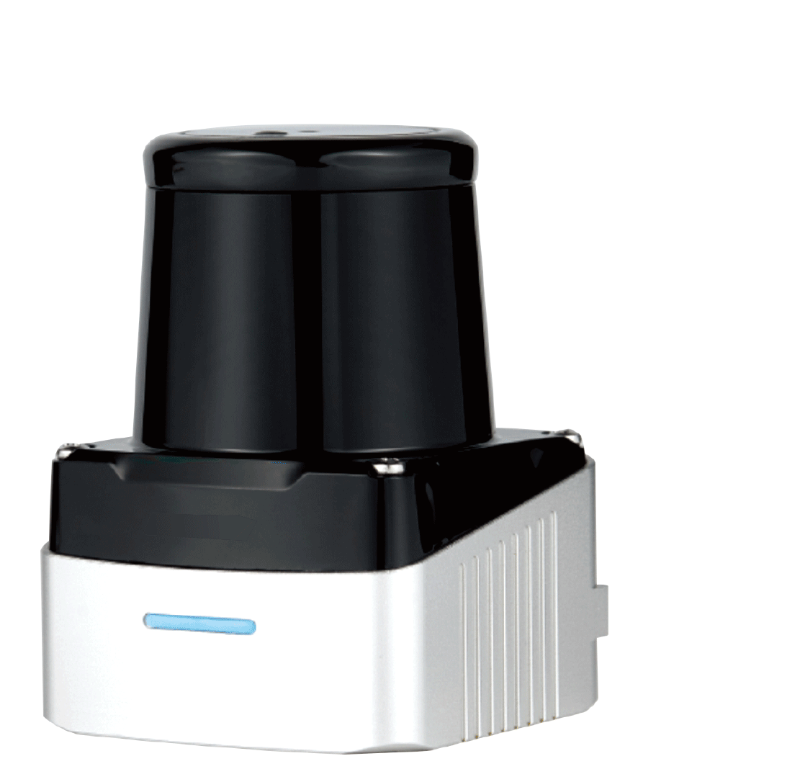
DLD-100D single-line TOF scanning laser radar

Built for Wide Areas, Sized for Small Mounts

The DLD-100D spins a 905 nm Class 1 laser through its surroundings and times each return flight, producing a 2D distance profile of everything in the plane on every revolution. What sets it apart in our line-up is reach: rated up to 100 m at 90% reflectivity and 40 m at 10% reflectivity, from a housing that measures just 60 × 60 × 80 mm and weighs 250 g.

Published ranging accuracy is ±20 mm and ±10 mm inside the 0.1–15 m near field, which is where docking, positioning and profiling work actually happens. The document lists multi-echo processing, ambient-light immunity above 80,000 lux and an IP67 enclosure. Validate the actual target, mounting and weather conditions: neither the enclosure rating nor multi-echo processing guarantees outdoor detection in all circumstances.

This is a perception/measurement LiDAR, not an IEC 61496 certified safety component; do not use it as the sole means of personnel protection. For safety functions, see the ST27 Type 3 safety laser scanner.

Three Variants, One Housing

DLD-100DH280° · 50/25 Hz0.08°/0.16°/0.32°DLD-100DCFull 360° · 50/25 Hz0.08°/0.16°/0.32°DLD-100DP280° · fixed 100 Hz0.32° — speed firstSame range, accuracy, IP67 body and Ethernet output on all three

Original DAIDISIKE schematic. Start with DC for full-circle coverage, DH for a sector scan, or DP for the listed 100 Hz option. Confirm the suffix and supported rate/resolution pairing; family-wide maximum figures are not simultaneous.

Compact 60 × 60 × 80 mm Platform

DLD-100D scanning laser radar housing, front and angled views

Specification Sheet

Ranging principleSingle-line 2D Time-of-Flight (TOF)
Range @90% / @10% reflectivity100 m / 40 m
Accuracy (full / 0.1–15 m)±20 mm / ±10 mm
Scan angle280° (DLD-100DH, DLD-100DP) · 360° (DLD-100DC)
Scan frequency50/25 Hz selectable (DH, DC) · 100 Hz fixed (DP)
Angular resolution0.08°/0.16°/0.32° selectable (DH, DC) · 0.32° fixed (DP)
Vertical field of view±0.5°
Laser905 nm, Class 1 eye-safe
Echo handlingMulti-echo processing (dust / rain / fog)
Ambient light immunity> 80,000 lux
Data interfaceEthernet 100BASE-TX (no discrete/relay/analog output)
Supply / consumption9–36 V DC · ~0.25 A @12 V · 3 W max
Enclosure / massIP67 · 60 × 60 × 80 mm · 250 g excl. cable
Operating temperature−10 °C to +55 °C
Start-up / service life< 20 s · 5 years (motor life)

The model table in the supplied PDF is the basis for the variant figures above: DH/DC list 50/25 Hz and 0.08°/0.16°/0.32° options; DP lists 100 Hz at 0.32°. Confirm the requested configuration. Values we cannot document — enclosure material, quantified beam spot, exact PTP sync precision — are left out rather than invented; PTP is customizable per project, so ask us with your requirement. Certification documents are available on request.

Plan the Measurement, Not Just the Maximum Range

A long-range LiDAR is most useful when its scan plane, target return and data interface match the job. Use the following questions to narrow the configuration before ordering an evaluation unit.

What must the scanner see?

Record target dimensions, colour, surface angle and the closest and farthest measurement distances. Use the 90% and 10% reflectivity ratings as stated test conditions, then trial your real objects. A small dark target is not equivalent to a large bright test surface.

Where will the scan plane sit?

A 2D scanner measures one plane, not a complete 3D volume. Show the proposed mounting height, obstructions and areas hidden behind structural members. For a closed sweep, evaluate DC; for a sector or higher listed scan rate, compare DH and DP against the variant table above.

What will consume the data?

Identify the IPC or controller, operating system and data format your software needs. Request the matching protocol and connection instructions; Ethernet 100BASE-TX alone is not a promise of a particular PLC protocol or software driver. Confirm any PTP requirement separately.

How will you validate outdoors?

Include direct sunlight, wet or dusty optics, representative targets and the intended environmental limits in the trial. Define a response to invalid or missing data. Our outdoor LiDAR guide explains why weather performance and enclosure sealing are separate checks.

Need a different output or range?

Compare the DLD-50D navigation LiDAR when your range requirement fits the 50 m family. If the controller also needs ordinary NPN/PNP signalling, review the DLD50T8N/P output options and confirm their electrical details. For the overall selection process, see our industrial LiDAR selection guide. Neither ordinary Ethernet nor NPN/PNP output establishes a personnel-protection safety function.

For a model recommendation, send the target and distance, installation sketch, required scan coverage, host controller, environment and quantity through our application enquiry page.

DLD-100D Product PDF

DLD-100D LiDAR — English Product Document

Four pages, approximately 4.3 MB. Review the product overview, model-specific specification table and reference illustrations alongside this page. Use the model table to confirm the DH/DC/DP distinctions, and request the connection and commissioning details for your selected configuration.

Opens in a new tab when requested. The file is not automatically loaded while you browse this product page.

Deployment Scenarios

Outdoor Perimeter Lines

One IP67 unit sweeps a fence line or gate zone to 100 m on bright targets — fewer poles, fewer cables than beam chains.

Smart Traffic & Tolling

The 100 Hz DP variant profiles vehicles passing lanes, gates and kerbside points for presence, class and dimension logic.

AGV / Service Robots

250 g and 3 W fit battery platforms; the point cloud feeds obstacle avoidance and localization stacks over Ethernet.

Yard & Port Awareness

Long-range scan data can support large-vehicle awareness around cranes and loading areas. Validate target returns in dust, drizzle and the site's actual lighting; multi-echo does not remove weather limits.

Frequently Asked Questions

How far can the DLD-100D really see on dark targets?

Plan around two numbers, not one. On a bright 90%-reflectivity surface the rated range is 100 m; on a dark 10%-reflectivity surface — black rubber, dark clothing, matte housings — it is 40 m. If your critical target could be dark, lay out the installation against the 40 m figure and treat anything beyond it as a bonus, not a guarantee.

Which variant should I pick: DLD-100DH, DLD-100DC or DLD-100DP?

DC is the only one that closes the full circle (360°), so choose it for pole-mounted omnidirectional monitoring. DH scans a 280° sector with selectable 0.08°/0.16°/0.32° resolution at 50/25 Hz — the mapping and fine-target choice. DP trades resolution for speed: fixed 0.32° at a 100 Hz refresh, suited to counting or tracking fast-moving vehicles. Range, accuracy, housing and interface are identical across all three.

Does rain, fog or dust blind this sensor?

The DLD-100D document lists multi-echo processing, >80,000 lux ambient-light immunity and an IP67 enclosure. These features do not guarantee detection in every outdoor condition. Rain, fog, airborne dust or a contaminated optical window can affect the returned signal and usable range. Test representative weather and targets at your installation, and define what the application should do when valid measurement data are unavailable.

How do I get data out of it, and can it drive a relay directly?

The documented interface is Ethernet 100BASE-TX — your controller or IPC ingests the scan data over the network. There is no NPN/PNP, relay or analog output on this model, so a hardwired trip signal needs either an Ethernet-to-I/O gateway or a sibling model with discrete outputs, such as the DLD50T8N/P.

Can I use the DLD-100D to protect people around a machine?

No. This is a perception/measurement LiDAR, not an IEC 61496 certified safety component; do not use it as the sole means of personnel protection. It has no OSSD outputs and no Type/SIL/PL rating. Where a scanner must stop a machine to protect a person, specify our ST27 Type 3 safety laser scanner and size the field per ISO 13855.

What are the electrical and mechanical basics for integration?

9–36 V DC input (about 0.25 A at 12 V, 3 W max), 60 × 60 × 80 mm envelope, 250 g without cable, IP67 sealing, −10 °C to +55 °C operating range, under 20 s start-up. The document lists a 905 nm Class 1 laser and a rated working life of 5 years based on the scanning motor. Follow the supplied installation and laser-safety instructions for the delivered unit.

Can I combine 100 Hz scanning with 0.08° angular resolution?

Do not assume that combination. The model table lists 50/25 Hz and 0.08°/0.16°/0.32° options for DLD-100DH/DC, and 100 Hz with 0.32° for DLD-100DP. Select the suffix and confirm its available rate/resolution pairing before purchase; the family-wide headline values are not all available simultaneously.

What is the MOQ and delivery time, and do you support OEM projects?

MOQ is 1 unit for evaluation. Standard lead time runs 3–15 days depending on variant and quantity, confirmed in writing with your quotation. We ship factory-direct from China worldwide, and OEM/ODM programs (labelling, cable options, firmware parameters such as PTP time-sync per project) are open to volume integrators — describe your platform through the inquiry form.