
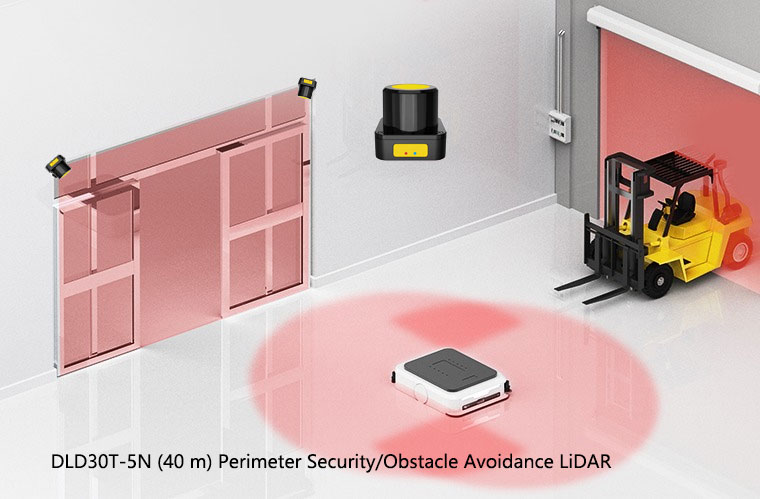
Consider an illustrative gate scenario: snow crosses the detection plane while sunlight reflects from a wet truck. The sensor may report an object or lose usable range even though its enclosure stays dry. This is an explanation, not a documented customer installation or measured false-alarm result.
That is the article in one paragraph. Outdoor perimeter LiDAR is a distinct category of device, and the difference is not the housing. It is the signal processing, the optics, the wavelength decision and the temperature design. This page is the engineering reference we keep meaning to write — what changes when a LiDAR moves outside, and what the answer looks like for fence lines, vehicle lanes, port operations, substations and parking entrances.
Why outdoor is fundamentally different from indoor
Indoor and outdoor installations expose optics to different conditions. IEC 61496-3:2025 is the AOPDDR product standard; use exact model documents to establish environmental limits. This article does not attribute universal sunlight, rain or fog thresholds to that standard.
Direct sun, precipitation, contamination and temperature cycling impair detection independently of enclosure sealing. IEC TS 62998-1:2019 addresses safety sensors where product-specific standards lack necessary provisions, including indoor and outdoor environmental influences. It is not automatic outdoor approval for perimeter LiDAR.
The practical consequence: when someone tells you their scanner is “outdoor capable,” ask which standard it has been tested to, at what ambient light level, at what rain rate, and at what temperature range. If those numbers are not on the datasheet, you have an indoor scanner in a weather housing.
IP ratings: IP65, IP67, IP69K and what they actually buy you
The ingress-protection rating is defined by IEC 60529. Two digits: the first is solid-particle protection on a 0 to 6 scale, the second is water protection on a 0 to 9 scale. The shorthand everyone uses on outdoor LiDAR datasheets:
- IP65 — dust-tight; protected against water jets from any direction. The practical minimum for any outdoor mount. Fine for a scanner under a canopy or eave, fine for a yard fence line in temperate climates.
- IP67 — dust-tight; protected against immersion to one metre for 30 minutes. The right answer where puddle splash, ground-level mounting, or short flood events are real, e.g. low-mounted scanners on a port apron or a vehicle wash bay approach.
- IP69K — dust-tight; protected against high-pressure, high-temperature wash-down. Strictly speaking this rating comes from ISO 20653 (formerly DIN 40050-9) rather than IEC 60529, and the standard test is roughly 80 C water at 80 to 100 bar from defined nozzle angles. Overkill on a fence line. Necessary in a food yard, dairy yard, or any facility where hot pressure-washing is a routine cleaning cycle.
One trap worth flagging: IP67 is not strictly stronger than IP65 on the water digit. IP65 is jets, IP67 is immersion — a device certified to IP67 only has not been tested against continuous high-pressure jets, just static immersion. Where both jets and immersion matter, look for a device certified to IP67 and IP65, with separate evidence for each jet, immersion and hot-wash test required. IP69K does not automatically prove immersion resistance.
Weather: fog, rain, snow, dust and the multi-echo trick
The single most important piece of signal processing in a modern outdoor LiDAR is multi-echo discrimination. A pulsed time-of-flight LiDAR fires a short laser pulse and times the return. In clear air the return is unambiguous. In fog or rain, the same pulse hits a droplet at two metres, another droplet at four metres, the rear wall of a fog bank at twelve metres, and finally a real solid target at thirty metres. A primitive single-echo scanner takes whichever return crosses the detection threshold first — usually the closest droplet — and reports a person standing two metres in front of the scanner. Boom barrier slams shut, vehicle queue backs up, operations get frustrated, scanner gets bypassed.
Multi-echo processing can retain several returns from one pulse and help distinguish particles from a target. Available echoes and logic are model-specific. Severe fog can still remove the target return; filtering cannot recover an absent signal.
The published research on multi-echo denoising in adverse weather has matured significantly in the last few years — modern outdoor-grade firmware combines multi-echo with intensity filtering and short-window temporal averaging to reject not just rain but also airborne dust and the spurious returns you get from blowing snow.
Sun glare and wavelength — the 905 nm versus 1550 nm question
Solar irradiance on a clear day at sea level peaks in the visible and rolls off into the near infrared, but there is still plenty of solar power at 905 nm — the wavelength almost all safety-certified LiDAR uses. That sunlight is noise on the detector. When the scanner is pointed roughly toward the sun, or at a wet, sunlit surface, the noise floor rises and weak returns become harder to discriminate.
Wavelength affects atmospheric transmission, detector choice and emission limits, but does not establish outdoor performance alone. Laser safety depends on the complete product and accessible emission, not a fixed wavelength-based multiplier.
Select the complete device using documented detection performance, ambient-light limits and laser classification. No detector-cost ratio or future certification trend is asserted here.
Examine receiver filtering, the ambient-light test conditions and permitted mounting orientation. Verify low sun angles and wet reflective backgrounds. A lux number alone does not establish every outdoor operating condition.
Temperature: what -25 to +50 C really means
A -25 to +50 C range is an example of a specification to examine, not a universal outdoor rating or a DAIDISIKE product claim. Check the selected model's operating, storage, cold-start and condensation limits separately. DLD30T-5N's current model table instead lists -10 to +55 C operation.
Evaluate local seasonal extremes and additional solar or process heat at the installed housing. A device may have different limits for startup, continuous operation and storage; do not infer cold-start capability from the operating range or assume a heater is fitted. Condensation and icing require their own documented limits and response.
Select a suitable model or manufacturer-approved environmental solution when climate exceeds the rating. An added enclosure or window changes reflections, detection and condensation and requires verification. A heater fault must not leave an undetected gap in a personnel-safety function.
False-trip taxonomy: what actually trips an outdoor perimeter
On every long outdoor installation we see, the same list of false-trip sources comes up. In rough order of frequency:
- Precipitation — rain, snow, sleet, hail. Handled by multi-echo processing and intensity filtering.
- Birds and insects — a sparrow crossing the field, a moth at dusk. Handled by minimum-object-size filtering and dwell-time filtering in the configuration software.
- Vegetation — a deciduous branch moving in wind, a tumbleweed, leaves falling across a beam. Handled by physical aim — do not point a perimeter field through foliage — and by careful protective-field geometry.
- Sun glare — direct sun in the scanner field at sunrise or sunset. Handled by mount orientation and by the receiver bandpass filter.
- Reflective surfaces — a wet truck cab, a corrugated metal building wall, a puddle reflecting sky. Handled by background-teach-in during commissioning and by intensity-based filtering.
- Fence-post movement — the post the scanner is mounted on swaying in wind. Handled by a rigid mount on a substantial structure, not a chain-link post.
Set acceptance criteria from site requirements and log alarms with weather, contamination and configuration during a representative trial. No monthly false-alarm rate is claimed. Personnel-safety filtering must retain detection capability and its delay must enter the stopping assessment.
Long-range performance and laser class
Derive usable range from the actual layout and task. There is no universal five-metre protective field adequate for every forklift, or a forty-metre requirement for every fence line. Compare the stated target remission, object size, incidence angle and environmental conditions. Dark clothing and wet surfaces can return less useful light; do not infer human detection range from a white-target headline specification.
Check the exact product's IEC 60825-1 laser classification and installation requirements separately from range and machinery-safety certification. Pulse design, receiving optics, processing and target conditions all affect usable range. Wavelength or a Class 1 label alone does not establish a maximum outdoor detection distance or a personnel-protection rating.
Applications: where these scanners actually go
These applications include security monitoring and machine safeguarding. A personnel-protection stop requires a suitable rated device and validated safety function. Hazard severity does not itself certify a sensor.
- Yard perimeter and fence lines — logistics yards, storage compounds, warehouses with external storage. A scanner above the fence detects climb-over and breach attempts; multiple scanners on long runs handle hundreds of metres of boundary.
- Vehicle lane and gate control — barrier-controlled entrances where a person can walk through the open boom alongside a vehicle. A perimeter LiDAR can report occupancy; preventing harmful barrier contact needs validated safeguarding.
- Port and dock operations — quay-side crane working areas, automated container handling lanes, ship-to-shore approach paths. Wet, salty, high-traffic outdoor environments — the IP rating and corrosion resistance matter as much as the optics.
- Substation and high-voltage yard perimeters — intrusion detection on energised yards. The consequences require a site assessment; a security alarm must not be presented as a certified safety function.
- Outdoor automated parking and AS/RS approaches — automated parking towers, outdoor automated storage retrieval entry zones. A vehicle enters, the perimeter clears, the system commits.
Indoor vs outdoor scanner requirements — at a glance
| Parameter | Indoor scanner (AGV / cell) | Outdoor perimeter scanner |
|---|---|---|
| Safety evidence | Exact model approval and application validation | Also prove actual outdoor conditions |
| Enclosure | Match dust and cleaning | Match rain, jets and immersion separately |
| Ambient light | Verify lamps and reflections | Verify direct sun and wet backgrounds |
| Rain and fog | Steam and condensation affect optics | Document limits and degraded-visibility response |
| Temperature | Use operating limits | Check cold start, sunlight and condensation |
| Range | Rated protective range for safety | Security range is not protective range |
| False-trip sources | Steam, reflective floor, sparks | Birds, rain, snow, sun, foliage, fence movement |
Where the DAIDISIKE DLD30T-5N fits
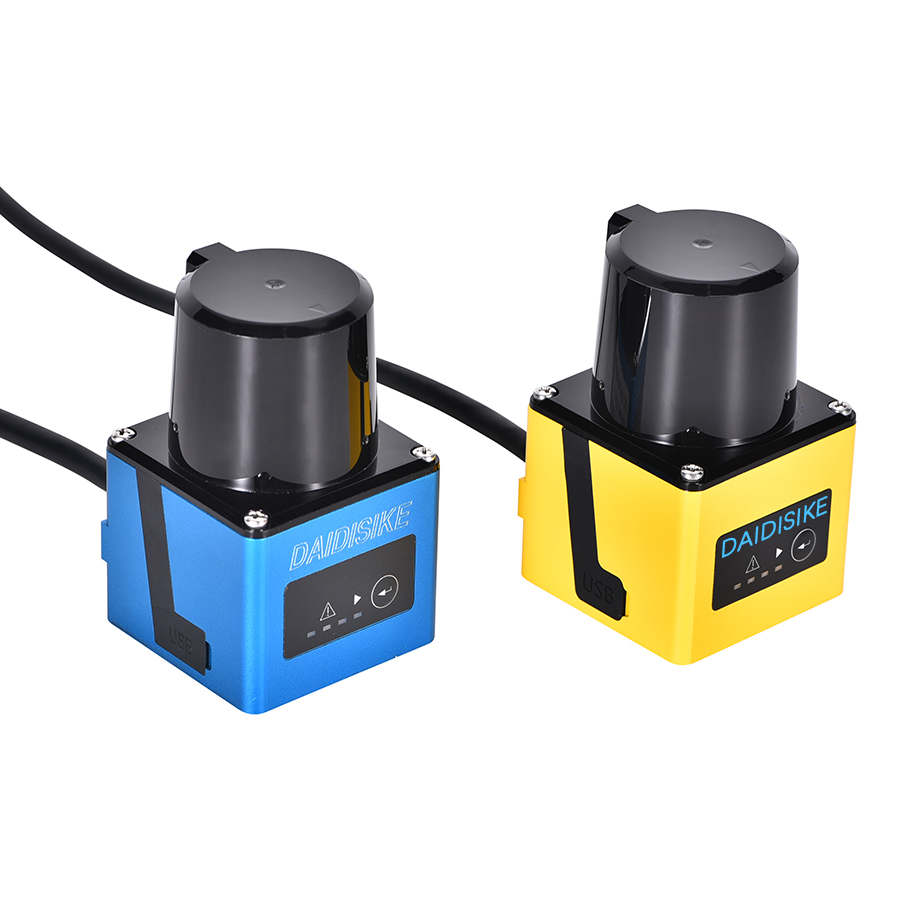
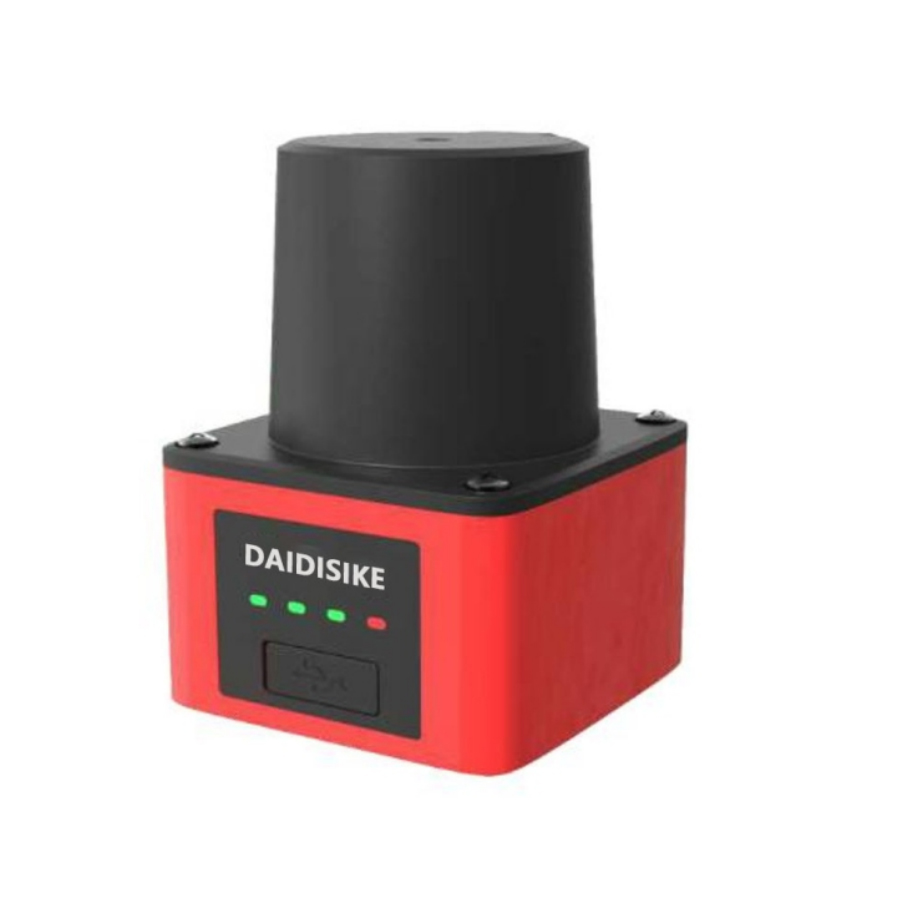
We make a family of LiDAR scanners covering indoor and outdoor use, and at the outdoor perimeter end of the range the DLD30T-5N is a non-safety perception model. Its current factory table states 30 m at 90% remission and 10 m at 10% remission; the legacy 40 m label is not protective range. The page lists IP67 and −10 °C to +55 °C operation. Confirm current documents and site conditions; this article does not claim multi-echo weather immunity or outdoor safety certification. Compare shorter-range DLD sensing models in the LiDAR category by sensing duty.
Match documented environmental and detection limits before nominal range. Use the scanner fault and contamination workflow for maintenance and recovery. Longer range does not automatically mean outdoor approval.
The bottom line
Before deployment, establish the required function, targets at the furthest point, permitted conditions and response to visibility loss or sensor failure. Validate in representative conditions and retain the records. Do not bypass a protective function to meet an availability target.
Related reading
Industrial Safety LiDAR — Complete Reference
The pillar guide to the LiDAR cluster — fields, ranges, response time and selection.
DAIDISIKE DLD30T-5N Perimeter Measurement LiDAR
Non-safety perimeter measurement LiDAR; check current range, temperature and environmental limits for the intended installation.
What Is a LiDAR Scanner?
Time-of-flight basics, how LiDAR builds a scan, and where it fits in industrial safety.