
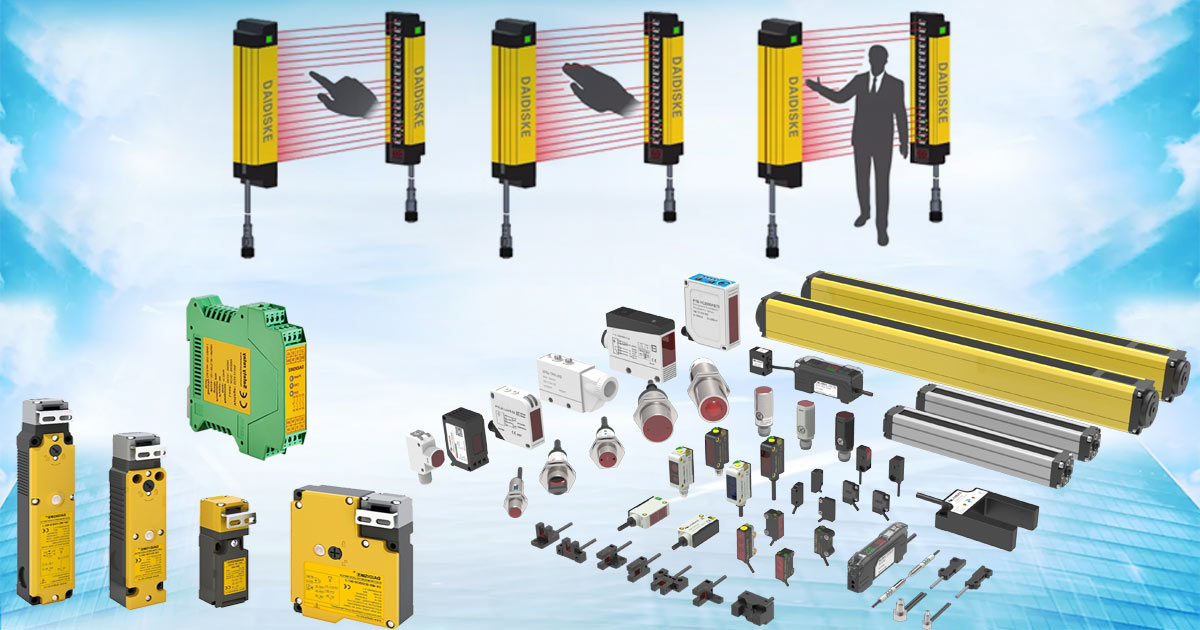
In a wood shop, optical safeguarding and dust control must work together without confusing their roles. Physical guards can restrain access or ejected material; extraction controls dust; an appropriate curtain detects crossing of a plane. The light-curtain range and documentation checklist is the model starting point, but machine-specific eligibility comes before price, range or enclosure selection.
Why does my light curtain keep tripping on a panel saw or CNC router?
Dust is one possible cause, not a diagnosis or a proven frequency ranking. Wood dust and process deposits can attenuate emitter/receiver beams. Check the actual fault code, event history and operating conditions with the machine secured. Treat a loss of optical signal as a condition to resolve, not as evidence that the protective device may be bypassed.
Check alignment and bracket security, damaged windows, wiring/supply faults, reflective surfaces and actual material crossing. Follow the device manual for diagnostics and the validated installation geometry. Material feed does not automatically justify muting; the device must support a validated material-only arrangement. Raising an IP water rating cannot prevent external lens fouling. For the safe isolation, inspection and return-to-service order, use the light-curtain troubleshooting guide.
What IP rating does a light curtain need in a furniture factory?
Match ingress and cleaning specifications to the actual exposure at each location. A sander or edgebander does not automatically need IP68, and IP65 is not automatic approval of a saw infeed. The shared dust-tight first digit 6 is separate from water-jet or immersion tests; cleaning chemistry, temperature, connector sealing and exposed-window deposits require additional review.
| Enclosure characteristic | What it withstands | Selection boundary |
|---|---|---|
| IP65 — MK and plain DQR are listed examples | Dust-tight enclosure; specified water-jet test | No immunity to external dust deposits; verify exact safety and cleaning documentation |
| IP67 — where explicitly specified | Dust-tight enclosure; temporary immersion test | Not a higher dust category or automatic rinse/chemical qualification |
| IP68 — covered DQRF option | Dust-tight; immersion conditions defined by manufacturer | Check cover, connectors, medium and conditions; no blanket hose-down or glue resistance |
Enclosure ingress and optical-window contamination need separate controls. The DQR / DQRF housing documentation distinguishes plain DQR IP65 from the covered DQRF option up to IP68; older series labels must not be read as every variant having the latter rating. See the IP and window-protection guide for the limits of those tests.
What does EN ISO 19085 require, and which part fits my machine?
EN ISO 19085 is the woodworking-machinery safety family; pick the part that names your machine and read it together with Part 1. ISO 19085-1 gives the common safety requirements for the whole family; each numbered part then covers a machine type. The electro-sensitive protective equipment (ESPE) you mount — the light curtain or scanner — has to satisfy both the common part and the machine-specific part, plus the generic safety standards (ISO 13849-1, ISO 13855, IEC 61496) underneath them.
| EN ISO 19085 part | Machine covered | Application review focus |
|---|---|---|
| Part 1 | Common requirements (whole family) | Read alongside the applicable machine part and scope |
| Part 2 | Horizontal beam panel saws | Infeed access, pressure-beam hazards and ejection; not automatic DQC approval |
| Part 3 | NC/CNC boring & routing (CNC routers) | Access and retained enclosure design; DQSA rating needs evidence, DLD is non-safety |
| Part 4 | Vertical panel saws | Retain required guarding; verify whether an optical device is suitable |
| Part 8 | Wide belt sanding and surface treating machines | Dust extraction, nip access and cleaning; water rating separately assessed |
| Part 14 | Four-sided moulders | Cutter containment, infeed/outfeed access and stopping requirements |
In the United States, OSHA 1910.213 includes machine-specific woodworking guarding provisions, alongside the general rule 1910.212. It is incorrect to say that a Type 4 curtain satisfies both European and US regimes automatically. Retain required mechanical guards and assess the applicable legal and machine-specific requirements; component classification is only one part of the design.
Finger vs hand protection: which resolution for an edgebander or panel saw?
Use the documented detection capability, not the spacing between beams. A rated 14 mm finger-detection device and a rated 30 mm hand-detection device have different detection and intrusion allowances. DQA/DQC factory pitch values are not equal to their guaranteed test-piece sizes. Finer detection can reduce one distance term, but cannot make a slow-stopping blade safe at an inaccessible separation or prevent ejection. Check actual geometry and the specified test piece before assigning a model.
How do I size the safety distance (ISO 13855) on a woodworking machine?
Use the applicable positioning method and remember that a blade or cutter may remain hazardous after power removal. The familiar S = K × T + C expression is conditional on geometry and approach. T includes exact sensor configuration, safety logic, final switching and worst-case measured machine stopping time, with required allowances. Reach-over, under, around and pass-through risks require separate assessment. If effective stopping before access is not achievable, use suitable physical guarding or guard locking. The ISO 13855 minimum-distance guide supports calculation, not automatic machine approval.
Which DAIDISIKE model fits which woodworking machine?
Use the machine, safety requirement and interface evidence to screen candidates. The product families below are references for requesting documentation, not approved machine-to-model substitutions. DQC, DQA, DQR, MK and DQSA must not be assigned Type 4, PL e or safety OSSD from a family name. A relay cannot upgrade an unproven sensor into a certified protective function.
| Machine | Hazard / what to guard | Documentation reference | Evidence still required |
|---|---|---|---|
| Horizontal / vertical panel saw | Infeed point of operation (hand) | DQC | Exact detection and safety classification; no universal saw suitability |
| Edgebander loading | Close-up finger/hand near rollers | DQA | Factory pitch differs from detection; no blanket finger-protection claim |
| Belt sander / calibrating / glue line | Dust deposits, nip access and actual cleaning exposure | DQR / DQRF | DQR IP65; covered DQRF up to IP68; no chemical or external-fouling immunity |
| Four-sided moulder / high-risk cell | High-energy working zone | DQT4 | Request exact Type 4 / PL e evidence and validate the full machine function |
| CNC router / nesting cell | Perimeter & access to the whole cell | DQSA (+ DLD LiDAR) | DQSA is a reflector-based perimeter curtain with rating to verify; DLD is non-safety navigation/perception, not a protective stop |
| Stop logic & guard door (any machine) | Dual-channel stop + door monitoring | DA31 + DX-R1 | Exact input/interface and interlock evidence; do not assume DA31 EDM |
For a CNC nesting cell, decide what prevents reaching the cutter, what contains fragments, and what detects entry or continued occupancy. A curtain across one opening does not perform all those tasks. DQSA is a perimeter curtain, not automatically a Type 4 scanner. DLD-series LiDAR remains non-safety perception. Where a safety-rated area scanner is needed, verify its classification against the required function, environment and geometry. See the curtain selection method for a separate model review.
How does DAIDISIKE compare to Pilz, Banner, Schmersal and the Chinese OEMs?
Compare documented functions and support, not country-of-origin categories. Pilz, Banner, Allen-Bradley, Schmersal, IDEC and other suppliers offer different devices and variants; model names such as PSENopt, PSENscan or GuardShield are not a blanket interchangeability claim. Chinese OEM options also require exact evidence. The brand names here identify comparison starting points, not a partnership, tested substitution or approved woodworking installation.
DAIDISIKE can quote documented light-curtain and control options for an export machine specification. Request the exact order code, safety classification evidence, detection capability, input compatibility and environmental conditions. CE marking is not itself an independent certificate; no TÜV document should be promised without an applicable issued record. MOQ, lead time and OEM branding require a current quotation. DQR/DQRF enclosure choices do not establish Type 4 or solve external dust deposition by themselves.
How often should I clean the lens in a wood shop?
Set the inspection and cleaning interval from the manual, risk assessment and observed conditions. Secure the machine and control stored energy before cleaning; use only approved cloths and media. Inspect damage, brackets and alignment, then carry out the prescribed checks using the specified test piece before restoring service. Rising trips have several possible causes, not just an insufficient cleaning interval. Improve extraction or mounting where justified without creating access gaps, masking beams or authorizing an unapproved optical cover.
Buying for a build vs retrofitting an existing line
A new machine and an existing machine need different evidence and change-control reviews. For a new build, design the required guarding, extraction and stopping functions together. For a retrofit, first assess whether optical safeguarding is permissible and effective, retaining blade guards, riving knives and ejection protection where required. Do not assume that a curtain can replace a table-saw top guard. Measure stopping performance, check all operating modes and access paths, then verify exact sensor/logic/final-element compatibility. DA31 is not assumed to provide EDM, and a photo plus opening dimensions is not a retrofit validation.
Standards referenced
- ISO 19085 — Woodworking machines safety (national EN adoption must be checked): Part 1 common requirements; Part 2 horizontal beam panel saws; Part 3 NC/CNC boring & routing; Part 4 vertical panel saws; Part 8 wide belt sanding/surface treating; Part 14 four-sided moulders. Confirm the relevant edition and scope, including exclusions for older machines or particular configurations.
- ISO 13849-1 — Safety-related parts of control systems; Performance Levels (PL d / PL e).
- ISO 13855 — Positioning of safeguards with respect to approach and geometry using the applicable positioning method, not an unconditional S = K × T + C shortcut.
- IEC 61496-1 / -2 — Electro-sensitive protective equipment; Type 2 / Type 4 classification.
- ISO 14119 — Interlocking devices associated with guards (coded / Type 4 interlocks).
- OSHA 29 CFR 1910.213 and 1910.212 — US machine-specific and general guarding requirements, not an automatic equivalence to an ISO component label.
- ISO 19085-2:2021; Part 3:2021; Part 4:2024; Part 8:2024 — official machine-scope summaries; draft revisions are not published replacements.
- HSE circular saw bench guidance and woodworking braking guidance — retain appropriate physical safeguards; an optical signal does not stop blade run-down instantly.
- SICK IP-rating explanation — water-ingress tests do not certify oil or chemical compatibility.