
Why solar lines are different from automotive or electronics
PV module factories share robots, conveyors and control architectures with automotive and electronics plants, but the workpieces add fragile glass handling and large moving assemblies. Actual module dimensions, mass, line speed and layout must come from the project data; none of these establishes a safe access distance by itself.
Three things make PV module manufacturing distinct as a guarding problem.
It is a chain of machines from different builders. A line may combine stringing, layup, bussing, lamination, framing, EL and IV testing from different suppliers. Request the actual declarations, instructions and scope boundaries for each machine or partly completed machine. Individual CE markings, where applicable, do not validate the assembled line or leave transfer conveyors outside the integration risk assessment.
Cell technology can change the handling requirements. A retrofit from PERC to TOPCon, HJT or another cell architecture can change tooling, process temperatures and access needs. Reassess the actual modifications and operating modes; guarding approved for the previous configuration is not automatically valid after a retrofit.
New lines and retrofits need the same scope discipline. Market growth or price pressure is not a safety acceptance criterion. Whether expanding capacity or reusing older equipment, assign the responsibility for buffers, manual rework, energy isolation and emergency-stop interfaces before approving the integrated layout.
Walking a TOPCon module line, station by station
1. Cell sorting and visual / EL inspection
The line may begin with incoming cells being graded by colour, current and electroluminescence response. Cell-handling shuttles and pickup heads can create pinch or crush hazards when an operator replenishes a tray. Assess the reachable body parts and stopping performance. Select detection capability and fixed guarding from that assessment; a blanket 30–40 mm resolution is not a finger-protection specification.
2. Stringer / tabbing — the most hazard-dense station
A stringer picks cells, feeds interconnect material and bonds it using the process specified by its builder. Moving pickup heads, ribbon feeds and shuttles can operate close together. Record the actual throughput, motion profiles, joining technology and maintenance access requirements rather than assuming a universal cells-per-hour figure or that every TOPCon or HJT stringer uses the same heat source.
The hazards can include pinch and crush from moving heads, hot joining tools and hazardous optical emissions if the process uses IR or laser sources. Flux or other process emissions require an appropriate exposure assessment and ventilation. A light curtain detects access; it does not contain radiation or capture fumes, so the enclosure and extraction design remain separate parts of risk reduction.
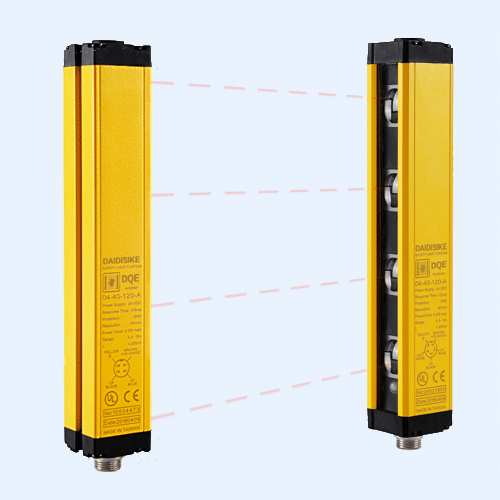
An enclosed stringer cell with interlocked access doors may be needed to contain process hazards. At a tray-loading opening, use a light curtain only if reaching the hazard is prevented until the safe condition is achieved; choose its rating, detection capability and position from the risk assessment and measured total response time. If dangerous motion or process hazards persist, assess guard locking and its release conditions. The DX safety door lock product information is a candidate reference, not evidence of compatibility with a particular stringer or safe release based on temperature.
3. Layup and bussing — mass plus fragility
Layup is where the module starts to look like a module. A backsheet or rear glass sheet is placed on a layup tray; an EVA or POE encapsulant sheet on top; the cell-string matrix on top of that; another encapsulant sheet; then the front glass. Bussing ribbons are soldered or welded to connect the strings into a series-parallel matrix. Robots and gantries do most of the heavy lifting; operators handle alignment correction, ribbon rework, and occasional manual placement of edge cells.
The dominant hazards can include crush from the glass-handling gantry, pinch at matrix transfer and operator reach-in to correct a misaligned string. Design a safe rework method that does not require entering an active motion zone. Do not infer near-miss frequency from this illustrative walkthrough.
At an operator-facing edge, choose a light curtain with detection capability and mounting geometry appropriate to the reachable hazard. Provide a defined rework mode and safe access procedure. Behind the gantry, assess fixed guarding or a safety-rated scanner for the floor zone, accounting for occlusion, reach-over, escape and whole-body presence after entry. A 30–40 mm device description alone does not establish whole-body protection.
4. Pre-EL test — small machine, real electrical hazard
Before lamination, a pre-EL inspection can identify damaged cells or interconnection problems while rework is still possible. Depending on the tester, a bonnet, shuttle or clamp can introduce mechanical hazards. EL inspection applies electrical excitation to produce luminescence: use the tester's actual voltage, current, stored-energy and protective measures, not a generic module-voltage assumption, to assess electrical access hazards.
The access interlock must address both hazardous motion and the test system's hazardous energized state. Removing an enable command is not proof of isolation or discharge. Follow the tester manufacturer's protective circuit and verified safe-access conditions, including hazardous stored energy where present. Do not improvise shorting the module as a discharge method. A light curtain may detect approach, but it cannot provide electrical isolation, containment or a maintenance lockout procedure.
5. Lamination — slow, hot, large, and routinely misunderstood
A laminator is a large-area thermal and vacuum processing machine, not necessarily a stamping press. Platen dimensions, temperatures, pressure states and cycle time depend on the equipment and encapsulant recipe. Obtain those values and the cooling and isolation instructions from the machine and material suppliers.
A slow closing speed does not automatically produce a short ISO 13855 separation distance: use total stopping or hazard-cessation time, approach conditions and access geometry. The closing platen can create a large-area pinch hazard, while hot surfaces remain a burn risk after motion stops. Loading and unloading shuttles introduce additional motion zones that need their own assessment.
Guarding here is layered: thermal shielding and restricted access for hot surfaces, safe pressure and energy states, and suitable motion safeguards at the loading and unloading faces. Where access requires guard locking, release must depend on verified safe conditions; an operator acknowledge alone does not make a hot platen safe. A light curtain can form part of a validated shuttle stop function, but cannot remove the residual thermal hazard.
6. Trim, framing and junction box
After lamination the module is trimmed of excess encapsulant, framed in anodized aluminium, and fitted with a junction box. These are the stations where the line starts to feel like a metal-fabrication shop again, and the hazards are correspondingly familiar.
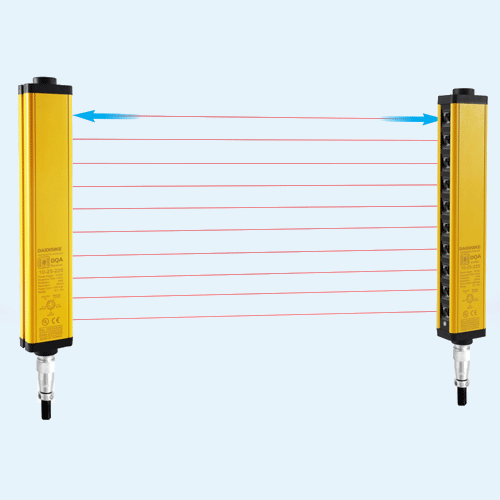
Trim tools can create cutting and ejection hazards, requiring suitable containment as well as access control. Framing heads and robots create closing and crush hazards around the profiles and module. A conveyor opening may need a validated muting arrangement and additional measures against following a load into the cell. For a combined trim, framing and junction-box island, assess every approach and occupied space; a DQSA area curtain or safety scanner is a candidate only where its actual detection coverage and application limits satisfy that assessment.
Junction-box installation may include placement, soldering, adhesive or potting operations. Assess moving tooling, hot surfaces, fumes and the material safety data for the actual process. Access-detection devices and interlocks do not by themselves control chemical exposure or ventilation requirements.
7. Curing oven
After the junction box silicone is dispensed, modules pass through a curing oven held at a moderate temperature for a defined dwell. The mechanical hazard is mostly the conveyor motion entering and leaving the oven. The thermal hazard is real but contained inside the tunnel. Guarding is usually fixed enclosure with interlocked end doors and limited operator access. A light curtain at the operator loading face — if the line uses one — is sized for access detection rather than point-of-operation.
8. Post-EL and flash / IV test
The finished module can undergo post-EL inspection and IV measurement using a solar simulator. Pulse duration, source type and optical hazard depend on the tester; a simulator classification is not a statement that direct viewing is safe. Obtain the manufacturer's optical and electrical protection requirements and keep the appropriate containment in place.
Guarding may combine a suitable enclosure with monitored access interlocks. At conveyor openings, a light curtain does not identify a module as distinct from a person. Any permitted muting sequence must be validated with measures against reaching around, riding on or following a load. Assess electrical energy from both the EL excitation circuit and the illuminated module during IV testing; confirm safe test-contact access from the actual tester design.
9. Final pack and palletising
At final packing and palletising, moving robots, crates and modules can create substantial crush hazards. Do not classify this station as low-risk merely because processing is complete. Validate access detection, total response time, whole-body presence and restart prevention, including any conveyor muting. Our guide to light curtains for automatic palletising systems discusses that access-control intent; apply it to the actual cell.
The PV-line guarding cheat sheet
| Station | Primary hazard | Safeguards to assess, not a specification |
|---|---|---|
| Cell sorting / inspection | Tray pickup head; operator reach-in | Detection capability selected for reachable hazard; fixed shuttle guards |
| Stringer / tabbing | IR or laser soldering, ribbon feed, pickup head | Process containment; suitable access detection; guard locking if hazard persists |
| Layup and bussing | Glass gantry crush; matrix pinch; reach-in rework | Validated access detection and presence protection; safe rework mode |
| Pre-EL test | Bonnet motion; forward-bias electrical | Motion and electrical access interlocks; verified safe energy state |
| Lamination | Slow platen pinch; hot platen burn; shuttle motion | Thermal guarding; verified safe-access conditions; shuttle stop function |
| Trim / framing / J-box | Cutting tools; framing head; potting dispenser | Containment and access detection; validated muting and presence protection |
| Curing oven | Conveyor entry; contained thermal | Fixed enclosure; interlocked end doors; optional access curtain |
| Post-EL & flash/IV | Optical flash; biased module | Optical/electrical containment and interlocks; validated transfer access; isolation for service |
| Final pack / palletise | Palletising robot | Validated robot-cell access, presence and restart measures; conveyor muting assessment |
Treat the table as a starting point, not a specification. Every station still needs its own risk assessment and its own ISO 13855 safety-distance calculation. The table tells you which family of device to reach for; it cannot tell you where to mount it or what response time to target.
The mistakes that get caught in audits
The interfaces between machines. Check whether the transfer conveyor, buffer or manual rework space falls between supplier scopes. An individual machine's acceptance does not cover those interfaces automatically. Assign an explicit integration owner and document the protective functions across each boundary.
Muting that defeats the curtain. Muting lets a module or pallet pass a curtain without stopping the machine. It is permitted only under the conditions established by the validated safety design. Done badly — too few muting sensors, muting windows left open too long, sensors positioned so a person can shadow the load — it is a hole a worker can walk straight through. PV lines have many muted pass-throughs because product moves continuously, so the muting design deserves real attention. Our piece on muting vs blanking is worth reading before commissioning.
Confusing device rating with system rating. A Type 4 light curtain may support a PL e / SIL 3 function where its documented capability and application conditions allow. It does not, by itself, make the function PL e. The achieved Performance Level depends on the whole chain — curtain, safety logic, and final actuator. If the contactor that actually cuts power to the stringer welding head is the weak link, the whole function is dragged down. We unpack that properly in our companion guide to Performance Level and SIL.
Safety distance that no longer holds. A line is commissioned at one throughput target. Eighteen months later it is pushed to a higher target, machine stopping time creeps up, and nobody recalculates the distance. The curtain is now too close. This is a change-control risk, not a claimed frequency from site audits. Any speed change should trigger a re-validation; the formula is in our ISO 13855 safety-distance guide.
Optical interference at the stringer and EL stations. Check actual optical sources at stringing and inspection stations, including reflections, sunlight, other sensors and any process emitters. EL cameras detect emission from the electrically excited module; do not assume every EL tester uses an external NIR lamp. Verify interference conditions against each protective device manual. Investigate nuisance trips without bypassing the protective function.
Where DAIDISIKE fits, honestly
Since you may be reading this on our site, a direct answer. This article presents candidates from the published DAIDISIKE range; it does not establish a verified PV customer installation. The DQA light curtain candidate is a candidate for access detection where its documented characteristics meet the station requirements; the DQSA area protection family needs a coverage and presence assessment for larger footprints; and the wider DAIDISIKE safety light curtain range can be compared by required rating, detection capability and response time. Type 2 is appropriate only where the assessed function and applicable requirements permit it.
One part number does not solve a whole PV line. Send the station layout, required safety functions and device requirements through our product enquiry contact to request available model documentation. The machine builder or responsible integrator must approve and validate the complete guarding design; this article does not promise an independent engineering review or site commissioning service.
Commissioning evidence to keep for each station
- Hazard and access map, including residual heat, electrical energy and whole-body entry.
- Required safety function, selected devices and manuals, logic and final switching elements.
- Measured worst-case stopping or hazard-cessation time, positioning calculation and coverage tests.
- Validated transfer/muting sequence, fault response, restart prevention and safe rework procedure.
- Named integration owner and recorded acceptance criteria for every station interface.
For the conveyor and pallet-transfer parts of this design, compare the practical zoning issues in our automated packaging line safety guide. The general risk-assessment framework is ISO 12100; protective-device integration is covered by IEC 62046:2026, used with ISO 13855:2024 for positioning. These references do not approve the illustrative station choices above.
The bottom line
A PV module line rewards engineers who resist the urge to flatten the safety design down to a single answer. Standardise the hardware platform — fewer part numbers genuinely helps spares and training across a gigafactory. Do not standardise away the per-station risk assessment. A stringer head, a layup gantry, a laminator platen, an EL bonnet and a framing robot are five different hazards. The guarding only works when each one is treated on its own terms, and when the conveyors between them are owned by a named engineer rather than left as someone else’s problem.