Frequently Asked Questions
Why is a DLD-50D manual provided on the DLD-50G page?
It is the supplied DLD-50D reference manual, provided for background on that model's operation and software workflow. It names the DLD-50D variants; it does not establish the DLD-50G's range, supply, connector pinout or protocol compatibility. Confirm the DLD-50G-specific documentation and ordered configuration with us before wiring or commissioning.
What problem does a diffuse-remission LiDAR actually solve?
It removes the cooperative target from the equation. Reflector-based measurement needs a plate, tape or corner-cube mounted on whatever you measure — impossible on a coal pile, a moving truck or a random carton. The DLD-50G reads the faint diffuse return from the object's own surface, so the object itself is the target, with nothing to install, align or clean.
How is this different from a single-point laser distance sensor?
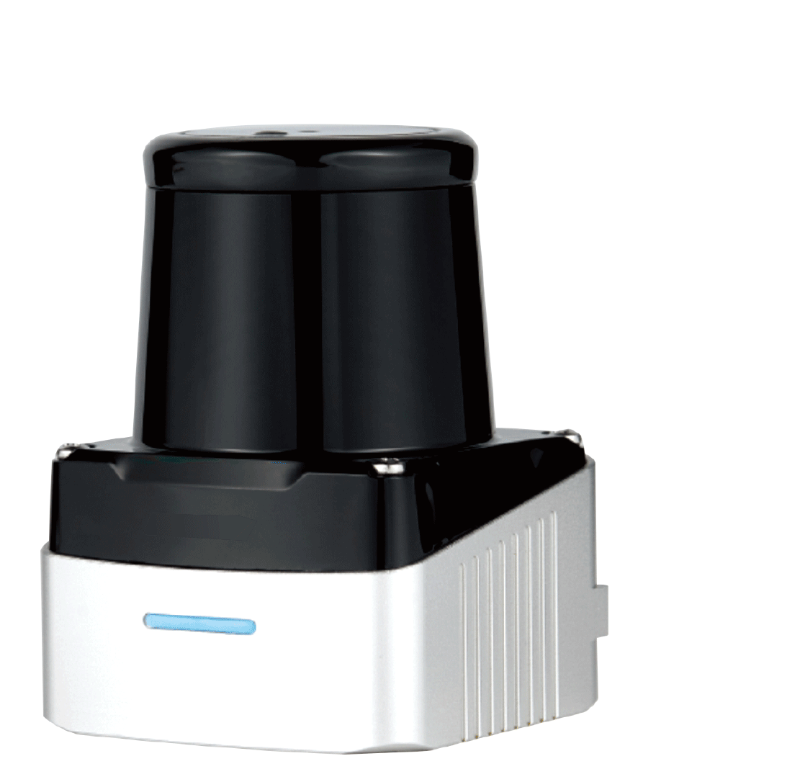
A single-point sensor gives you one number per instant. The DLD-50G rotates its measurement plane and delivers a whole cross-sectional distance profile every revolution — the outline of a pile, the flank of a vehicle, the gap profile of a doorway. Where one distance is not enough information, a scan line is the cheapest upgrade path.
Which surfaces work, and which are difficult?
Diffuse measurement lives off scattered light, so matte and semi-matte natural surfaces — earth, timber, cartons, painted steel, fabric — are its home ground. Mirror-like, jet-black or transparent surfaces return less usable signal for any diffuse-mode LiDAR. Tell us your actual material and we will confirm feasibility against the factory data before you commit.
Why is there no range or accuracy figure on this page?
Because the factory has not released confirmed numbers for the DLD-50G, and we will not print a figure we cannot stand behind. What is confirmed: product category (laser scanning LiDAR), scan type (2D single-line) and measuring principle (diffuse remission, reflector-free). For a committed range and accuracy today, look at the published DLD-50D (50 m @90%) or DLD-100D (100 m @90%).
Can the DLD-50G guard a machine or protect personnel?
No. This is a perception/measurement LiDAR, not an IEC 61496 certified safety component; do not use it as the sole means of personnel protection. No safety rating or OSSD output is published for it. Where the scanner must stop a machine to protect a person, specify our ST27 Type 3 safety laser scanner instead.
What should I include in an inquiry to get a fast, accurate answer?
Four things: the surface you must measure (material and colour), the working distance you need, the ambient conditions (indoor/outdoor, dust, sunlight) and the interface your controller expects. With those we can confirm within days whether the DLD-50G fits or whether a sibling model with published specs serves you better.
What are the MOQ and lead time for the DLD-50G?
MOQ is 1 unit for evaluation, and we encourage a bench sample first precisely because this model's public spec set is still thin. Lead time is confirmed case by case with the factory — typically within the 3–15 day window our LiDAR line ships in — and stated in writing on the quotation. OEM discussions are welcome once your sample validates the principle.