
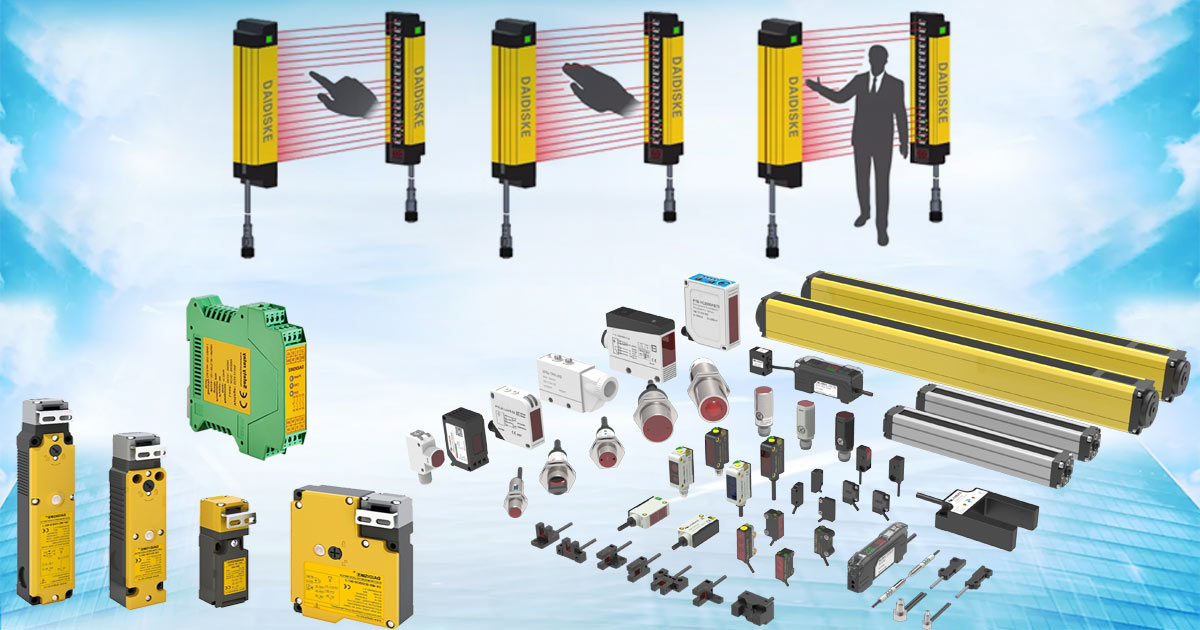
Most light-curtain selection guides start from the catalogue: pick a resolution, pick a height, done. In ceramics and glass that order is backwards. The thing that kills a sensor early in these plants is not the wrong resolution — it is dust caking the optics, water getting past a marginal seal, or radiant heat from a kiln baking the housing. So we start where the failures start: with the environment.
Why does the environment, not the feature list, decide the sensor?
Ceramics is a dust problem, glass is a heat-and-water problem, and both add a sharp-edge laceration hazard — each of those maps to an IP rating and a detection resolution before you look at anything else. Walk a tile plant and the air near the press is thick with body powder; the frit press and the dry grinding and edging stations throw fine particulate that settles on every horizontal surface, including a curtain's lenses. Walk a glass plant and you meet the opposite extremes in the same building: radiant heat off tempering furnaces and kilns, and standing water on the wash and wet-cut lines. On top of both, glass and fired ceramic edges cut — a guarding failure on a cutting or edging line is a laceration, not just a crush.
An IP code does not prevent dust settling on optical windows, and IP68 immersion does not establish high-pressure or hot-jet cleaning resistance. Confirm temperature, chemicals, connectors and cleaning conditions independently. Translate the assessment into separate specifications. The IP rating must match the actual ingress exposure: dust, specified immersion and water jets are distinct requirements. The detection resolution answers the hazard question: finger (~14 mm) or hand (~30 mm) at a press point of operation, coarser (40 mm+) only for arm/body detection at a perimeter. Get those two right for the environment and the rest of the selection — height, range, outputs — falls out cleanly.
What IP rating and curtain suit a dusty ceramic tile or frit press?
Specify enclosure dust protection separately from optical-window cleaning, and a finger or hand resolution sized to the opening; the DAIDISIKE MK is the IP65 dust-sealed curtain for these cells. A ceramic tile press, a frit press and a dry grinding or edging machine all share the same problem: fine powder in the air that, over weeks, films the optical windows. IP65 means the housing is dust-tight and addresses specified water-jet conditions; it does not keep a dust film from blocking the beams. The DAIDISIKE MK (IP65) is built for exactly this dusty press and grinding duty.
At a tile or frit press opening, compare the exact DQC and DQA detection and safety documentation against the reachable hazard. Do not weaken detection capability to reduce dust trips. Use the specified cleaning method, contamination diagnostics and suitable mounting; enclosure IP alone does not keep the optical window clear.
How do you guard a wet glass wash or cutting line?
Specify immersion and spray exposure separately. The DQR catalogue IP68 statement is a starting point for assessing the exact installation. A glass wash line and a wet cutting or scoring line expose the curtain to spray, splash and cleaning chemicals whose compatibility must be established. The DAIDISIKE DQR is an IP68 catalogue option; obtain exact immersion conditions, materials and cleaning limits. Size its resolution and protective height to the opening you are guarding, and re-check the ISO 13855 distance for that resolution.
Glass cutting and edging can expose people to cutting hazards and ejected fragments. A light curtain detects access but does not contain fragments; suitable physical guarding may be needed as well. Evaluate any access interlock and curtain as part of the complete safety function, rather than assuming the combination fails safe. The IP and optical-window guide separates enclosure tests from contamination and material resistance.
Curtain or scanner: which for robot loading and palletizing on a glass line?
A curtain wins at the human point of operation for finger/hand detection and short response time; a safety laser scanner wins for horizontal area and perimeter guarding of robot loading and palletizing, where layout flexibility matters. A vertical light curtain protects a defined plane — the opening an operator reaches through. That is the right tool at a glass loading machine's manual feed point. But a robot loading a tempering furnace, or a palletizing station stacking finished panels, is approached across a floor area, sometimes from more than one side. A horizontal safety laser scanner covers that floor with programmable warning and stop fields and adapts to an irregular layout that a flat curtain plane cannot.
Compare safety scanner and industrial LiDAR roles before selecting the floor device. ST27 is the user-confirmed Type 3 / PL d / SIL 2 safety scanner, subject to exact-configuration suitability. DLD and SDLD support non-safety perception and cannot provide the protective stop. The DQSA and DQC/DQA access options require their own detection geometry and safety review.
How do you set the ISO 13855 safety distance for a press curtain?
Calculate separation using the applicable ISO 13855:2024 geometry and allowances. Include worst-case sensor and safety-logic response plus measured press stopping time without double-counting. Detection capability affects reach-through allowance, but reach-over or another constraint may govern. The historical reach-through calculator is restricted to its stated legacy arithmetic domain and is not a complete current-edition or press-compliance result.
Which DAIDISIKE device fits which ceramics or glass station?
Match the station to the environment column first, then the resolution column — the device follows. This table is a starting map; confirm resolution, protective height and range against the machine and a fresh ISO 13855 calculation.
| Station / machine | Dominant stress | What to detect | DAIDISIKE fit |
|---|---|---|---|
| Ceramic tile / frit press point of operation | Heavy dust | Fingers / hands (~14 / 30 mm) | DQC, DQA; MK (IP65) for dusty housing |
| Dry grinding / edging cell | Dust + sharp edge | Hands at access opening | MK (IP65) curtain + DX-R1 door switch |
| Glass wash / wet cutting line | Water / washdown | Hands at operator interface | DQR (IP68 immersion-rated) |
| Glass loading machine (manual feed) | Sharp edge | Hands at the feed plane | DQC / DQA with only documented, validated muting/blanking modes |
| Tempering furnace robot loading cell | Heat (keep sensor off furnace mouth) | Person on the floor area | Certified ST27 configuration or an appropriate access curtain; DLD/SDLD are non-safety |
| Palletizing / unloading station | Wide perimeter | Person crossing perimeter | Certified safety scanner selected by protective range; DLD ranges are non-safety |
| Access doors / furnace-door interlock | Heat / access | Door open / closed | Exact switch and compatible controller arrangement; no DA31 interface inferred |
One honest framing point about heat. Glass plants have real high-temperature zones near kilns and tempering furnaces, and the right engineering answer is usually to keep the optical safety device out of the direct radiant field — guard the human approach where the sensor can live, not at the furnace mouth. We describe the DQR strictly as its listed IP68 catalogue rating; we do not publish a wide-temperature number for it because that is not how it is specified. Where heat is the dominant constraint, the design fix is placement and shielding, plus a coded door interlock on the furnace door, not a claimed temperature spec.
What standards and what safety circuit pull this together?
Determine the press-specific requirements, required PLr and applicable ISO 13855 method before selecting the protective device. OSHA 1910.217 applies to mechanical power presses, not all hydraulic or pneumatic presses, and excludes presence sensing on full-revolution clutches. Dual OSSD must feed compatible qualified safety logic; verify reset and EDM support from the actual controller manual. A DA31 product listing is not proof of those functions. Door interlocks such as the DX-R1 also require exact-model and integration evidence. Validate the entire sensor–logic–actuator chain.
How does DAIDISIKE compare with SICK, Keyence, Banner, Pilz and the rest?
The premium brands set the reference; DAIDISIKE is the Chinese OEM/ODM route — confirm MOQ, delivery and exact-model conformity documents in the quotation — for ceramics and glass OEMs and integrators watching unit cost. Plants in this sector evaluate against the established safety brands: SICK (deTec, S3000 safety laser scanner), Keyence (GL-R light curtain, SZ-V scanner), Banner Engineering (EZ-SCREEN, SX5 series), Pilz (PSENopt II), Leuze (MLC light curtains, RSL scanner), Omron (F3SG-R), plus Contrinex, Datasensing (Datalogic), Schmersal (SLC), ReeR, IDEC (SE2L) and Hokuyo (UAM) scanners. We reference these by name for honest comparison only — there is no partnership implied, and we do not quote their specs beyond what they publish.
DAIDISIKE's position against that field is straightforward: founded 2013, a 5000 m² factory exporting to 20+ countries, a minimum order of one set and a 3–15 day lead, carrying CE (self-declared), IEC 61496 and ISO 9001, with TUV testing arranged per order. For a ceramics or glass machine builder who needs both curtains and area scanners at a workable unit cost and a short lead, that combination — cost, low MOQ, fast turnaround, and one supplier for both the curtain and the LiDAR — is the case. For the wider brand-by-brand cross-reference, see the brand replacement & compatibility hub.
How do you add presence sensing to an existing ceramic press (PSDI)?
For an older ceramic press, first confirm that it can stop safely during the relevant hazardous motion and that presence-sensing safeguarding is allowed by its machine-specific requirements. Then select the necessary detection capability, measure stopping performance, position the safeguard and validate suitable safety logic and final elements. A cleared light curtain must not initiate a cycle merely because a protective device was added. PSDI is a distinct control function with additional requirements; no DA31 interface or complete PL is established by this example.
For US applications, OSHA 1910.217 is scoped to mechanical power presses; do not apply its PSDI provisions indiscriminately to hydraulic ceramic presses. A curtain protective stop is not permission for clearing the field to initiate a press cycle. Confirm the machine-specific requirements and any DA31 reset/EDM capability from the supplied documentation.
Guarding a ceramics or glass machine? Send us the station and the environment.
Tell us the machine, the opening, the stop time and whether the cell is dusty or wet, and our engineers will return a matched curtain, scanner, relay and switch set. Call or WhatsApp +86 15218909599 or use the contact page.
Standards & references
- IEC 61496-1 / IEC 61496-2 — electro-sensitive protective equipment; Type 4 light curtain requirements.
- ISO 13849-1 — safety-related parts of control systems; Performance Level (PL e) rating.
- ISO 13855:2024 — positioning and dimensions of safeguards; apply the full relevant method.
- ISO 14119 — interlocking devices associated with guards (coded non-contact switches).
- OSHA 29 CFR 1910.217 presence-sensing device guidance; ANSI B11.2 for hydraulic presses.