
RS Series M12/M18/M30 Capacitive Proximity Sensors
The corrosion-immune build of our capacitive range: molded ABS bodies in three thread sizes, tuned for tanks, hoppers and every target an inductive sensor cannot see.
- ABS plastic housing — no plating to corrode or stain
- Adjustable ranges from 1–2 mm up to 2–30 mm
- NPN / PNP output, NO / NC logic, 10–30 V DC
- 48 part numbers across M12, M18 and M30
- 1.5 ms response, LED indicator, 2 m PVC cable
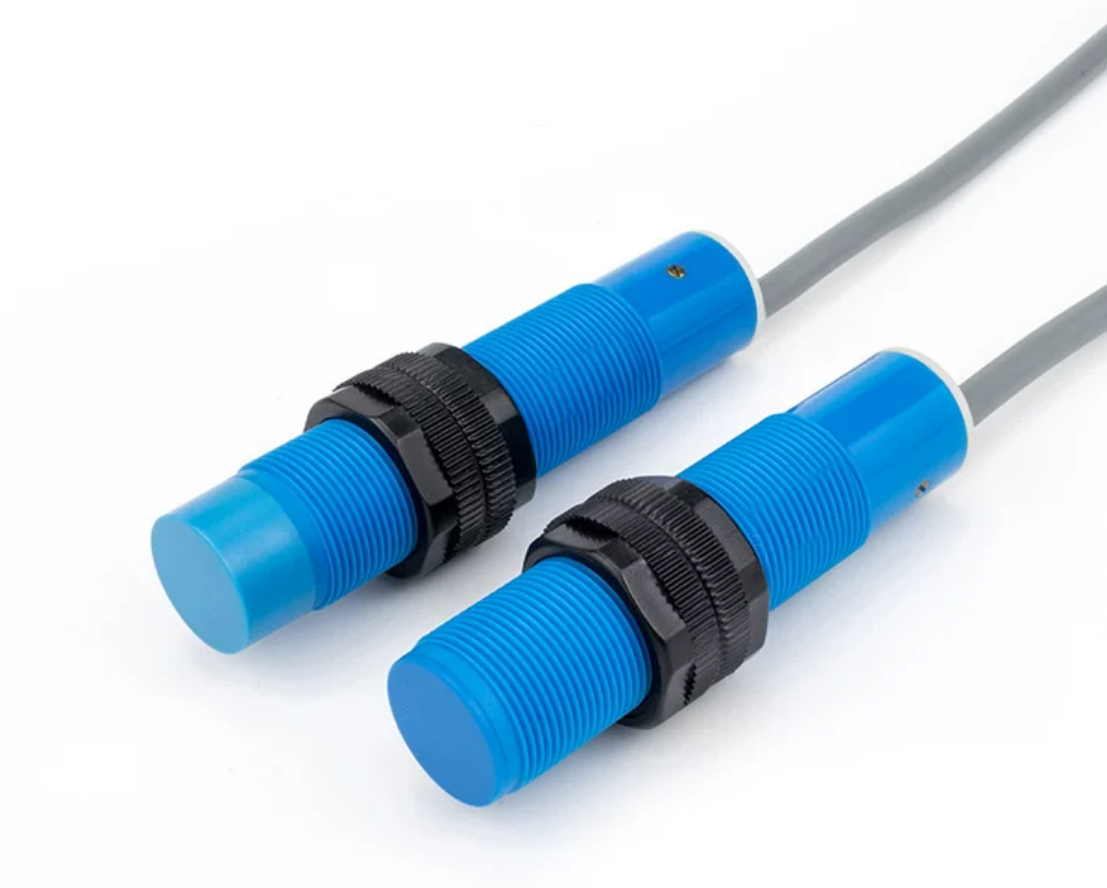
Why a Plastic-Bodied Capacitive Sensor?
Capacitive sensors spend their working lives next to liquids, powders and washdown hoses — exactly the conditions that attack plated-metal housings over time. The RS series answers with a molded ABS body: nothing to rust, no plating to blister, and no galvanic pairing with stainless brackets. The distinctive blue barrel also makes the sensing points easy to spot during line audits.
Functionally it is a full capacitive family, not a cut-down one: three thread sizes (M12, M18, M30), flush and non-flush construction, and adjustable windows from 1–2 mm on the smallest flush M12 to 2–30 mm on the non-flush M30 — each set on site so the trip point matches the real target, whether that is water behind a tank wall, pellets in a hopper or glass jars on a conveyor.
Flush vs Non-Flush: What the T Suffix Means
Technical Specifications
| Sensing principle | Capacitive — detects metal and non-metal targets |
|---|---|
| Thread sizes | M12 × 1 / M18 × 1 / M30 × 1.5 |
| Housing | Molded ABS plastic, PBT sensing face |
| Body length | M12: 58 mm (flush) / 63 mm (non-flush) · M18: 72 / 82 mm · M30: 87 mm |
| Sensing distance | Adjustable per model, 1–2 mm up to 2–30 mm (see selection table) |
| Supply voltage | 10–30 V DC, ripple < 10% |
| Output | NPN or PNP, NO or NC, 3-wire DC, max. load 150 mA |
| No-load current | < 10 mA · leakage < 0.01 mA · voltage drop < 1.5 V |
| Response time | 1.5 ms |
| Switching frequency | 50 Hz |
| Hysteresis / repeatability | < 15% Sr / < 5% Sr · temperature drift < 20% Sr |
| Protection circuits | Short-circuit protection; overload protection point 240 mA |
| Ingress protection | IP65 (M12, M18 and M30) |
| Operating temperature | −25 °C to +70 °C |
| Connection | 2 m PVC cable, ø5.0 mm, 3 × 0.33 mm² (4 × 0.33 mm² for 4-wire) · LED indicator |
Model Selection Table
| Size · Mounting | Models (NPN NO / PNP NO / NPN NC / PNP NC) | Sensing distance | Output / Wiring |
|---|---|---|---|
| M12 · flush | RS1202N1 / RS1202P1 / RS1202N2 / RS1202P2 | 1–2 mm adjustable | NPN/PNP · NO/NC · 3-wire DC cable |
| M12 · flush | RS1203N1 / RS1203P1 / RS1203N2 / RS1203P2 | 1–3 mm adjustable | NPN/PNP · NO/NC · 3-wire DC cable |
| M12 · non-flush | RS1204N1T / RS1204P1T / RS1204N2T / RS1204P2T | 1–4 mm adjustable | NPN/PNP · NO/NC · 3-wire DC cable |
| M12 · non-flush | RS1206N1T / RS1206P1T / RS1206N2T / RS1206P2T | 1–6 mm adjustable | NPN/PNP · NO/NC · 3-wire DC cable |
| M18 · flush | RS1805N1 / RS1805P1 / RS1805N2 / RS1805P2 | 2–5 mm adjustable | NPN/PNP · NO/NC · 3-wire DC cable |
| M18 · flush | RS1808N1 / RS1808P1 / RS1808N2 / RS1808P2 | 2–8 mm adjustable | NPN/PNP · NO/NC · 3-wire DC cable |
| M18 · non-flush | RS1808N1T / RS1808P1T / RS1808N2T / RS1808P2T | 2–8 mm adjustable | NPN/PNP · NO/NC · 3-wire DC cable |
| M18 · non-flush | RS1815N1T / RS1815P1T / RS1815N2T / RS1815P2T | 2–15 mm adjustable | NPN/PNP · NO/NC · 3-wire DC cable |
| M30 · flush | RS3010N1 / RS3010P1 / RS3010N2 / RS3010P2 | 2–10 mm adjustable | NPN/PNP · NO/NC · 3-wire DC cable |
| M30 · flush | RS3020N1 / RS3020P1 / RS3020N2 / RS3020P2 | 2–20 mm adjustable | NPN/PNP · NO/NC · 3-wire DC cable |
| M30 · non-flush | RS3015N1T / RS3015P1T / RS3015N2T / RS3015P2T | 2–15 mm adjustable | NPN/PNP · NO/NC · 3-wire DC cable |
| M30 · non-flush | RS3030N1T / RS3030P1T / RS3030N2T / RS3030P2T | 2–30 mm adjustable | NPN/PNP · NO/NC · 3-wire DC cable |
Part-number key: RS + size (12/18/30) + range code + N/P (NPN/PNP) + 1/2 (NO/NC) + T (non-flush). Ranges per the manufacturer's catalog selection table.
Typical Applications
Chemical-Adjacent Level Points
ABS bodies shrug off the damp, salty or mildly corrosive air around dosing stations and washdown zones where brass housings stain.
Plastic Tank & Hopper Sensing
Detect liquid, powder or pellet level through a non-metallic wall — the classic capacitive duty, in a matching plastic body.
Wood, Paper & Glass Lines
Sense boards, sheets, bottles and jars that inductive sensors cannot see, from M12 tight spots up to long-range M30 points.
Cost-Optimized OEM Builds
Same thread sizes and 3-wire DC wiring as metal sensors, so machine builders can standardize while trimming BOM cost.
Frequently Asked Questions
Why choose the ABS-housing RS series over the metal-housing capacitive series?
Two reasons: environment and cost. Molded ABS does not corrode, so the RS series suits damp, salty or mildly chemical-laden air where plated brass may degrade cosmetically or seize in the bracket. And a plastic body is the more economical option when the mechanical duty does not demand metal.
What sensing ranges does the RS series offer?
Twelve range/mounting combinations: M12 from 1–2 mm up to 1–6 mm, M18 from 2–5 mm up to 2–15 mm, and M30 from 2–10 mm up to 2–30 mm, each adjustable within its window. Flush models take the shorter windows; non-flush T models the longer ones.
Can the RS series detect liquid inside a plastic container?
Yes — capacitive sensing reacts to the dielectric change of the media behind a non-metallic wall, so an RS sensor mounted outside a plastic tank can signal the level inside. Verify the trip point with your wall thickness and medium, and use the adjustment to set margin.
How do I read an RS part number, e.g. RS1815N2T?
RS = capacitive series, 18 = M18 thread, 15 = range code (2–15 mm adjustable), N = NPN (P would be PNP), 2 = normally closed (1 = normally open), T = non-flush mounting. No T means flush.
What are the electrical characteristics?
10–30 V DC supply (ripple < 10%), 3-wire DC wiring, maximum load 150 mA, no-load current < 10 mA, leakage < 0.01 mA, voltage drop < 1.5 V, response time 1.5 ms, switching frequency 50 Hz, with short-circuit protection and a 240 mA overload protection point.
What is the ingress protection rating?
IP65 across all three thread sizes, per the manufacturer's selection table. That covers dust ingress and low-pressure water jets from any direction. If your installation is regularly hosed down or washed at pressure, specify the nickel-plated metal-housing capacitive series instead, which is rated IP67.
Do you support small export trial orders and OEM marking?
Yes. Small mixed-model trial orders are the normal first step, and OEM requirements can be discussed per project. Contact the factory through our contact page with model codes and quantities for MOQ, pricing and lead time.
General-purpose sensing component, not a certified safety device. Specs reviewed by Engineer Cai, Senior Application Engineer.