
Q20 Flat Square Capacitive Proximity Sensor
A capacitive detection point only 10 mm thick: screw it flat to a bracket or tank wall and sense liquids, powders and plastics from the top face.
- 50 × 20 × 10 mm flat-pack body, 3.2 mm mounting holes
- 10 mm rated distance, adjustable 2–10 mm via trimmer
- NPN / PNP output, NO / NC logic, 3-wire DC
- 10–30 V DC supply, LED status indicator
- Detects non-metal and metal targets alike
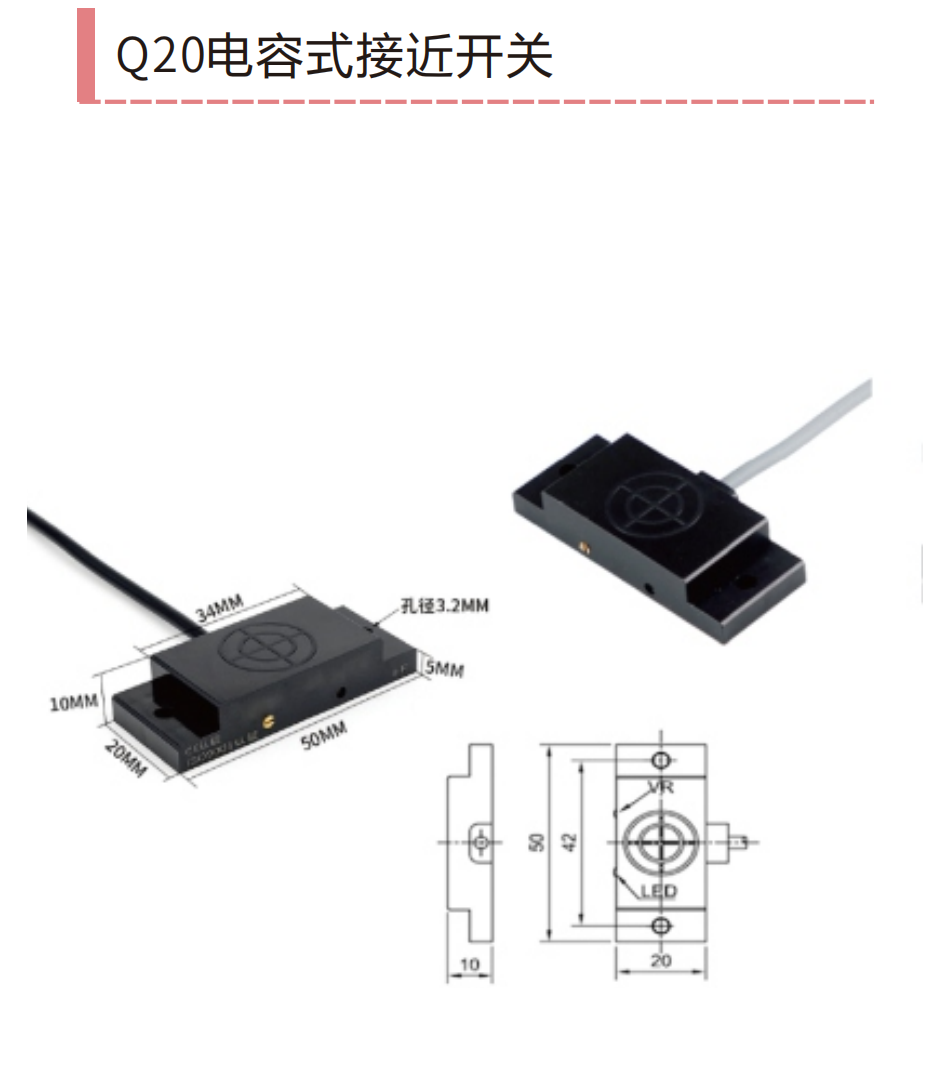
Capacitive Sensing in a Limit-Switch Footprint
Cylindrical capacitive sensors need barrel depth — an M30 with lock nuts easily claims 90 mm behind the mounting face. The Q20 takes the opposite approach: a flat 50 × 20 × 10 mm block with two through-holes, sensing upward from its face like a miniature limit switch. That geometry drops into places barrels never fit — under conveyors, against tank walls, inside shallow guide rails.
Detection is fully capacitive: the sensor trips on any material whose dielectric constant differs from air, so one part number covers liquid level behind a thin wall, powder in a chute, or paper, plastic and glass on the line. The built-in trimmer adjusts the trip point across a 2–10 mm window, and four model numbers cover NPN/PNP output with NO/NC logic.
Through-Wall Level Detection, Illustrated
Technical Specifications
| Sensing principle | Capacitive — detects metal and non-metal targets |
|---|---|
| Body dimensions | 50 × 20 × 10 mm, sensing face on top; mounting holes ø3.2 mm |
| Housing material | PBT |
| Temperature drift | < 10% (Sr) |
| Overload current trip | 180 mA |
| Sensing distance | 10 mm rated; adjustable 2–10 mm via built-in trimmer (VR) |
| Supply voltage | 10–30 V DC, ripple < 10% |
| Output | NPN or PNP, NO or NC, 3-wire DC, max. load 150 mA |
| No-load current | < 10 mA · voltage drop < 1.5 V |
| Response time | < 1.5 ms |
| Switching frequency | 50 Hz |
| Hysteresis / repeatability | < 15% Sr / < 5% Sr |
| Protection circuits | Short-circuit and reverse-polarity protection |
| Ingress protection | IP67 |
| Operating temperature | −25 °C to +70 °C |
| Indicator | LED switching-state indicator |
| Connection | 2 m PVC cable, ø3.0 mm, 3 × 0.15 mm² |
Model Selection Table
| Model | Output | Mounting | Sensing distance | Wiring |
|---|---|---|---|---|
| Q2010N1 | NPN · NO | Flush | 2–10 mm adjustable | 3-wire DC, 2 m cable |
| Q2010P1 | PNP · NO | Flush | 2–10 mm adjustable | 3-wire DC, 2 m cable |
| Q2010N2T | NPN · NC | Non-flush | 2–10 mm adjustable | 3-wire DC, 2 m cable |
| Q2010P2T | PNP · NC | Non-flush | 2–10 mm adjustable | 3-wire DC, 2 m cable |
Part-number key: Q2010 + N/P (NPN/PNP) + 1/2 (NO/NC) + T (non-flush). Other output/mounting combinations — contact factory.
Typical Applications
Tank-Wall Level Windows
Strap the flat face against a thin plastic or glass wall to signal liquid or powder level without a probe in the media.
Under-Conveyor Detection
The 10 mm profile slides beneath belts and guide rails to confirm product presence from below.
Magazine & Stack Monitoring
Watch label stacks, carton magazines and paper piles — capacitive sensing sees the material, not just metal.
Bracket-Mount Retrofits
Two M3 screws replace drilled-and-tapped holes for cylindrical sensors on existing frames and fixtures.
Frequently Asked Questions
Why choose a flat square body instead of a threaded cylindrical sensor?
Installation space and mounting style. The Q20 is only 10 mm thick and fastens flat with two screws through 3.2 mm holes, sensing from its top face. Where a bracket face, tank wall or under-belt gap cannot accept an M18 or M30 barrel plus lock nuts, the Q20 mounts like a small limit switch instead.
What is the sensing distance and can it be adjusted?
The rated distance is 10 mm, and the catalog lists a 2–10 mm adjustable window set by the built-in trimmer (marked VR next to the LED in the dimension drawing). Tune it against the real target after mounting — effective distance varies with the target's dielectric constant.
Which materials can the Q20 detect?
As a capacitive sensor it responds to metal plus any material with a dielectric constant sufficiently different from air: water and other liquids, powders and granules, plastics, wood, glass and paper. This is what distinguishes it from same-size inductive square sensors, which only see metal.
What do the four model numbers mean?
Q2010 + output letter + logic digit + mounting suffix: Q2010N1 (NPN, normally open, flush), Q2010P1 (PNP, NO, flush), Q2010N2T (NPN, normally closed, non-flush) and Q2010P2T (PNP, NC, non-flush).
How is it wired?
3-wire DC on a 2 m PVC cable (ø3.0 mm, 3 × 0.15 mm² conductors): brown +10–30 V DC, black signal output, blue 0 V. Choose NPN for sinking PLC input cards and PNP for sourcing cards.
Is it suitable for damp or dusty locations?
The manufacturer's catalog lists IP67 protection and a −25 °C to +70 °C operating range. As with all capacitive sensors, heavy condensation or material build-up directly on the sensing face can shift the trip point — mount with the face protected from splash accumulation where possible and use the trimmer to set margin.
What is the MOQ, and can I order mixed NPN/PNP models?
Mixed-model trial orders are welcome — many buyers validate one NPN and one PNP variant first. Send quantities through our contact page for MOQ, pricing and lead time in one reply.
General-purpose sensing component, not a certified safety device. Specs reviewed by Engineer Cai, Senior Application Engineer.