
M12/M18/M30 Metal-Housing Capacitive Proximity Switches
One threaded sensor family that sees what inductive switches cannot: liquids, powders, plastics, wood and glass — as well as metal.
- Adjustable sensing ranges from 1–2 mm up to 2–30 mm
- Nickel-plated brass body, IP67, 2 m PVC cable
- NPN / PNP output, NO / NC logic, 10–30 V DC
- 1.5 ms response with LED status indicator
- Flush and non-flush (T-suffix) mounting styles
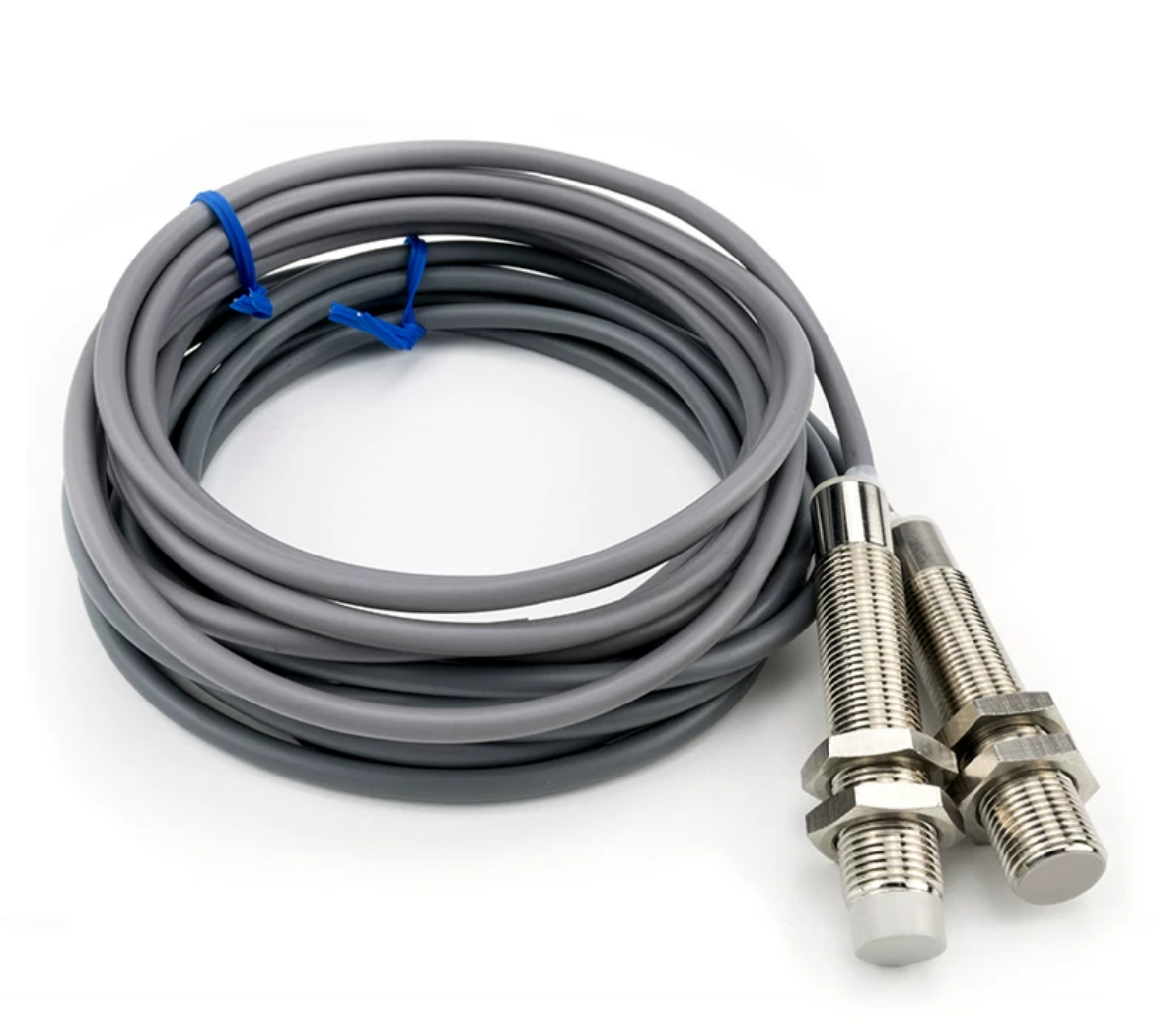
Capacitive or Inductive? Why This Series Exists
An inductive proximity switch is blind to anything that is not metal. The moment your target is a liquid level behind a plastic wall, a hopper of granules, or a wooden or glass part on a conveyor, you need a different physics — and that is exactly what this series delivers. Each switch generates an electrostatic field at its PBT sensing face and trips when any material with a dielectric constant different from air enters that field.
The family spans three thread sizes — M12, M18 and M30 — in a nickel-plated brass body with a fixed 2 m PVC cable. Every model carries a screwdriver-adjustable sensing range rather than a single fixed trip point, so commissioning is a matter of mounting the switch, presenting the real target and turning the adjuster until the LED confirms a clean switch-on margin. Flush models embed level with surrounding metal; non-flush T-suffix models trade mounting freedom for up to a 2–30 mm window on the M30 size.
How Capacitive Sensing Works
Dimensions (M12 shown)
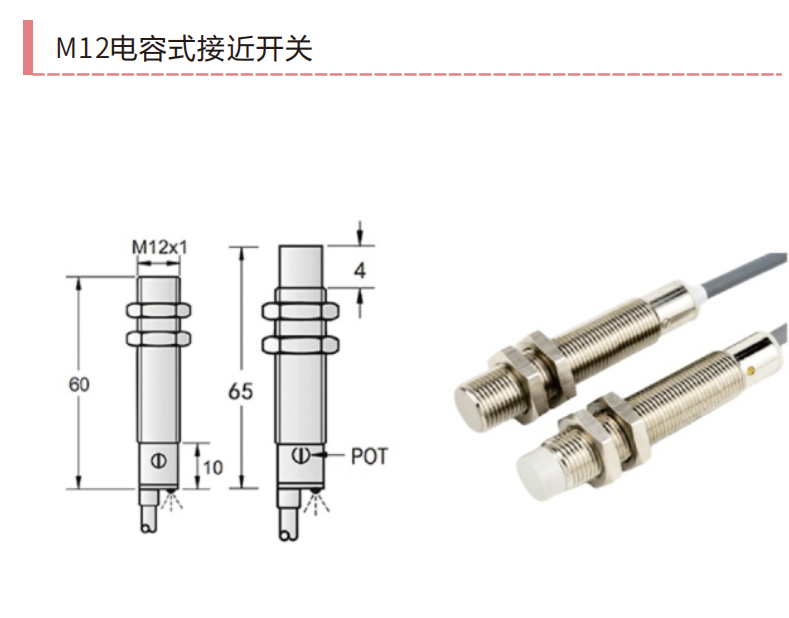
Overall length: M12 60 mm (flush) / 65 mm (non-flush) · M18 70 mm / 82 mm · M30 81 mm. Each body carries a POT adjuster near the cable end.
Technical Specifications
| Sensing principle | Capacitive — detects metal and non-metal targets |
|---|---|
| Thread sizes | M12 × 1 / M18 × 1 / M30 × 1 |
| Housing | Nickel-plated brass, PBT sensing face |
| Overall length | M12: 60 / 65 mm · M18: 70 / 82 mm · M30: 81 mm |
| Sensing distance | Adjustable per model, 1–2 mm up to 2–30 mm (see selection table) |
| Supply voltage | 10–30 V DC, ripple < 10% |
| Output | NPN or PNP, NO or NC, 3-wire DC, max. load 150 mA |
| Response time | 1.5 ms |
| Switching frequency | 50 Hz |
| No-load current | < 10 mA |
| Leakage current | < 0.01 mA |
| Voltage drop | < 1.5 V |
| Hysteresis / repeatability | < 15% Sr / < 5% Sr |
| Temperature drift | M12: < 20% Sr · M18: < 15% Sr · M30: < 20% Sr |
| Protection circuits | Short-circuit protection; overload protection point 240 mA |
| Indicator | LED switching-state indicator |
| Ingress protection | IP67 |
| Operating temperature | −25 °C to +70 °C |
| Connection | 2 m PVC cable — M12: ø4.0 mm 3×0.15 mm² · M18/M30: ø5.0 mm 3×0.33 mm² or 4×0.33 mm²; BN (+) / BK (signal) / BU (−) |
Model Selection Table
| Size · Mounting | Models (NPN NO / PNP NO / NPN NC / PNP NC) | Sensing distance | Output / Wiring |
|---|---|---|---|
| M12 · flush | R1202N1 / R1202P1 / R1202N2 / R1202P2 | 1–2 mm adjustable | NPN/PNP · NO/NC · 3-wire DC cable |
| M12 · flush | R1203N1 / R1203P1 / R1203N2 / R1203P2 | 1–3 mm adjustable | NPN/PNP · NO/NC · 3-wire DC cable |
| M12 · non-flush | R1204N1 / R1204P1 / R1204N2 / R1204P2 | 1–4 mm adjustable | NPN/PNP · NO/NC · 3-wire DC cable |
| M12 · non-flush | R1206N1T / R1206P1T / R1206N2T / R1206P2T | 1–6 mm adjustable | NPN/PNP · NO/NC · 3-wire DC cable |
| M18 · flush | R1805N1 / R1805P1 / R1805N2 / R1805P2 | 2–5 mm adjustable | NPN/PNP · NO/NC · 3-wire DC cable |
| M18 · flush | R1808N1 / R1808P1 / R1808N2 / R1808P2 | 2–8 mm adjustable | NPN/PNP · NO/NC · 3-wire DC cable |
| M18 · non-flush | R1808N1T / R1808P1T / R1808N2T / R1808P2T | 2–8 mm adjustable | NPN/PNP · NO/NC · 3-wire DC cable |
| M18 · non-flush | R1815N1T / R1815P1T / R1815N2T / R1815P2T | 2–15 mm adjustable | NPN/PNP · NO/NC · 3-wire DC cable |
| M30 · flush | Contact factory | 2–10 mm adjustable | NPN/PNP · NO/NC · 3-wire DC cable |
| M30 · flush | Contact factory | 2–20 mm adjustable | NPN/PNP · NO/NC · 3-wire DC cable |
| M30 · non-flush | Contact factory | 2–15 mm adjustable | NPN/PNP · NO/NC · 3-wire DC cable |
| M30 · non-flush | Contact factory | 2–30 mm adjustable | NPN/PNP · NO/NC · 3-wire DC cable |
Part-number key: R + size (12/18/30) + range code + N/P (NPN/PNP) + 1/2 (NO/NC) + T (non-flush). Data per the manufacturer's catalog selection table; for any configuration not listed, contact factory.
Typical Applications
Tank & Hopper Level Points
Sense liquid, powder or granule level through a thin non-metallic tank or hopper wall — no contact with the media.
Non-Metal Part Detection
Confirm the presence of plastic, glass, wood or paper parts that an inductive switch simply cannot see.
Packaging & Filling Lines
Verify fill level and package presence at line speed with a 1.5 ms response and LED status indication.
OEM Machine Platforms
One wiring convention (BN/BK/BU) and one naming logic across M12, M18 and M30 simplifies BOM standardization.
Frequently Asked Questions
When should I choose a capacitive proximity switch instead of an inductive one?
Choose capacitive when the target is non-metallic — liquid, powder, granules, plastic, wood or glass — or when you need to sense a material through a thin non-metallic wall. Inductive switches respond only to metal; capacitive switches respond to any material whose dielectric constant differs enough from air, which also includes metal.
Is the sensing distance of this series fixed or adjustable?
Adjustable. Every model has a factory-defined adjustment window — for example R1202 covers 1–2 mm and R1815T covers 2–15 mm — so the installer can fine-tune the trip point on site after mounting. The M30 sizes reach 2–30 mm; confirm M30 part numbers with the factory when ordering.
What is the difference between flush and non-flush (T-suffix) models?
Flush models (e.g. R1203, R1805) can be embedded level with surrounding metal without derating. Non-flush models (T suffix, e.g. R1206T, R1815T) need free space around the sensing face but reach a longer adjustable range for the same thread size.
Can it really detect liquid level through a plastic tank wall?
Yes. Capacitive sensing reacts to the change in dielectric constant when liquid rises behind the wall, so the switch can be mounted on the outside of a thin plastic or glass vessel. Validate the trip point with your actual wall thickness and medium — dielectric constants vary.
How do I pick NPN or PNP, NO or NC?
Match your PLC input card: NPN (sinking) or PNP (sourcing). In the part number, 1 = normally open and 2 = normally closed. Every model in this family is wired 3-wire DC: brown (+), black (signal), blue (−).
Will humidity, dust build-up or condensation affect the switch?
It can. Because capacitive sensing responds to any dielectric change near the face, heavy condensation or material caked on the sensing face may shift the trip point. Keep the face clean, use the adjustment range to set margin, or use an inductive switch if the target is metal and the environment is dirty.
What is the MOQ and lead time for export orders?
As the factory we support small trial orders and mixed-model cartons. MOQ, price and lead time depend on the model mix and quantity — send the model numbers through our contact page for a prompt quotation.
Are certificates and datasheets available?
Datasheets, wiring diagrams and available certification documents are provided on request together with the quotation.
General-purpose sensing component, not a certified safety device. Specs reviewed by Engineer Cai, Senior Application Engineer.