
M18/M30 Capacitive Proximity Switches with M12 Plug
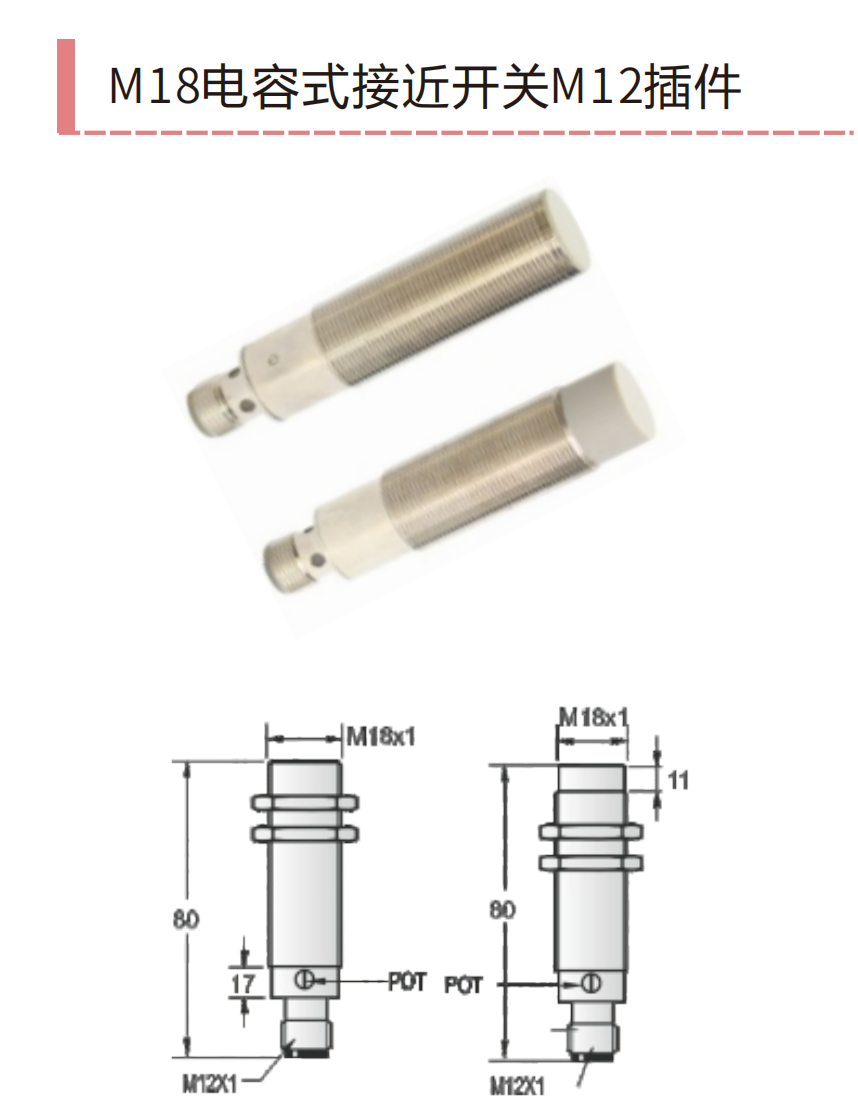
The maintenance-friendly build of our capacitive family: the same adjustable non-metal sensing, terminated in a detachable M12 4-pin connector instead of a fixed cable.
- Cordset swaps in seconds — no re-termination
- Adjustable ranges from 2–5 mm up to 2–30 mm
- NPN / PNP output, NO / NC logic, 10–30 V DC
- Nickel-plated metal body, IP67, 1.5 ms response
- M18 × 80 mm and M30 × 93 mm sizes
Built for Uptime, Not Just Detection
On a busy filling or material-handling line, the sensor is rarely what fails first — the cable is. This series accepts that reality: each M18 or M30 capacitive head ends in an M12 4-pin quick-disconnect plug, so the cordset becomes a stocked consumable and a cable strike no longer means cutting, stripping and re-terminating at the machine.
Sensing behaviour is identical to the cable-type family: an electrostatic field at the PBT face trips on any material with a dielectric constant different from air — liquid behind a plastic tank wall, powder in a hopper, or a glass jar on a conveyor. Each model carries a POT adjuster to set the trip point against the real target after mounting, and flush or non-flush (T-suffix) construction chooses between embedded mounting and maximum range.
M12 Connector & Wiring at a Glance
Technical Specifications
| Sensing principle | Capacitive — detects metal and non-metal targets |
|---|---|
| Thread sizes | M18 / M30 |
| Connector | Detachable M12 plug-in connector, 4-pin |
| Overall length | M18: 80 mm (M18 × 80 × M12) · M30: 93 mm (M30 × 93 × M12) |
| Sensing distance | Adjustable per model, 2–5 mm up to 2–30 mm (see selection table) |
| Supply voltage | 10–30 V DC |
| Output | NPN or PNP, NO or NC, 3-wire DC (BN / BK / BU) |
| Response time | 1.5 ms |
| Switching frequency | 50 Hz |
| Ripple | < 10 % |
| No-load current | < 10 mA |
| Max. load current | 150 mA |
| Leakage current | < 0.01 mA |
| Voltage drop | < 1.5 V |
| Switching hysteresis | < 15 % (Sr) |
| Repeat accuracy | < 5 % (Sr) |
| Temperature drift | < 20 % (Sr) |
| Protection circuits | Short-circuit protection; overload protection point 240 mA |
| Indicator | LED switching-state indicator |
| Housing | Nickel-plated brass, PBT sensing face, IP67 |
| Operating temperature | −25 °C to +70 °C |
Model Selection Table
| Size · Mounting | Models (NPN NO / PNP NO / NPN NC / PNP NC) | Sensing distance | Output / Wiring |
|---|---|---|---|
| M18 · flush | R1805N1M12 / R1805P1M12 / R1805N2M12 / R1805P2M12 | 2–5 mm adjustable | NPN/PNP · NO/NC · M12 4-pin plug |
| M18 · flush | R1808N1M12 / R1808P1M12 / R1808N2M12 / R1808P2M12 | 2–8 mm adjustable | NPN/PNP · NO/NC · M12 4-pin plug |
| M18 · non-flush | R1808N1TM12 / R1808P1TM12 / R1808N2TM12 / R1808P2TM12 | 2–8 mm adjustable | NPN/PNP · NO/NC · M12 4-pin plug |
| M18 · non-flush | R1815N1TM12 / R1815P1TM12 / R1815N2TM12 / R1815P2TM12 | 2–15 mm adjustable | NPN/PNP · NO/NC · M12 4-pin plug |
| M30 · flush | R3010N1M12 / R3010P1M12 / R3010N2M12 / R3010P2M12 | 2–10 mm adjustable | NPN/PNP · NO/NC · M12 4-pin plug |
| M30 · flush | R3020N1M12 / R3020P1M12 / R3020N2M12 / R3020P2M12 | 2–20 mm adjustable | NPN/PNP · NO/NC · M12 4-pin plug |
| M30 · non-flush | R3015N1TM12 / R3015P1TM12 / R3015N2TM12 / R3015P2TM12 | 2–15 mm adjustable | NPN/PNP · NO/NC · M12 4-pin plug |
| M30 · non-flush | R3030N1TM12 / R3030P1TM12 / R3030N2TM12 / R3030P2TM12 | 2–30 mm adjustable | NPN/PNP · NO/NC · M12 4-pin plug |
Part-number key: R + size (18/30) + range code + N/P + 1/2 (NO/NC) + T (non-flush) + M12 (connector). Data per the manufacturer's selection table; anything not listed — contact factory.
Typical Applications
Fast Cordset Swaps
A forklift clips a cable at 2 a.m.? Unplug, click a spare M12 cordset in, line restarts — no terminal box, no re-termination.
Pre-Fabricated Harnesses
OEMs pre-build M12 harnesses per machine variant and connect sensors at final assembly, cutting wiring hours per unit.
Level Sensing Retrofits
Add liquid, powder or granule level points to tanks and hoppers using standard M12 cabling already stocked in the plant.
Moving Machine Sections
Where cables flex and wear, a plug-in interface turns cable damage into a consumable-replacement job instead of a sensor swap.
Frequently Asked Questions
Why choose the M12-plug version instead of the fixed-cable version?
Serviceability. The sensing head, ranges and outputs are identical to the cable-type M18/M30 capacitive family; the difference is that the cable becomes a detachable M12 4-pin cordset. If a cable is crushed or cut, maintenance replaces the cordset in seconds without opening a junction box or re-terminating wires.
What sensing ranges are available?
M18 flush: 2–5 mm (R1805) or 2–8 mm (R1808). M18 non-flush: 2–8 mm (R1808T) or 2–15 mm (R1815T). M30 flush: 2–10 mm (R3010) or 2–20 mm (R3020). M30 non-flush: 2–15 mm (R3015T) or 2–30 mm (R3030T). All ranges are adjustable on site via the built-in POT.
Can it detect non-metallic materials and liquids?
Yes — that is the point of capacitive sensing. The switch responds to any material whose dielectric constant differs from air: liquids, powders, granules, plastics, wood and glass, in addition to metal. Typical duty is level detection through a thin non-metallic tank wall.
What are the body dimensions?
M18 models are 80 mm overall (M18 × 80, M12 plug end); M30 models are 93 mm overall (M30 × 93, M12 plug end). Both use a nickel-plated metal housing rated IP67.
Which cordset do I need?
A standard M12 4-pin female cordset. Wiring follows the 3-wire DC convention — BN (+), BK (signal), BU (−). Confirm the pin assignment of your cordset brand against the wiring diagram before energizing; we can supply matching cordsets with the sensors.
Is the connector joint suitable for high-vibration installations?
For permanently vibrating or never-touched installations, the fixed-cable version avoids a mating joint altogether. Where cables are exposed to damage or machines are re-configured often, the plug-in version usually wins on total downtime. Contact factory if you need connector mating-cycle data for a specific duty.
What is the MOQ for a mixed export order?
We ship mixed-model trial orders — for example a few of each output type to validate a retrofit. Send the part numbers via our contact page and sales will confirm MOQ, price and lead time promptly.
General-purpose sensing component, not a certified safety device. Specs reviewed by Engineer Cai, Senior Application Engineer.