
M8/M12 Capacitive Proximity Sensors, Quick-Disconnect
Two compact capacitive formats, one maintenance philosophy: plug the cordset in, tune the trip point, and never re-terminate a sensor wire again.
- M8: stainless steel, 60 mm, M8 3-pin plug, fixed 1 / 2 mm
- M12: nickel-plated brass, 69 mm, M12 4-pin plug
- M12 POT-adjustable ranges: 1–2 / 1–3 / 1–4 / 1–6 mm
- NPN / PNP, NO / NC; 3-wire or 4-wire NO+NC
- 10–30 V DC, 1.5 ms response, 4-point LED
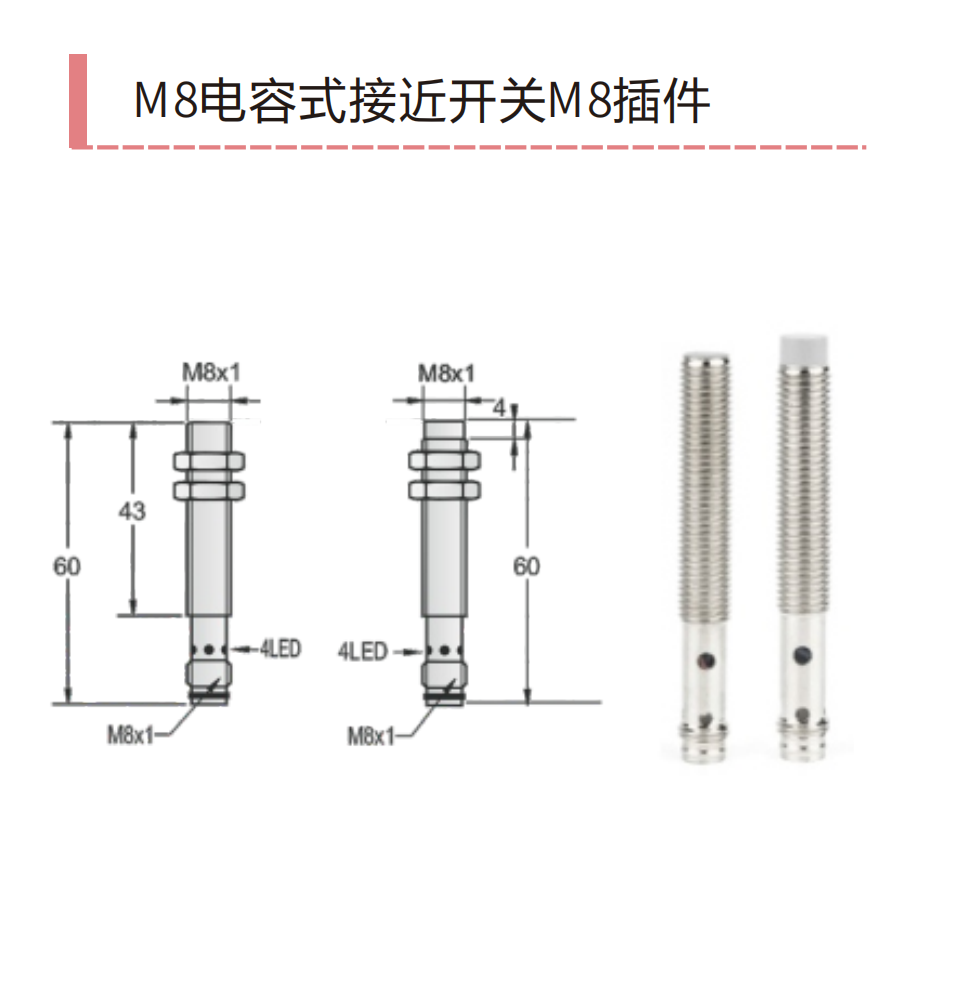
Small Bodies, Serviceable by Design
This family pairs the two most common small mounting sizes — M8 and M12 — with plug-in aviation connectors, so a damaged cable or a failed detection point is fixed by unplugging, not by opening terminal boxes. The M8 head is a fixed-range stainless-steel unit for repeatable close-range checks; the M12 head adds a rear potentiometer (POT) that lets commissioning dial the capacitive trip point to the actual product and gap.
Being capacitive, both sizes detect what the inductive JM8/JM12 style sensors in the same holes cannot: liquid behind a thin wall, powder and granules, plastic, wood and glass — plus metal. Twenty-four part numbers cover output transistor (NPN/PNP), switching logic (NO/NC), mounting (flush / non-flush T) and the four M12 adjustment windows.
Wiring: 3-Wire NO/NC and 4-Wire NO+NC
Technical Specifications
| Sensing principle | Capacitive — detects metal and non-metal targets |
|---|---|
| Body / housing | M8 × 1 × 60 mm stainless steel · M12 × 1 × 69 mm nickel-plated brass; PBT sensing face |
| Connector | M8 series: M8 3-pin plug · M12 series: M12 4-pin plug |
| Sensing distance | M8: 1 mm ±10% flush / 2 mm ±10% non-flush · M12: 1–2 / 1–3 / 1–4 / 1–6 mm POT-adjustable |
| Supply voltage | 10–30 V DC |
| Output | NPN or PNP, NO or NC; 3-wire, or 4-wire NO+NC |
| Supply ripple | < 10 % |
| No-load / load current | < 10 mA / max. 150 mA (leakage < 0.01 mA, voltage drop < 1.5 V) |
| Response time | 1.5 ms |
| Switching frequency | 100 Hz (M8 flush) / 80 Hz (M8 non-flush) / 50 Hz (M12) |
| Hysteresis / repeatability | < 15% Sr / < 5% Sr |
| Temperature drift | < 15% Sr (both sizes) |
| Overload protection point | M8: 280 mA · M12: 240 mA |
| Ingress protection | IP67 |
| Operating temperature | −25 °C to +70 °C |
| Indicator / protection | 4-point LED; short-circuit protection |
Model Selection Table
| Size · Mounting | Models (NPN NO / PNP NO / NPN NC / PNP NC) | Sensing distance | Connector / Wiring |
|---|---|---|---|
| M8 · flush | R0801N1M8 / R0801P1M8 / R0801N2M8 / R0801P2M8 | 1 mm ±10% (fixed) | M8 3-pin plug · 3/4-wire DC |
| M8 · non-flush | R0802N1TM8 / R0802P1TM8 / R0802N2TM8 / R0802P2TM8 | 2 mm ±10% (fixed) | M8 3-pin plug · 3/4-wire DC |
| M12 · flush | R1202N1M12 / R1202P1M12 / R1202N2M12 / R1202P2M12 | 1–2 mm adjustable (POT) | M12 4-pin plug · 3/4-wire DC |
| M12 · flush | R1203N1M12 / R1203P1M12 / R1203N2M12 / R1203P2M12 | 1–3 mm adjustable (POT) | M12 4-pin plug · 3/4-wire DC |
| M12 · non-flush | R1204N1TM12 / R1204P1TM12 / R1204N2TM12 / R1204P2TM12 | 1–4 mm adjustable (POT) | M12 4-pin plug · 3/4-wire DC |
| M12 · non-flush | R1206N1TM12 / R1206P1TM12 / R1206N2TM12 / R1206P2TM12 | 1–6 mm adjustable (POT) | M12 4-pin plug · 3/4-wire DC |
Part numbers listed exactly as in the factory selection table (the T suffix appears on the M8 2 mm stage and on both M12 non-flush stages, 1–4 mm and 1–6 mm). Key: R + size + range code + N/P + 1/2 (NO/NC) + [T] + connector code.
Typical Applications
Frequently Re-Tooled Machines
Format changes and re-tooling go faster when every detection point unplugs instead of unwiring.
Adjustable Close-Range Points
The M12 version's POT lets commissioning tune the trip point to the real product — cap heights, fill levels, wall thicknesses.
Compact Feeder & Fixture Sensing
60 mm (M8) and 69 mm (M12) bodies drop into tight mechanisms while keeping metal-housing durability.
Dual-Signal Interlocks
4-wire NO+NC wiring gives both a run signal and its complement from one sensor for plausibility checks.
Frequently Asked Questions
What is the difference between the M8 and M12 versions?
The M8 series uses a stainless-steel M8 × 1 body, 60 mm long, an M8 3-pin plug and a fixed sensing distance (1 mm flush / 2 mm non-flush, ±10%). The M12 series uses a nickel-plated brass M12 × 1 body, 69 mm long, an M12 4-pin plug and a potentiometer-adjustable distance — 1–2, 1–3, 1–4 or 1–6 mm depending on the model.
How does the potentiometer adjustment work on the M12 models?
Each M12 model has a built-in POT at the rear of the body. After mounting, present the real target, then turn the POT until the 4-point LED shows a clean switch with margin. Adjustment stays within the model's rated window (for example 1–6 mm on R1206T models).
Which targets can these sensors detect?
Both sizes are capacitive, so they respond to metal and to non-metal materials with a dielectric constant different from air — liquids, powders, granules, plastics, wood, glass. That is what separates them from the inductive M8/M12 sensors sharing the same mounting sizes.
What wiring options exist?
Standard 3-wire DC — BN (+), BK (signal), BU (−) — in NPN or PNP, NO or NC. The wiring diagram also covers 4-wire NO+NC operation with an additional WH (white) conductor where both signals are needed at once.
What are the protection ratings?
IP67 for both the M8 and M12 connector versions, with an operating temperature range of −25 °C to +70 °C. Short-circuit protection is built in, and the overload protection point is 280 mA on the M8 series and 240 mA on the M12 series.
What are the switching frequencies?
100 Hz for M8 flush models, 80 Hz for M8 non-flush models and 50 Hz for the M12 series, with a 1.5 ms response time across the family.
Can you quote matching cordsets with the sensors?
Yes — tell us the sensor part numbers and required cable lengths through the contact page and we will quote sensors plus mating M8 3-pin or M12 4-pin cordsets together, with MOQ and lead time confirmed in the same reply.
General-purpose sensing component, not a certified safety device. Specs reviewed by Engineer Cai, Senior Application Engineer.