
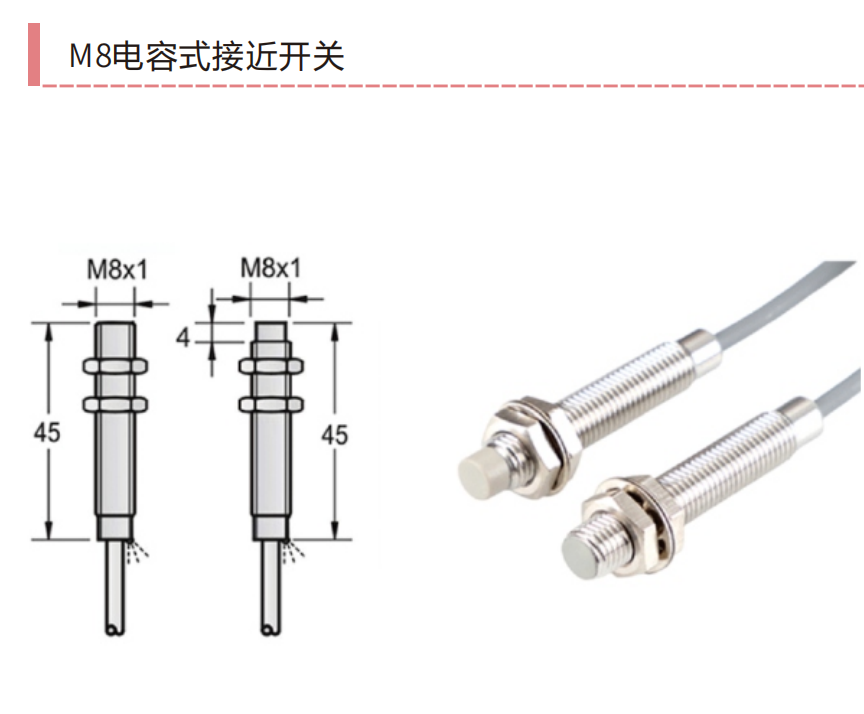
M8 Capacitive Proximity Sensor
Non-metal detection in the footprint of an M8 screw: a 45 mm nickel-plated body that senses plastics, liquids and powders where larger capacitive sensors simply cannot go.
- 1 mm flush / 2 mm non-flush sensing distance
- M8 × 45 mm nickel-plated brass body, IP67
- NPN / PNP output, NO / NC logic, 10–30 V DC
- 1.5 ms response, 100 Hz switching frequency
- Built-in short-circuit protection and LED indicator
Why an M8 Capacitive Sensor?
Capacitive proximity switches usually start at M12 — the sensing electrode needs area. That leaves a gap in compact machinery: feeders, small filling nozzles, blister lines and test fixtures where the only mounting room is an M8 hole, but the target is plastic, glass or a liquid meniscus that an inductive M8 can never see. This sensor fills exactly that gap.
The trade-off is honest and predictable: at 8 mm diameter the electrostatic field is small, so the rated distance is 1 mm flush / 2 mm non-flush — a genuine close-range detector rather than an area sensor. In return you get an IP67 nickel-plated brass body only 45 mm long, a 100 Hz switching rate for moving product, and the same 3-wire DC NPN/PNP wiring as every other proximity switch in your panel.
Effective Range Depends on the Target Material
Technical Specifications
| Sensing principle | Capacitive — detects metal and non-metal targets |
|---|---|
| Body dimensions | M8 × 45 mm |
| Housing | Nickel-plated brass, PBT sensing face |
| Sensing distance | 1 mm (flush) / 2 mm (non-flush, T suffix) — fixed |
| Supply voltage | 10–30 V DC |
| Output | NPN or PNP, NO or NC, 3-wire DC, max. load 150 mA |
| Response time | 1.5 ms |
| Switching frequency | 100 Hz |
| Ripple | < 10 % |
| No-load current | < 10 mA |
| Leakage current | < 0.01 mA |
| Voltage drop | < 1.5 V |
| Switching hysteresis | < 15 % (Sr) |
| Repeat accuracy | < 5 % (Sr) |
| Temperature drift | < 15 % (Sr) |
| Ambient temperature | −25 °C to +70 °C |
| Protection circuits | Short-circuit protection; overload protection point 280 mA |
| Indicator | LED switching-state indicator |
| Ingress protection | IP67 |
| Connection | 2 m PVC cable, ø3.0 mm, 3 × 0.15 mm² — BN (+) / BK (signal) / BU (−) |
Model Selection Table
| Mounting | Model | Output | Sensing distance | Wiring |
|---|---|---|---|---|
| Flush (embeddable) | R0801N1 | NPN · NO | 1 mm | 3-wire DC, 2 m cable |
| Flush (embeddable) | R0801P1 | PNP · NO | 1 mm | 3-wire DC, 2 m cable |
| Flush (embeddable) | R0801N2 | NPN · NC | 1 mm | 3-wire DC, 2 m cable |
| Flush (embeddable) | R0801P2 | PNP · NC | 1 mm | 3-wire DC, 2 m cable |
| Non-flush (T) | R0802N1T | NPN · NO | 2 mm | 3-wire DC, 2 m cable |
| Non-flush (T) | R0802P1T | PNP · NO | 2 mm | 3-wire DC, 2 m cable |
| Non-flush (T) | R0802N2T | NPN · NC | 2 mm | 3-wire DC, 2 m cable |
| Non-flush (T) | R0802P2T | PNP · NC | 2 mm | 3-wire DC, 2 m cable |
Part-number key: R08 + distance code (01/02) + N/P (NPN/PNP) + 1/2 (NO/NC) + T (non-flush). Data per the manufacturer's selection table.
Typical Applications
Tight-Space Detection Points
Fixtures, small feeders and compact mechanisms where an M12 or M18 body physically does not fit.
Thin-Wall Container Sensing
Confirm liquid or product presence through a thin plastic or glass wall at very close range.
Small-Part Presence Checks
Detect plastic caps, seals, tablets-in-blister and other small non-metal parts on assembly lines.
Washdown & Dusty Areas
IP67 sealing and a nickel-plated brass body handle packaging-hall washdown and powder-laden air.
Frequently Asked Questions
How close does the target have to be?
The flush version (R0801) switches at 1 mm and the non-flush T version (R0802T) at 2 mm, as listed in the factory selection table. This is a deliberately short-range, small-diameter family; if you need more distance, step up to our M12–M30 capacitive series with ranges up to 2–30 mm.
What materials can an M8 capacitive sensor detect?
Anything with a dielectric constant sufficiently different from air: liquids, powders, granules, plastics, wood, glass — and metal. Higher-dielectric materials (like water) give the strongest response; dry, low-dielectric materials trip at a shorter effective distance.
Flush or non-flush — which should I order?
Flush (no T suffix) if the sensor face must sit level with a surrounding metal fixture — at 1 mm sensing distance. Non-flush (T suffix) if you can leave clearance around the face and want the longer 2 mm distance.
Is the sensing distance adjustable?
No — this M8 series has a fixed distance per mounting style (1 mm flush / 2 mm non-flush). If you need an on-site adjustable trip point in a small body, the M12 version of our quick-disconnect capacitive series offers a POT-adjustable 1–6 mm range.
What are the electrical ratings?
10–30 V DC supply, 3-wire connection (brown +, black signal, blue −), maximum load current 150 mA, response time 1.5 ms, switching frequency 100 Hz, with built-in short-circuit protection and a 280 mA overload protection point.
Can I get samples before committing to a volume order?
Yes — sample and small trial quantities are the normal way to validate a capacitive application, because target material and wall thickness affect the effective trip point. Contact us with your model codes and application notes for a prompt sample quotation.
Do you provide datasheets and certification documents?
Datasheets, dimension drawings and wiring diagrams ship with the quotation; available certification documents are provided on request.
General-purpose sensing component, not a certified safety device. Specs reviewed by Engineer Cai, Senior Application Engineer.