
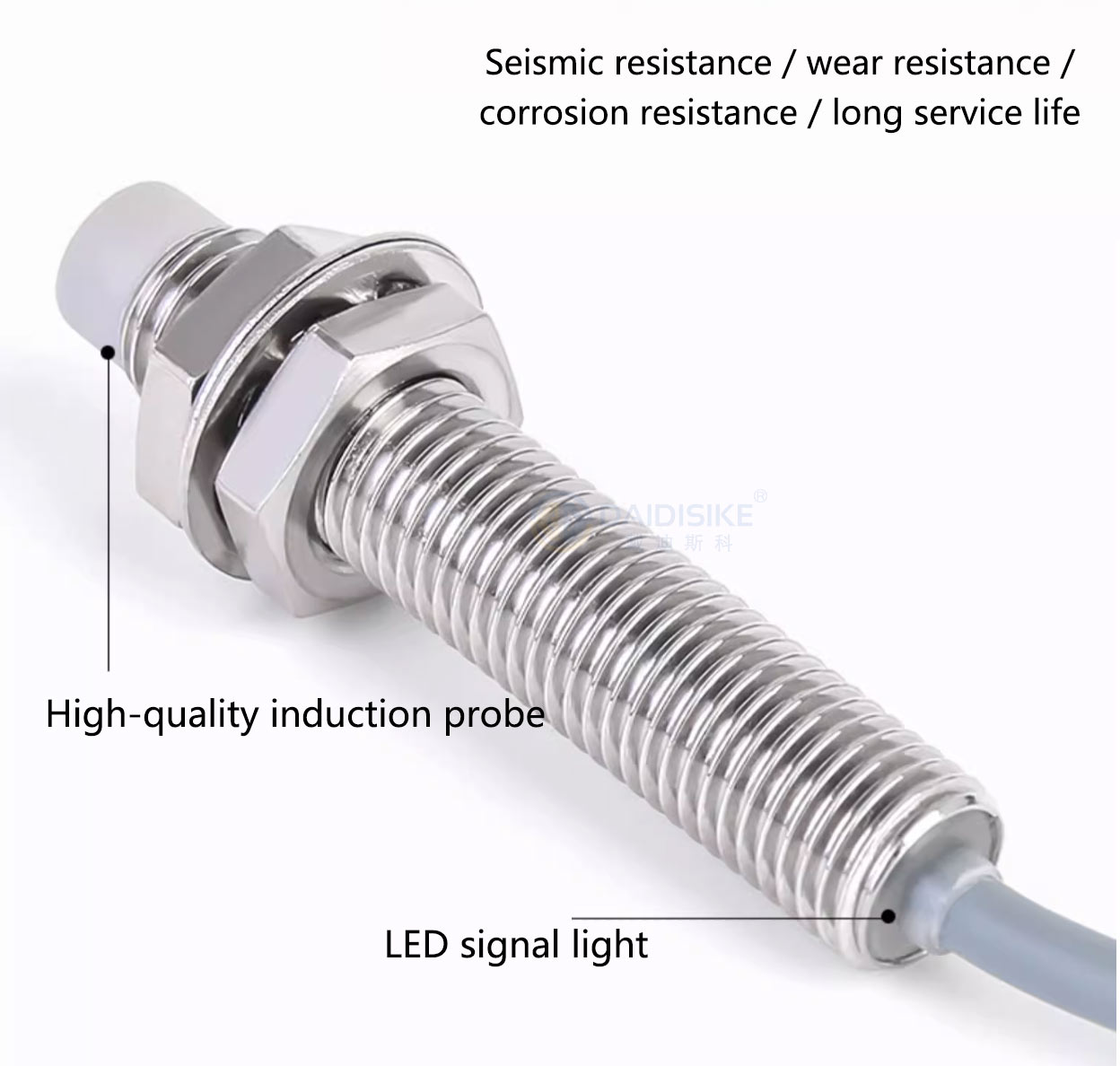
Spend a day commissioning a line and you will wire dozens of inductive proximity switches — end-of-stroke on cylinders, part-present on fixtures, home position on indexers. They are cheap, they are everywhere, and for thirty years the only real decision was thread size, sensing distance and whether the customer's PLC wanted PNP or NPN. That comfortable boredom is over. The device itself looks the same as it did in 2010, but what happens behind the third wire has changed enough that an engineer specifying a sensor in 2026 ought to ask different questions.
Here is the honest read on what is actually moving — and, just as important, what is being oversold.
What is driving the proximity sensor market in 2026?
Four threads, in rough order of how much they should change your next purchase order: IO-Link going from “nice option” to default digital layer; Single-Pair Ethernet finally arriving at the field; factor-1 sensing becoming affordable enough to standardise on; and miniaturisation pushing real performance into M8 and even M5 bodies. None of these is a brand-new invention. What is new is that they have all crossed the line from datasheet curiosity to something you can buy off the shelf and have to reason about.
Keep market developments separate from an orderable model’s features. The DAIDISIKE standard proximity switch range provides the current product starting point; this industry overview does not claim IO-Link, SPE, Factor 1 or weld-field immunity for those standard sensors. Request the selected device’s manual and, for IO-Link, its IODD before planning diagnostics.
How is IO-Link changing inductive proximity sensors?
IO-Link is the one that actually matters for most plants. It is standardised as IEC 61131-9 — the SDCI, or single-drop digital communication interface — and the adoption curve has gone vertical. PI’s April 2026 report states that approximately 9.7 million IO-Link devices and master ports were added in 2025, bringing the total to 71 million. These are industry node figures, not the number of inductive sensors or DAIDISIKE installations.
An IO-Link sensor exchanges digital data over its C/Q connection to an IO-Link master. Supported communication rates are device-specific, with COM3 at 230.4 kbit/s. The practical benefits below are possibilities to verify in the selected device’s IODD, not features of every inductive sensor:
- Diagnostics. Inspect the IODD for the actual events and values exposed, such as a supported short-circuit or temperature warning. Do not assume contamination or marginal-target detection exists.
- Parameterisation. Identify which settings are writable and how the controller handles them. Automatic replacement parameter restoration requires compatible devices and correctly configured master data storage.
- Process data beyond on/off. Some devices expose additional process values, but a switching sensor does not become a distance-measuring sensor merely by having IO-Link. Verify units, resolution, accuracy and supported values.
IO-Link uses standard unshielded sensor cabling for links up to 20 m, but check the selected device’s connector, port class, pinout and power requirement. Reusing an existing cable is a compatibility decision, not a blanket promise that every three-wire installation can be converted unchanged.
What is Single-Pair Ethernet and is it ready for sensors?
Single-Pair Ethernet (SPE) is the longer-horizon story, and it is easy to over-hype, so let me be precise. For the field level the relevant flavour is 10BASE-T1L, standardised in IEEE 802.3cg: 10 Mbit/s full-duplex over a single twisted pair, reach up to 1000 m, with power delivered on the same pair via PoDL (Power over Data Line). Connector selection must match the equipment interface: IEC 63171-6 is one SPE connector standard, while IEC 63171-7 also forms part of the developing ecosystem. Verify actual sensor, switch and power-class availability for the project; a launch date does not establish compatibility.
The appeal is genuine: end-to-end IP from the sensor all the way to the controller and the cloud, with no protocol gateway in between, over a thin two-wire cable that can run a kilometre. For a sprawling conveyor system or a water-treatment plant, that reach is hard to beat.
But be clear-eyed about where SPE fits in 2026. It is not a drop-in for the millions of cheap discrete prox switches on a typical machine. SPE needs a compatible single-pair cable and the connector specified by the equipment — so adopting it is a cabling decision, not a swap of a master port the way IO-Link is. The economics only work where the distance or the bandwidth genuinely earns the new infrastructure: long runs, measuring sensors, process instruments. For the end-of-stroke switch on a pneumatic cylinder, IO-Link will remain the right answer for years. My read: SPE and IO-Link are complementary through this decade, not competitors, and anyone telling you SPE replaces IO-Link in 2026 is selling cable.
What is factor-1 sensing and is it worth the premium?
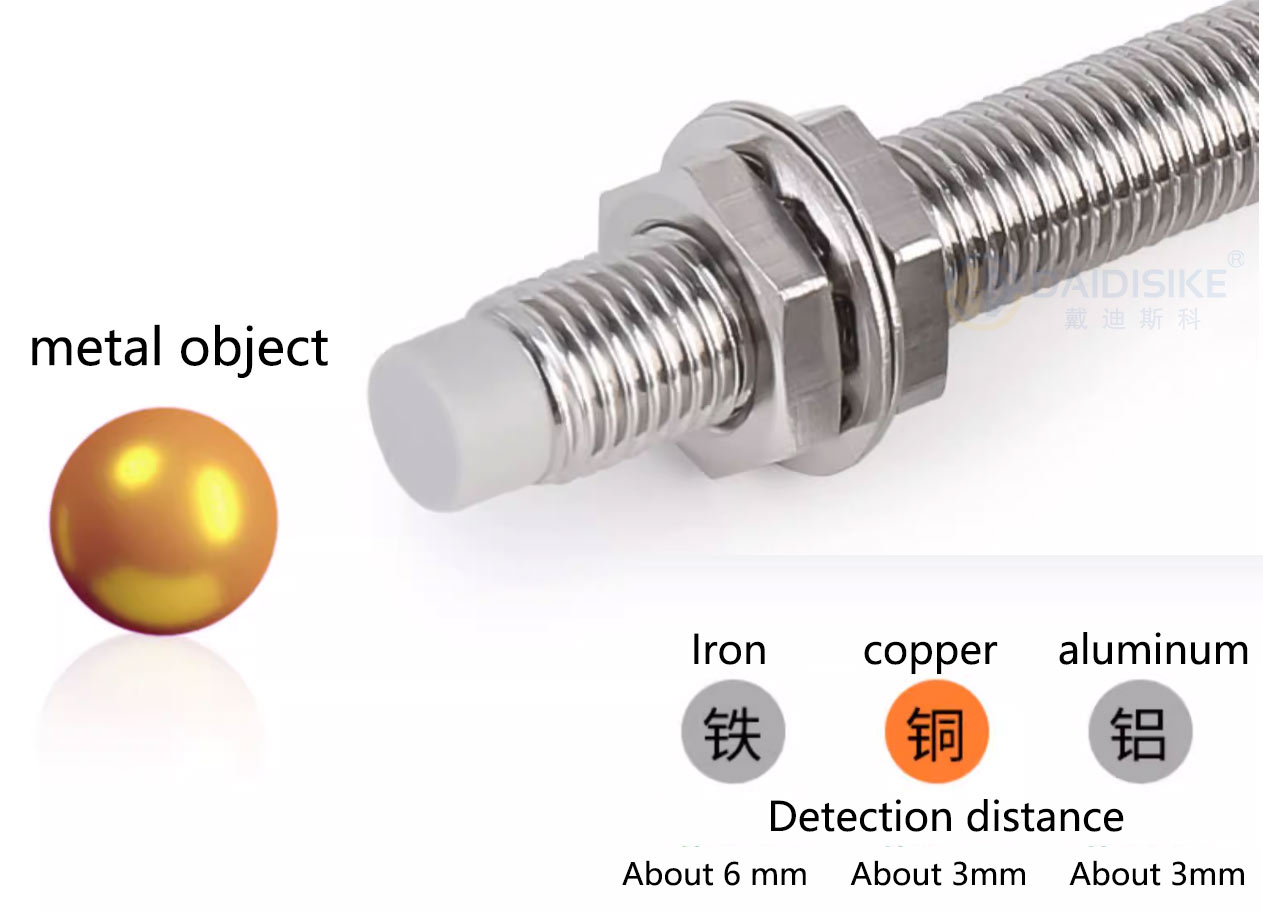
Conventional inductive sensing distances are specified using a defined target. Aluminium, brass and other metals can require a reduced operating distance; use the manufacturer’s material factors and target-size guidance instead of treating a typical correction range as a guaranteed value.
A Factor 1 model is specified for equal sensing distance across the stated metals. Construction varies by manufacturer. Welding-field immunity is a separate claim: some products combine Factor 1 and weld-resistant designs, but the Factor 1 label alone does not establish resistance to every AC, DC or medium-frequency welding field. See the Factor 1 and weld-immunity selection guide for the distinction.
Specify Factor 1 when target-material variation makes its range behavior useful. For welding, additionally verify field type and strength, temperature, spatter exposure, cable protection and installation clearance. A fixed steel target in an ordinary environment may be served by a standard model once its operating margin is verified.
How small can you go — and what does miniaturisation cost you?
The fourth thread is mechanical. Miniature M5, M6 and M8 sensing heads create useful mounting options, but do not infer IO-Link, a COM rate or flush mountability from diameter. Verify the actual sensor and its IODD; connector thread size is not necessarily the sensing-head diameter. That matters wherever mounting space is contested: robot end-effectors, 3C electronics assembly, small pneumatic grippers, dense tooling plates.
The trade-off is honest physics. A smaller coil sees a shorter distance. DAIDISIKE's own three-wire DC range steps through the familiar sizes — M8 at a short rated range, then M12, M18 and M30 with progressively longer sensing distances — precisely because the physics does not let you have a long range in a tiny body. Size the housing to the target gap first, then to the available hole. If the gap is large, do not force an M8 in just because the bracket is small; step up to an M12 or M18. Our M8-vs-M12 selection guide works through that trade-off in detail.
PNP or NPN, and what about harsh-environment housings?
Two perennial spec-sheet questions that have quietly settled. On output polarity: for new European and most global machinery, default to PNP (sourcing). In a grounded-negative system PNP is the safer failure mode — a signal-to-frame short de-energises the input rather than spuriously asserting it — and it is what modern sinking PLC input cards expect. NPN (sinking) is not dead; it persists in legacy Asian-built machinery and older controllers. But this is one fault example, not a functional-safety rating. Ordinary PNP and NPN sensors are not personnel-protection devices. Always confirm against your input card's common polarity before you order — the full reasoning, with wiring diagrams, is in our PNP-vs-NPN wiring guide.
On environment: the bar has moved from IP67 to IP69K for any sensor that meets a high-pressure, high-temperature washdown — food, beverage, pharma. IP67 (dust-tight, temporary immersion) is still fine for general machine builds; IP69K describes a defined hot-water jet test, not unconditional chemical or cleaning-process resistance. Compare the actual water temperature, pressure, duration, cleaning agents and connector assembly against the model’s documented limits; an immersion rating alone is insufficient.
What should an engineer actually do about this in 2026?
Start with the function the machine needs. Use IO-Link when its documented diagnostics or parameter management justify a compatible master and integration work. Evaluate SPE where the selected device’s Ethernet interface, reach and data needs fit the architecture. Select Factor 1 for stated material behavior and a separately rated weld-immune model for a welding environment. Match housing, clearance and ingress protection to the installation rather than assuming that newer communication automatically improves sensing reliability.
Related reading
DAIDISIKE M8 Inductive Proximity Switch
Compact three-wire DC inductive switch for tight fixtures and short target gaps.
DAIDISIKE M12 Metal Inductive Proximity Switch
The workhorse size — longer range than M8, PNP/NPN, NO/NC variants.
Single-Pair Ethernet for Sensors (2026)
10BASE-T1L, IEC 63171-6 and where SPE actually pays off at the field level.