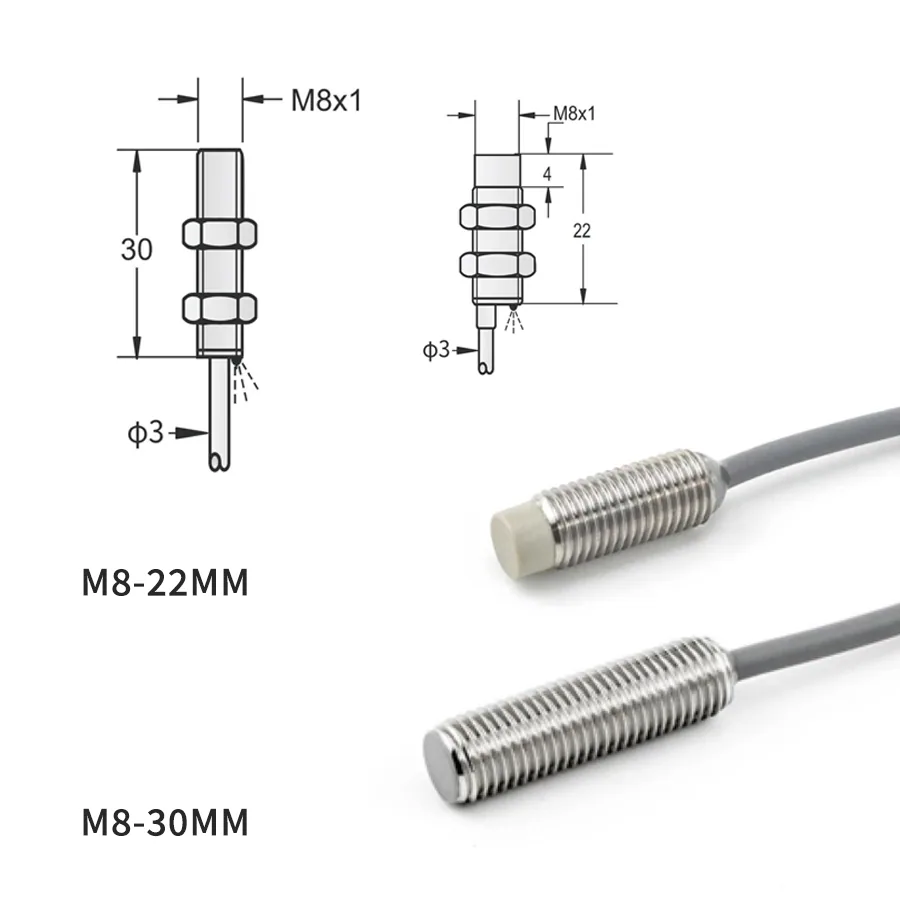
DAIDISIKE M8 proximity switch is a high-performance inductive proximity switch, also known as a metal proximity switch or metal sensing switch. This product features a DC three-wire design, with an M8 × 1 thread, supporting flush and non-flush mounting, with rated detection distances of 1-3 mm flush and 2-6 mm non-flush. It is suitable for industrial automation, mechanical positioning, and metal detection scenarios. The housing material is nickel-plated brass, with an IP67 protection rating, corrosion-resistant and impact-resistant, and an operating temperature range of −25 °C to +70 °C. Choose DAIDISIKE M8 proximity switch to enhance your production efficiency and reliability.
DAIDISIKE M8 inductive proximity switch is a high-performance metal proximity switch, also known as inductive proximity switch or metal sensing switch. This series features DC 3-wire design, tailored for industrial automation, capable of reliably detecting metal objects with non-contact sensing. Our M8 proximity switches offer flush and non-flush mounting options, suitable for various installation environments. The DAIDISIKE brand is committed to providing high-quality, reliable sensor solutions to help customers improve production efficiency.
M8 Proximity Sensor Description
DAIDISIKE M8 inductive proximity switch is a cylindrical inductive sensor with an M8 × 1 thread and body styles including the 18 mm straight body (22 mm in the non-flush version), the 18 mm right-angle Y-type body, and extended 35 mm and 45 mm bodies. The product supports flush and non-flush installation, where flush type is ideal for embedded mounting, and non-flush type offers longer detection distance. It features a nickel-plated brass housing with IP67 protection rating, corrosion-resistant and impact-proof. Output types include NPN or PNP, NO/NC optional, suitable for PLC, robots, and automation equipment.
Working Principle
The working principle of the inductive proximity switch is based on electromagnetic induction. When a metal object enters the sensor's detection zone, it changes the inductance of the internal coil, causing amplitude variations in the oscillation circuit, thereby triggering the output signal. The sensor uses a high-frequency oscillator to generate an electromagnetic field for non-contact detection of metals like iron, steel, and aluminum. The DC 3-wire design includes power, ground, and output lines for stable output. Detection distance is influenced by metal type, size, and installation method; flush type has shorter distance but concealed installation, while non-flush has longer range.
Industrial Applications
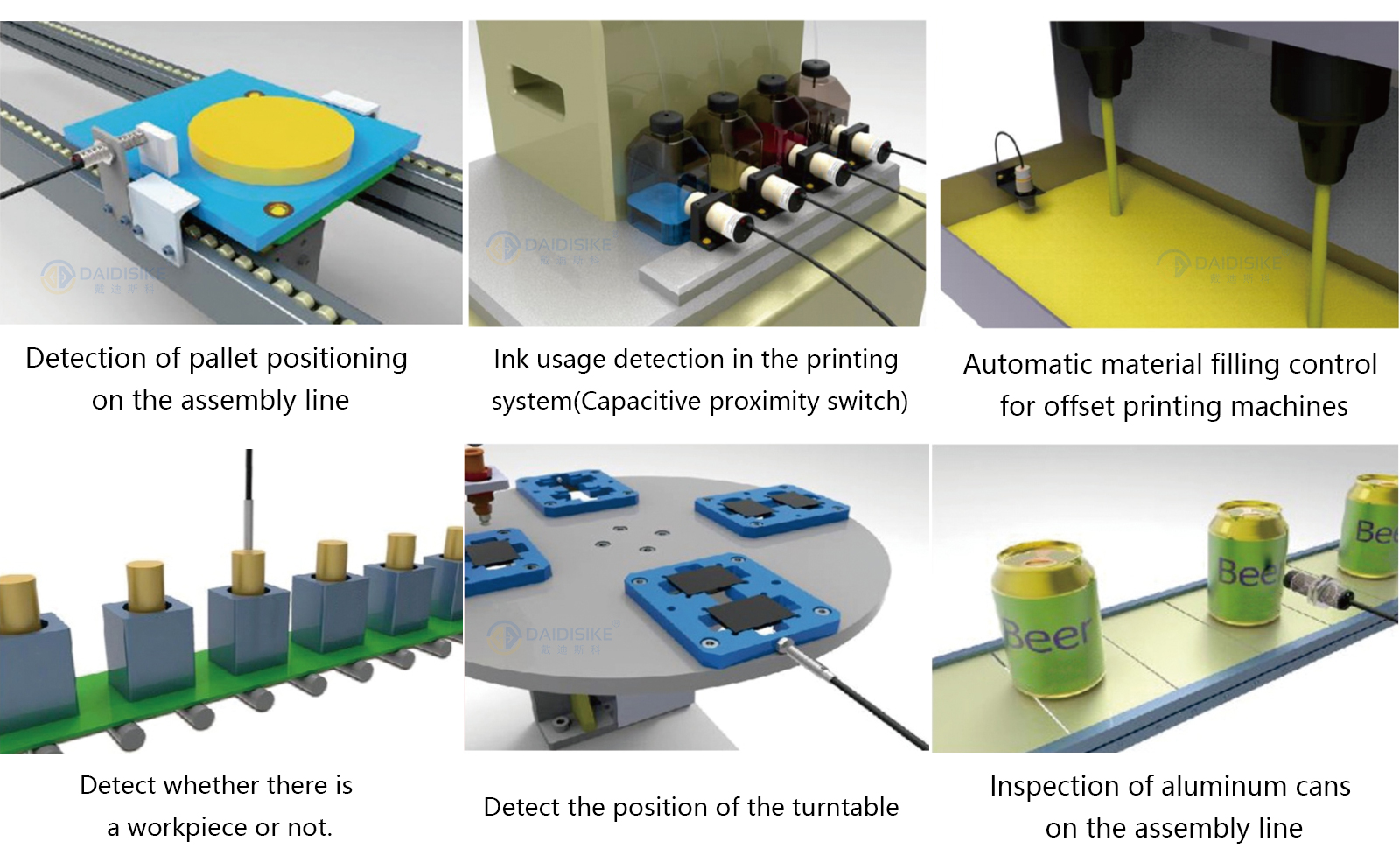
DAIDISIKE M8 proximity switch is widely used in industrial automation, machinery manufacturing, automotive assembly, packaging lines, and logistics systems. It is suitable for detecting metal part positions, counting metal objects, or preventing collisions. It performs excellently in harsh environments like humid, dusty, or vibrating conditions, with a working temperature range of −25 °C to 70 °C. Typical applications include robot arm positioning, conveyor belt metal detection, and machine tool limit switches. The product is oil-resistant and water-resistant, applicable in food processing, chemical, and metallurgy industries.
Product Parameters
Supply Voltage: 10-30 V DC
Output Type: DC 3-wire, NPN/PNP optional, NO/NC
Sensing Distance (Sn): 1 / 2 / 3 mm flush; 2 / 4 / 6 mm non-flush (by model)
Response Time: 0.1 ms (18 mm, Y-type and short-range 35/45 mm variants)
Short-circuit Protection: Yes; overload current protection point 180 mA
Indicator: LED switching-state indicator
Protection Rating: IP67
Housing Material: Nickel-plated brass
Operating Temperature: −25 °C ~ +70 °C
Cable: 2 m standard (longer lengths on request)
Connection Method: Pre-wired cable; Y-type body has a right-angle cable exit
Detailed Specifications Table for All Models
Model
Mounting Type
Detection Distance (mm)
Length (mm)
Housing Material
Output Type
Switching Frequency (Hz)
Supply Voltage (V DC)
Current Consumption (mA)
Load Current (mA)
Protection Rating
Operating Temperature (°C)
Connection Method
Features
M801/M802 …P18 (18 mm, flush)
Flush
1 / 2
18
Nickel-plated brass
NPN/PNP, NO/NC
2000 / 1500
10-30
< 10 mA (no-load)
150 mA max
IP67
-25 ~ +70
Cable (2 m)
Standard short body, axial cable exit
M801/M802 …P18C (Y-type, flush)
Flush
1 / 2
18
Nickel-plated brass
NPN/PNP, NO/NC
2000 / 1500
10-30
< 10 mA (no-load)
150 mA max
IP67
-25 ~ +70
Cable (2 m), right-angle exit
Right-angle (Y-type) body for limited lateral clearance
M802 …T22 (22 mm, non-flush)
Non-Flush
2
22
Nickel-plated brass
NPN/PNP, NO/NC
2000
10-30
< 10 mA (no-load)
150 mA max
IP67
-25 ~ +70
Cable (2 m)
Non-flush head, needs metal-free clearance
M801/M802 …P35 (35 mm, flush)
Flush
1 / 2
35
Nickel-plated brass
NPN/PNP, NO/NC
2000 / 1500
10-30
< 10 mA (no-load)
150 mA max
IP67
-25 ~ +70
Cable (2 m)
Extended body for deeper thread engagement
M802/M804 …T35 (35 mm, non-flush)
Non-Flush
2 / 4
35
Nickel-plated brass
NPN/PNP, NO/NC
2000 / 1000
10-30
< 10 mA (no-load)
150 mA max
IP67
-25 ~ +70
Cable (2 m)
Longer detection distance on a 35 mm body
M801/M802/M803 …P (45 mm, flush)
Flush
1 / 2 / 3
45
Nickel-plated brass
NPN/PNP, NO/NC
2000 / 1500 / 1000
10-30
< 10 mA (no-load)
150 mA max
IP67
-25 ~ +70
Cable (2 m)
Widest flush sensing-distance choice (up to 3 mm)
M802/M804/M806 …T (45 mm, non-flush)
Non-Flush
2 / 4 / 6
45
Nickel-plated brass
NPN/PNP, NO/NC
2000 / 1000 / 400
10-30
< 10 mA (no-load)
150 mA max
IP67
-25 ~ +70
Cable (2 m)
Longest range in the M8 family (up to 6 mm)
Frequently Asked Questions
What is the sensing distance of an M8 inductive proximity switch?
Flush (shielded) M8 sensors are rated 1 mm, 2 mm or 3 mm depending on body length (18 mm and Y-type: 1–2 mm; 35 mm: 1–2 mm; 45 mm: 1–3 mm). Non-flush (unshielded) versions are rated 2 mm, 4 mm or 6 mm (22 mm short body: 2 mm; 35 mm: 2–4 mm; 45 mm: 2–6 mm). The rated sensing distance Sn is specified for a standard steel target — non-ferrous metals such as aluminium, brass and stainless steel reduce it.
What is the difference between flush and non-flush M8 sensors?
Flush (embeddable) sensors mount level with surrounding metal and have a shorter, more interference-immune range. Non-flush sensors need a clear zone around the face but give a longer sensing distance. The DAIDISIKE M8 is available in both.
Should I choose NPN or PNP, NO or NC output?
PNP (sourcing) is the default for most modern PLCs, especially in Europe; NPN (sinking) is common in some Asian controls. NO closes on detection, NC opens. The DAIDISIKE M8 is a DC 3-wire sensor available in NPN/PNP and NO/NC.
Can the DAIDISIKE M8 replace an Omron, SICK, Balluff or Autonics M8 proximity sensor?
Usually yes — it shares the M8×1 thread, DC 3-wire NPN/PNP wiring, IP67 rating and 1–6 mm range, so it fits the same bracket and cable. Match the flush/non-flush type, length (18 / Y-type / 35 / 45 mm) and output to the unit being replaced.
What ingress protection and temperature range does it have?
The DAIDISIKE M8 is rated IP67 with a nickel-plated brass housing and a −25 °C to +70 °C operating range, suitable for machine tools, conveyors and automotive assembly lines.
What is the switching frequency of the M8 proximity switch?
Switching frequency depends on the rated sensing distance: flush 1 mm = 2 kHz, 2 mm = 1.5 kHz, 3 mm = 1 kHz; non-flush 2 mm = 2 kHz, 4 mm = 1 kHz, 6 mm = 400 Hz. Response time is 0.1 ms on the 18 mm, Y-type and short-range 35/45 mm variants.
Does the M8 sensor have short-circuit protection?
Yes. Short-circuit protection is standard and the overload current protection point is 180 mA. Every unit also carries an LED switching-state indicator and a 2 m cable (longer lengths on request).