
High-Grade Threaded M4/M5/M6 Inductive Proximity Switch
The precision tier of the miniature range: pick the exact sensing-distance grade your gap needs — 0.6 to 1.5 mm — in a lock-nut-adjustable threaded body.
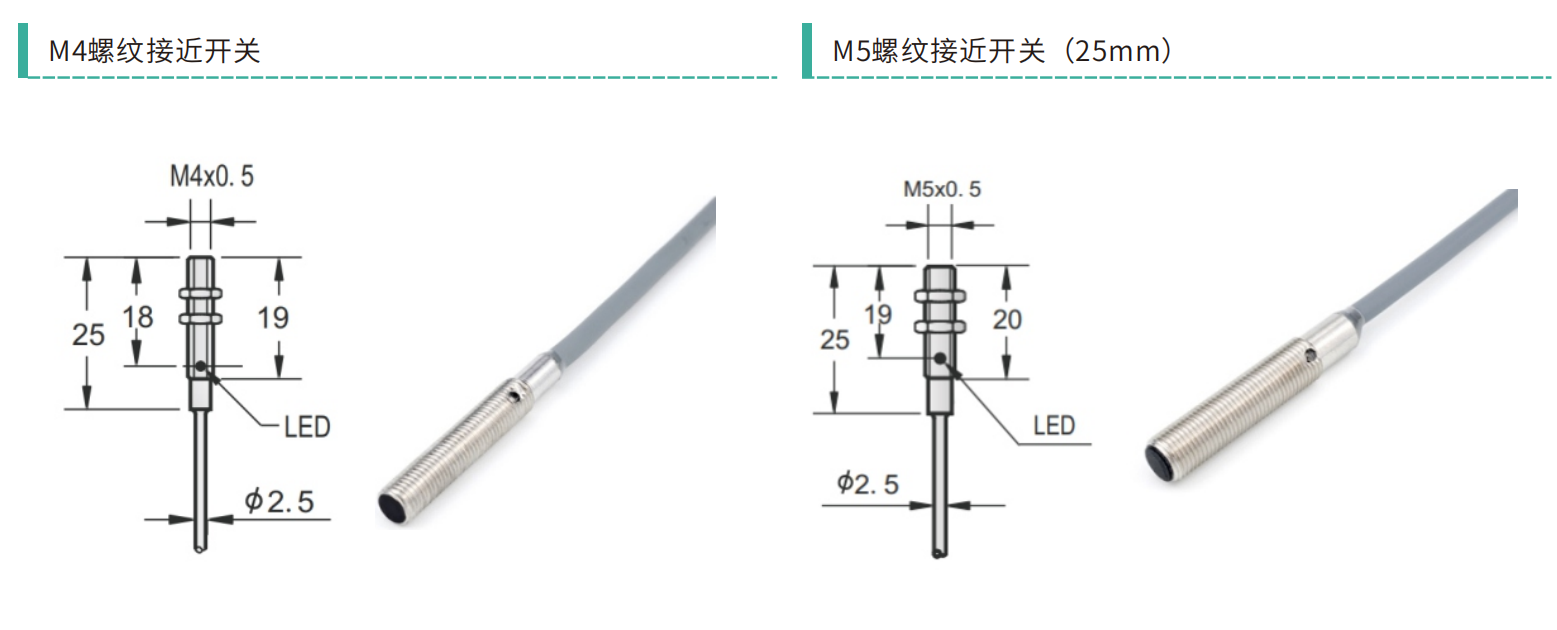
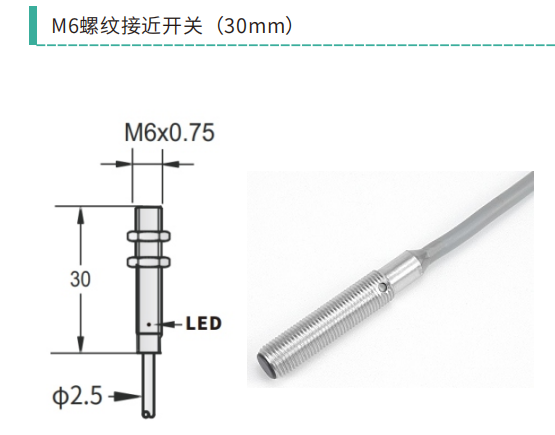
- M4×0.5 / M5×0.5 (25 mm bodies) and M6×0.75 (30 mm body)
- Selectable grades: 0.6 / 0.8 / 1.0 / 1.2 / 1.5 mm
- 44 catalogued part numbers — NPN/PNP × NO/NC at every grade
- 10–30 V DC 3-wire, IP67, −25 to +70 °C, flush mountable
- Fine-pitch threads for sub-millimetre gap tuning
Why a "Grade-Selectable" Miniature Sensor Exists
Most miniature proximity switches give you one rated distance per size and leave the rest to your bracket design. This high-grade series inverts that: within the same M4/M5/M6 footprints as the economy M4–M6 line and the standard M5/M6 series, it catalogues up to four sensing-distance grades per thread size. That matters at miniature scale, where the whole working range is around a millimetre — a grade matched to the real gap keeps switching repeatable without re-machining fixtures.
It is the option to specify when a compact mechanism needs a documented, repeatable switching distance and the M8-and-up cylindrical sizes (see the M8 page) are physically too large.
Lock-Nut Mounting and Gap Adjustment
Model Selection Table (44 Part Numbers)
| Models (NPN NO / PNP NO / NPN NC / PNP NC) | Thread / body length | Sensing distance | Response / frequency | Mounting | Output & wiring | Connection |
|---|---|---|---|---|---|---|
| M4N10.6 / M4P10.6 / M4N20.6 / M4P20.6 | M4×0.5, 25 mm | 0.6 mm | 0.1 ms / 2 kHz | Flush | NPN/PNP, NO/NC, 3-wire DC 10–30 V | Cable tail (⌀2.5 mm), 2 m |
| M4N10.8 / M4P10.8 / M4N20.8 / M4P20.8 | M4×0.5, 25 mm | 0.8 mm | 0.1 ms / 2 kHz | Flush | NPN/PNP, NO/NC, 3-wire DC 10–30 V | Cable tail (⌀2.5 mm), 2 m |
| M4N110 / M4P110 / M4N210 / M4P210 | M4×0.5, 25 mm | 1.0 mm | 0.2 ms / 1 kHz | Flush | NPN/PNP, NO/NC, 3-wire DC 10–30 V | Cable tail (⌀2.5 mm), 2 m |
| M5N10.8 / M5P10.8 / M5N20.8 / M5P20.8 | M5×0.5, 25 mm | 0.8 mm | 0.1 ms / 2 kHz | Flush | NPN/PNP, NO/NC, 3-wire DC 10–30 V | Cable tail (⌀2.5 mm), 2 m |
| M5N110 / M5P110 / M5N210 / M5P210 | M5×0.5, 25 mm | 1.0 mm | 0.1 ms / 2 kHz | Flush | NPN/PNP, NO/NC, 3-wire DC 10–30 V | Cable tail (⌀2.5 mm), 2 m |
| M5N112 / M5P112 / M5N212 / M5P212 | M5×0.5, 25 mm | 1.2 mm | 0.2 ms / 1.5 kHz | Flush | NPN/PNP, NO/NC, 3-wire DC 10–30 V | Cable tail (⌀2.5 mm), 2 m |
| M5N115 / M5P115 / M5N215 / M5P215 | M5×0.5, 25 mm | 1.5 mm | 0.2 ms / 1 kHz | Flush | NPN/PNP, NO/NC, 3-wire DC 10–30 V | Cable tail (⌀2.5 mm), 2 m |
| M6N10.8 / M6P10.8 / M6N20.8 / M6P20.8 | M6×0.75, 30 mm | 0.8 mm | Contact factory | Flush | NPN/PNP, NO/NC, 3-wire DC 10–30 V | Cable tail (⌀2.5 mm), 2 m |
| M6N110 / M6P110 / M6N210 / M6P210 | M6×0.75, 30 mm | 1.0 mm | Contact factory | Flush | NPN/PNP, NO/NC, 3-wire DC 10–30 V | Cable tail (⌀2.5 mm), 2 m |
| M6N112 / M6P112 / M6N212 / M6P212 | M6×0.75, 30 mm | 1.2 mm | Contact factory | Flush | NPN/PNP, NO/NC, 3-wire DC 10–30 V | Cable tail (⌀2.5 mm), 2 m |
| M6N115 / M6P115 / M6N215 / M6P215 | M6×0.75, 30 mm | 1.5 mm | Contact factory | Flush | NPN/PNP, NO/NC, 3-wire DC 10–30 V | Cable tail (⌀2.5 mm), 2 m |
Response time and switching frequency are published per sensing grade for the M4 and M5 bodies; the corresponding M6 figures are not in the factory chart — contact the factory if switching speed is critical on that size. All models in this series are flush (shielded) mount.
M6 Version (30 mm Drawing)
Typical Applications
Miniature indexing
Sub-millimetre position confirmation on small feed and index mechanisms.
Compact assembly cells
Small-part presence checks where M8 bodies cannot mount.
Retrofit points
Threaded body + two nuts matches existing bracket holes and lets you re-tune the gap on site.
OEM standardization
One family, three threads, 44 SKUs — fewer part types across product lines.
Frequently Asked Questions
What makes this the 'high-grade' tier compared with the economy M4/M5/M6 series?
Choice and precision. The economy M4–M6 line offers one 1.0 mm sensing grade per size; this high-grade line catalogues 44 part numbers with selectable grades — 0.6/0.8/1.0 mm on M4 and 0.8/1.0/1.2/1.5 mm on M5/M6 — so you order a distance that matches the real installation gap instead of adapting the mechanics to a single fixed value. All bodies are threaded for lock-nut fine adjustment, and a factory wiring diagram is supplied.
How do I read the model number?
Thread size + output letter + logic digit + distance code. N = NPN, P = PNP; 1 = NO, 2 = NC; the trailing digits are the sensing distance ('0.6' = 0.6 mm, '10' = 1.0 mm, '12' = 1.2 mm, '15' = 1.5 mm). So M5P212 is an M5 thread, PNP, normally-closed, 1.2 mm switch, and M6N115 is M6, NPN, NO, 1.5 mm.
Why would I pick a 0.6 mm grade when 1.0 mm exists?
A shorter rated distance gives a tighter, more repeatable switching point for precision indexing and small-gap position confirmation — useful when the mechanism itself only moves fractions of a millimetre. Conversely, pick 1.5 mm when target run-out or bracket tolerance eats into your margin.
Can the sensing gap be adjusted after installation?
Yes — that is the point of the threaded body. Mount through a bracket hole with two lock nuts, screw the barrel in or out until the gap is right, then lock. The M4×0.5 fine pitch moves 0.5 mm per turn, giving very fine control at these short sensing distances.
Can these be embedded flush in surrounding metal?
Yes. The factory selection chart lists the mounting type for every M4, M5 and M6 model in this series as flush (齐平, shielded), so the sensing face can sit level with surrounding metal. Mount type is not encoded in the model number because the whole series is flush — there is no non-flush variant to choose.
What are the IP rating, temperature range and voltage?
10–30 V DC supply, IP67 housing and an operating temperature range of −25 °C to +70 °C, per the factory specification table. Load current is 150 mA maximum with a 180 mA overload trip point and built-in short-circuit protection; no-load current is under 10 mA, leakage under 0.01 mA and voltage drop under 1.5 V. Housing is nickel-plated brass with a 2 m cable as standard.
How do I order samples or an OEM batch, and can you cross-reference a competitor part?
Send the model list (or the competitor part number and your PLC input type) through the contact page. The four-way N/P × NO/NC matrix at every grade makes cross-referencing straightforward, and mixed-grade sample sets are the usual way to validate the right distance before a volume order.
Specs reviewed by Engineer Cai, Senior Application Engineer. See certificates.