
Fiber Optic Sensor Heads — M3 / M4 / M6 Fiber Units
A detection point the size of a screw thread, with zero electronics on board — routed into fixtures, furnaces and welding cells where no sensor body could ever live.
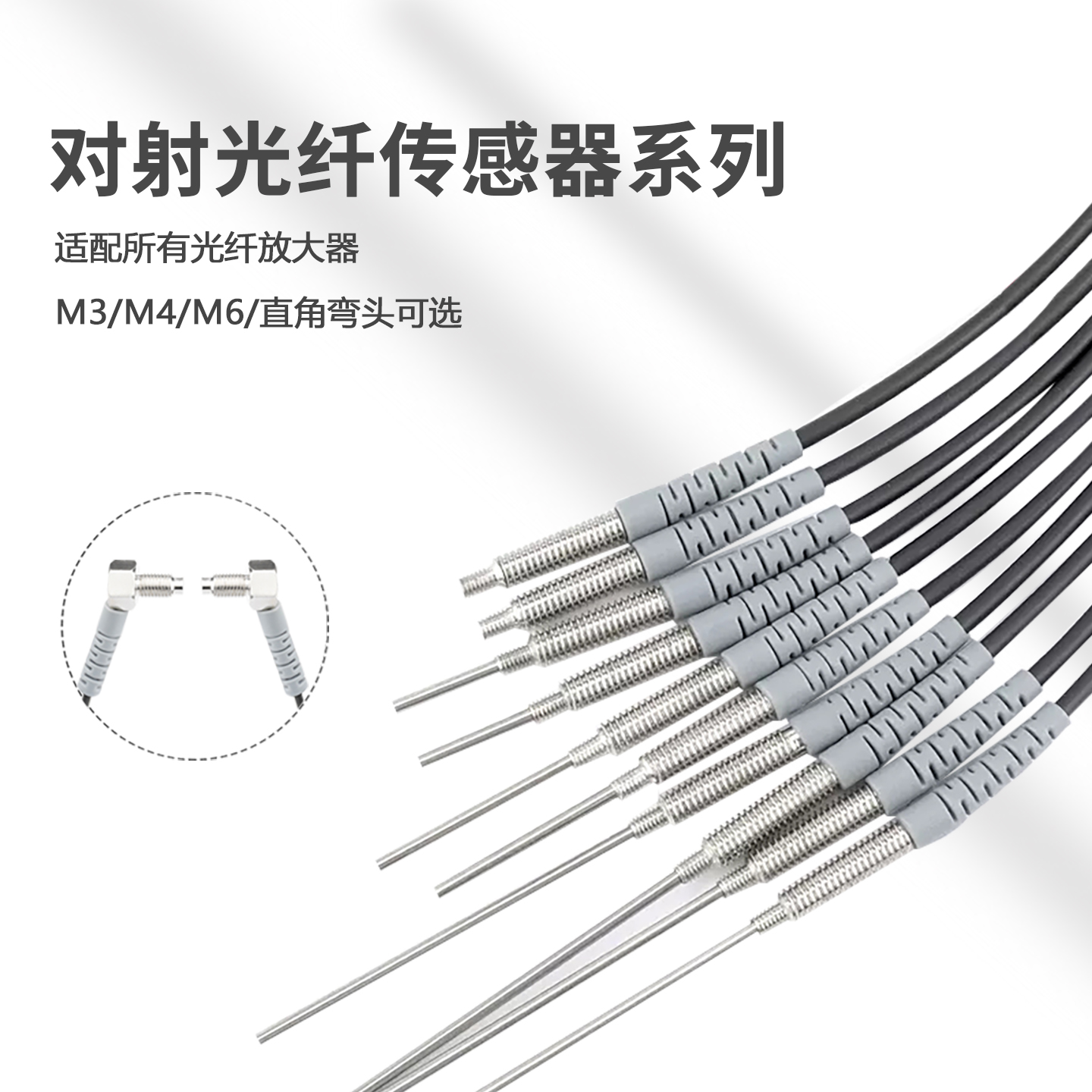
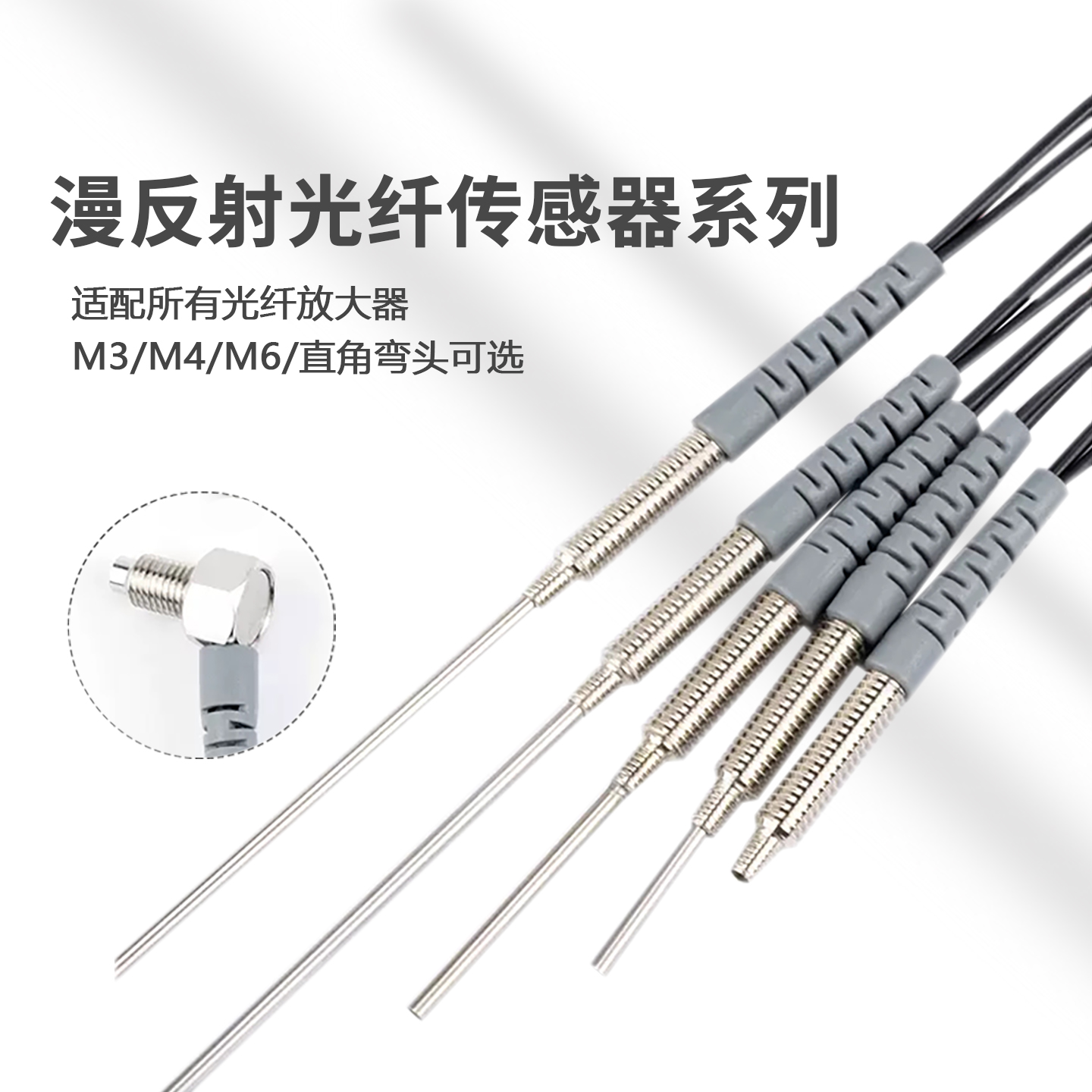
- Through-beam (T), diffuse (KS) and coaxial (RC) series
- M3 / M4 / M6 threads, common 310/410/610 body system
- Four sleeve lengths: 10 / 20 / 40 / 90 mm
- Right-angle (90°) heads across all three series
- 1 m cable standard, 2 m optional on RC
Two Optical Layouts, One Passive Principle
A fiber unit does one job: carry light to and from a point your amplifier could never reach on its own. The T series splits emitter and receiver into two opposed heads — a light curtain one beam wide — for the strongest signal and the best dirt tolerance. The KS series bounces light off the target itself, so a single head handles spots where the far side is simply not accessible. The RC series nests receiving fibers around a central emitting core, keeping the spot dead-centre on the thread axis for small-hole and mark detection.
All three share the 310/410/610 (M3/M4/M6) body system and the same four sleeve lengths, and every head drives the same DDSK fiber amplifier platform. Need a detection band instead of a point? See the DK-KT / DK-KF matrix fiber units.
Series & Model Selection Table
| Series | Optical type | Sizes | Models | Cable | Right-angle |
|---|---|---|---|---|---|
| T | Through-beam (opposed pair) | T310 (M3) / T410 (M4) / T610 (M6) | Base + -I/-S/-M/-L sleeves = 15 models | 1 m | Yes |
| KS | Diffuse reflective (single head) | KS310 / KS410 / KS610 | Base + -I/-S/-M/-L sleeves = 15 models | 1 m | Yes |
| RC | Coaxial multi-core diffuse | RC310 / RC410 / RC610 | Base + -I/-S/-M/-L sleeves = 15 models | 1 m (2 m optional) | Yes |
Fiber bend radius, core diameter, head operating temperature and IP rating are not published — contact the factory with your installation details rather than assuming values. Fiber units are general-purpose detection components, not IEC 61496 certified safety parts; never use them alone for personnel protection.
Diffuse Reflective (KS) Family
Typical Installations
Deep Fixture Recesses
An M3/M4 head with the 90 mm -L sleeve confirms part seating at the bottom of jigs no sensor body can enter.
High-Temperature Zones
The passive tip sits in the heat; the amplifier's electronics stay in the cabinet. No circuit board ever sees the hot zone.
Welding & VFD Neighborhoods
No electronics at the sensing point means nothing for arc EMI to disturb — a common fix for chronic false-trip stations.
Small-Hole & Mark Detection
RC coaxial heads keep the spot centred on the thread axis for repeatable fixed-point detection inside bores and slots.
Low-Profile Flush Mounting
Right-angle heads aim the beam 90° from the body, mounting flush to walls and floors without stressing the fiber.
Moving Mechanisms
The flexible fiber routes through drag chains and along arms like ordinary wire, in oily and vibrating conditions.
Frequently Asked Questions
Is there any electronics or power connection at the fiber head?
None at all. The head is a purely passive light guide — it only carries light between the detection point and the remote amplifier. That is exactly why it survives detection positions next to welders, inside heated fixtures, or in strong electromagnetic fields where a housed sensor's circuitry would misfire or degrade.
Through-beam (T) or diffuse (KS) — which should I specify?
Choose T-series through-beam when you can mount heads on both sides of the target: it gives the highest excess gain and the best tolerance to dust on the lens face. Choose KS-series diffuse when only one side is accessible — one head does both emitting and receiving, saving a bracket, a cable run and the alignment step.
What are the RC-series coaxial heads for?
The RC coaxial multi-core layout keeps the light spot concentric with the mounting thread axis. Use it for small-hole inspection, mark detection and fixed-point close-range jobs where the spot must stay centred no matter how the head is rotated during installation.
What do the 310/410/610 numbers and -I/-S/-M/-L suffixes mean?
310/410/610 are the three body size groups corresponding to M3, M4 and M6 threads. The suffix selects the sleeve length: none = flush head, -I = 10 mm, -S = 20 mm, -M = 40 mm, -L = 90 mm. A T410-L, for example, is an M4 through-beam head whose 90 mm sleeve reaches deep into a fixture recess.
How far can a fiber head detect?
Range is set by the amplifier + head combination, not the head alone. The compatible DDSK amplifier platform is rated up to 0–4000 mm system maximum; a through-beam pair reaches much further than a diffuse head of the same size. Tell us your head type, amplifier model and target and we will give a working-distance reference.
Are right-angle versions available, and when do they help?
Yes — through-beam, diffuse and coaxial series all offer 90° right-angle heads. They redirect the optical axis at the head itself, so you get flush, low-profile mounting against a wall or floor without bending (and stressing) the fiber cable to aim it.
How do I order — and what about MOQ and certificates?
Specify series (T/KS/RC), size (310/410/610), sleeve (-I/-S/-M/-L or none), plus the amplifier model (WDN/WAN/DA4, NPN or PNP). Standard cable is 1 m; RC offers an optional 2 m. MOQ and lead time are confirmed per model by the factory, and certification documents are available on request.
Specs reviewed by Engineer Cai, Senior Application Engineer. See certificates.